Observer-robust energy condition verification for warp drive spacetimes
Published 20 Feb 2026 in gr-qc, cs.MS, and physics.comp-ph | (2602.18023v1)
Abstract: We present \textbf{warpax}, an open-source, GPU-accelerated Python toolkit for observer-robust energy condition analysis of warp drive spacetimes. Existing tools evaluate energy conditions for a finite sample of observer directions; \textbf{warpax} replaces discrete sampling with continuous, gradient-based optimization over the timelike observer manifold (rapidity and boost direction), backed by Hawking--Ellis algebraic classification. At Type~I stress-energy points, which comprise ${>}\,96$\% of all grid points across the tested metrics, an algebraic eigenvalue check determines energy-condition satisfaction \emph{exactly}, independent of any observer search or rapidity cap. At non-Type~I points the optimizer provides rapidity-capped diagnostics. Stress-energy tensors are computed from the ADM metric via forward-mode automatic differentiation, eliminating finite-difference truncation error. Geodesic integration with tidal-force and blueshift analysis is also included. We analyze five warp drive metrics (Alcubierre, Lentz, Van~Den~Broeck, Natário, Rodal) and one warp shell metric (used primarily as a numerical stress test). For the Rodal metric, the standard Eulerian-frame analysis misses violations at over $28\%$ of grid points (dominant energy condition) and over $15\%$ (weak energy condition). Even where the Eulerian frame identifies the correct violation set, observer optimization reveals that violation severity can be orders of magnitude larger (e.g.\ Alcubierre weak energy condition: ${\sim}\,90{,}000\times$ at rapidity cap $ζ{\max} = 5$, scaling as $e{2ζ{\max}}$). These results demonstrate that single-frame evaluation can systematically underestimate both the spatial extent and the magnitude of energy condition violations in warp drive spacetimes. \textbf{warpax} is freely available at https://github.com/anindex/warpax.
The paper introduces an open-source, GPU-accelerated toolkit that continuously optimizes observer parameters to rigorously detect energy condition violations in warp drive spacetimes.
It leverages exact autodiff curvature computation and Hawking–Ellis classification to distinguish metric regions, accurately resolving severe violations often missed by Eulerian analysis.
The toolkit reveals orders-of-magnitude increases in worst-case violation margins, emphasizing the limitations of traditional single-frame methods in exotic spacetime studies.
Observer-Robust Energy Condition Analysis for Warp Drive Spacetimes
Introduction
This paper introduces an open-source, GPU-accelerated Python toolkit for systematic, observer-robust analysis of classical energy conditions (ECs) in warp drive spacetimes, with a focus on continuous optimization over the full observer manifold rather than the discrete sampling typical in prior work. ECs—including the null (NEC), weak (WEC), strong (SEC), and dominant (DEC) energy conditions—are essential constraints on the stress-energy tensors required by exotic geometries such as the Alcubierre warp drive and its variants. While the existence or violation of these conditions is fundamentally observer-independent, the standard computational approach often evaluates only a finite, low-dimensional set of observer trajectories. This can systematically underestimate the extent and depth of EC violations.
The presented toolkit leverages Hawking–Ellis algebraic classification to distinguish metric regions by the type (with >96% of points typically Type I), directly exploits eigenvalue-based EC certification in Type I regions, and applies gradient-based rapidity and direction optimization for generality elsewhere. All tensor derivatives are computed using JAX forward-mode autodifferentiation for numerical exactness up to round-off. The results demonstrate both significant increases in detected violation sets and amplified violation severities relative to the Eulerian-frame (ADM-normal) analysis, revealing limitations inherent to the single-frame approach.
Methods: Exact Curvature and Observer Optimization
The computation of the stress-energy tensor follows the full Einstein tensor construction chain,
gab→Γbca→Rbcda→Rab,R→GabEFETab,
all implemented using forward-mode autodiff, avoiding finite-difference error. Once the stress-energy Tab is constructed, energy condition verification proceeds via algebraic criteria at each coordinate grid point, using the Hawking–Ellis eigenstructure to select the matching observer classes:
Type I: Four real eigenvalues, one timelike eigenvector. ECs reduce to algebraic inequalities on ρ and pi.
Non-Type I: No real, diagonalizable form; observer-dependent optimization is needed.
For observer parametrization, timelike directions are defined through rapidity ζ and spherical orientation (θ,ϕ),
ua=coshζna+sinhζs^a(θ,ϕ),
with boosts up to ζmax (default: 5, corresponding to γ≈74). Null directions for NEC are parameterized solely by orientation. Optimization over observers employs JAX-compiled BFGS with multi-start initialization, providing robust detection of worst-case EC violations even in narrow observer cones.
Empirical Results: Warp Metric Survey
Alcubierre Metric
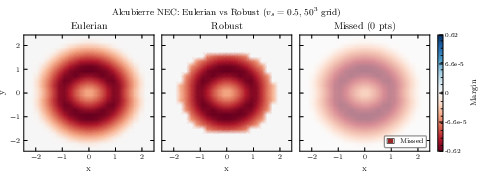
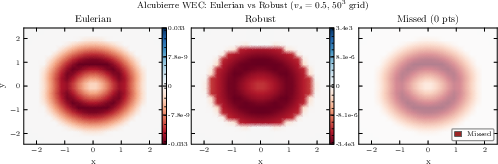
For the prototypical Alcubierre warp drive, observer-robust analysis yields no increase in the NEC- or WEC-violating region volumes compared to the ADM-normal result; violation sets coincide across the spatial grid at moderate wall thickness. However, the EC violation severity is dramatically amplified for boosted observers, with worst-case WEC margin at rapidity cap ζmax=5 exceeding the Eulerian observer result by orders of magnitude (up to 90,000×).
Figure 1: NEC evaluation for the Alcubierre metric, demonstrating violation localization at the bubble wall.
Figure 2: WEC evaluation for the Alcubierre metric shows that observer-optimization does not increase the violating region, but finds much larger negative margins.
Lentz, Van Den Broeck, Natário, Rodal, and WarpShell Metrics
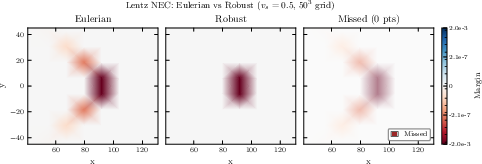
Lentz: Despite claims of positive energy, previously established WEC violations are confirmed; no new NEC/WEC points are missed by Eulerian analysis, but SEC misses appear.
Van Den Broeck/Natário: Violation sets for NEC/WEC nearly coincide with ADM-normal analysis; SEC violations show small increases detectable only with observer optimization.
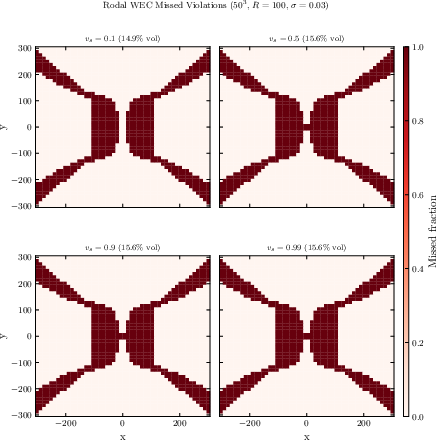
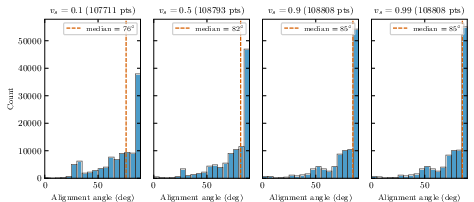
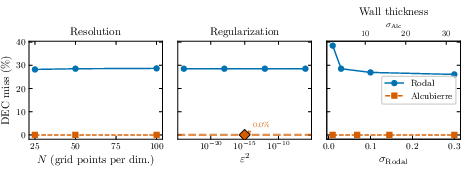
Rodal: A major discrepancy is found; single-frame analysis misses 28% of DEC-violating grid points and 15% of WEC, with violation cones missed due to angular shift misalignment.
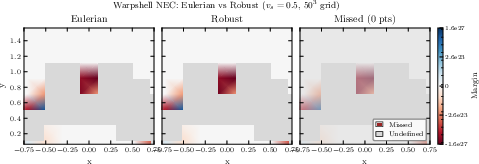
WarpShell: Serves as a stress test case for the diagnostic pipeline due to extreme shell transition gradients; under regularization, missed violation rates are negligible, but absolute violation margins become enormous due to high curvature.
Figure 3: NEC evaluation for the Lentz metric confirms all NEC-violating points are found by single-frame analysis under conventional parameters.
Figure 4: NEC evaluation for the WarpShell metric shows robust agreement between ADM and observer-robust approaches, with negligible missed fraction.
Violation Severity and Worst-Case Observers
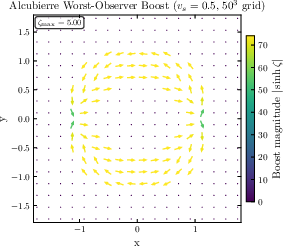
Focusing on observer-optimized violation severity, the minimum WEC/NEC margins diverge strongly from ADM-normal results wherever there are underlying EC violations, scaling as ∼exp(2ζmax). The physical worst-case observer field in the Alcubierre background is highly aligned with the direction of bubble propagation, with rapidity increasing with vs.
Figure 5: Worst-case WEC observer boost direction field for the Alcubierre metric, visualizing the boost vectors yielding maximal observed violations.
Sampling Versus Optimization: Detection Guarantees
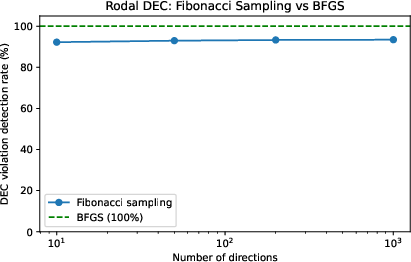
Cross-comparison with dense observer sampling (e.g., WarpFactory, random and Fibonacci-lattice approaches) reveals that discrete sampling—even with 104 observer directions—systematically fails to achieve 100% detection of algebraic Type I violations for the Rodal DEC condition. Optimization reliably recovers all (by construction) algebraic violations, exposing detection plateaus at $54$–93% for pure sampling on challenging metrics. This supports continuous optimization as the only rigorous approach for observer-robust verification in high-dimensional, anisotropic spacetimes.
Figure 6: Visualization of violations missed by Eulerian analysis for varying velocities—substantial missed regions for WEC/DEC are clearly evident in the Rodal spacetime.
Geodesics: Tidal Forces and Frequency Shifts
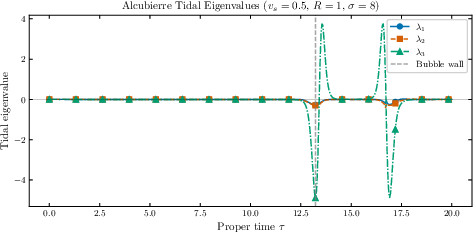
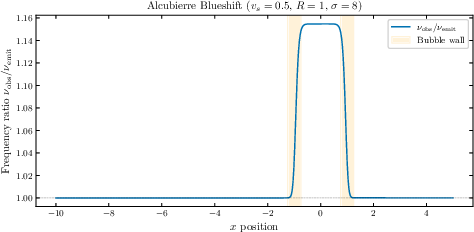
The toolkit supports integration of the geodesic deviation equation for tidal eigenvalue analysis and null geodesic frequency shift computation. Radial crossings of warp bubble walls induce sharply peaked tidal forces (stretching/compression in the principal transverse directions), and photons traversing the bubble exhibit blueshifts matching the Lorentz factor γ(vs), consistent with analytic expectations.
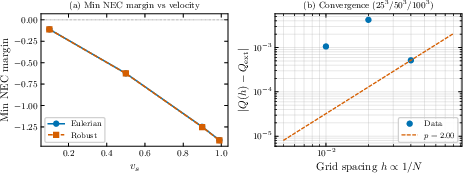
Figure 7: Minimum NEC margin in Alcubierre as a function of bubble velocity, demonstrating close tracking between Eulerian and observer-optimized values.
Figure 8: Tidal eigenvalue evolution for a timelike radial geodesic through the bubble—note the wall-induced eigenvalue spikes.
Figure 9: Photon frequency (blueshift) ratio along null geodesic through Alcubierre bubble; peak values track Lorentz factor.
Kinematic Scalars
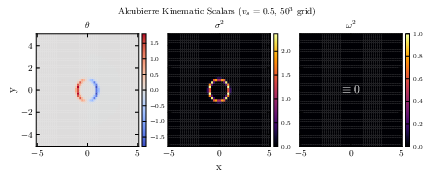
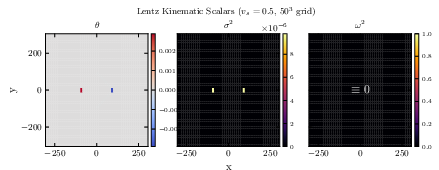
Analysis of kinematic congruence scalars (expansion, shear, vorticity) elucidates structural features of warp metrics. The expected bipolar expansion field characteristic of Alcubierre and its variants is recovered, correlating wall regions of exotic matter with large gradients of the expansion scalar.
Figure 10: Kinematic scalars (expansion, shear, vorticity) in Alcubierre geometry, highlighting the characteristic signature of superluminal warp spacetime.
Figure 11: Kinematic scalar fields for the Lentz metric, showing smoother expansion compared to Alcubierre but similar qualitative structure.
Resolution and Numerical Stability
Richardson extrapolation across 253 to 1003 grids confirms second-order resolution stability for the minimum NEC margin and violation volume except in severely under-resolved configurations (e.g., Lentz thin-wall). All tensor identity tests (Riemann symmetries, Bianchi identities) hold to tight numerical tolerances. The dominance of Type I points enables rapid algebraic certification of ECs, minimizing reliance on costly optimizer runs.
Limitations and Future Directions
The main limitation is the practical necessity of a finite rapidity cap ζmax, which bounds the class of observer boosts; in pathologically narrow violation cones, gradient optimization could, in principle, miss violations asymptotically close to the lightcone. The non-Type I regime receives only ζmax-capped diagnostics. The presented regularized metrics differ from idealized thin shells, and quantum energy inequalities are not yet incorporated. Future directions include metric-shape optimization, integration of quantum energy bounds, and extension into more general relativistic backgrounds.
Conclusion
The presented toolkit systematically exposes the insufficiency of single-frame analysis for ECs in generic warp drive metrics. For highly symmetric backgrounds (e.g., Alcubierre), Eulerian and robust analyses may agree on violation point sets, but the observer-optimized violation magnitude grows rapidly with boost parameter. In anisotropic or nontrivial shift spacetimes (e.g., Rodal), the ADM frame misses a significant fraction of the legal violation region, and only continuous observer-space optimization is sufficient for rigorous certification. These findings underscore the necessity of observer-robust, continuous optimization in EC verification studies for hypothetical spacetime engineering scenarios.
Figure 12: Alignment histogram quantifying the angle between worst-case optimizer boost direction and the spatial eigenvector direction for Rodal DEC—demonstrating large misalignment at most violating points.
Figure 13: Sampling convergence for DEC violations in Rodal—pure sampling fails to recover a significant violation fraction accessible to gradient optimization.
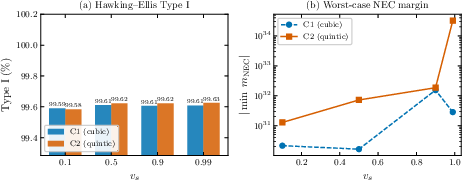
Figure 14: Transition function smoothness ablation for WarpShell; Type I and violation statistics are insensitive to C1 vs C2 smoothstep, but C2 ensures Riemann continuity.
Figure 15: Rodal DEC missed violation fraction as a function of resolution, regularization, and wall thickness—missed fraction is stable against resolution but sensitive to geometric details.
This study establishes the necessity of continuous, observer-robust verification of classical energy conditions for warp drive geometries. Discrete or single-frame analyses can significantly underestimate both occurrence and severity of violations, especially in metrics with misaligned or anisotropic stress-energy distributions. The presented toolkit combines exact autodiff-derived curvature computation with gradient-based observer optimization, ensuring both correctness and practical efficiency. These developments are immediately applicable to the ongoing theoretical assessment of physical plausibility for exotic spacetimes and provide a robust methodological framework for future explorations in gravitational engineering and numerical relativity.