- The paper establishes that a sign flip in the quartic coupling maps the symmetric and broken phases in scalar φ⁴ theory.
- It uses non-perturbative R1-level resummation and saddle point expansions to derive precise interrelations across dimensions 2, 3, and 4.
- The findings offer new insights into triviality debates in four dimensions and clarify phase transitions in scalar field models.
Self-Dualities in Scalar ϕ4 Theory: Saddle Point Expansions, Sign Flip Dualities, and Dimensional Structure
Introduction
This work rigorously analyzes self-dualities in scalar ϕ4 theory, focusing on the interplay between the symmetric and spontaneously broken phases. By constructing controlled interacting saddle expansions in both phases, the study establishes precise relations between the two—most notably, that the broken and symmetric phase results are interconnected via a sign flip in the quartic coupling. The analysis utilizes analytically tractable, non-perturbative resummation schemes at the R1-level, ensuring clarity of the qualitative structure while making explicit the limitations regarding quantitative precision. The implications of these dualities are explored for dimensions d<4 (where results are consistent with established literature) as well as for d=4, where the findings suggest new perspectives relevant to triviality debates.
Interacting Saddle Point Expansions: Construction and Properties
The scalar ϕ4 theory is formulated with the Euclidean action:
S=∫dx(21∂μϕ∂μϕ+21mB2ϕ2+λBϕ4)
where mB and λB are bare parameters. Through a Hubbard-Stratonovich transformation, the model admits two expansion schemes:
- Symmetric Phase Expansion: The action is recast using an auxiliary field, and the free energy at R1-level resummation is expressed as:
ΩR1(d)(mB)=−2(4π)d/2Γ(−2d)(M2)d/2−48λB(M2−mB2)2
where M2 is fixed by a nontrivial saddle condition involving the self-consistent propagator.
- Broken Phase Expansion: By decomposing ϕ(x)=ϕ0+ξ(x), expanding around a classical background ϕ0, and integrating out fluctuations ξ, the broken phase saddle yields a structurally similar free energy, but with sign flips in key coefficients, specifically in the quartic self-coupling.
A critical observation is that the saddle equations and resulting physical quantities in the two phases are mapped to each other by a sign change in the quartic coupling, λB→−2λ~B. This duality underlies the Chang (for d=2) and Magruder (for d=3) correspondences and generalizes to a self-duality in four dimensions.
Dualities in d=2: Chang Duality and Phase Structure
In two dimensions, explicit analytic control is possible using dimensional regularization and resummed saddle-point techniques. The symmetric and broken expansion schemes yield saddle equations for pole masses M and M~,
λBM2=π3lnM2ΛMS2,λ~BM~2=−π6lnM~2ΛMS2
where the relation λB=−2λ~B connects the two systems. The free energy difference ΔΩ(2) directly determines which phase is thermodynamically favored, allowing for a precise identification of the phase boundary.
For small λB/ΛMS2, the symmetric phase is energetically preferred; however, above a critical value λc≃1.69371, the broken phase dominates, indicating a symmetry-breaking phase transition. This approach recovers the well-known Chang duality [Chang, 1976] in a non-perturbative framework and is consistent with lattice and high-order computations in the literature.
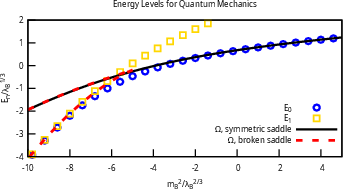
Figure 1: A comparison of lowest-lying eigenvalues E0,E1 from direct diagonalization to the free energies ΩR1(1), Ω~R1(1) from the symmetric and broken saddle expansions at R1-level in the quantum mechanical (d=1) case.
Three Dimensions: Magruder Duality
In three dimensions, the phase structure is again accessible via analytically tractable R1-level resummed saddles. The absence of logarithmic divergences simplifies analytic work, and an explicit mapping is established between the symmetric and broken phase results via a coupling sign flip, as in the two-dimensional case. The broken phase saddle admits real-valued solutions for pole masses only above a critical value of λB/mB, providing a natural criterion for determining the onset of symmetry breaking.
While the numerics for the critical coupling differ from high-order approaches (e.g., λc≃1.55 at R1 versus λc≃1.07 from better resummations), the overall qualitative phase structure agrees with known results and establishes the correctness of the duality principle at this level. The existence of Magruder duality is thus linked to non-perturbative resummation properties and not restricted to perturbative expansions.
Four Dimensions: Self-Duality and Triviality Implications
In four dimensions, the duality structure qualitatively changes. Renormalization conditions for the couplings and the mapping of renormalized parameters in both phases demonstrate that the free energies and physical masses in the symmetric and broken phases are identical modulo the proper identification of scale parameters and the sign flip in the coupling. This result is established within the R1-level resummation, with renormalized couplings obeying
λR(μˉ)=3ln(μˉ2/ΛMS2)4π2,λ~R(μˉ)=3ln(Λ~MS2/μˉ2)2π2
and the mapping λB=−2λ~B. Under these, the broken and symmetric phases are precisely self-dual.
A notable theoretical implication is that theories with negative quartic couplings in the symmetric phase are mapped to physically viable, symmetry-broken theories with positive couplings, and vice versa. This duality provides potential pathways for circumventing triviality theorems in four-dimensional scalar field theory, suggesting that certain "trivial" theories may possess dual nontrivial physical content when nonperturbative dualities are properly accounted for. Addressing the nonperturbative renormalization structure in the broken phase beyond R1 is posed as an open direction, with potential theoretical relevance for thermal ϕ4 theory and the continuum limit of scalar field models.
Discussion: Exclusivity and Mutual Independence of Expansions
A methodological highlight is the demonstration that the symmetric-phase and broken-phase expansions correspond to genuinely mutually exclusive representations of the theory; attempting to hybridize or interpolate between the two merely collapses one description into the other, as shown through path integral manipulations. For each fixed parameter set, one and only one saddle (phase) is energetically preferred, and free energy comparison robustly identifies the dominating phase.
Further, explicit calculations in d=1 (quantum mechanics) reveal that the saddle-point analysis, while numerically highly accurate for lowest eigenvalues, predicts a spurious phase transition not present in the exact spectrum—an instructive illustration of the strengths and limitations of this analytic, saddle-based resummation approach.
Conclusion
This work develops a comprehensive, analytically transparent framework for understanding self-dualities in scalar ϕ4 theory across dimensions 1≤d≤4. The key technical finding—that symmetric and broken phases are related via a sign flip in the quartic interaction—is shown to organize the phase structure, critical couplings, and duality relations in both perturbative and nonperturbative regimes, with a full self-duality emerging in four dimensions. These results clarify the mapping between apparently distinct sectors of scalar field theory and open avenues for addressing foundational questions such as triviality and renormalization group completeness.
Going forward, extending the analysis to higher-order resummations, finite temperature, and large-N generalizations will be essential to fully clarify the non-perturbative phase structure and potential phenomenological implications for continuum quantum field theory.