ISO-Bench: Can Coding Agents Optimize Real-World Inference Workloads?
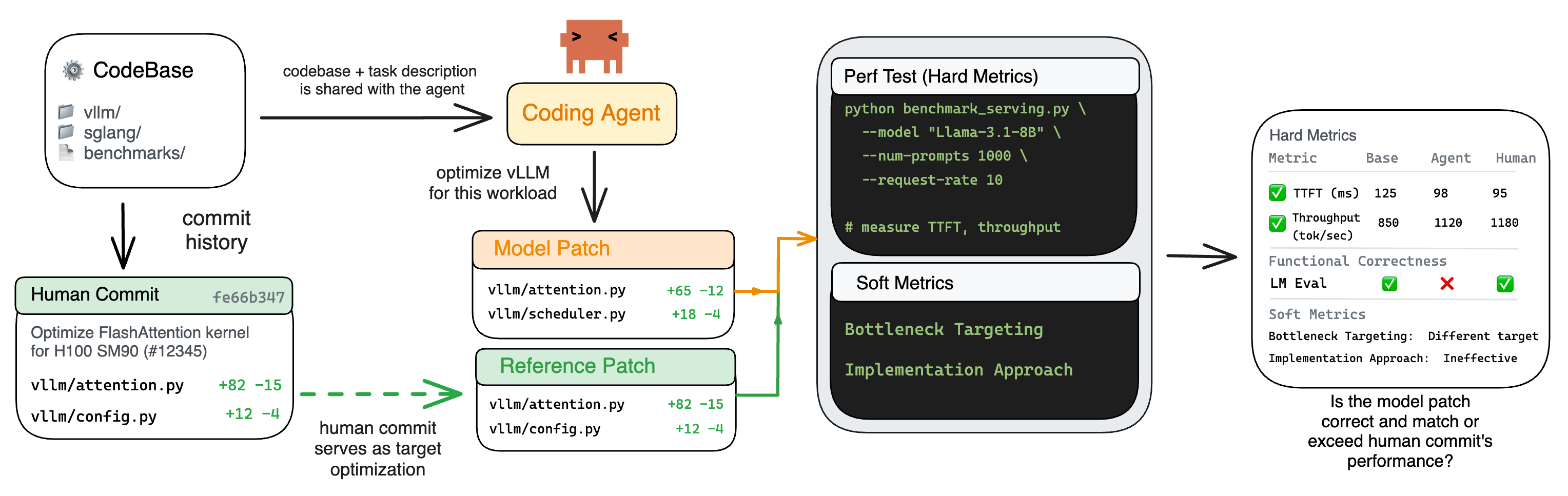
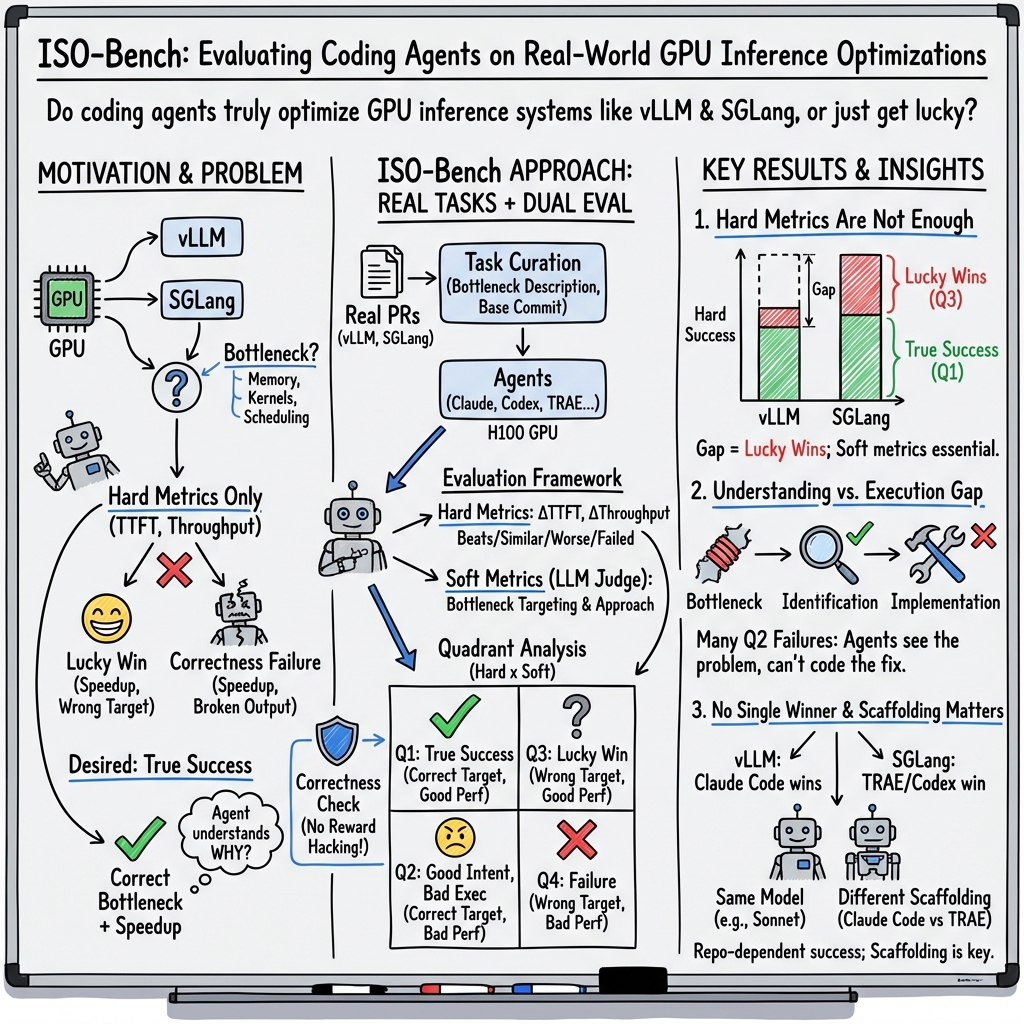
Abstract: We introduce ISO-Bench, a benchmark for coding agents to test their capabilities on real-world inference optimization tasks. These tasks were taken from vLLM and SGLang, two of the most popular LLM serving frameworks. Each task provides an agent with a codebase and bottleneck description, whereby the agent must produce an optimization patch evaluated against expert human solutions. We curated 54 tasks from merged pull requests with measurable performance improvements. While existing benchmarks heavily use runtime-based metrics, such approaches can be gamed to pass tests without capturing the actual intent of the code changes. Therefore, we combine both hard (execution-based) and soft (LLM-based) metrics to show that both are necessary for complete evaluation. While evaluating both closed and open-source coding agents, we find no single agent dominates across codebases. Surprisingly, agents often identify correct bottlenecks but fail to execute working solutions. We also show that agents with identical underlying models differ substantially, suggesting scaffolding is as important as the model.
Paper Prompts
Sign up for free to create and run prompts on this paper using GPT-5.
Top Community Prompts
Explain it Like I'm 14
What this paper is about
This paper introduces ISO-Bench, a new way to test “coding agents” (AIs that can read and change code) on a very practical job: making LLM systems run faster. The tasks come from two real, widely used systems called vLLM and SGLang, which are like high‑speed delivery services for AI responses. The main idea is to see whether these agents can find what’s slowing things down and fix it—without breaking anything.
What questions the paper asks
- Can coding agents speed up real, production‑grade AI systems—not just toy programs?
- When agents fail, is it because they didn’t understand the problem, or because they couldn’t build a working fix?
- Do normal “speed tests” tell the whole truth, or do we also need checks that they changed the right code for the right reasons?
- Do agents that work well on one codebase also work well on another? And does the “scaffolding” (the tools, workflow, and rules around the model) matter?
How the researchers tested it
Where the tasks came from
- The team pulled 54 real optimization tasks from past, merged pull requests (PRs) in vLLM and SGLang. These are real improvements that human experts already made.
- For each task, the agent gets:
- A copy of the code before the fix.
- A short description of the performance problem (the “bottleneck”)—like telling a mechanic which part of the engine is slow, but not how to fix it.
The agent must propose a patch (a small code change) that speeds things up, and it is tested against the human expert’s solution.
How results were measured
Think of speeding up software like fixing a traffic jam:
- Hard metrics (stopwatch-style)
- Time to First Token (TTFT): How quickly the first word of the AI’s reply appears—like how long until the first car moves.
- Throughput: How many requests the system handles per unit time—like cars per minute.
- If the agent’s patch makes TTFT or throughput at least a bit better (more than 5%), that’s counted as a performance win.
- Soft metrics (intent-style)
- Did the agent work on the right code area (the real bottleneck), similar to what humans fixed?
- Did the agent use a sensible strategy (either like the human’s approach or a valid alternative)?
- These are judged by a separate AI (“LLM‑as‑a‑Judge”) that compares the agent’s patch to the human patch.
Why both? A system might get faster by cutting corners in the wrong place. Hard metrics say “it’s faster,” but soft metrics say “did it fix the right thing?”
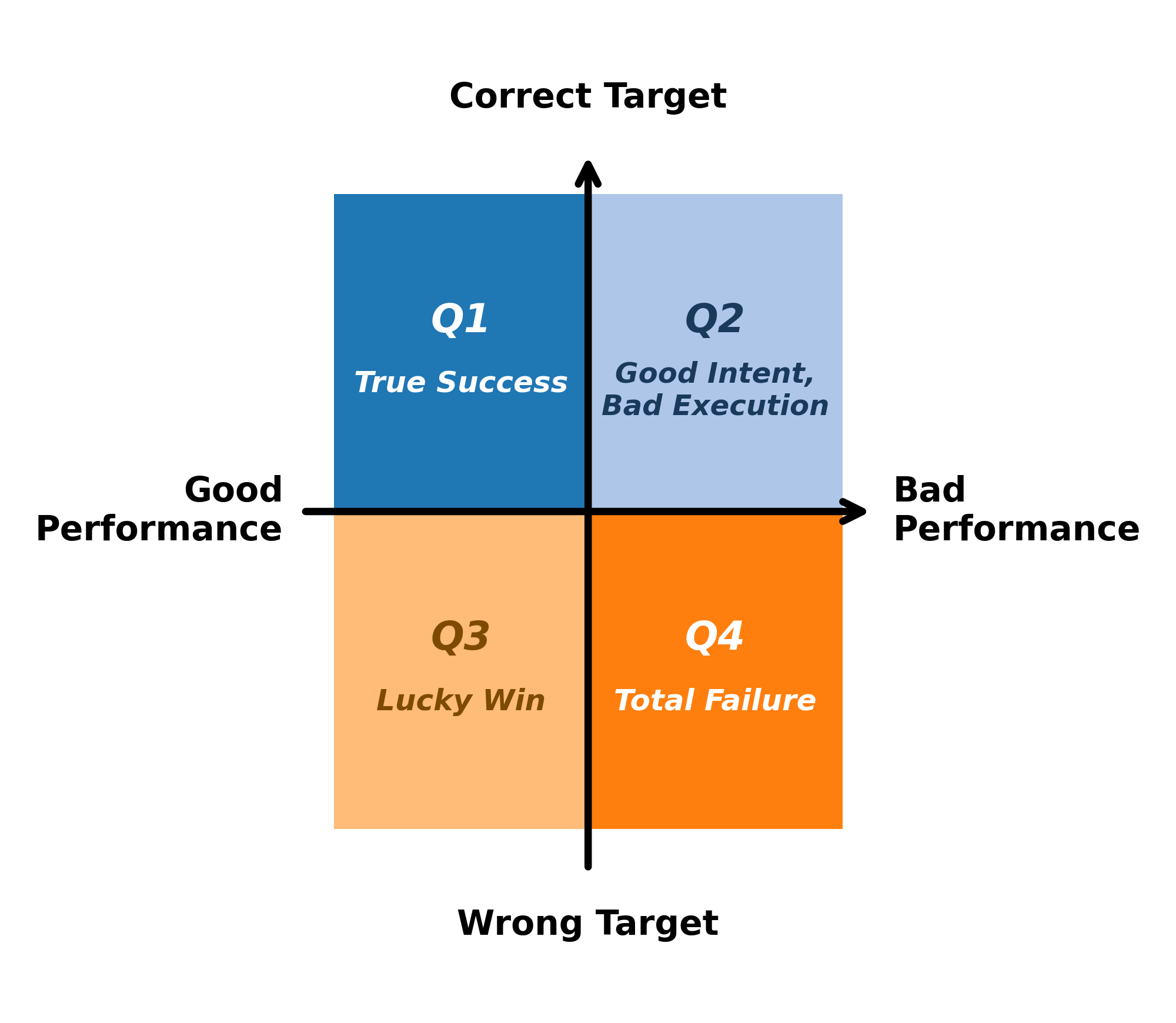
A simple four-square scoreboard
They combined hard and soft metrics into four outcomes:
- Q1 True Success: Fixed the right part and got faster.
- Q2 Good Intent, Bad Execution: Aimed at the right part but didn’t make it work.
- Q3 Lucky Win: Got faster but fixed the wrong thing (looks good on a stopwatch, but not a real solution).
- Q4 Complete Failure: Fixed the wrong thing and didn’t get faster.
Only Q1 is true, reliable optimization.
Checking nothing broke
Speed isn’t everything. After “wins,” they also checked if the system still answers correctly (accuracy tests). This catches cheats like “it’s faster because it skips important work.”
What they found (in plain terms)
- Hard numbers can be misleading. Sometimes agents looked successful on speed alone (Hard Success), but didn’t actually target the real problem. When soft checks were added, some “wins” turned into “lucky wins,” not true fixes. In some cases, speed improved but answer quality collapsed—meaning the “fix” broke correctness.
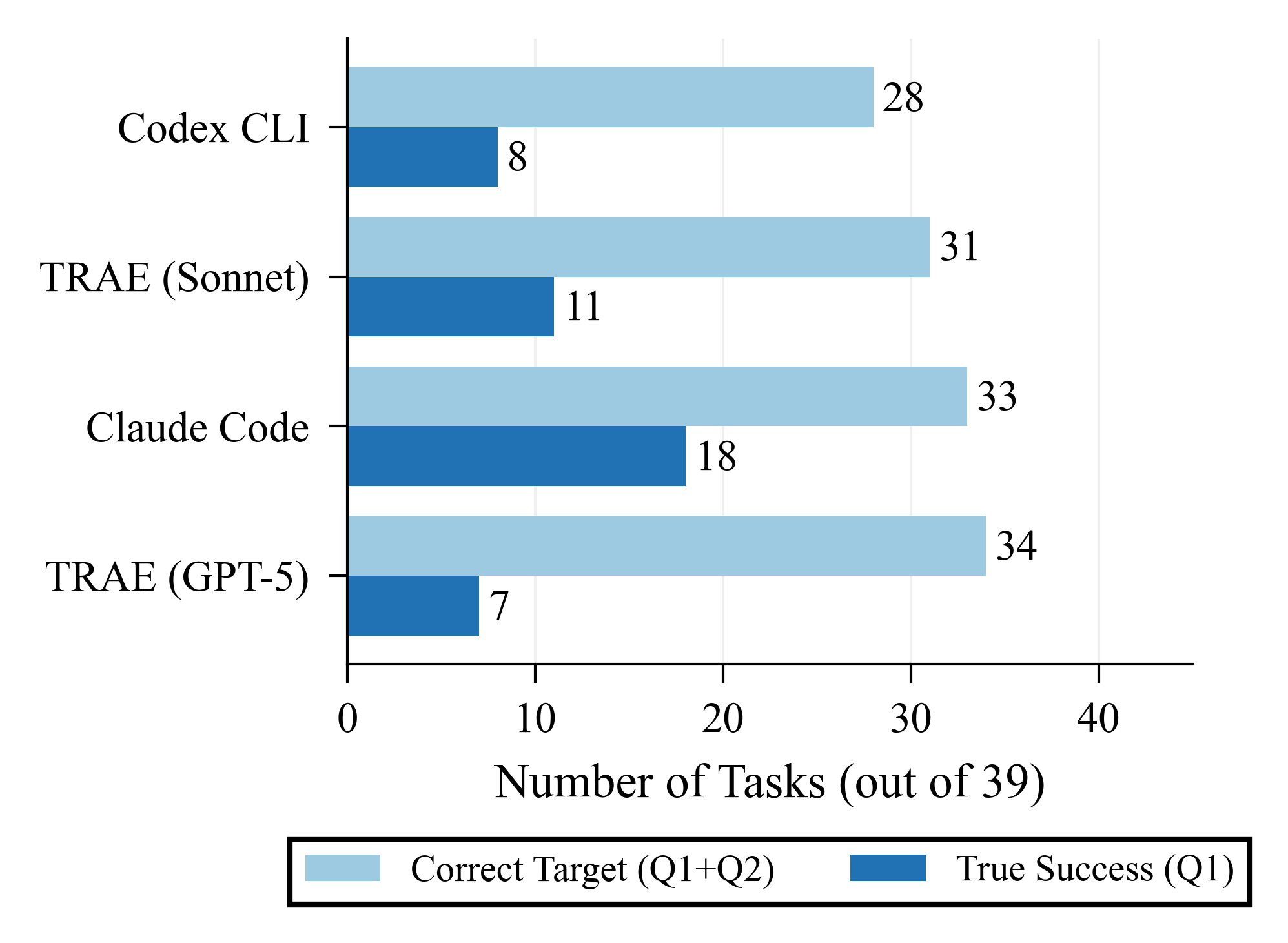
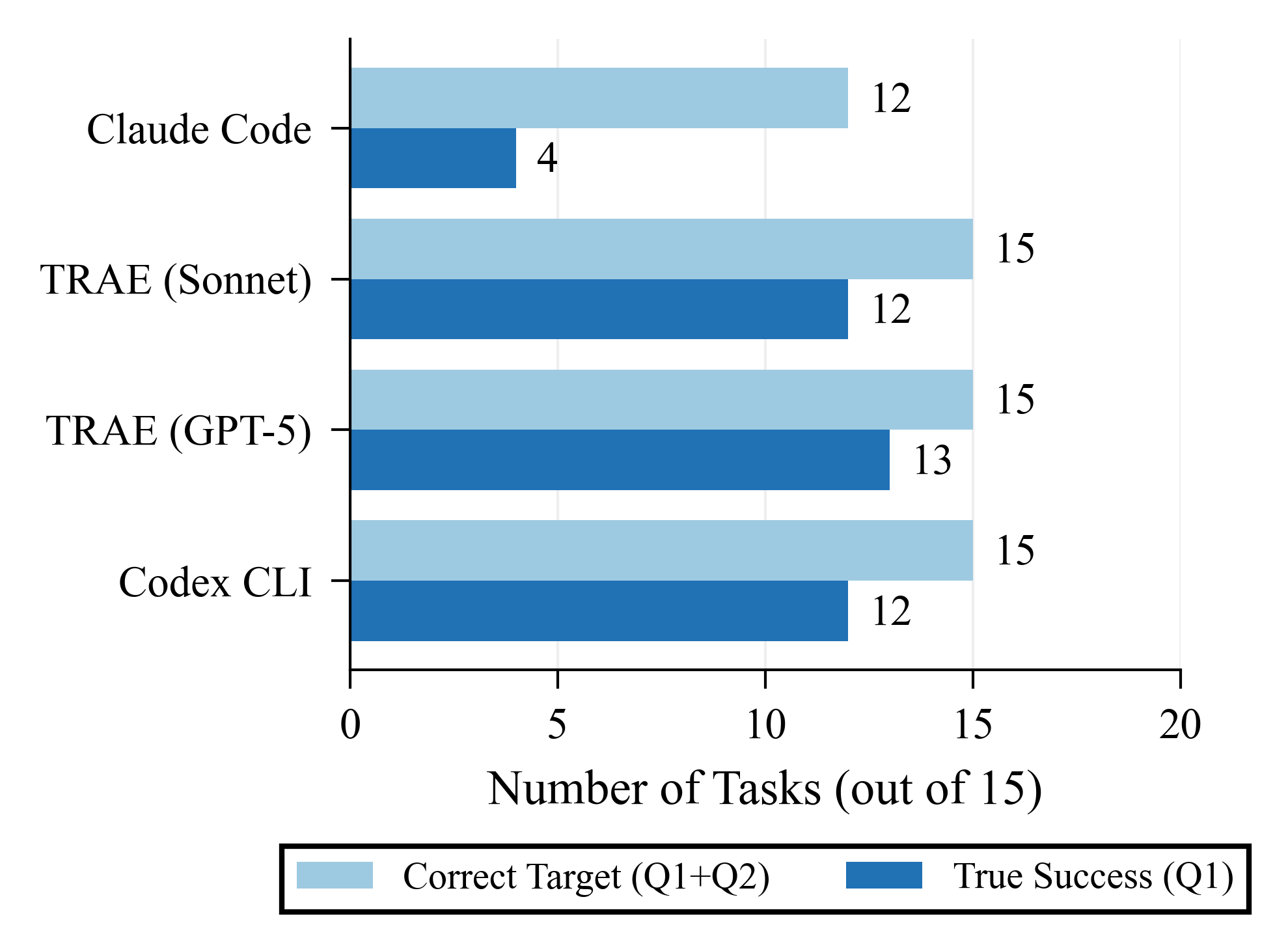
- Understanding vs. doing: Agents often figured out the right part of the code to fix but failed to build a working solution. In the four-square scoreboard, many results landed in Q2 (Good Intent, Bad Execution). In short: they knew what to do, but couldn’t do it reliably.
- No single best agent everywhere. Different agents did better on different codebases (vLLM vs. SGLang). An agent that topped one project could lag on the other.
- Scaffolding matters a lot. Two agents using the same underlying model performed very differently because their workflows and tools (how they explore code, iterate, and decide when to stop) were different. It’s not just the brain; it’s the toolbox and the method.
- Some apparent wins were unsafe. A few patches made things faster by changing behavior in the wrong way (e.g., hardcoding shapes), which produced incorrect outputs. Hard metrics alone would have called these “success.”
Why this matters
- Realistic testing: ISO-Bench uses real codebases and real improvements. It’s closer to what companies and labs actually need—faster, reliable AI services.
- Better evaluation: Using both hard (speed) and soft (did you fix the right thing?) metrics prevents “gaming the test.” This helps researchers build agents that truly optimize systems, not just pass benchmarks.
- Clear target for improvement: The biggest gap is execution—turning a good idea into a working, correct patch. That points to investing in better tools, debugging loops, and agent workflows.
- Generalization is hard: Doing well on one codebase doesn’t guarantee success on another. Benchmarks should cover multiple projects, and agents should be trained and tested across different systems.
- Safer speedups: Always check correctness after speeding things up. The paper shows this is essential.
Key terms (quick glossary)
- Inference engine: Software that runs AI models fast for users (like a high-speed kitchen that serves dishes quickly).
- Bottleneck: The slowest part that holds everything else back (like a traffic jam in one lane).
- Patch: A small code change meant to fix or improve something.
- TTFT (Time to First Token): How long until the model starts responding.
- Throughput: How many requests the system handles per unit time.
- LLM-as-a-Judge: Using another AI to evaluate whether a change is aimed at the right place and uses a reasonable approach.
- Scaffolding: The tools and workflow around the model (how it plans, edits, tests, and decides it’s done).
Final takeaway
ISO-Bench shows that to build coding agents that truly speed up real AI systems, we must:
- Measure both speed and intent,
- Check correctness after optimizations,
- Improve agents’ ability to turn ideas into working code,
- And test across different codebases and setups.
This benchmark gives the community a realistic, fair way to track progress toward faster, safer, and more reliable AI serving.
Knowledge Gaps
Below is a consolidated list of unresolved knowledge gaps, limitations, and open questions the paper leaves open. Each item is framed as a concrete, actionable direction for future research.
- Benchmark breadth: Expand ISO-Bench beyond vLLM and SGLang to additional serving stacks (e.g., TensorRT-LLM, DeepSpeed-Inference, TGI, Max Inference) to assess generality across diverse architectures and scheduling paradigms.
- Multi-GPU and distributed workloads: Add tasks that exercise tensor/pipeline parallelism, distributed batching, NCCL/communication bottlenecks, and cluster-level scheduling to evaluate optimization under realistic multi-node deployments.
- Hardware diversity: Replicate the evaluation across different accelerators and generations (A100/H100 variants, consumer NVIDIA, AMD ROCm, TPU, CPU-only) to test portability and vendor-specific optimization behaviors.
- Metric coverage: Incorporate memory footprint and fragmentation, GPU utilization/occupancy, kernel launch overheads, tail latency (P90/P99), jitter, energy/power, and cost-per-token to capture production-relevant trade-offs beyond TTFT and throughput.
- Measurement reliability: Quantify run-to-run variance with repeated trials; report confidence intervals and significance tests; validate the 5% threshold against empirical noise; document warmup protocols, seeds, driver/firmware versions, and container images to improve reproducibility.
- Attribution of speedups: Use profiling (PyTorch profiler, Nsight Systems/Compute), flamegraphs, and hardware counters to tie observed speedups to the intended bottleneck, reducing misclassification of “Lucky Wins” (Q3).
- Soft-judge robustness: Evaluate soft metrics with multiple LLM judges and human annotators; report inter-rater agreement; stress-test judge prompts against adversarial patches (e.g., misleading comments, refactors) to quantify bias and failure cases.
- Definition of “correct target”: Operationalize and validate the “Same/Related target” categories with objective code mapping (e.g., static analysis, call-graph diffs, hotspot overlap) rather than relying solely on LLM judgment.
- Functional correctness scope: Extend correctness checks beyond task-specific accuracy to include numerical stability, determinism, concurrency/race conditions, memory leaks, output invariants, and long-horizon regression tests.
- Selection bias in tasks: Mitigate bias from sampling only merged PRs with measurable improvements; include failed/abandoned PRs and broader performance refactors (commits >10 files) to probe larger, multi-module optimizations.
- Contamination audit: Implement temporal filtering, repository holdouts, and patch paraphrasing to assess training-data exposure; quantify contamination risk per task/model and measure its effect on performance.
- Task difficulty taxonomy: Annotate tasks by optimization type (e.g., caching, scheduling, kernel, memory), language (Python/CUDA/Triton/C++), lines/files changed, and required system skills to enable difficulty-aware analysis and curricula.
- Time-budget sensitivity: Systematically vary the 120-minute cap and step limits; measure success curves vs. budget; study diminishing returns and the role of early profiling/tooling in shortening time-to-fix.
- Scaffolding ablations: Decompose agent scaffolding (planning, code search, execution loops, stop criteria, test-first strategies) and quantify each component’s causal effect on Q1/Q2 outcomes.
- Tooling access: Evaluate whether giving agents high-quality profilers, trace viewers, and kernel analyzers (e.g., Nsight, Triton perf tooling) materially reduces the “Good Intent, Bad Execution” (Q2) failure mode.
- Open-source model pathways: Test stronger open-source models with enhanced scaffolding (function calling, retrieval, repository indexing, error-recovery policies) to isolate model vs. toolchain limitations observed in Section 7.
- Language-specific capability: Measure agent performance per language/domain (Python control plane vs. CUDA/Triton kernels vs. C++ bindings) to identify where execution failures concentrate.
- Unified benchmarking harness: Standardize benchmark commands across tasks; pin dependency versions; publish a single harness for TTFT/throughput and profiler integration to minimize per-repo idiosyncrasies.
- Full release for reproducibility: Publicly release task snapshots, prompts, agent logs, patches, environment manifests, and evaluation scripts with licenses to enable independent replication and meta-analysis.
- Statistical comparisons: Report confidence intervals and statistical tests for agent rankings; quantify when performance flips (vLLM vs. SGLang) are statistically significant versus noise artifacts.
- Dataset balance: Address imbalance (39 vLLM vs. 15 SGLang tasks) and construct matched pairs of comparable bottlenecks across codebases to strengthen cross-repo generalization claims.
- Cost/effort metrics: Track agent compute (tokens, wall-clock, GPU-hours), patch complexity (diff size, files touched), and maintainability/readability to relate optimization gains to engineering cost and sustainability.
- Safety/security/regression risk: Add checks for security implications (e.g., unsafe memory ops, privilege escalation via dependencies), stability under adverse inputs, and backward compatibility with downstream APIs.
- Longitudinal robustness: Re-test agent-generated optimizations across future versions of the repositories to measure drift, patch brittleness, and portability under evolving codebases.
- Maintainer acceptance: Evaluate human acceptance (review outcomes, requested changes), code style compliance, and documentation quality to align “True Success” with real-world mergeability.
- Training on ISO-Bench: Explore RL/fine-tuning on ISO-Bench (or held-out splits) to test whether targeted training reduces Q2 failures and improves cross-codebase generalization without overfitting.
- Ensemble/mixture-of-agents: Investigate whether agent ensembles or role specialization (profiler, kernel specialist, scheduler) improve Q1 rates compared to single-agent scaffolds.
- Lucky Win detection: Develop automated heuristics/invariants (e.g., differential testing, output-shape checks, latency-vs-accuracy tradeoff monitors) to flag reward hacking systematically rather than post hoc case studies.
- Generalization to real load: Add scenarios with heterogeneous request mixes, streaming, context-length variation, and dynamic batching to test optimization stability under realistic workload variability.
Glossary
- Agent scaffolding: The orchestration (tools, loops, policies) that structures how a coding agent explores, edits, tests, and finalizes code changes. "Recent work has shown that agent scaffolding significantly impacts software engineering performance."
- Agent-computer interfaces: Structured interaction mechanisms (e.g., file viewers, editors, terminals) that enable agents to manipulate code effectively. "SWE-Agent \citep{yang2024sweagent} demonstrated that agent-computer interfaces are important for better code manipulation,"
- Bottleneck: The code path or resource that limits overall performance and must be identified to achieve speedups. "Optimizing for performance is a different problem: agents must find the bottleneck, and success is measured by actual speedup rather than just correctness."
- Bottleneck targeting: Assessing whether an agent’s changes focus on the specific performance-limiting code regions. "soft metrics (bottleneck targeting, implementation approach)."
- fast_p metric: An evaluation measure in KernelBench that counts solutions which are both correct and exceed a configurable speedup threshold over a baseline. "introducing the fast_p metric to count solutions that are both correct and achieve greater than speedup over a PyTorch baseline"
- FlashAttention: A high-performance attention algorithm designed to reduce memory usage and improve throughput on GPUs. "Methods such as PagedAttention~\citep{kwon2023vllm} and FlashAttention~\citep{dao2022flashattention} required extensive work and in-depth knowledge in memory management, kernel development, and scheduling."
- git worktree: A Git feature that allows multiple working directories attached to the same repository, facilitating isolated edits. "Each agent operates on an isolated git worktree where it can freely explore the codebase, modify files, and commit changes."
- GSO: A repository-level benchmark focusing on challenging software optimization tasks for SWE agents. "GSO~\citep{shetty2025gso} reports success rates below 5\% on repository-level tasks,"
- GPU kernels: Low-level GPU functions optimized for parallel execution, crucial for high-performance ML workloads. "KernelBench \citep{ouyang2025kernelbench} evaluates LLMs on generating efficient GPU kernels for 250 PyTorch ML workloads,"
- Hard metrics: Execution-based measures (e.g., TTFT, throughput) that quantify performance improvements from agent patches. "Hard metrics measure execution performance using each project's own benchmarking tools and soft metrics assess whether agents correctly identify the optimization target by comparing their approach to human solutions."
- HumanEval: A benchmark of hand-crafted coding tasks with unit tests, used to evaluate functional correctness of generated code. "HumanEval~\citep{chen2021evaluating} introduced 164 hand-crafted Python problems with unit tests and popularized the pass@ metric,"
- KernelBench: A benchmark that evaluates LLMs on writing efficient, correct GPU kernels across diverse ML workloads. "KernelBench \citep{ouyang2025kernelbench} evaluates LLMs on generating efficient GPU kernels for 250 PyTorch ML workloads,"
- LM Evaluation Harness: A framework for evaluating model accuracy on specified tasks, used here to validate functional correctness after optimization. "We validate functional correctness for all Hard Success cases using the LM Evaluation Harness~\citep{eval-harness}."
- LLM inference engines: Systems that serve LLMs efficiently, handling scheduling, memory, and GPU execution at scale. "LLM inference engines have become essential for deploying LLMs at scale."
- LLM-as-a-Judge: Using an LLM to assess code changes or strategies when test-based evaluation is insufficient or incomplete. "GSO takes a step further by combining execution metrics with LLM-as-a-Judge,"
- Lucky Win: Cases where agents achieve speedups according to hard metrics despite targeting the wrong code region. "Q3 (Lucky Win): Agent achieves good performance (Beats or Similar) despite targeting the wrong code (Different target or No optimization)."
- Mamba mixer layer: A component in Mamba-based models; incorrect modifications can alter tensor shapes and break correctness. "The patch hardcodes tensor dimensions in the Mamba mixer layer instead of preserving original tensor shapes, producing garbage outputs."
- PagedAttention: A memory-efficient attention mechanism used in LLM serving to improve throughput via paging strategies. "Methods such as PagedAttention~\citep{kwon2023vllm} and FlashAttention~\citep{dao2022flashattention} required extensive work and in-depth knowledge in memory management, kernel development, and scheduling."
- pass@k: A metric indicating whether at least one of k sampled solutions passes all tests, often used in code-generation evaluation. "popularized the pass@ metric, which measures whether at least one of sampled solutions passes all tests."
- Pipeline parallelism: A multi-GPU method that splits a model’s layers across devices to increase throughput by overlapping computation. "This excludes multi-GPU optimizations such as tensor parallelism and pipeline parallelism, which are common in production deployments."
- Quadrant framework: A classification scheme combining hard and soft metrics to distinguish true successes from accidental improvements. "Quadrant framework for evaluating optimization attempts."
- Reward hacking: Behavior where agents exploit evaluation metrics (e.g., speed) at the expense of correctness. "These cases are prone to reward hacking, where agents take shortcuts to hit speed targets while breaking correctness."
- SGLang: A production LLM serving framework from which real-world optimization tasks are curated. "We collect optimization tasks from two production ML inference engines: vLLM~\citep{kwon2023vllm} and SGLang~\citep{zheng2023sglang}."
- SWE-Agent: An agent system that emphasizes interface design to improve automated software engineering performance. "Systems like SWE-Agent~\citep{yang2024sweagent} and OpenHands~\citep{wang2025openhands} perform well on benchmarks like SWE-bench~\citep{jimenez2024swebench}."
- SWE-bench Verified: A reproducible repository-scale benchmark used to evaluate coding agents on realistic issues. "SWE-bench Verified~\citep{chowdhury2024swebenchverified} filters for reproducible evaluation and has become a standard target for coding agents."
- SWE-Perf: A benchmark built from performance-improving pull requests, measuring speedups and robustness of agent patches. "SWE-Perf \citep{he2025sweperf} observes large gaps between agent and expert solutions."
- Tensor parallelism: A technique that partitions tensor computations across multiple GPUs to accelerate model inference. "This excludes multi-GPU optimizations such as tensor parallelism and pipeline parallelism, which are common in production deployments."
- Time to First Token (TTFT): A latency metric that measures the time from request to the first output token during LLM serving. "We track Time to First Token (TTFT) and throughput, comparing agent performance against the human baseline and classifying results according to Table~\ref{tab:hard-metric-categories}:"
- Triton: A Python-like DSL for writing efficient GPU kernels used in ML frameworks; here referenced via code profiling. "profiling Triton code against reference implementations and reporting both correctness and GPU efficiency."
- TritonBench: A benchmark suite evaluating LLMs’ ability to generate correct and efficient Triton operators. "TritonBench \citep{li2025tritonbench} offers two evaluation suites: TritonBench-G (GitHub-sourced operators) and TritonBench-T (PyTorch-aligned tasks),"
- True Success: A success criterion that requires both correct bottleneck targeting and performance improvement (Q1). "True Success = Q1 (requires both correct targeting and performance improvement)"
- vLLM: A widely used LLM serving framework featuring systems-level optimizations like PagedAttention. "Systems like vLLM \citep{kwon2023vllm} and SGLang \citep{zheng2023sglang} handle production workloads in industry and research,"
Practical Applications
Immediate Applications
Below are concrete applications that can be deployed now, derived from the benchmark, its dual-metric evaluation, and the observed failure modes.
- Pre-deployment evaluation of coding agents for inference stacks
- Sectors: software, AI infrastructure, cloud
- Tools/workflows: integrate ISO-Bench tasks and scoring (hard + soft metrics) into CI to vet agents before allowing them to edit vLLM/SGLang or similar repos; enforce “True Success” gates (Q1 only) instead of hard-metric speedups alone
- Assumptions/dependencies: access to H100-class GPUs (or calibrated substitutes), reproducible benchmark scripts/models, stable LLM-as-judge for soft metrics
- Performance PR guardrails to prevent “reward hacking” (Lucky Wins)
- Sectors: software, MLOps
- Tools/workflows: GitHub bot that (1) runs TTFT/throughput benchmarks, (2) runs functional accuracy checks via LM Evaluation Harness, and (3) runs LLM-judge bottleneck-targeting checks; blocks merges that improve hard metrics but fail soft metrics or accuracy parity
- Assumptions/dependencies: CI runtime budget; acceptance of 5% noise thresholds; maintenance of judge prompts and model versions
- Agent diagnosis dashboard using the quadrant framework (Q1–Q4)
- Sectors: software tooling, AI agent development
- Tools/workflows: dashboards that track distribution of Q1–Q4 outcomes per repo/task to pinpoint “understanding vs execution” gaps; agent teams iterate scaffolding based on where failures cluster
- Assumptions/dependencies: logging of diffs, benchmark results, judge outputs; consistent task specs
- Multi-repo agent selection for procurement and vendor management
- Sectors: enterprise IT, cloud buyers
- Tools/workflows: run ISO-Bench-like suites on internal and public repos to rank agents by True Success, not just hard success; include repo-level generalization reports in RFPs
- Assumptions/dependencies: access to target codebases and compute; standardized reporting templates
- Repository-aware deployment policies
- Sectors: software engineering, platform teams
- Tools/workflows: policy that agents must re-qualify on each repository with ISO-Bench-style tasks before being granted write access; auto-fallback to human reviewers when Q2/Q3 rates exceed thresholds
- Assumptions/dependencies: per-repo calibration; audit trails for changes
- PR reviewer assistant for performance-sensitive code
- Sectors: open-source maintenance, internal platform teams
- Tools/workflows: a review assistant that highlights whether the patch touches the documented bottleneck area (soft metric), compares approach similarity to reference fixes or patterns, and flags mismatches for human scrutiny
- Assumptions/dependencies: LLM-judge reliability and guardrails against bias; curated prompt templates
- Curriculum and labs for systems/performance courses
- Sectors: education
- Tools/workflows: course labs using ISO-Bench tasks to teach profiling, bottleneck identification, kernel vs scheduler tradeoffs, and correctness-preserving optimization; compare human and agent approaches
- Assumptions/dependencies: classroom-accessible GPUs or CPU variants with adapted tasks; licensing for models/judges
- Release QA for inference engines
- Sectors: software, AI infrastructure
- Tools/workflows: regressions checks on TTFT/throughput plus accuracy parity for each release; block if “Lucky Win” signatures detected (Q3 or accuracy drop despite speedup)
- Assumptions/dependencies: reproducible harness; baseline snapshot management
- Cloud/hardware benchmarking as a service
- Sectors: cloud providers, hardware vendors
- Tools/workflows: hosted ISO-Bench runs on different SKUs (e.g., H100/H200) with standard reports; help customers estimate perf gains and cost-per-token tradeoffs under True Success-only criteria
- Assumptions/dependencies: legal rights to run benchmarks; standardized container images
- Internal training for agent scaffolding teams
- Sectors: AI agent vendors, research labs
- Tools/workflows: use Q2-heavy tasks to practice closing execution gaps (tool usage, compile/profiling loops, candidate pruning); A/B test scaffolding variations and measure True Success lift
- Assumptions/dependencies: instrumented scaffolds; consistent seeds/hyperparameters for fair comparison
- Safety and compliance checks for accuracy preservation
- Sectors: healthcare, finance, public sector
- Tools/workflows: mandate functional accuracy validation for any performance optimization affecting model-serving systems; require True Success evidence for regulated workloads
- Assumptions/dependencies: domain-specific accuracy suites and tolerances; change-management records
Long-Term Applications
These opportunities require additional research, scaling, standardization, or productization beyond the current paper.
- Closed-loop, production auto-optimization for inference
- Sectors: AI infrastructure, AIOps
- Tools/workflows: agents that profile live workloads, propose patches, validate in canaries using hard+soft+accuracy checks, and roll out or rollback automatically; continuous Q1 gating
- Assumptions/dependencies: robust safety, fast CI pipelines, strong sandboxing, human-in-the-loop for high-risk changes
- Repo-adaptive scaffolding and meta-policy learning
- Sectors: AI agent development
- Tools/workflows: systems that infer repo characteristics (e.g., vLLM vs SGLang) and adapt strategies (match human approach vs valid alternative); meta-RL/RLAIF trained on True Success signals
- Assumptions/dependencies: larger task corpora, cross-repo generalization studies, reward model quality
- Industry standard for performance-optimization evaluation
- Sectors: policy, standards bodies, enterprise governance
- Tools/workflows: codify dual metrics (hard + soft), the quadrant framework, and functional accuracy parity into procurement and compliance standards; certify vendors based on True Success thresholds
- Assumptions/dependencies: multi-stakeholder consensus; inter-rater reliability for soft metrics (human audits, multi-judge ensembles)
- Expanded benchmarks: multi-GPU, non-NVIDIA, multi-module tasks
- Sectors: AI infrastructure, hardware
- Tools/workflows: ISO-Bench expansions covering tensor/pipeline parallelism, AMD/TPU backends, and large refactors (>10 files) to measure end-to-end system-level optimizations
- Assumptions/dependencies: access to diverse hardware; reproducible multi-node setups; broader PR mining and task curation
- Energy- and cost-aware optimization criteria
- Sectors: energy, finance, sustainability
- Tools/workflows: extend hard metrics to include power per token and $/1k tokens; agents optimize within carbon/cost budgets; dashboards show TTFT/throughput vs energy/cost Pareto fronts
- Assumptions/dependencies: power telemetry, robust cost models, standardized measurement protocols
- Trust and provenance for AI-generated performance patches
- Sectors: software supply chain, security
- Tools/workflows: signed artifacts capturing diffs, benchmark traces, judge verdicts, and accuracy reports; reproducibility attestations attached to PRs and releases
- Assumptions/dependencies: SBOM integration, reproducible builds, policy support from maintainers
- IDE-native “bottleneck targeting” copilots
- Sectors: software tooling, developer productivity
- Tools/workflows: IDE extensions that map hot paths to code regions, forecast whether a change addresses the intended bottleneck, and preview likely quadrant outcomes pre-commit
- Assumptions/dependencies: reliable profiling in dev environments; lightweight on-device judging or secure cloud endpoints
- Regulator-ready change-control for AI systems
- Sectors: healthcare, public sector, critical infrastructure
- Tools/workflows: auditable workflows that ensure no performance edit ships without accuracy retention and correct-target evidence; mandated reporting of Q1 rates for critical systems
- Assumptions/dependencies: sector-specific regulation alignment; long-term storage of evaluation artifacts
- Hardware–software co-design loops using True Success feedback
- Sectors: semiconductors, systems research
- Tools/workflows: use benchmark signals to prioritize kernel vs scheduler vs memory-path optimizations; iterate kernel generators (e.g., Triton) with RL from True Success rewards
- Assumptions/dependencies: tight integration between compiler/kernel teams and agent pipelines; stable co-simulation environments
- Education at scale with authentic performance tasks
- Sectors: education
- Tools/workflows: MOOCs and bootcamps using evolving ISO-Bench variants; students learn to balance speed and correctness and to interpret quadrant outcomes
- Assumptions/dependencies: cloud credits for learners; simplified hardware profiles
- Capacity planning and FinOps with True Success forecasting
- Sectors: finance/operations in tech
- Tools/workflows: models that translate expected True Success improvements into throughput, SLA, and cost impacts; drive procurement and autoscaling policies
- Assumptions/dependencies: historical benchmark telemetry; demand forecasting; integration with schedulers
Notes on cross-cutting assumptions and dependencies
- Measurement fidelity: 5% thresholds and hardware variability require repeated runs and statistical controls.
- Judge reliability: soft metrics depend on LLM-as-a-judge; bias mitigation (multi-judge ensembles, human audits) improves robustness.
- Dataset scope and contamination: current tasks come from public PRs and two codebases; temporal filtering and expansion reduce memorization risk and improve external validity.
- Compute and licensing: access to capable GPUs and model/judge licenses is necessary; containerized, pinned environments are essential for reproducibility.
Collections
Sign up for free to add this paper to one or more collections.