- The paper presents high-cadence, multi-band photometry revealing an exceptionally fast decline (t2 = 1.2 days) and a consistent 0.153-day orbital period.
- Methodology integrates photometric, spectral, and morpho-kinematic analyses via Lomb-Scargle periodograms and SHAPE modeling to elucidate complex ejecta geometry.
- Key findings include stringent constraints on optical spin modulation, confirmation of ONe white dwarf composition, and insights into bipolar shell formation.
Optical Evolution and Morpho-Kinematic Analysis of Nova V1674 Herculis
Photometric and Period Analysis
High-cadence and multi-band photometric observations of V1674 Her were carried out using the GROWTH-India Telescope, supplemented by AAVSO archival data. The light curve is characterized by an exceptionally fast decline (t2=1.2 days) and a notable absence of significant periodic modulation attributable to the white dwarf's spin in the optical data. Detailed time-domain analysis via Lomb-Scargle periodograms yielded a robust orbital period of $0.153$ days, which is consistent across multiple bands and previous literature.
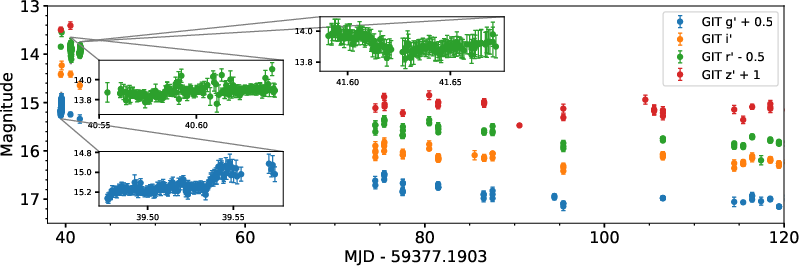
Figure 1: Light curve of nova V1674 Her in the GIT g′, r′, i′, and z′ bands with offsets for visual clarity; insets highlight high-cadence segments.
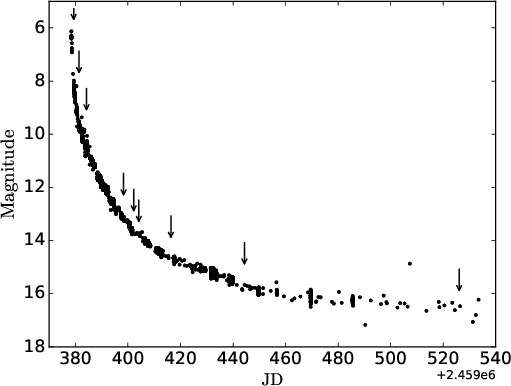
Figure 2: AAVSO V-band light curve of V1674 Her indicating epochs of spectroscopic observations.
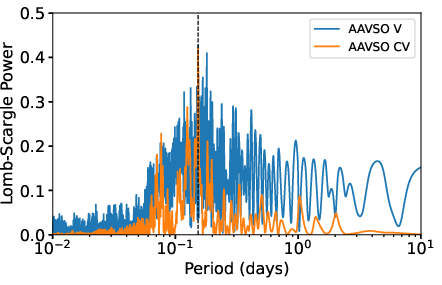
Figure 3: LS periodogram of V1674 Her showing a distinct peak at ∼0.153 days in both V and CV bands.
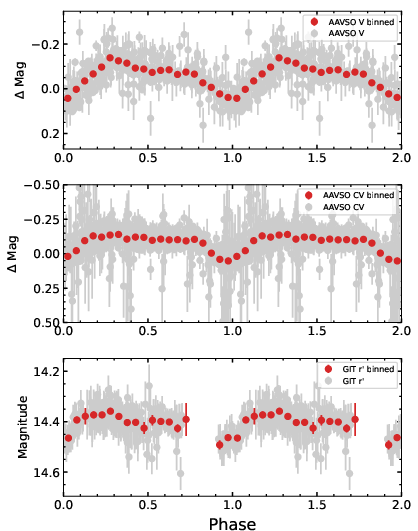
Figure 4: Phase-folded AAVSO V/CV and GIT r′ light curves at the $0.153$-day orbital period.
Upper limits for feasible detection of spin modulation in the optical were established at amplitudes of <0.04 (r′) and <0.065 (g′), quantitatively constraining the potential for optical spin detection during the post-eruption phase.
Spectral Evolution: Ionisation and Line Diagnostics
Eight epochs of optical spectra reveal a rapid transition from low-ionisation conditions (dominated by He I, H, O I, N II, Fe II) to an environment characterized by high-ionisation and coronal features. Early emission-line velocities reached >6000 km/s for He, O, N, and Balmer lines, with broad wings (∼10,000 km/s FWZI) and pronounced multi-component, non-Gaussian profiles. The Fe II signatures, typical of Fe II-class novae, vanished swiftly post-eruption, and He/N features emerged, reinforcing the hybrid nature.
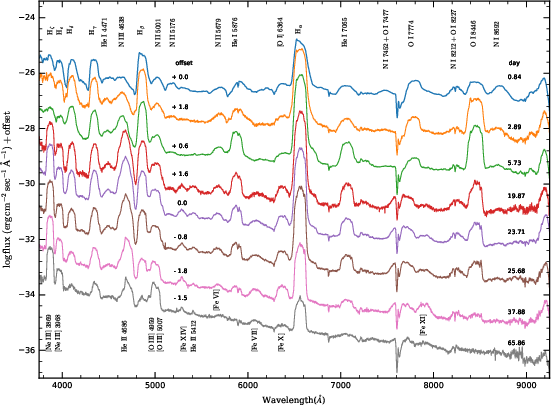
Figure 5: Multi-epoch evolution of optical spectra in logarithmic flux, highlighting the progression from low-ionisation to coronal/nebular regimes.
On day 19.87, simultaneous presence of [Fe VI], [Fe VII], [Fe X], [Fe XIV], [Ne III], [Ne V], [O III] points to ONe WD identification, supported by consistent UV/optical neon diagnostics.
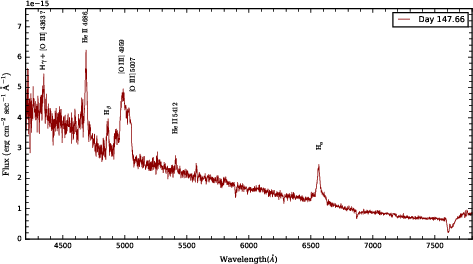
Figure 6: Spectrum at day 147.66, demonstrating persistent nebular lines and blue continuum; He II 4686 Å is dominant.
The terminal-stage spectra (day 147.66) show absence of coronal iron lines, persistence of nebular [O III], narrowing of He II 4686 Å velocity width (∼1500 km/s), and a blue continuum—implying re-establishment of accretion disk dominance.
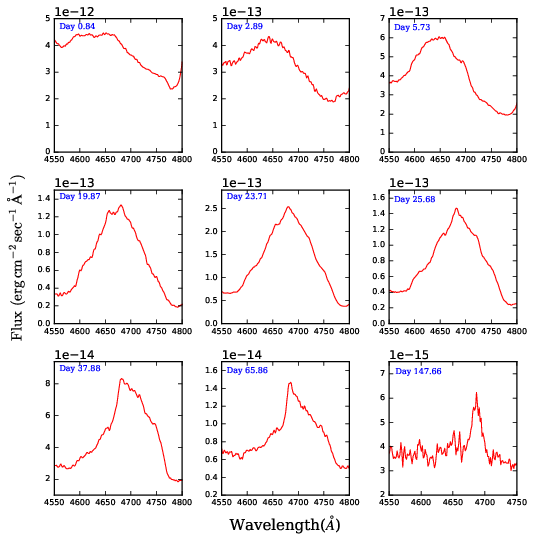
Figure 7: Evolution of He II 4686 Å across nine epochs, with early blending and eventual narrowing suggesting spatially shifting emission loci.
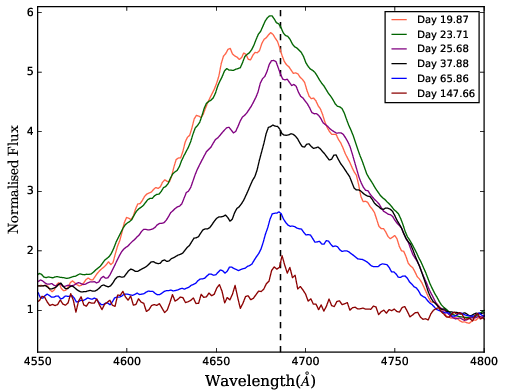
Figure 8: Normalized emission line profiles for He II 4686 Å highlight its enduring presence and evolution.
Emission Line Characterization
Corrugated line profiles in Hα and Hβ indicate ejecta with complex substructure and velocity gradients. Orbital inclination constraints (∼65∘) and ejecta geometry inferred from line modeling agree with earlier resolved imaging results.
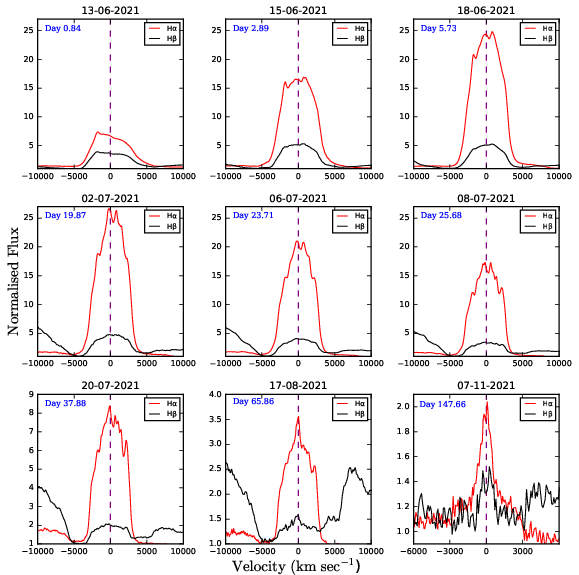
Figure 9: Hα and Hβ profiles for nine epochs reveal asymmetric and evolving velocity structures.
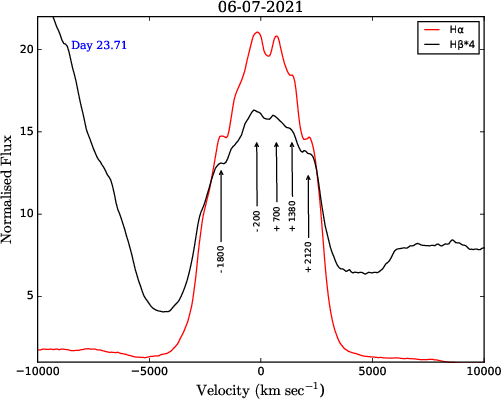
Figure 10: Velocity profiles for Hα and Hβ at day 23.71, showing five distinct gas parcels with similar morphologies.
Oxygen Excitation Mechanisms
The ratio O I 8446 Å/7774 Å peaking at >7 (day 5.73) indicates dominant Lyman-beta fluorescence—a diagnostic for neutral oxygen in highly irradiated ejecta. O I 8446 Å line profile shares structure with He I 7065 Å and Balmer lines, confirming velocity-correlated emission regions.
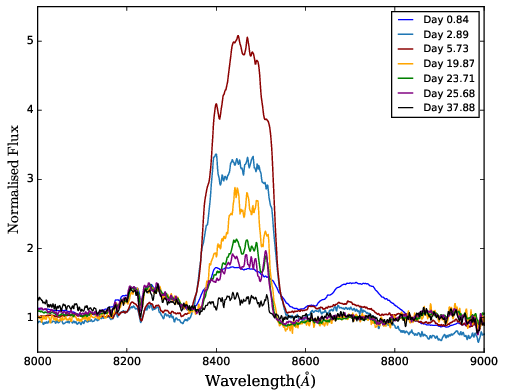
Figure 11: Evolution of O I 8446 Å, peaking early and declining, supporting Lyman-beta fluorescence dominance.
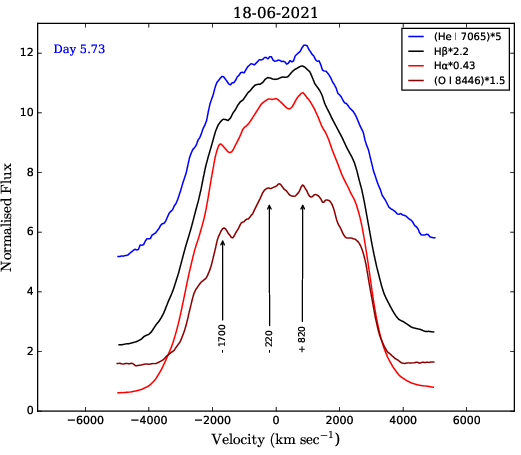
Figure 12: Velocity profiles of O I 8446 Å, He I 7065 Å, Hα, and Hβ at day 5.73 elucidate correlated substructure.
Neon and Coronal Lines
Emergent [Ne III] 3869/3968 Å and [Ne V] 3426 Å with corrugated profiles confirm ONe WD composition. Persistence and eventual weakening of these lines track nova ionisation trajectory.
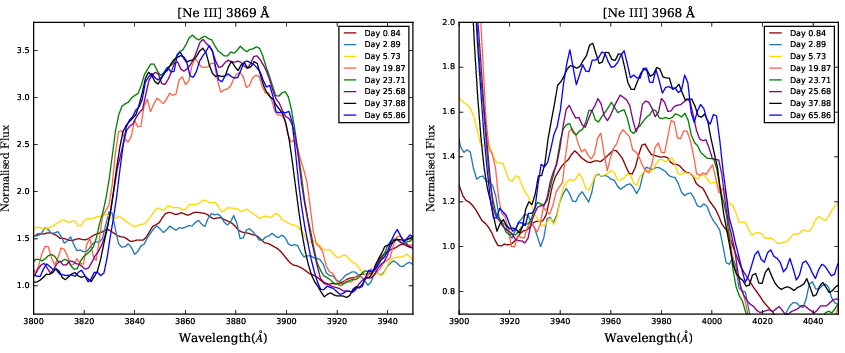
Figure 13: Temporal evolution of [Ne III] 3869 Å and 3968 Å emission lines, with neon lines becoming dominant post-SSS entry.
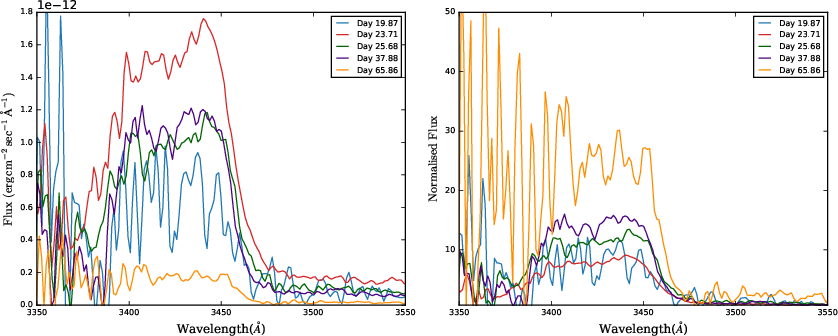
Figure 14: [Ne V] 3426 Å evolution, visible from day 19.87 through day 65.86, aligning with multi-wavelength neon diagnostics.
Iron coronal lines ([Fe VI] 5677 Å, [Fe VII] 6087 Å, [Fe X] 6375 Å, [Fe XI] 7892 Å, [Fe XIV] 5303 Å) appeared post-SSS, driven by photoionisation, declining by late epochs.
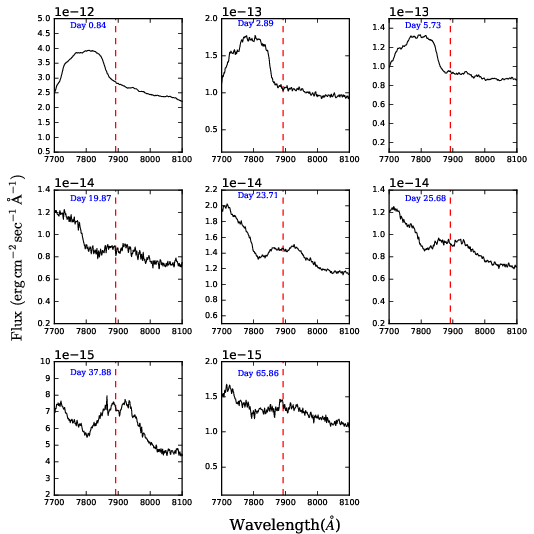
Figure 15: [Fe XI] 7892 Å weak at day 23.71, peaks at day 37.88, then fades by day 65.86.
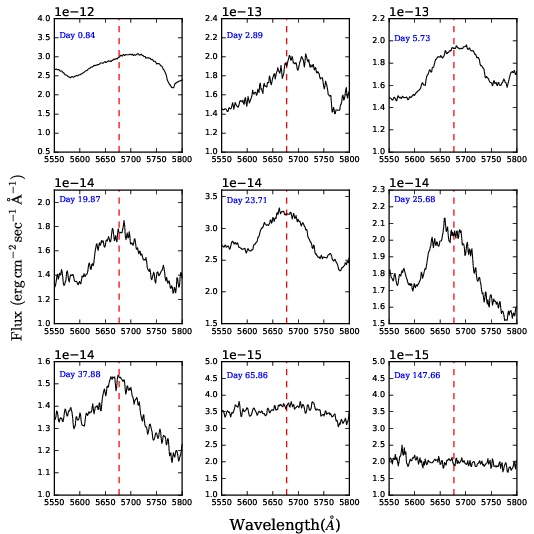
Figure 16: [Fe VI] 5677 Å robust at day 19.87 to 37.88, weakens thereafter.
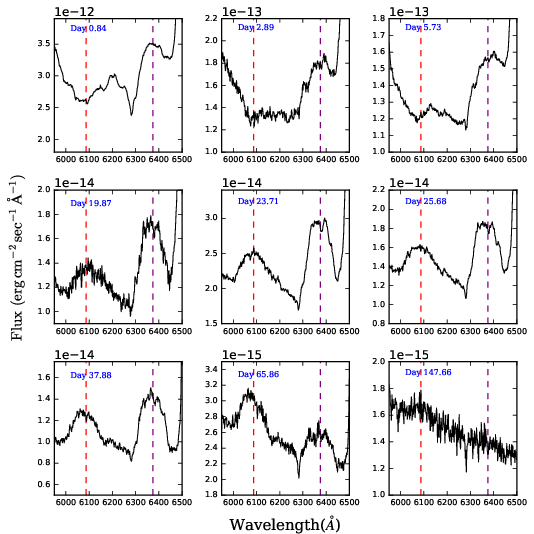
Figure 17: [Fe VII] 6087 Å and [Fe X] 6375 Å emerge post-SSS, stable until day 65.86, absent at day 147.66.
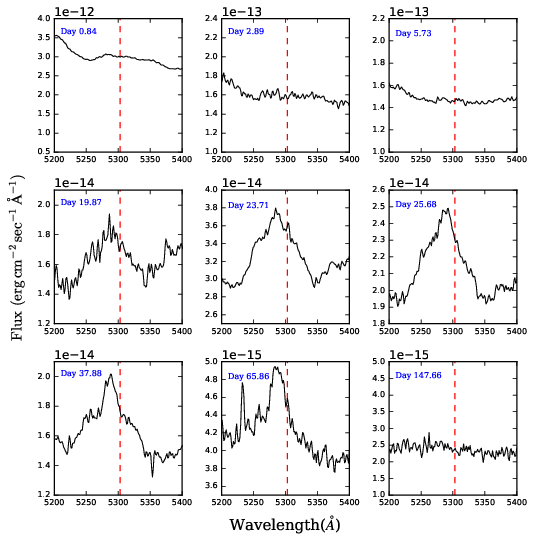
Figure 18: [Fe XIV] 5303 Å tracks high-ionisation phase, disappears by final epoch.
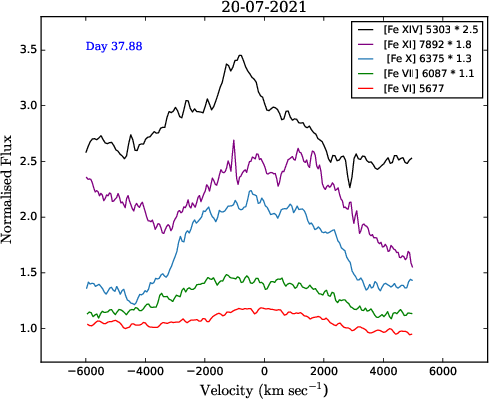
Figure 19: Velocity profiles for iron coronal lines at day 37.88, illustrating multi-component velocity structure.
Morpho-Kinematic Modeling
Using SHAPE, a morpho-kinematic model matches observed Hα profiles, revealing a bipolar shell structure with polar blobs and equatorial ring—an atypically pronounced morphology for a fast nova per speed class-axial ratio empirical trends. Parameter space exploration (inclination, density, velocity) yielded best-fit for i=65∘, with central ring density exceeding shell. Temporal progression shows polar component broadening, attributed to uncollimated outflow.
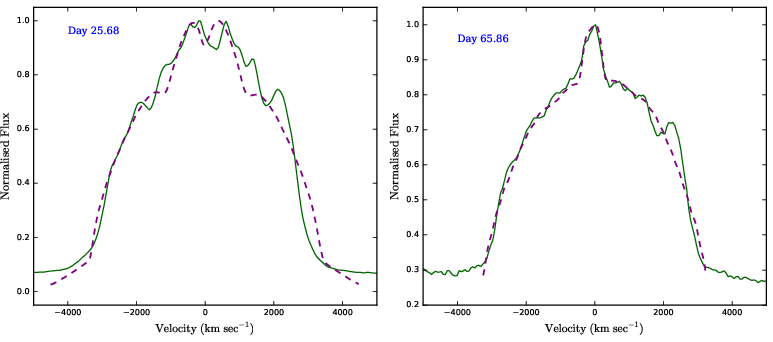
Figure 20: Comparison of observed and modeled Hα profiles at day 25.68 and day 65.86; excellent fit supports SHAPE-based ejecta geometry.
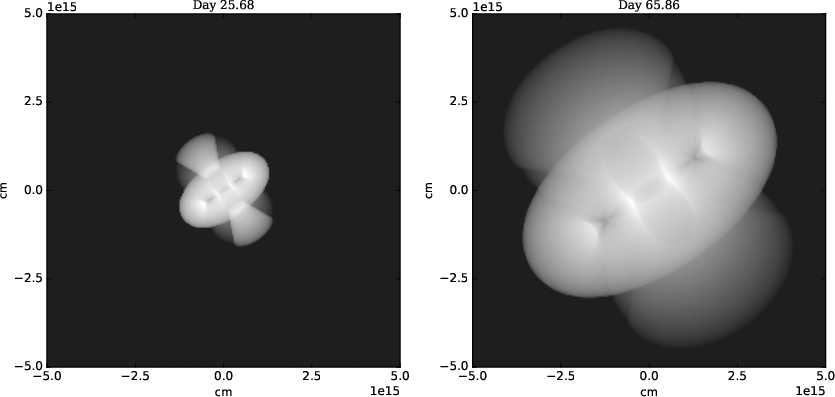
Figure 21: Inferred 3D morphology for V1674 Her ejecta at two epochs, illustrating bipolar shell and equatorial ring.
Implications and Future Directions
This detailed optical temporal and spectral analysis establishes V1674 Her as a prototypical fast, ONe-type nova with hybrid Fe II/He/N characteristics. The dynamical evolution, excitation mechanisms (Lyman-beta fluorescence, photoionisation, shock), and morpho-kinematic constraints contribute to understanding ejecta shaping mechanisms, WD composition diagnostics, and outflow physics. Persistent nebular lines at late epochs imply delayed quiescence transition and sustained accretion activity.
The pronounced bipolar structure challenges classical speed class-shaping paradigms, suggesting additional collimation or ejection mechanisms in fast novae. Further multi-epoch resolved imaging and high-resolution spectroscopy can refine these models and elucidate the interplay of accretion, magnetic field, and binary dynamics in shaping nova ejecta.
Conclusion
The optical monitoring of V1674 Her demonstrates a rapid ionisation evolution, diverse excitation mechanisms, and complex ejecta morphology. The ONe WD composition is confirmed via neon diagnostics. Detailed morpho-kinematic modelling substantiates a bipolar shell with equatorial ring and polar blobs, providing empirical constraints for future studies on nova shaping and WD progenitor characteristics. The persistence of emission signatures at late epochs highlights ongoing accretion and delayed return to quiescence, warranting extended temporal monitoring for fast and hybrid novae (2602.19940).

