- The paper shows that an asymptotically safe UV fixed point does not guarantee bounded, physical scattering amplitudes in the IR regime.
- It demonstrates that gravitational logarithms disrupt derivative expansions and standard RG improvements, leading to incorrect momentum dependencies.
- It reveals that analytic FRG solutions expose a momentum beta function and scale transmutation, challenging traditional truncation strategies in quantum gravity.
Asymptotically (Un)safe Scattering Amplitudes: Analytic Insights into Infrared Structure and Approximation Reliability
Introduction and Context
This paper rigorously investigates the leading-order quantum gravity corrections to a scalar two-to-two scattering amplitude within the asymptotic safety paradigm, employing the functional renormalization group (FRG) and analytic techniques. Emphasis is placed on the infrared (IR) regime, the reliability of truncation strategies commonly used in quantum gravity, and the distinction between fixed point existence and physically acceptable, unitary scattering.
The analysis proceeds in the context of shift-symmetric scalar fields minimally coupled to gravity, with detailed consideration of both massless and massive cases. Distinctive claims are made regarding the failure of derivative expansions, the limitations of RG improvement heuristics, the possibility of large quantum gravitational logarithms in the IR, and the subtleties of correspondingly reconstructing the effective action and amplitudes.
The effective action is formulated with momentum-dependent nonlocal form factors for the relevant invariants, focusing on the four-scalar interaction and its impact on ϕϕ→χχ scattering. All quantum corrections are mediated by graviton loops, and the dressing of the amplitude is tied to solutions of the FRG flow equation, which tracks both explicit k-dependence and scale-dependent couplings/functionals. The analytic treatment enables explicit evaluation in both Euclidean and Minkowski (after Wick rotation) signatures.
The central technical objects are the form factors Fi(□) in the action, which encode higher-derivative and nonlocal quantum gravity corrections. The calculation proceeds by solving these flow equations for the full momentum dependence, extracting both fixed point behavior and the k→0 (physical) limit.
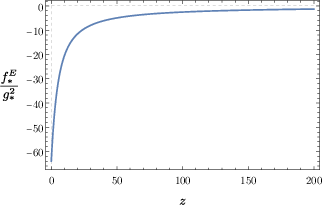
Figure 2: The fixed-point solution for the dimensionless Euclidean momentum-dependent form factor, illustrating regularity in the IR and $1/z$ decay for large momenta.
Main Findings: Breakdown of Approximation Schemes
1. Fixed Point Versus Physical Boundedness
It is explicitly demonstrated that the mere existence of an asymptotically safe UV fixed point in the FRG does not guarantee the boundedness/unitarity of the physical scattering amplitude for all partial waves. Specifically, in the computed case, the high-energy (s→∞) partial wave amplitudes remain unbounded for all fixed point couplings, in contrast to expectations, establishing a separation between mathematical fixed points and physical acceptability.
2. Gravitational Logarithms in the Massless IR
The quantum gravity-induced form factor for the four-point amplitude exhibits a logarithmic enhancement for small momentum transfer. This gravitational logarithm dominates the IR regime, leading to a breakdown of polynomial truncations and power series expansions in the derivative (momentum) expansion. These logarithms are structurally analogous to those encountered in other effective field theories, but here are sourced purely by graviton loops.
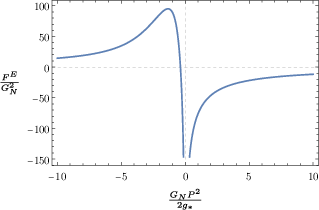
Figure 4: The full analytic form factor as a function of Euclidean squared momenta, exhibiting the logarithmic divergence at low momenta dominating the IR sector.
3. Quantitative Failure of Derivative Expansions
The standard derivative/Taylor expansion in powers of p2 fails to reproduce the physical Wilson coefficients for the form factor: the expansion yields IR divergences in the couplings when the quantum (gravitational) term in the flow equation dominates over classical dimensional running. Even after regularizing or removing power-law divergences, the constant values and logarithmic structure are quantitatively incorrect except in the strict fixed point regime.
4. Qualitative Failure of RG Improvement Heuristics
Attempts to substitute k→p "by hand" ('RG improvement') using the flow for k-dependent couplings—a common phenomenological approach—produce qualitatively wrong physical momentum dependence, especially in the UV. RG-improved form factors show either too-rapid decay at high momentum (∼1/p4 instead of 1/p2) or approach a constant, both violating the true scaling found in the analytic solution.
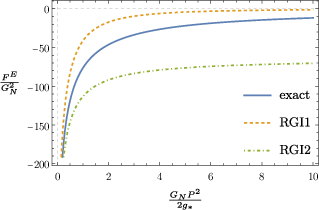
Figure 1: Comparison of RG-improved results for the Euclidean form factor with the exact analytic solution; both leading RG improvement schemes fail to reproduce the correct large-momentum (UV) behavior.
5. Momentum Beta Function and Scale Transmutation
The analytic solution exposes a "momentum beta function" for the form factor, with clear fixed point behavior at large p and the phenomenon of "scale transmutation": running in the auxiliary FRG scale k is transmuted, in the physical k→0 limit, into running with the physical scale GNp2, providing nonperturbative constraints on how quantum gravity corrections are organized. Power expansions and RG heuristics cannot adequately reproduce this phenomenon (Figure 6).
Figure 3: The momentum beta function for the physical form factor, showing asymptotic vanishing at large momenta, indicative of fixed-point-like behavior.
Implications for IR Construction and the No-Global-Symmetries Conjecture
The behavior found in the IR fundamentally alters how the low-energy effective action must be reconstructed: only a full functional (momentum-dependent, curvature-dependent) resolution can reproduce the correct physical behavior in massless and certain massive scenarios. This presents a fundamental challenge to the widespread use of truncated expansions in quantum gravity.
Additionally, if physical asymptotic safety is achieved (i.e., scattering amplitudes are bounded), the RG flow can induce effective symmetry breaking at high energies—even in the case of shift symmetry—while remaining symmetric in the deep IR, providing a potential mechanism for a version of the swampland no-global-symmetries conjecture within the asymptotically safe framework.
Results with Mass Terms
The analytic structure is modified when scalar masses are included. In this case, the problematic gravitational logarithms are exponentially suppressed below scales set by the mass, and the derivative expansion becomes practically reliable for all irrelevant and many marginal couplings as long as there is scale separation between the masses and the Planck scale.
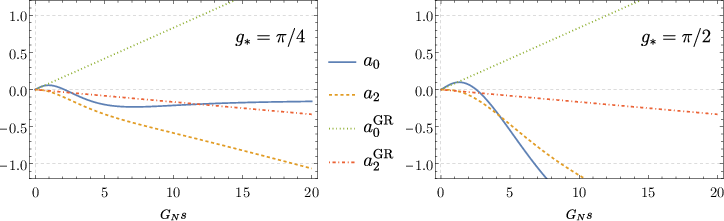
Figure 6: Partial-wave amplitudes a0 and a2 for various fixed point couplings; neither are simultaneously bounded, confirming that a fixed point does not guarantee unitarity for all waves.
However, for classically marginal couplings and in the purely gravitational sector, issues can still persist, particularly when the fixed point is located at vanishing mass parameters. The robustness of results for realistic Standard Model-like situations is thus contingent on the details of symmetry breaking and the fixed point structure.
Theoretical and Practical Implications
- Theoretically, the results make clear that interpreting asymptotic safety solely in terms of RG fixed points is insufficient; physical amplitude boundedness and functional resolution are indispensable. This not only impacts mathematical constructions but also indicates that some longstanding numerical truncation strategies can produce reliable fixed point results but incorrect physics in the k→0 IR limit.
- Practically, calculations in realistic gravity-matter systems must employ functional (momentum, curvature, or field) dependence in the effective action, especially when massless degrees of freedom are present or when gravitational/marginal interactions are studied. Standard RG improvement and derivative expansions need reevaluation except where exponential suppression affords safe use.
- Phenomenologically, the presence and scaling of quantum gravity logarithms, as well as the location of the effective Planck/suppression scales, can be model-dependent (e.g., depending on the fixed point value g∗, tied to the matter content and the existence of a "species scale"), with possible links to the dark sector or UV cutoff scales in phenomenological models.
Outlook on Extensions and Future Directions
The lessons extend directly to higher-order and more realistic truncations (including the Standard Model/Higgs and f(R) gravity), with the mandatory requirement of functional resolution for meaningful physical predictions. The work opens the door for numerical implementations that track physical momentum/curvature dependence, especially in combination with methodologically improved FRG treatments (e.g., non-background flows, explicit Lorentzian signature).
Further, the analytic control realized here provides concrete tests for the conjectured relation between quantum gravity, amplitude bounds, and the fate of global (shift or otherwise) symmetries, inviting future work on black hole configurations, matter couplings, and positivity bounds in the context of massless graviton-mediated theories.
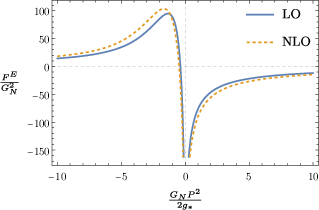
Figure 7: Leading-order versus next-to-leading-order evaluation of the Euclidean form factor, confirming the stability of the qualitative momentum dependence and only moderate quantitative changes.
Conclusion
This study conclusively establishes, with explicit analytic solutions, key structural facts about quantum gravity corrections to scattering amplitudes in asymptotic safety, the limitations of common approximation strategies, and the subtleties of IR physics with (and without) masses. The approach provides both new technical tools and theoretical clarity, setting essential benchmarks for future research in constructive quantum gravity, phenomenology, and the numerical implementation of the FRG in gravitational systems.