Track4World: Feedforward World-centric Dense 3D Tracking of All Pixels
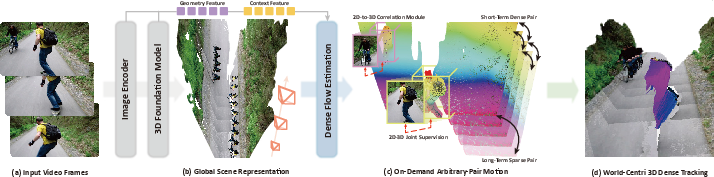
Abstract: Estimating the 3D trajectory of every pixel from a monocular video is crucial and promising for a comprehensive understanding of the 3D dynamics of videos. Recent monocular 3D tracking works demonstrate impressive performance, but are limited to either tracking sparse points on the first frame or a slow optimization-based framework for dense tracking. In this paper, we propose a feedforward model, called Track4World, enabling an efficient holistic 3D tracking of every pixel in the world-centric coordinate system. Built on the global 3D scene representation encoded by a VGGT-style ViT, Track4World applies a novel 3D correlation scheme to simultaneously estimate the pixel-wise 2D and 3D dense flow between arbitrary frame pairs. The estimated scene flow, along with the reconstructed 3D geometry, enables subsequent efficient 3D tracking of every pixel of this video. Extensive experiments on multiple benchmarks demonstrate that our approach consistently outperforms existing methods in 2D/3D flow estimation and 3D tracking, highlighting its robustness and scalability for real-world 4D reconstruction tasks.
Paper Prompts
Sign up for free to create and run prompts on this paper using GPT-5.
Top Community Prompts
Explain it Like I'm 14
Track4World: A simple explanation
What is this paper about?
This paper introduces Track4World, a computer system that can watch a regular video from one camera (like a phone) and figure out where every tiny dot (pixel) in the picture moves in 3D over time. Think of it like turning a video into a “pop-up” version of the world where the computer knows what’s closer, what’s farther, and how everything moves from moment to moment.
What questions are the researchers trying to answer?
The paper focuses on a few simple but tough goals:
- Can we track the 3D motion of every pixel in a video—not just a few selected points?
- Can we do this using only one camera view (no depth cameras or multiple cameras)?
- Can we make it fast and efficient, instead of slow and heavy?
- Can we learn 3D motion better by also learning from lots of 2D motion data (which is easier to find)?
How does Track4World work? (Explained with everyday ideas)
Here’s the big idea, step by step:
- Build a mental map of the scene
- The system uses a powerful “vision transformer” (a kind of AI model) to understand each frame of the video.
- It creates a 3D map (point cloud) for each frame and estimates where the camera is pointing.
- Think of this as the computer making a rough pop-up book version of the video.
- Estimate movement between pairs of frames instead of all at once
- Tracking every pixel across the whole video directly would be like drawing lines from every dot in every picture to every other picture—too huge and slow.
- Instead, the system calculates how things move between pairs of frames (this is called “scene flow” for 3D motion and “optical flow” for 2D motion).
- By chaining these pairwise motions, it can follow pixels across the whole video.
- Start coarse, then go dense (sparse-to-dense)
- It first estimates motion for a smaller set of “anchor” points (like a grid of landmarks), which saves time.
- Then it fills in the details to get a motion estimate for every pixel.
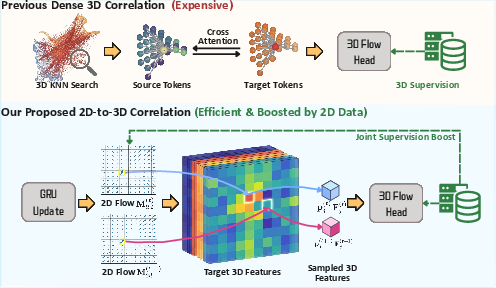
- Use 2D clues to get 3D motion (2D-to-3D correlation)
- Finding 3D matches directly is expensive. So Track4World first compares image patterns in 2D (like matching patches between frames), which is much faster.
- Then it “lifts” those 2D matches into 3D using the pop-up map (the point cloud) and camera information it already built.
- It repeats this in small steps, improving both the 2D and 3D motion each time.
- Learn from 2D data to improve 3D results
- There’s lots of training data for 2D motion (optical flow), but much less for 3D.
- Because Track4World tightly links 2D and 3D motion, it can learn from 2D tasks and use that knowledge to get better at 3D tracking.
- World-centric tracking
- The system describes motion in a “world” coordinate system—not just relative to the moving camera.
- Imagine the world as a fixed stage, and the camera is moving around it. Track4World keeps track of objects on the stage, so you get stable, consistent 3D tracks over time.
What did the researchers find?
Across many tests, Track4World does better than previous methods at both 2D and 3D motion tracking:
- It more accurately estimates how things move in 3D between frames (scene flow).
- It tracks points over long stretches of video more reliably, in both camera and world coordinates.
- It also produces strong 3D geometry (the pop-up map) and camera motion estimates.
- It works on different kinds of videos (synthetic and real-world) and different settings (indoors, outdoors, moving cameras, busy scenes), showing good generalization.
Why this matters:
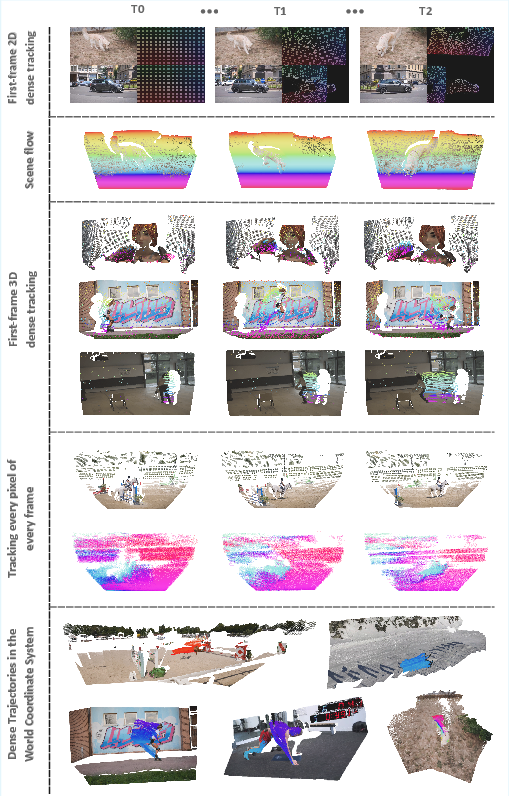
- Tracking “every pixel” means you get a complete picture of how the entire scene evolves, not just a few points.
- Doing it fast and efficiently makes it practical for real applications (like on robots or phones).
Why is this important?
If a computer can understand where everything in a video is and how it moves in 3D, it unlocks a lot of possibilities:
- Robotics: A robot can better grasp and navigate around moving objects.
- AR/VR and filmmaking: More realistic effects, object insertion, and motion-aware editing using normal videos.
- Science and education: Understanding real-world motion (like how objects fall or move) from simple videos.
- Everyday devices: Phones and drones can capture richer 3D information without special sensors.
Quick recap in plain words
- Track4World is like giving a video superpowers: it knows where each tiny dot moves in 3D, through time.
- It does this efficiently by first matching in 2D (easy and fast), then lifting to 3D using its learned pop-up map, and finally chaining these motions across the whole video.
- It outperforms previous methods and can help many real-world tasks that need understanding of moving scenes from just a single camera.
Knowledge Gaps
Knowledge gaps, limitations, and open questions
Below is a focused list of what remains missing, uncertain, or unexplored in the paper, phrased to guide concrete follow-up research.
Methodological and modeling limitations
- Scale ambiguity and metric consistency: All 3D evaluations are aligned with a per-video scale and shift; the method does not establish metric scale or absolute orientation. How to recover or maintain metric world scale and orientation without external sensors remains open.
- Sensitivity to depth/pose errors: The scene flow relies on feedforward camera-centric point clouds and poses (e.g., DA3/Pi3). The paper lacks a sensitivity analysis quantifying how depth/pose errors propagate to 3D flow and final tracks.
- Occlusion and disocclusion handling: While a visibility confidence is predicted during 2D flow updates, the paper does not detail how long-term occlusions, re-emergence (track re-identification), or out-of-view transitions are handled during global trajectory fusion.
- Drift in long sequences: Global tracking is obtained by chaining pairwise flows or using a reference-to-all scheme with a temporal aggregator, but there is no explicit cycle-consistency or drift correction mechanism; robustness over very long videos remains untested.
- Ambiguity in low-texture/repetitive patterns: The 2D-to-3D correlation relies on image-plane correlations; the method’s robustness in scenes where 2D matching is ambiguous (where explicit 3D neighborhood constraints can help) is not characterized.
- Sparse-to-dense upsampling fidelity: Dense flows are recovered from 1/8-resolution anchors via learned upsampling. The impact on motion boundary sharpness, thin structures, and small fast-moving objects is not analyzed.
- Hybrid unprojection assumption: The final “hybrid” recovery that mixes 2D flow with Z-axis 3D displacement assumes geometric consistency that may fail under large parallax or strong perspective effects; conditions under which this approximation breaks are not discussed.
- Intrinsics variability and camera models: The approach assumes a pinhole model and uses intrinsics inferred from point maps; handling of time-varying intrinsics (zoom/focus), lens distortion, rolling shutter, or fisheye cameras is not addressed.
- Handling of non-Lambertian/illumination changes: Robustness to specularities, shadows, and exposure changes is not evaluated; the reliance on 2D correlations may degrade under photometric inconsistencies.
Training data and supervision
- Dependence on 2D flow supervision: The method leverages abundant 2D datasets to compensate for scarce 3D labels, but potential negative transfer or bias from 2D-only supervision to 3D flow/generalization is not studied.
- 3D ground-truth requirements: The amount, diversity, and composition of the 3D supervision used are not specified; the minimal 3D annotations needed to achieve strong 3D generalization are unknown.
- Domain coverage: Despite strong results, the training/evaluation mix skews toward synthetic and curated datasets; behavior in heavily dynamic, cluttered, or extreme real-world conditions (e.g., handheld videos with zoom/blur) is not analyzed.
Algorithmic design trade-offs
- Omitted details of “3D correlation”: The decoder avoids k-NN search, but still references a 3D correlation term; the exact implementation, approximations, and trade-offs vs explicit 3D k-NN/cross-attention are not detailed or ablated.
- Anchor density and iteration budget: There is no ablation on the number of anchor points, update iterations, or neighborhood size, nor a characterization of accuracy vs. efficiency trade-offs.
- Fusion of conflicting pairwise flows: The temporal aggregator is described at a high level; strategies for resolving contradictions among multiple pairwise flows and enforcing global consistency are not specified.
- Uncertainty quantification: Beyond a visibility score, the framework provides no calibrated uncertainty for 2D/3D flow or track positions, limiting downstream decision-making and robust fusion.
Scalability, efficiency, and resource use
- Runtime and memory benchmarks: Despite claims of efficiency, the paper reports no throughput/latency comparisons, GPU memory footprints, or complexity scaling with image size or video length T.
- Whole-video processing scalability: The backbone employs global temporal self-attention; maximum processable T, memory scaling, and strategies for streaming or chunked processing are not evaluated.
- Pairwise computation scaling: Computing arbitrary-pair flows can scale as O(T2); the practical pairing strategy for long videos and its accuracy/compute trade-offs are not specified.
- Model size and training cost: The reported model has ~1.38B parameters; compute requirements for training/inference and practical deployment constraints are not discussed.
Evaluation and analysis gaps
- Failure case analysis: The paper does not present qualitative or quantitative failure modes (e.g., motion blur, fast camera rotations, textureless scenes, large displacements).
- Motion-boundary metrics: There is no dedicated evaluation on motion boundary accuracy or thin-structure tracking, which are typically sensitive to sparse-to-dense upsampling.
- Absolute pose/trajectory metrics: Although camera pose estimation is mentioned, the excerpt provides no pose error metrics or world-trajectory accuracy without scale alignment.
- Fairness of baselines: Some baselines are run without bundle adjustment or with different intrinsics/inputs; the paper does not fully analyze how setup choices affect comparative results.
Edge cases and application scope
- Topology changes and non-rigid phenomena: The capability to handle topological changes (e.g., fluid, cloth tearing) or highly articulated non-rigid deformations is not explored.
- Fast zoom/auto-focus and sensor artifacts: Behavior under autofocusing, zooming, rolling shutter, or sensor noise (e.g., smartphone videos) is untested.
- Multi-camera or multimodal extensions: The method is monocular-only; how it extends to stereo, multi-camera, event cameras, or IMU fusion to improve metric consistency is left open.
Concrete open research questions
- Can metric scale and absolute orientation be recovered in a purely feedforward fashion (e.g., via learned priors, gravity cues, or sparse sensor fusion) while preserving efficiency?
- What is the quantitative sensitivity of 3D tracking accuracy to errors in depth, pose, intrinsics, and 2D flow, and can robustifying strategies (e.g., uncertainty-aware fusion) mitigate it?
- How can explicit cycle-consistency and global constraints be integrated to reduce drift while keeping compute tractable for long videos?
- Can boundary-aware or segmentation-guided upsampling improve fine-scale motion fidelity without sacrificing speed?
- Under what conditions does 2D-to-3D lifting underperform explicit 3D neighborhood matching, and can hybrid schemes adaptively switch based on ambiguity cues?
- How to scale the approach to streaming/online settings with controlled memory, avoiding O(T2) pairwise computations while retaining long-range associations?
- Can the framework provide calibrated per-pixel uncertainty for flows and tracks to enable robust downstream reasoning and fusion?
- What training curricula or dataset mixtures optimize transfer from 2D flow supervision to accurate 3D motion in the wild?
Practical Applications
Immediate Applications
Below are concrete, deployable uses that can be built now by integrating the paper’s feedforward, world-centric, dense 3D tracking and 2D–3D scene-flow estimation into existing workflows.
- VFX and post-production matchmove/roto acceleration — sectors: media/entertainment, software. Enables frame-accurate, per-pixel world-centric 3D motion for compositing, rotoscoping, and depth-aware effects from a single camera. Tools/workflows: Nuke/After Effects/Blender plugins that output dense point maps and scene flow; depth-aware relighting and matte extraction; video-to-4D scene capture. Assumptions/dependencies: reliable depth/pose from the backbone; scale alignment if metric measurements are needed; GPU for medium- to high-resolution footage.
- AR content anchoring and occlusion handling — sectors: AR/VR, mobile. Provides dense, per-pixel 3D motion for robust world-locked anchors and occlusion-aware rendering from monocular phone cameras. Tools/workflows: mobile SDK that returns dense scene flow + point map per frame for Unity/Unreal; occlusion masks derived from 3D flow; improved visual-inertial SLAM plug-in. Assumptions/dependencies: on-device acceleration or streaming; camera intrinsics estimation; scale recovery via IMU or known object size for metric placement.
- Robotics perception module for dynamic scenes — sectors: robotics, industrial automation. Supplies dense 3D scene flow from an RGB stream to detect, track, and anticipate dynamic obstacles, aiding navigation and manipulation. Tools/workflows: ROS node publishing dense flow in world coordinates; hazard detection and motion segmentation; grasp planning informed by local 3D motion. Assumptions/dependencies: latency budget (GPU recommended); scale/metric grounding via calibration or supplementary sensors (e.g., IMU/lidar) for precise control.
- Broadcast sports analytics and telestration — sectors: sports tech, media. Extracts player and ball trajectories in 3D from single-camera footage; supports automated replays and tactical overlays. Tools/workflows: SaaS pipeline that ingests video, outputs 3D tracks and speeds; coaching dashboards. Assumptions/dependencies: metric scale via field dimensions; handling of motion blur and occlusions.
- Driver monitoring and dashcam scene understanding — sectors: automotive, insurance. Enhances dashcam analytics with per-pixel 3D motion to flag risky maneuvers, cut-ins, or near misses from monocular cameras. Tools/workflows: edge device or cloud API that returns actor-centric scene flow and relative trajectories. Assumptions/dependencies: not safety-grade without sensor fusion; metric scale via camera calibration or map priors.
- Construction/site monitoring and digital twins — sectors: AEC (architecture/engineering/construction), GIS. Tracks equipment, workers, and material motion; detects progress and deviations from plan using dense 3D motion from walkthrough videos. Tools/workflows: BIM integration for change detection; per-pixel 3D activity heatmaps. Assumptions/dependencies: consistent capture routes; metric scale via known distances or surveyed references.
- Motion-aware video editing and enhancement — sectors: creator tools, consumer apps. Improves stabilization, super-resolution, and deblurring using dense 3D flow; enables depth-aware cinematic effects on phones. Tools/workflows: mobile/desktop filters using 3D flow for parallax-correct warps and seam-reduced interpolation. Assumptions/dependencies: resource constraints on-device; robustness to rolling shutter.
- Scientific and educational motion studies — sectors: academia, education. Provides dense 3D particle/object motion fields for lab videos (e.g., pendulum, fluids, granular media) from single cameras. Tools/workflows: Python API for exporting scene flow to NumPy; Jupyter notebooks for kinematics labs. Assumptions/dependencies: relative (not metric) motion may suffice; lighting and texture affect accuracy.
- Retail and warehouse safety analytics — sectors: retail, logistics. Tracks human–robot interactions and near-miss events using world-centric trajectories from ceiling cameras. Tools/workflows: dashboards with risk heatmaps, trajectory clusters, and compliance alerts. Assumptions/dependencies: privacy controls; metric scale via calibrated installation; compute at the edge or in cloud.
- Automatic 3D motion annotation for datasets — sectors: AI/ML tooling. Converts raw videos into dense 2D/3D flow and trajectories to bootstrap training of detection, tracking, and segmentation models. Tools/workflows: labeling platform plugin generating pseudo-GT flow/track labels; active learning loops. Assumptions/dependencies: domain shift handling; quality gating; scale optional unless metric labels are required.
- Teleoperation and remote inspection — sectors: robotics, energy, utilities. Adds dense 3D motion understanding to monocular inspection feeds to highlight moving components, leaks, or vibration patterns. Tools/workflows: overlays of 3D flow vectors and temporal differencing in control UIs. Assumptions/dependencies: streaming latency; low-texture surfaces may reduce fidelity.
- Video forensics and incident review — sectors: security, insurance. Reconstructs relative 3D trajectories and contact events from bodycam/CCTV for post-incident analysis. Tools/workflows: casework tool that outputs world-centric tracks and timelines. Assumptions/dependencies: admissibility and chain-of-custody; metric scale via scene measurements.
- Data strategy: leverage 2D labels for 3D tasks — sectors: AI/ML across domains. Uses the paper’s 2D–3D joint supervision mechanism to train 3D motion models with abundant 2D optical-flow datasets, reducing reliance on scarce 3D GT. Tools/workflows: training pipelines that co-train on 2D flow corpora plus light 3D supervision. Assumptions/dependencies: careful loss balancing; representative 2D data diversity.
Long-Term Applications
These uses are feasible with further research, scaling, and/or integration work such as real-time constraints, metric-scale robustness, and safety validation.
- Real-time dynamic SLAM with dense scene flow — sectors: AR/VR, robotics. Unifies mapping and motion estimation for dynamic environments (moving people/objects) with world-locked content. Tools/workflows: SLAM back-ends that fuse joint geometry + motion to maintain persistent maps. Dependencies: on-device acceleration; long-horizon temporal consistency; drift correction and loop closure.
- Surgical and endoscopic tissue motion tracking — sectors: healthcare/medtech. Monocular 3D tissue deformation tracking for surgical guidance, tool–tissue interaction analysis, and AR overlays. Tools/workflows: OR-integrated visualization; instrument motion quantification. Dependencies: medical-grade validation; photometric oddities (specular fluids); metric calibration.
- Monocular-only ADAS perception — sectors: automotive. Dense 3D motion of all scene elements for path prediction, free-space estimation, and risk assessment without stereo/lidar. Tools/workflows: embedded inference on automotive SoCs; fusion with map priors. Dependencies: safety certification; extreme-weather robustness; reliable metric scale or self-calibration.
- Closed-loop robot control from dense 3D flow — sectors: robotics, manufacturing. Use per-pixel 3D motion as feedback for impedance control, force inference, and adaptive manipulation of deformables. Tools/workflows: controllers consuming flow fields; sim-to-real transfer aided by 4D perception. Dependencies: low-latency inference; contact-rich generalization.
- Smartphone volumetric video capture — sectors: media, consumer tech. Turn regular videos into editable 4D content (dynamic meshes/point clouds) for VR/AR experiences. Tools/workflows: mobile capture app; cloud reconstruction and rigging. Dependencies: hole filling, non-Lambertian handling, temporal mesh consistency; scalable compression.
- Infrastructure health monitoring from fixed cameras — sectors: civil/energy. Long-term tracking of micro-motions (bridge vibration, turbine blade dynamics) from monocular feeds. Tools/workflows: dashboards with frequency spectra and anomaly detection. Dependencies: sub-pixel precision; metric calibration; environmental stability.
- Physics parameter estimation and system identification — sectors: research, simulation. Infer damping, stiffness, drag from observed dense 3D motion; validate simulators from real videos. Tools/workflows: inverse modeling pipelines linking scene flow to PDE/ODE solvers. Dependencies: accurate force–motion coupling; ground-truth for validation.
- Agricultural phenotyping and canopy dynamics — sectors: agtech. Track plant growth and motion due to wind or irrigation for stress detection and yield modeling. Tools/workflows: field cameras + analytics for per-plant 3D motion indices. Dependencies: outdoor robustness; scale via known row spacing; occlusions in dense foliage.
- City-scale traffic flow analytics from CCTV — sectors: public policy, urban planning. Derive 3D motion fields and near-miss rates for safety interventions and signal timing. Tools/workflows: anonymized, aggregated flow heatmaps; before/after policy evaluation. Dependencies: privacy safeguards; camera calibration; fairness and bias controls.
- Telepresence with 4D scene re-rendering — sectors: communications, enterprise. Live capture and transmission of dynamic 3D environments for immersive remote collaboration. Tools/workflows: streaming codecs driven by 3D flow; bandwidth-adaptive rendering. Dependencies: real-time pipeline; compression standards; synchronization.
- Climate and environmental monitoring — sectors: earth science. Track glacier flow, landslides, and shoreline dynamics from time-lapse monocular imagery. Tools/workflows: scientific toolkits for large-scale spatiotemporal motion estimation. Dependencies: very long baselines; lighting/seasonal changes; georeferencing for metric scale.
- Retail try-on and home staging in dynamic scenes — sectors: e-commerce, real estate. Robust AR overlays that respect moving people/objects with occlusion-aware rendering. Tools/workflows: AR product viewers with dense scene flow; dynamic shadowing. Dependencies: consistent metric placement; photorealistic relighting; user privacy.
- Insurance and legal accident reconstruction — sectors: insurance, legal. Reconstruct 3D trajectories and collision dynamics from dash/body cams for claims/litigation. Tools/workflows: standardized reconstruction reports with uncertainty bounds. Dependencies: metric calibration; evidentiary standards; adversarial robustness.
- Autonomous drones in dynamic environments — sectors: aerospace, logistics. Use dense 3D flow to navigate crowds and clutter with monocular payloads. Tools/workflows: onboard perception stack integrating flow with planning. Dependencies: compute/power constraints; vibration mitigation; certification.
- General-purpose 4D dataset generation at scale — sectors: AI/ML infra. Auto-curate and label massive 4D corpora from web videos for training foundation models that reason in space-time. Tools/workflows: distributed pipelines producing point maps, scene flow, trajectories and occlusion masks. Dependencies: licensing/ethics; dataset bias control; continual evaluation.
Notes on cross-cutting assumptions and dependencies
- Metric scale: Monocular scale is ambiguous; applications needing absolute measurements require calibration (known intrinsics/baselines), sensor fusion (IMU, wheel odometry, lidar), map priors, or scene measurements.
- Compute and latency: The backbone (ViT-scale, ~1B+ params) and global flow fusion are GPU-friendly but may need model distillation, tiling, or streaming for real-time/on-device use.
- Domain robustness: Textureless/specular surfaces, fast motion, rolling shutter, severe occlusions, and lighting changes remain challenging; additional training, augmentation, or sensor fusion may be needed.
- Privacy, safety, and ethics: Person/vehicle tracking raises compliance (GDPR/CCPA), consent, and fairness concerns; safety-critical domains (automotive, medical) need validation, monitoring, and certification.
- Data strategy: The 2D–3D joint supervision allows leveraging large optical-flow datasets to train 3D motion models, but careful loss design and domain coverage are required to avoid brittleness.
- Streaming vs. batch: The method processes arbitrary frame pairs with global temporal context; production systems may need windowed inference, online updates, or memory-efficient flow chaining.
Glossary
- 2D-3D joint supervision: Training strategy that simultaneously supervises both 2D and 3D predictions to improve generalization when 3D ground truth is scarce. Example: "allows 2D-3D joint supervision."
- 2D iterative correlation: An iterative process that builds and refines image-plane correlation volumes to update 2D motion estimates. Example: "2D Iterative Correlation."
- 2D-to-3D correlation: A mechanism that uses 2D image-plane correlations to efficiently inform and update 3D motion estimates. Example: "we introduce a novel 2D-to-3D correlation module that completely avoids expensive 3D spatial correlation"
- 3D spatial correlation: Correlation computed directly among 3D points (e.g., via nearest neighbors) for matching across frames. Example: "expensive 3D spatial correlation"
- 4D reconstruction: Reconstructing both 3D structure and its evolution over time (3D + time). Example: "real-world 4D reconstruction tasks."
- Absolute Relative Error (Abs Rel): A depth/point-map error metric measuring mean absolute relative difference to ground truth. Example: "We adopt the absolute relative error (Abs Rel) and the percentage of inlier points () for this assessment."
- Accuracy Relax (AccR): A scene flow accuracy metric under a relaxed threshold. Example: "report the standard metrics: End Point Error (EPE3D), Accuracy Strict (AccS), and Accuracy Relax (AccR)."
- Accuracy Strict (AccS): A scene flow accuracy metric under a strict threshold. Example: "report the standard metrics: End Point Error (EPE3D), Accuracy Strict (AccS), and Accuracy Relax (AccR)."
- Anchor points: A sparse subset of pixels/points used to reduce computation before upsampling to dense predictions. Example: "we operate on a set of sparse anchor points"
- Average Jaccard (AJ): A tracking metric assessing both geometric accuracy and occlusion prediction quality. Example: "Average Jaccard (AJ), which jointly assesses geometric and occlusion prediction accuracy."
- Average Percent Deviation (APD): A 3D tracking metric measuring the fraction of points within a depth-relative threshold. Example: "We report the APD metric to evaluate 3D point tracking"
- Bundle adjustment: An optimization that jointly refines camera parameters and 3D structure across frames. Example: "bundle adjustment is not used."
- Camera-centric: Representations defined in the camera’s coordinate frame (e.g., depth, poses), as opposed to a global/world frame. Example: "focus on camera-centric predictions."
- Camera intrinsics: Internal camera parameters (e.g., focal length, principal point) needed for projection/unprojection. Example: "which require known camera intrinsics"
- Camera pose: The position and orientation of the camera in space (extrinsic parameters). Example: "camera pose estimation"
- Correlation volume: A tensor encoding similarity between features across locations/frames to guide matching and flow estimation. Example: "constructing correlation volumes and iteratively updating the motion field"
- Cross-attention: An attention operation that relates query features to features from another set (e.g., target frame) for matching. Example: "followed by cross-attention operations"
- Delta < 1.25 (δ<1.25): The percentage of depth/point-map predictions within a 1.25 multiplicative error of ground truth. Example: "the percentage of inlier points ()"
- Differentiable SLAM: SLAM pipelines designed to be differentiable for end-to-end learning of geometry and motion. Example: "Recent differentiable SLAM methods"
- End Point Error (EPE2D): Average Euclidean endpoint error between predicted and ground-truth 2D optical flow vectors. Example: "we follow~\cite{teed2020raft,zhao2022global,wang2024sea} to report 3 metrics, EPE2D, AccS, AccR."
- End Point Error (EPE3D): Average Euclidean endpoint error between predicted and ground-truth 3D scene flow vectors. Example: "report the standard metrics: End Point Error (EPE3D), Accuracy Strict (AccS), and Accuracy Relax (AccR)."
- Feedforward model: A non-iterative inference architecture that predicts outputs in a single forward pass without test-time optimization. Example: "we propose a feedforward model, called Track4World"
- Global self-attentions: Self-attention layers applied across tokens/frames to aggregate global temporal-spatial context. Example: "using global self-attentions"
- GRU (Gated Recurrent Unit): A recurrent neural network module used here to iteratively refine flow and context. Example: "a GRU-based operator updates the hidden context feature"
- Hybrid unprojection scheme: A method that combines 2D flow with depth/Z displacement to lift motion into 3D coordinates. Example: "we introduce a hybrid unprojection scheme."
- k-nearest neighbor (k-NN) search: A search for the closest k points in 3D space, often used for explicit 3D matching. Example: "require performing computationally expensive -nearest neighbor searches in 3D space"
- Monocular video: Video captured from a single camera/view, without stereo or multi-view inputs. Example: "from a monocular video"
- Occlusion Accuracy (OA): A metric that evaluates the correctness of binary occlusion predictions in tracking. Example: "Occlusion Accuracy (OA), measuring occlusion prediction as a binary classification;"
- Optical flow: The per-pixel 2D motion field between two frames. Example: "optical flow estimation"
- Pixel-shuffle operation: A learned upsampling technique that rearranges feature channels into higher-resolution spatial grids. Example: "upsampled to full resolution via a learned pixel-shuffle operation"
- Point cloud: A set of 3D points representing scene geometry. Example: "camera-centric point clouds"
- Point map: A dense per-pixel 3D point representation of a frame (depth lifted to 3D). Example: "point map prediction"
- Scene flow: The per-point 3D motion field between two frames. Example: "scene flow estimation"
- Scene flow decoder: The network module that predicts dense 3D scene flow between frame pairs. Example: "the scene flow decoder predicts dense 3D scene flow"
- Temporal aggregator: A module that enforces temporal consistency by attending over flow features across time. Example: "a temporal aggregator that applies attention over concatenated flow features"
- Trajectory prior: A prior constructed from historical motion to regularize and smooth current flow updates. Example: "construct a trajectory prior"
- Vision Transformer (ViT): A transformer architecture applied to vision tasks, operating on image tokens. Example: "VGGT-like ViT-style 3D geometry reconstruction framework"
- Visibility confidence: A per-point confidence indicating whether a correspondence is visible/not occluded. Example: "visibility confidence "
- Warp-sampling mechanism: Efficiently sampling target features/coordinates by warping source positions using current flow estimates. Example: "our warp-sampling mechanism operates with a strict complexity"
- World-centric coordinate system: A global, scene-level coordinate frame independent of the camera’s viewpoint. Example: "in the world-centric coordinate system."
Collections
Sign up for free to add this paper to one or more collections.

