- The paper establishes a rigorous information-theoretic framework for using syndrome data to enhance logical observable estimation in noisy quantum systems.
- It shows that classical syndrome-aware protocols can at best halve the effective logical error rate, reducing sampling overhead quadratically.
- Quantum syndrome-aware measurements, especially using even-distance codes, achieve exponential error suppression by adapting the measurement basis to observed syndromes.
Quantum Advantages for Syndrome-Aware Noisy Logical Observable Estimation
Introduction and Motivation
The paper "Quantum advantages for syndrome-aware noisy logical observable estimation" (2603.05145) develops a rigorous information-theoretic framework for quantifying the impact of leveraging error syndrome information during logical-layer observable estimation in fault-tolerant quantum computing. The context is the growing practical need for protocols that mitigate logical errors on early quantum hardware, where resource constraints often limit the effectiveness of full quantum error correction (QEC). Rather than discarding syndrome records after decoding, the paper proposes and analyzes protocols that explicitly use syndrome information in the estimation procedure and characterizes the resulting enhancements in estimation precision.
Framework and Protocol Taxonomy
The work distinguishes three operational regimes:
- Syndrome-agnostic estimation: Estimation is performed solely on the decoded logical state, with the syndrome record ignored.
- Classical syndrome-aware protocols: The logical measurement basis remains fixed, and syndrome information is used only in classical post-processing (e.g., rescaling, post-selecting, or error mitigation).
- Quantum syndrome-aware protocols: The logical measurement basis is allowed to depend on the observed syndrome, enabling adaptive quantum control conditioned on syndromes.
The paper formalizes these approaches using classical and quantum Fisher information to quantify estimation precision and introduces the notion of an effective logical error rate—that is, the rate in a syndrome-agnostic protocol that produces equivalent information to the syndrome-aware variant.
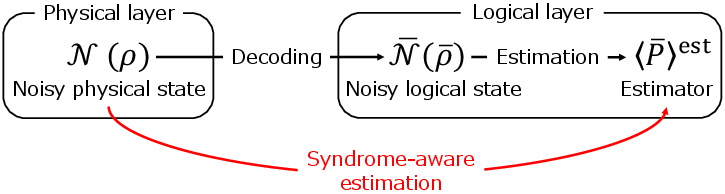
Figure 1: Schematic illustration contrasting conventional syndrome-agnostic logical estimation with the syndrome-aware paradigm, where decoding and estimation are jointly optimized utilizing syndrome records.
Fundamental Limits on Classical Syndrome-Awareness
Analyses for classical syndrome-aware estimation reveal a universal restriction: improvement of effective logical error rate is bounded in all codes and noise models.
Main result:
For classical syndrome-aware protocols, incorporating syndrome information reduces the effective logical error rate by at most a factor of two, with EHaar[ϵeff]≥21ϵ where ϵ is the logical error rate under the maximum-likelihood decoder. Consequently, the sampling overhead can be quadratically reduced, but the exponential scaling inherent to error mitigation remains unavoidable.
This no-go theorem applies broadly to post-selection strategies and syndrome-conditioned error mitigation techniques, constraining their asymptotic benefits.
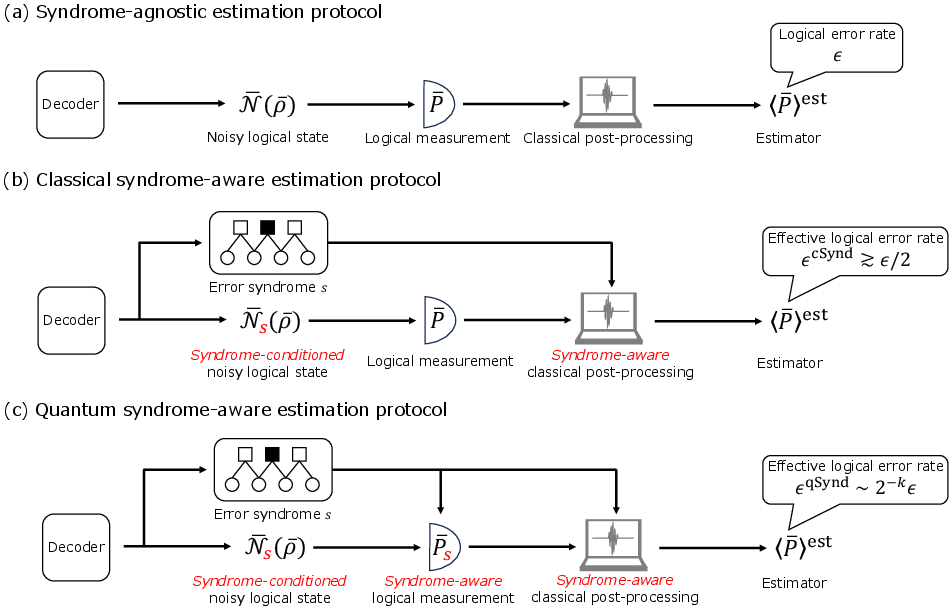
Figure 2: Schematic comparison between syndrome-agnostic, classical syndrome-aware (with post-processing), and quantum syndrome-aware (adaptive measurement) estimation protocols, highlighting exponential suppression of logical error in quantum protocols.
Numerical evaluations for various stabilizer codes corroborate these bounds and further clarify behavior in the low-error regime. Even-distance codes exhibit strictly improved effective error rates from syndrome awareness, while odd-distance codes show improvement only for ambiguous syndromes with persistent decoding ambiguity.
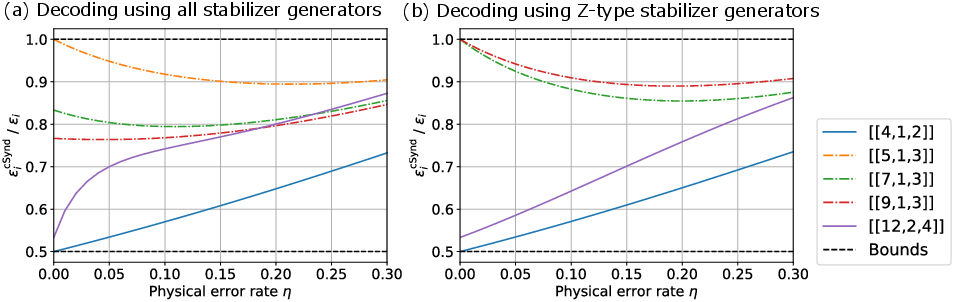
Figure 3: Ratio ϵeff/ϵ for classical syndrome-aware protocols across code families, verifying universal constant-factor improvements and distinctions by code distance parity.
Exponential Advantage via Quantum Syndrome-Awareness
Allowing syndrome-conditioned logical quantum measurements breaks the constant-factor barrier. For a broad class of codes, particularly even-distance stabilizer codes where ambiguous syndromes result in persistent logical ambiguity, the effective logical error rate can be suppressed exponentially in the number of logical qubits.
Key theorem:
For even-distance codes where all ambiguous syndromes induce a conditional logical Pauli error (anti-commuting with the target observable) with probability $1/2$, the Haar-averaged effective logical error rate obeys EHaar[ϵeff]∼2−kϵ, enabling exponential reduction in sampling overhead.
This separation arises due to the ability to exploit syndrome records for optimal measurement basis adaptation, thereby extracting maximal information in multi-parameter estimation settings. The information gain is formalized via the quantum Fisher information matrix of the syndrome-conditioned classical–quantum state.
Optimal quantum estimation protocols leveraging this mechanism involve:
- Measuring noiseless branches for anti-commuting parameters while treating commuting parameters as known due to noisy syndrome branches.
- Adaptive two-step measurement schemes that exploit syndrome-dependent outcome partitioning.
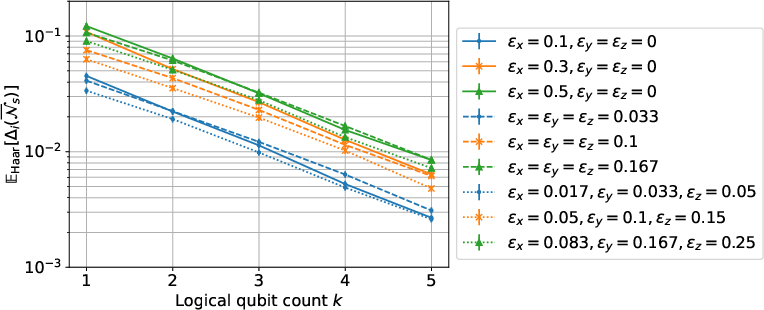
Figure 4: Haar-averaged contribution EHaar[Δi(Ns)] from ambiguous syndromes, demonstrating exponential suppression in syndrome-aware quantum measurements.
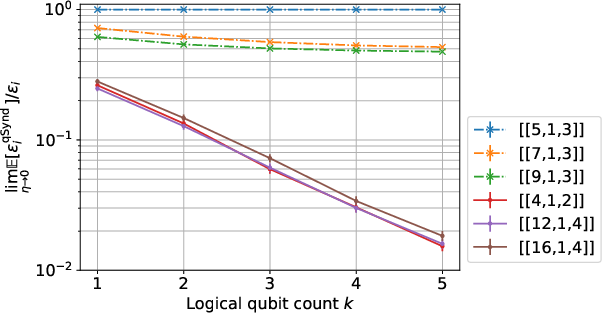
Figure 5: Low-error-limit ratio η→0limEHaar[ϵeff/ϵ] as a function of logical qubit count, verifying exponential decay in even-distance codes.
Practical and Theoretical Implications
The results sharply separate classical and quantum syndrome-aware estimation, providing a principled criterion for which syndrome information should be preserved and actively exploited. For logical observable estimation on early fault-tolerant devices, it is not sufficient to rely on syndrome-conditioned classical post-processing; genuine asymptotic advantages require the capacity for quantum control adapted to syndrome outcomes.
The framework also guides code design and lays foundations for syndrome-adaptive variants of quantum algorithms, where logical operations and measurements are dynamically optimized based on syndrome records—potentially accelerating the practical deployment of early FTQC platforms.
Numerical results suggest that exponential suppression of effective logical error rate is generic for even-distance codes, with scaling verified beyond the idealized assumptions. There is scope for further theoretical generalization and development of resource-efficient syndrome-aware quantum protocols using only stabilizer operations.
Conclusion
The paper establishes rigorous information-theoretic limits and potential for syndrome-aware observable estimation in quantum error correction. Classical approaches are restricted to constant-factor improvements, but the syndrome-adaptive quantum control paradigm enables exponential enhancement in estimation performance. This provides fundamental guidance for next-generation fault-tolerant architectures and protocols aiming to minimize logical error impact by fully exploiting syndrome information, with wide-ranging implications for quantum algorithm design, code selection, and experimental implementation.