- The paper establishes a novel bound linking the tension of fundamental domain walls to the UV cutoff, thereby constraining the AdS length and gravitino mass in flux compactifications.
- It employs a detailed supergravity analysis in type II string theory to explore how classical and quantum AdS vacua satisfy or challenge the bound, reinforcing swampland conjectures.
- The work indicates that models such as KKLT and racetrack constructions risk quantum inconsistency when the domain wall tension falls below the effective field theory cutoff.
Domain Wall Constraints on Anti-de Sitter Flux Vacua
Introduction and Motivation
The study develops a novel bound on effective field theory (EFT) UV cutoffs and anti-de Sitter (AdS) radii in flux compactifications admitting domain wall interpolations. The analysis is deeply rooted in the recognition of UV/IR mixing in string theory, where flux-induced domain walls mediate transitions between distinct AdS flux vacua. The authors formulate a domain wall bound: the tension of a fundamental domain wall, responsible for interpolating between vacua differing by a unit of flux, must not lie below the ultraviolet cutoff of the theory. This requirement imposes a concrete constraint translating into an upper bound on the AdS length and a lower bound on the gravitino mass in supersymmetric AdS backgrounds.
This bound implements the gravitino and AdS distance conjectures as articulated in the swampland program, operationalizing the idea that EFTs admitting large hierarchies between UV and IR scales are restricted by quantum gravitational consistency. The derivation is primarily carried out in string compactifications within type II, but the logic generalizes widely, provided the existence and identification of fundamental domain walls charged under the relevant flux.
Technical Derivation of the Domain Wall Bound
The derivation commences from the ten-dimensional supergravity equations of motion, integrating over the compactification manifold to relate the AdS curvature radius and the flux quanta. For a d-dimensional AdS vacuum in a weakly coupled EFT with N light degrees of freedom, the covariant entropy bound constrains the EFT entropy in a region of size LAdS, resulting in
ΛUVd−1≤MPl,dd−2LAdS−1
where ΛUV is the UV cutoff, and MPl,d the d-dimensional Planck mass.
The supergravity analysis identifies the AdS length with vacuum potential parameters set by on-shell fluxes and source contributions. Incorporating Dirac quantization and the identification of wrapped branes engineering domain walls interpolating the flux vacua, the domain wall's tension sets an upper bound for the valid UV cutoff of the EFT. Specifically, if a domain wall is fundamental, its tension Tdw provides:
Tdw≥ΛUVd−1
The combination yields the domain wall bound:
ΛUVd−1≤MPl,dd−2LAdS−1
which, in supersymmetric AdS, translates into a lower bound on the gravitino mass via m3/2∼1/LAdS.
Implications for Flux Vacua: Classical and Quantum Regimes
The effectiveness and implications of this bound are explicitly studied in major classes of AdS vacua engineered in string theory:
Classical Scale-Separated Flux Vacua
For models such as DGKT-type AdS4 vacua, both isotropic and anisotropic, the AdS scale is set by classical RR and NSNS fluxes. The supergravity solutions fulfill a "detailed balance" between source and flux contributions, ensuring that the domain wall bound is satisfied but not necessarily saturated. In these configurations, the UV cutoff is identified with the species scale—typically the string or ten-dimensional Planck scale—and always exceeds the IR scale set by 1/LAdS by a parametric margin. The hierarchy between the AdS radius and the KK scale can be large, but not arbitrarily so, consistent with the bound.
Racetrack and KKLT(-like) Vacua
The domain wall bound becomes sharply restrictive in AdS vacua supported by nonperturbative or quantum corrections, such as conventional KKLT, racetrack, and LVS constructions. These scenarios often aim for exponentially small cosmological constants and gravitino masses, with the flux superpotential W0 tuned to small values via quantized flux choices and non-perturbative superpotentials.
A central claim is that such suppressions may violate the domain wall bound: the tension of the domain wall (e.g., a wrapped D5 or NS5 brane corresponding to a single flux decrement) drops below the species cutoff, indicating that the field-theoretic description is incomplete unless one integrates in the domain wall degrees of freedom.
Explicit violation is demonstrated in the analytic study of the parameter space (for instance, for models in [Demirtas et al., (Demirtas et al., 2021, Demirtas et al., 2021)]). In these cases, mKK3LAdS≫1, violating the bound parametrically. The only way to avoid this is to keep the vacuum energy polynomially small in the compactification volume, not exponentially.
Warped Throat Scenarios
Configurations with strong warping, such as warped throats near conifold points a la Klebanov-Strassler, lead to a redshifted tower of KK modes, reducing the effective cutoff in the throat. In certain parameter regimes, when the AdS scale is determined primarily by bulk rather than throat fluxes, the domain wall bound can be obeyed, but if the warped region contributes significantly to the AdS energy, the bound may be challenged again.
Domain Wall Bound and Gravitino/AdS Distance Conjectures
A key upshot of the analysis is a robust connection between the domain wall bound and the conjectured lower bound on the gravitino mass and AdS scales in consistent quantum gravities:
MPl,dd−2ΛUVd−1≤m3/2
This directly implements the gravitino conjecture and the AdS distance conjecture, excluding configurations with parametrically light gravitino at fixed MPl,d that are not accompanied by an appropriate lowering of the species cutoff. Attempts to engineer vacua with m3/2≪MPl,d (with fixed or high cutoff) fall into quantum inconsistency, as realized in explicit examples.
Microscopic Interpretation and Field Theory Consequences
Violating the domain wall bound means the continuum EFT is incomplete; domain wall degrees of freedom become light, requiring their integration and invalidating the naive effective Lagrangian. From the Kachru-Pearson-Verlinde (KPV) perspective, the description of domain walls as NS5-branes wrapped on 3-cycles corresponds to axionic directions with small potential barriers (Figure 1):
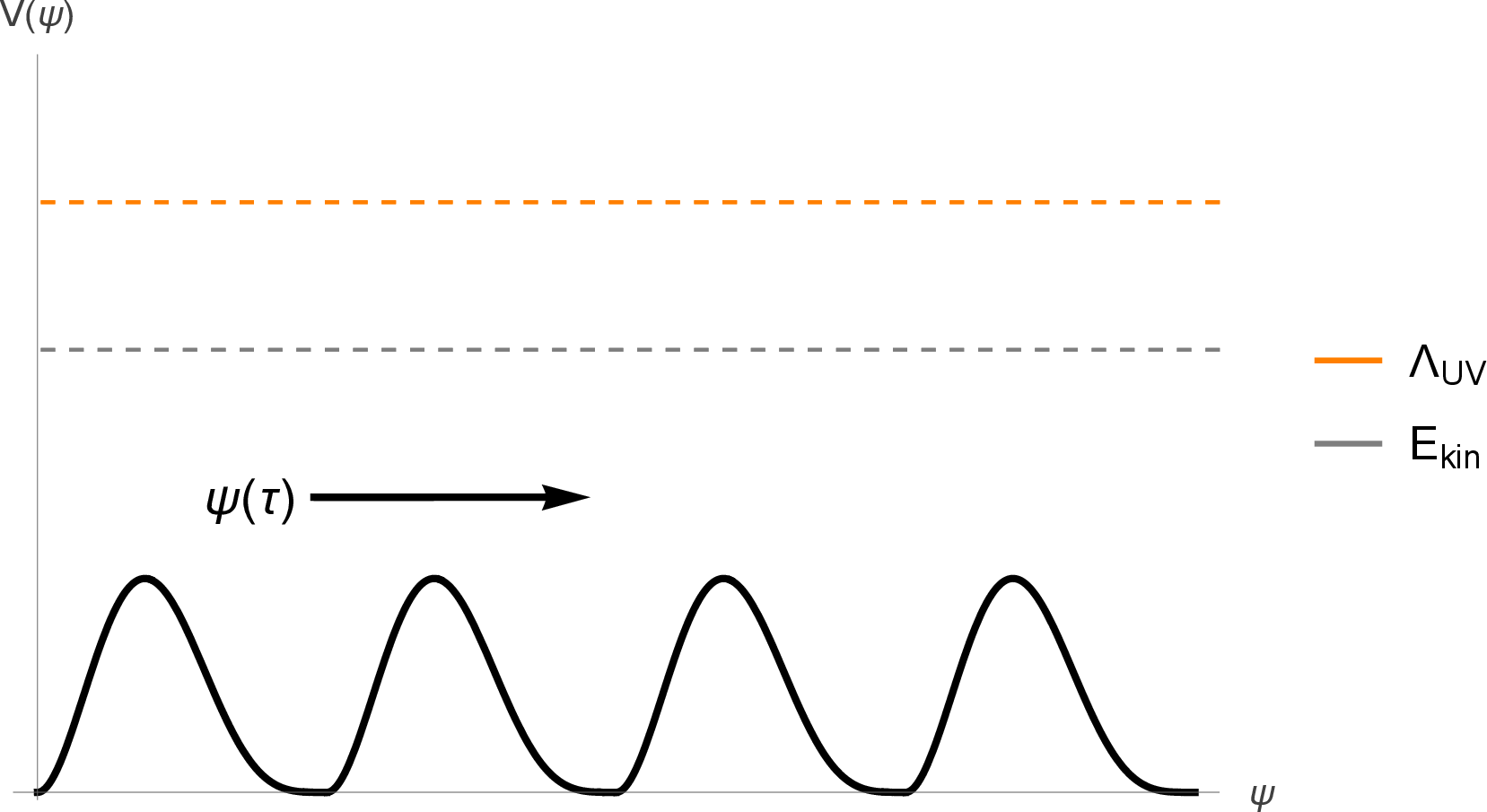
Figure 1: The KPV scalar ψ and its potential whose barriers are well below the cutoff scale ΛUV. Any kinetic energy in ψ exceeding the barrier but below the cutoff destabilizes the vacuum.
The upshot is that effective models with exponentially small superpotentials (and hence thin walls below cutoff) are dynamically unstable; the axionic scalar can roll over barriers even for sub-cutoff excitations, precluding the existence of well-localized classical vacua in the effective theory.
Theoretical and Phenomenological Implications
The requirement that thin, fundamental domain wall tensions not fall below the cutoff solidifies the proposal that quantum gravity enforces an upper limit on the realization of scale hierarchies, codifying a UV/IR connection absent in generic EFTs. Its satisfaction in classical flux vacua but tension in quantum-corrected or engineered racetrack/KKLT vacua indicates possible limitations of such constructions and new constraints for complex model building in the AdS/dS landscape.
An implication is that any scenario attempting to realize parametrically small vacuum energies with high effective UV cutoffs must integrate the associated domain wall physics at low energies, likely destabilizing the desired vacua and impacting the cosmological constant problem. For swampland analyses, the domain wall bound gives a precise, testable criterion linked to holographic and entropy bounds for quantum gravitational consistency.
Conclusion
The domain wall bound provides a precise, technically robust constraint on AdS flux vacua in string compactifications, closely associating the UV cutoff, AdS length, and the spectrum of fundamental domain walls. While satisfied in classical scale-separated vacua, it imposes strong restrictions on models trying to engineer exponential scale hierarchies (e.g., in racetrack or KKLT-like vacua), translating into a parametric lower bound on the gravitino mass and precluding the realization of arbitrarily light superpotentials. This advances the swampland program and provides a practical tool for diagnosing quantum gravitational consistency in AdS effective field theories (2603.08779).