Forecasting and Manipulating the Forecasts of Others
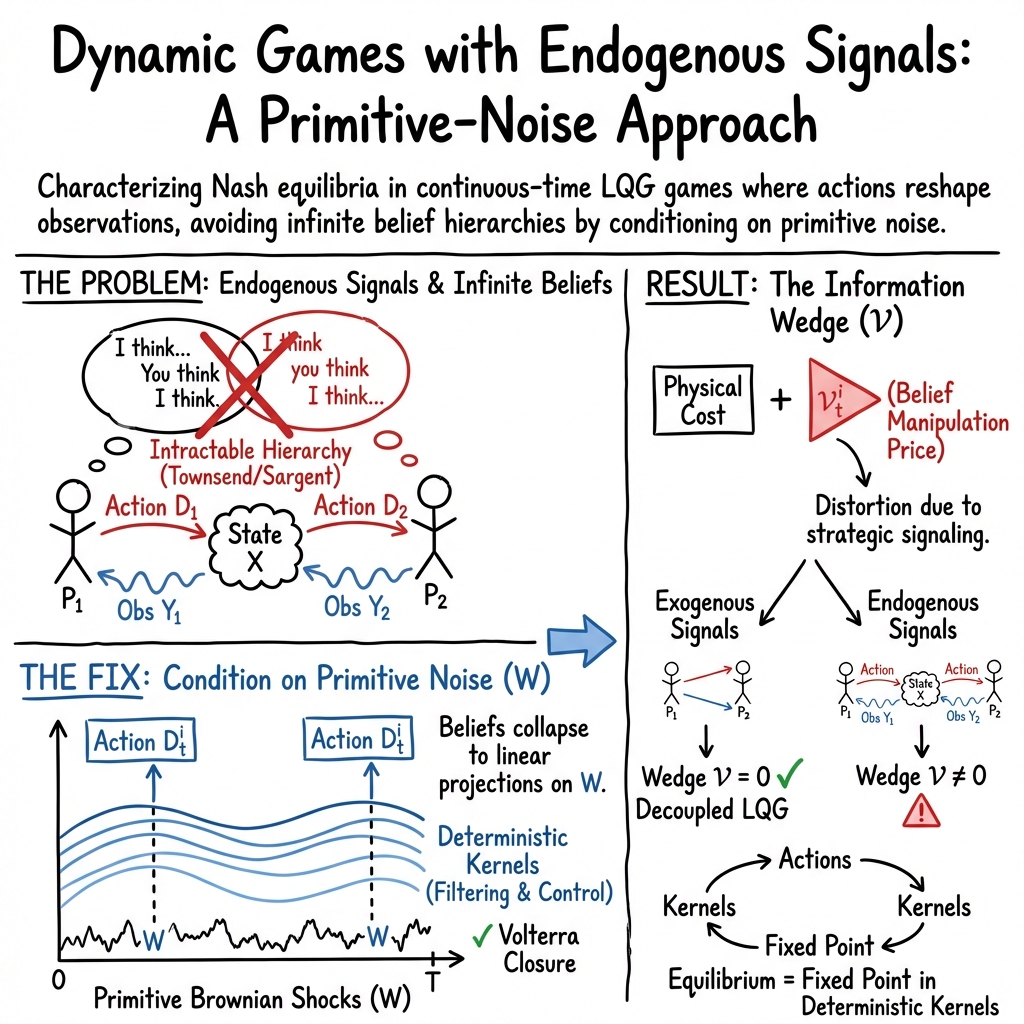
Abstract: In strategic environments with private information, evaluating a change in policy requires predicting how the equilibrium responds -- but when actions reshape opponents' signals, each agent's optimal response depends on an infinite hierarchy of beliefs about beliefs that has resisted exact analysis for four decades. We provide the first exact equilibrium characterization of finite-player continuous-time LQG games with endogenous signals. Conditioning on primitive Brownian shocks rather than the physical state -- a dynamic analogue of Harsanyi's common-prior construction -- collapses the belief hierarchy onto deterministic two-time kernels, reducing Nash equilibrium to a deterministic fixed point with no truncation and no large-population limit. The characterization yields an explicit information wedge $\mathcal{V}i_t$ -- a deterministic Volterra process -- that prices the marginal value of shifting opponents' posteriors. The wedge vanishes precisely when signals are exogenous to controls, formally delineating the boundary where strategic belief manipulation matters, and provides a closed-form mapping from information primitives to equilibrium outcomes.
Paper Prompts
Sign up for free to create and run prompts on this paper using GPT-5.
Top Community Prompts
Explain it Like I'm 14
Overview
This paper studies a tricky kind of “guessing game” where several players act over time while watching noisy clues about a hidden situation—and their actions also change the clues that others see. The main goal is to predict what everyone will do when the rules about information (like how precise signals are, or how often announcements arrive) change. The big contribution is an exact way to solve these games without approximations, even though they involve an “infinite mirror” of everyone forecasting everyone else’s forecasts.
What questions does the paper answer?
The paper asks, in simple terms:
- How can we predict what people will do when their actions not only change the world but also change what others learn about it?
- Can we collapse the “infinite chain” of beliefs-about-beliefs-about-beliefs into something we can compute exactly?
- Can we measure how much a person gains by nudging what others believe (that is, by strategically shaping others’ forecasts)?
- How do changes in information quality (like more precise reports) flow through the system to change outcomes?
How does the approach work? (Plain-language explanation)
Think of a group project where the “true progress” is hidden behind a curtain. Each teammate gets a blurry gauge (a noisy signal) of the project’s progress. Everyone also moves the project forward by acting. Here’s the twist: your actions not only change the project’s true progress, they also change what your teammates’ gauges display. So to choose your action, you need to guess the project’s true state and also guess how others are guessing, which depends on what they see, which depends on your action… That’s the infinite-mirror problem.
The paper solves this by making three simplifying, but powerful, choices:
- Linear–Quadratic–Gaussian (LQG) setting
- Linear: the system responds like a straight line (double the push, double the change).
- Quadratic: costs are like “sum of squared errors” (e.g., how far you are from a target plus effort cost).
- Gaussian: randomness is like the jittery wiggle of a “Brownian motion” (think tiny random bumps each moment).
- Focus on the source of randomness instead of the moving state
- Instead of directly tracking the hidden state (which mixes nature’s randomness and everyone’s actions), the paper tracks the underlying “primitive shocks” (the common random wiggles driving everything).
- Each player’s “noise-state” is their best running estimate of those random wiggles based on their private signals. It’s like reconstructing the dice throws that shook the room, rather than just watching the table that moved.
- Fixed recipes over time (“Volterra kernels”)
- A player’s strategy becomes a fixed, time-indexed recipe that says, “how much to react now to each past moment of the estimated random wiggles.”
- These recipes are deterministic (pre-calculated) functions of time, so the tangled belief hierarchy collapses into solving a set of deterministic equations.
- This yields two key “closure” results:
- Filtering closure: how players update their beliefs can be written exactly using fixed, two-time recipes.
- Best-response closure: the best thing to do against others using these recipes is to use the same kind of recipe yourself.
- With both closures, finding a Nash equilibrium becomes finding a fixed point in these recipes—no truncation, no large-population approximation.
What are the main findings and why do they matter?
- Exact equilibrium in a hard class of games
- The paper gives the first exact characterization of equilibria in finite-player, continuous-time LQG games where signals depend on actions (“endogenous signals”).
- This means we can predict how equilibrium changes when information policies (like disclosure precision) change—without resorting to rough approximations.
- The “information wedge”: putting a price on belief manipulation
- The paper uncovers a new object called the information wedge, written as for player i.
- Intuition: it’s a “price tag” on how valuable it is to tweak what others believe. If your action makes your opponent think the hidden situation is different, that changes how they act, which changes your future situation. The wedge measures that marginal value.
- It comes in two parts:
- Mean wedge: shifts average behavior.
- Kernel wedge: changes how players react to shocks over time.
- Crucially, the wedge is exactly zero when signals do not depend on actions (exogenous signals). That cleanly draws the line between cases where strategic belief manipulation matters and where it doesn’t.
- Clear map from information quality to outcomes
- The framework provides a closed-form mapping from “precision paths” (how accurate signals are over time) to the resulting equilibrium actions and payoffs.
- This lets a policymaker see how making reports more or less precise changes behavior—not only because people estimate the state better, but also because it changes how much they try to influence each other’s beliefs.
- Decomposing costs and optimizing attention
- The total cost for a player splits into:
- A certainty-equivalent part (what you’d pay if you saw the underlying shocks perfectly).
- An information cost (how much extra you pay because you’re estimating).
- Because the system is Gaussian and linear, the information cost is a clean, deterministic function of information precision, which means choosing how much attention/precision to buy is a standard optimization problem.
- The total cost for a player splits into:
- Special cases and extensions
- If signals are exogenous, the strategic channel disappears and the game becomes a set of independent single-agent LQG problems.
- The approach extends to risk-sensitive players and to long-run, time-homogeneous environments (where it connects to transfer functions and frequency-domain tools).
Why this matters:
- It shows precisely when and how changing the flow of information changes strategic behavior—not just via better estimates, but via the desire to steer what others believe.
- It replaces an intractable “infinite mirrors” problem with a solvable fixed-point system.
What could this change in practice?
This framework helps people who design information policies or decentralized systems:
- Central banks and public communication
- If a central bank releases more precise, faster information, firms not only react to the news—they also adjust knowing their actions will influence others’ readings. The method shows exactly how this plays out, which helps design better disclosure rules.
- Financial markets and transparency
- In trading, orders move prices, and prices inform others. The information wedge explains the strategic part of “price impact.” This can inform market design and regulation.
- Contracts and teams with hidden effort
- When several agents work on a shared project and infer each other’s effort from outcomes, their actions shape what others infer. The framework applies directly, guiding contract and incentive design.
- Robotics and multi-agent control
- When robots (or autonomous vehicles) have different sensors and their actions change what others can sense, the method gives a way to coordinate without assuming everyone shares all information.
- Research benchmarks
- The paper offers an exact solution as a benchmark to evaluate simpler approximations that cut off the belief hierarchy.
In short, the paper turns a long-standing “beliefs-about-beliefs” tangle into a concrete, computable system. It shows how to predict the effects of information policies in strategic settings and pinpoints when strategic belief manipulation matters—and by how much.
Knowledge Gaps
Knowledge gaps, limitations, and open questions
Below is a concise list of concrete gaps and unresolved questions that follow from the paper’s scope, assumptions, and results, aimed at guiding future research.
- Existence/uniqueness of equilibrium in deterministic-kernel space:
- Provide rigorous sufficient conditions (e.g., stabilizability/detectability bounds on , lower bounds on , and regularity of precision paths ) that guarantee the best-response operator is a contraction and admits a unique fixed point in the space of deterministic two-time kernels.
- Establish whether the Picard iteration used numerically is globally convergent, locally convergent, or requires damping/relaxation, and derive explicit convergence rates.
- Completeness of the equilibrium class:
- Determine whether equilibria exist outside the noise-state Volterra/deterministic-kernel class; either furnish a non-existence proof (closure of best responses implying closure of equilibria) or construct counterexamples that exploit non-Volterra or stochastic-kernel strategies.
- Multiplicity and selection:
- Characterize conditions under which multiple kernel fixed points (equilibria) arise, and develop selection criteria (e.g., stability to perturbations, minimal information cost, limiting procedures).
- Infinite-horizon theory and frequency-domain characterization:
- Formalize the infinite-horizon limit: prove existence of stationary equilibria, identify conditions for convolution-kernel (time-invariant) reduction, and establish when transfer functions are rational (yielding finite-dimensional state-space sufficiency).
- Derive stability conditions for stationary equilibria (e.g., spectral radius or pole constraints) and long-run variance/energy bounds for kernels.
- Endogenous precision as a strategic game:
- Extend Corollary P_closure (best-response precision is deterministic) to a full game in precision paths : characterize existence/uniqueness of Nash equilibria in attention/precision, provide comparative statics, and analyze efficiency and mechanism design implications.
- Analyze joint determination of for all players (equilibrium in controls and precisions), not only best-response given others.
- Risk-sensitive extension:
- Provide a complete equilibrium characterization (existence, uniqueness, and computational scheme) for the risk-sensitive case, including how risk aversion () deforms the information wedge and the backward kernel system.
- Quantify when risk sensitivity breaks separation strongly enough to alter qualitative comparative statics from the risk-neutral benchmark.
- Beyond LQG: structural robustness and generalization:
- Assess which parts of the closure survive modest departures from linear–Gaussian–quadratic (e.g., affine controls with sub-Gaussian noise, quadratic costs with mild nonlinear dynamics, or linear dynamics with non-Gaussian but elliptically symmetric shocks).
- Develop controlled approximations (e.g., projection onto deterministic kernels) and error bounds when primitives deviate from LQG.
- Constraints and nonconvexities:
- Incorporate control/state constraints (saturation, inequality constraints, budgets) and analyze whether best responses remain Volterra and whether convexity (ensuring global optimality of the maximum-principle FOC) is retained.
- Consider cross-player control couplings in costs (off-diagonal terms in ) and their impact on the adjoint system and wedge.
- Correlated observation noises and common shocks:
- Although a footnote claims extension to general and correlated observation noises, provide full proofs of filtering closure and best-response closure with cross-player observation-noise correlations and time-varying , clarifying how the primitive Brownian drivers and block selectors are constructed in that setting.
- Sensitivity and comparative statics of the information wedge:
- Derive analytical bounds/asymptotics for the mean and kernel components of the wedge as functions of precision , horizon , and cost parameters (e.g., ).
- Characterize limits and transition regimes (e.g., and ), and quantify how small endogenous-signal feedbacks perturb the wedge from zero.
- Numerical analysis and scalability:
- Provide discretization error bounds and stability analysis for the kernel PDE/Volterra system (especially near the causal diagonal where kernels become singular over long horizons).
- Develop scalable solvers for large and high-dimensional (e.g., low-rank kernel factorizations, operator preconditioning, FFT-based convolution for time-homogeneous cases), and assess computational complexity.
- Propose regularization schemes to handle kernel singularities and validate their impact on equilibrium accuracy.
- Identification and empirical relevance:
- Establish conditions under which the information wedge and key kernels are identifiable from observed time series of actions/signals, and design estimation procedures (e.g., GMM or likelihood-based) that recover wedge and precision paths from data.
- Robustness and misspecification:
- Analyze equilibrium under model uncertainty (e.g., wrong , or opponents’ precision paths), and extend to robust-control settings (ambiguity aversion) to understand how misspecification alters the wedge and strategies.
- Asynchrony, delays, and discrete sampling:
- Extend the framework to delayed/asynchronous observations or discrete-time sampling (hybrid time), re-derive the filtering closure, and characterize how delays reshape the wedge and fixed point.
- Heterogeneity and networks:
- Examine heterogeneous costs, observation structures, and networked couplings in dynamics or signals (e.g., with sparse interconnections), and characterize how network topology influences wedges and equilibrium.
- Connection to other solution concepts:
- Relate the noise-state characterization to common-information approaches: can the information wedge be represented as a coordinator’s adjoint? Under what conditions do the two coincide or differ?
- Compare to mean-field limits rigorously: quantify the rate at which vanishes as under scaling regimes, and delineate finite- corrections.
- Policy and design applications:
- Leverage the explicit mapping “precision → wedge → outcomes” to solve dynamic information-design problems (e.g., optimal public disclosure policies), deriving implementable first-order conditions and tractable constraints for regulators.
- Boundary behavior and stability of dynamics:
- Provide conditions ensuring closed-loop stability under equilibrium controls (boundedness of moments), and analyze bifurcations or instability when feedback through signals is strong.
- Microstructure and contract-theory embeddings:
- In the Kyle–Back and multi-agent moral-hazard embeddings mentioned, deliver explicit kernel characterizations and comparative statics, and benchmark against canonical results to quantify the added value of the wedge-based analysis.
Collections
Sign up for free to add this paper to one or more collections.

