Phenomenology of an Open Effective Field Theory of Dark Energy
Published 12 Mar 2026 in astro-ph.CO | (2603.12321v1)
Abstract: All observational evidence for dark matter and dark energy is so far exclusively gravitational. Hence, the dark sector may be equivalently described by a theory of the spacetime metric whose dynamics is affected by interactions with an unknown environment. Adapting open-system techniques, we have recently constructed such a general theory of open gravitational dynamics. Here we study a minimal and concrete realization of this theory that describes the late-time acceleration of the Universe. Our model provides a good fit to recent baryon acoustic oscillation measurements by construction, while avoiding violations of the null energy condition. Moreover, it leads to a set of correlated and observationally testable predictions. Studying the modified cosmological perturbation theory and compared to the $Λ$CDM model we find: a dissipative suppression of the gravitational-wave luminosity distance relative to the electromagnetic one; a modification in the evolution of the Bardeen potentials with a clear signal in the gravitational slip; and an enhancement of structure formation at low redshift. We present semi-analytical estimates of the magnitude of these effects and show that they lie within the reach of current constraints while providing clear targets for upcoming cosmological surveys.
The paper introduces an Open Effective Field Theory for dark energy, combining dissipative dynamics with gravitational-environment couplings.
It employs the Schwinger–Keldysh formalism to modify cosmic expansion and gravitational wave propagation, achieving late-time acceleration without violating stability criteria.
The model predicts distinctive signatures in gravitational slip and enhanced structure formation, offering testable targets for upcoming surveys and multi-messenger astronomy.
Phenomenology of an Open Effective Field Theory of Dark Energy
Introduction: Motivation and Novelty
The work systematically develops the phenomenology of dark energy and the late-time acceleration of the universe within a controlled example of Open Effective Field Theory (Open EFT) for gravity (2603.12321). Traditional approaches model dark energy as a perfect-fluid component with possible phantom violations and/or explicit couplings between dark and visible sectors. In contrast, this framework considers the gravitational sector as coupled to an unspecified environment—interpreted as the dark sector—using Schwinger-Keldysh machinery to construct a consistent open-system dynamics, thus generalizing the standard EFT of Inflation and dark energy.
Strong motivation arises from the recent baryon acoustic oscillations (BAO) data, which, under the assumption of separate conservation of dark matter and dark energy, favor an apparent violation of the null energy condition, in tension with theoretical stability. This motivates formalisms in which energy-momentum is not strictly conserved sector by sector, leading naturally to open-system descriptions. The Open EFT model discussed avoids instability, matches the expansion history, and further predicts correlated signatures in gravitational wave propagation, gravitational slip, and structure formation—offering distinctive observational targets.
Construction of the Open EFT and Its Background Cosmology
The theory is anchored in the Schwinger–Keldysh formalism, involving two copies of the spacetime metric, gμν and an auxiliary aμν, to encode dissipative effects. The minimal model retains the universal sector of the EFT of Inflation and Dark Energy, and includes a first-derivative dissipative operator, parameterized by a time-dependent function Γ(t). The effective action in unitary gauge has the form
Seff=∫d4x−g[…+Γ(t)κμνaμν+…],
where Γ modulates dissipation/anti-dissipation, and κμν encodes the extrinsic geometry. For the homogeneous FLRW background, the first Friedmann equation remains unchanged, but the acceleration equation acquires a dissipative correction:
3H2=ρ,H˙=−21(ρ+p)−ΓH.
This modification implies that late-time cosmic acceleration can be achieved for p≃0 when Γ<−H/2, without requiring a cosmological constant or phantom equation of state. The energy-momentum conservation law is non-standard:
ρ˙+3H(ρ+p)=−2Γρ,
mirroring a bulk viscosity or anti-friction interpretation, and is solved analytically to match the BAO and CMB-favored CPL parametrization. The model fits the observed expansion history without artificial sector partitioning or phantom instability.
Gravitational Wave Phenomenology
One of the sharp, model-independent consequences is a modification of GW propagation. The GW amplitude equation picks up an extra friction term proportional to Γ,
γ¨ij+(3H+Γ)γ˙ij+k2/a2γij=0,
resulting in a distance-redshift relation for standard sirens (dLgw(z)) distinct from the photon-based luminosity distance (dLem(z)):
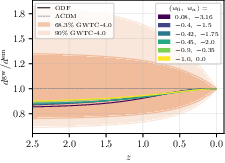
The predicted deviation, evaluated across the BAO+CMB-favored w0–wa parameter region, is consistent with current LIGO/Virgo/KAGRA bounds, but lies well within the forecasted sensitivity of next-generation GW observatories.
Figure 2: Gravitational wave luminosity distance predicted by the ODF model for (w0,wa) in the allowed BAO+CMB region compared with GWTC-4 constraints.
Cosmological Perturbations: Gravitational Slip and Structure Formation
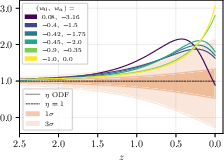
The analysis of scalar perturbations unveils several corollaries of open-system dynamics. Relative to ΛCDM, the two Bardeen potentials, Φ and Ψ, evolve differently, generating a nontrivial gravitational slip parameterη(z)≡Φ(z)/Ψ(z). The Schwinger–Keldysh structure guarantees gauge consistency and ensures stability for a wide range of dissipative operators.
Figure 1: Gravitational slip η(z) predicted by the ODF model versus BAO+CMB constraints; the dashed line gives ΛCDM (η=1).
The slip parameter robustly deviates from unity, making it a discriminant observable for surveys such as DESI and Euclid. The model sits near the current 3σ constraints for slip measurements derived from galaxy clustering and weak lensing.
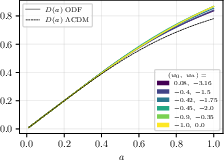
The growth history, which controls the matter power spectrum and σ8, is also explicitly modified. The baryon growth factor D(a), solution to the linearized Newtonian equation with the open EFT potential, features an enhancement of structure formation at low redshift with respect to ΛCDM—an unambiguous, testable prediction of open-sector dissipation.
Figure 5: Growth factor D(a) in the ODF scenario as compared to ΛCDM.
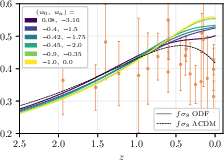
For realistic cosmological parameters, the amplitude at a=1 is increased by 7–11%, which significantly impacts the consistency of the model with fσ8 constraints from large-scale structure.
Figure 3: Predicted fσ8 in the ODF framework and ΛCDM, overlaid with observational data.
Implications, Limitations, and Future Directions
By postulating that all cosmic acceleration signatures are emergent properties of the open, dissipative metric dynamics, the Open EFT formalism reframes dark energy as a manifestation of gravitational-environment coupling rather than a separate fluid. This has several implications:
Model-agnostic signatures: The correlated predictions for dLgw(z), gravitational slip, and enhanced growth contradict the sector-by-sector decomposition of ΛCDM-like models and provide a falsifiable (not just parameter-fit) scenario.
Null Energy Condition and stability: The acceleration mechanism is achieved without crossing the w=−1 boundary for the true effective equation of state, ensuring theoretical stability.
Compatibility and tension with data: While background expansion is matched to BAO and CMB, the model yields an excess in present-day structure amplitude, placing this minimal realization outside the strictly allowed region—indicating that either further model (e.g., stochastic noise, additional operator content) or baryonic effects need to be incorporated for a fully viable scenario.
Links with GW astronomy: The magnitude and sign of the GW luminosity distance modification provide a concrete target for future multi-messenger programs, and a direct diagnostic for the nature of IR modifications of gravity.
Conclusion
This work delivers a first comprehensive, predictive framework for dark energy and cosmic acceleration deriving from open effective gravitational dynamics. The construction is theoretically robust—respecting unitarity, stability, and gauge invariance—and phenomenologically falsifiable via correlated departures from ΛCDM in the GW, weak lensing, and LSS data. The framework shifts the theoretical landscape towards environmental, open-system descriptions, connecting recent advances in non-equilibrium QFT with cosmological tests of gravity. Extensions with additional operator classes and stochastic source terms may reconcile the theory with current structure growth constraints, and the predictions outlined provide a clear target for near-future observational programs.