Formalization of QFT
Abstract: A foundational result in constructive quantum field theory is the construction of the free bosonic quantum field theory in four-dimensional Euclidean spacetime and the proof that it satisfies the Glimm-Jaffe axioms, a variant of the Osterwalder-Schrader axioms. We present a formalization of this result in the Lean 4 interactive theorem prover. The project is intended as a proof of concept that extended arguments in mathematical physics can be translated into machine-checked proofs using existing AI tools. We begin by introducing interactive theorem proving and constructive quantum field theory, then describe our formalization and the design decisions that shaped it. We also explain the methods we used, including coding assistants, and conclude by considering how AI assisted formalization may influence the future of theoretical physics. Our original release assumed three results, Minlos' theorem, the nuclear property of Schwartz space, and Goursat's theorem. In subsequent releases from our group and from contributors from the Lean community, these assumptions have been proven (or avoided), so that the OS/GJ axioms are now proven using only Lean and its library Mathlib.
Paper Prompts
Sign up for free to create and run prompts on this paper using GPT-5.
Top Community Prompts
Explain it Like I'm 14
What this paper is about
This paper shows that a very careful, computer-checked version of a basic quantum field theory can be done today. The authors use a proof-checking program called Lean to build and verify the “free” (non-interacting) scalar quantum field in four-dimensional space and check that it satisfies a standard list of rules (axioms) known as the Osterwalder–Schrader/Glimm–Jaffe (OS/GJ) axioms. They also explain how modern AI coding assistants helped them, and why this matters for the future of physics and math.
What questions the authors asked
In simple terms, they set out to answer:
- Can we translate a real piece of theoretical physics into a form a computer can check step-by-step?
- Can we rigorously construct a basic quantum field (the free scalar field) and prove it satisfies the key rules that make it a genuine quantum theory?
- Can today’s tools—Lean plus AI coding assistants—handle long, technical physics arguments?
- If we rely on a few big theorems at first, can those later be fully proved inside Lean so the whole construction is “axiom-free”?
How they did it
Think of this like building with LEGO using very strict instructions:
- Formalization: Instead of writing informal math, the authors write every definition and step in Lean, a “proof assistant” that only accepts correct logical moves. It’s like a super-picky math spellchecker that won’t let you skip steps.
- AI assistance: They used AI coding helpers to write and organize Lean code faster, especially as these tools improved during the project.
On the physics side, they constructed the free scalar field in “Euclidean” space (where time behaves like another space direction—this often makes things easier to define). Here’s the core idea in everyday language:
- The field as random ripples: A free field is like a sea of tiny, independent ripples. Mathematically, this is a special kind of “Gaussian” randomness (like bell-curve noise), but spread over every point in space.
- The generating functional: Instead of handling all possible measurements separately, they use one “summary function” that encodes every correlation and average you might want. You can think of it as a compact “statistics box” for the field.
- Existence of the Gaussian measure (Minlos’ theorem): In ordinary life, we know how to define a bell curve for one or a few variables. Here, there are infinitely many variables (one for each point in space), so it’s not obvious the “infinite bell curve” really exists. Minlos’ theorem is a big mathematical result that says, under the right conditions, it does. The authors first relied on this theorem and some technical properties (like the “nuclear” property of Schwartz space) to set everything up, then later integrated full Lean proofs so they no longer needed to assume them.
Finally, they verified the OS/GJ axioms—these are the rules that guarantee your Euclidean model really comes from a sensible quantum theory. In friendly terms:
- Analyticity and regularity: The summary function behaves smoothly and predictably when you tweak inputs.
- Euclidean symmetry: The theory looks the same if you shift, rotate, or reflect space.
- Reflection positivity: A “mirror test” that ensures the Euclidean model can be turned back into a true quantum theory with positive probabilities.
- Ergodicity/clustering: If you shift things very far in time, correlations fade—like stirring soup until it all tastes the same everywhere—matching the idea of a unique vacuum state.
What they found and why it matters
Here are the main results:
- They built and machine-checked the free massive scalar quantum field in 4D Euclidean space in Lean, following a classic framework (Glimm–Jaffe).
- They proved this model satisfies the OS/GJ axioms, which is the gateway to reconstructing a genuine quantum theory.
- At first, they assumed three big results (Minlos’ theorem, the nuclear property of Schwartz space, and Goursat’s theorem). Then, with help from their group and the Lean community, these were proved (or avoided) inside Lean/Mathlib. That means the whole construction can now be done without extra assumptions—just Lean and its math library.
- They shared their code publicly, showing that this kind of project is feasible today and getting easier as AI tools improve.
This is important because it proves that formal, computer-verified physics at a research level is practical—not just in pure math. It’s a proof of concept that long, technical arguments in mathematical physics can be machine-checked, increasing confidence and reducing hidden mistakes.
Why this work could be a big deal
- Reliability and clarity: Computer-checked proofs reduce ambiguity and catch gaps, giving the community more trust in complex results.
- Reuse and collaboration: Once formalized, definitions and theorems can be reused by others, speeding future work—like reusable code.
- A path toward harder theories: The free field is a basic building block. This success suggests we can tackle next steps: reconstruction theorems, free fermions, and eventually interacting theories in lower dimensions—stepping stones toward big open problems (like the Yang–Mills mass gap).
- AI + theorem proving: As AI coding assistants and auto-formalization improve, much larger parts of physics and math might be formalized and verified, helping researchers move faster without sacrificing rigor.
In short, this paper shows that the combination of Lean and modern AI tools can bring rigorous, computer-checked methods into theoretical physics—starting with a foundational example—and that the momentum is on the side of making far more ambitious projects possible soon.
Knowledge Gaps
Knowledge gaps, limitations, and open questions
Below is a focused list of concrete gaps and open problems that remain after this work, formulated so they can directly guide follow‑up research and formalization efforts.
- OS reconstruction in Lean (Euclidean → Minkowski): Provide a machine-checked proof of the corrected Osterwalder–Schrader reconstruction theorem (including the 1975 growth/temperedness hypothesis), explicitly constructing the Hilbert space via reflection positivity, the time-translation semigroup and its self-adjoint generator, operator-valued fields, and verifying the full Wightman axioms (spectral condition, locality, Lorentz covariance). Extend to proving CPT and spin–statistics within Lean.
- Equivalence of OS4 variants to Glimm–Jaffe’s ergodicity: The paper uses OS4 in an L2 form on the algebra A of exponential functionals and argues (informally) that it implies the L1 ergodicity axiom for all L1(μ) functions used by Glimm–Jaffe. Provide a fully formal Lean proof: (i) density of A in L1(μ), and (ii) that the L2-mean ergodic convergence implies L1 convergence on the constructed probability space.
- Bridge from Schwartz-based to compact-support-based axioms: The formalization is done on Schwartz test functions S(ℝD) and tempered distributions S′(ℝD). Develop Lean proofs that the Glimm–Jaffe axioms stated with D(ℝD), D′(ℝD) follow (including the required nuclearity and continuity arguments) and formalize the precise equivalence of the two formulations.
- Dimensional generality: The formalization is specialized to D=4. Generalize the construction and OS axioms verification to arbitrary D≥2 within Lean, making explicit the dimension-dependent steps (e.g., covariance regularity, reflection positivity proofs).
- Massless free field (m=0): Construct the Gaussian measure for the massless theory in ℝ4 and formalize strategies to resolve IR issues (e.g., quotienting constants, finite-volume limits, modified test spaces), then verify OS0–OS4 and (if possible) reconstruction.
- Alternative “mode-expansion” construction: Implement in Lean the diagonalization/Laplacian-eigenfunction construction of the GFF as a countable sum of independent Gaussians and prove its equivalence to the Minlos-based construction (including measurability and convergence issues).
- Analytic continuation machinery: Formalize the analytic continuation from Schwinger functions to Wightman distributions in Lean, including edge-of-the-wedge-type arguments, growth/temperedness estimates, and verification of the spectral condition.
- Free fermions: Develop Lean libraries for CAR algebras, spinor covariances, and reflection positivity adapted to fermions (including treatment of gamma matrices and spin structures) and construct free fermionic Euclidean fields satisfying the OS/GJ axioms.
- Operator-theoretic foundations: Build out Lean’s libraries for unbounded operators, self-adjointness, Stone’s theorem, spectral measures, and semigroup theory sufficient to carry Minkowski-space constructions and the Wightman framework.
- Connections between frameworks: Formalize reconstruction equivalences for the free field between (i) Glimm–Jaffe/OS Euclidean measures, (ii) Wightman distributions, and (iii) Haag–Kastler nets (including locality, isotony, covariance, and Haag duality), entirely within Lean.
- Curved backgrounds and manifolds: Extend the GFF construction to Riemannian manifolds M (e.g., using nuclear test spaces on M), prove isometry invariance and reflection positivity in appropriate settings, and examine OS axioms and reconstruction on manifolds.
- Boundaries and thermal states: Formalize GFF with boundary conditions (Dirichlet/Neumann) on domains and at finite temperature (KMS states on S¹×ℝ³); prove reflection positivity for the relevant time reflections and verify clustering/ergodicity.
- Short-distance structure and OS1: Provide machine-checked proofs of the local integrability and singular structure of the two-point function S₂(x,y) in ℝ⁴, quantify OS1 with explicit constants, and verify the precise regularity/growth bounds needed for reconstruction.
- Quantitative clustering: Establish in Lean polynomial (or exponential) clustering bounds for the free field (OS4PolynomialClustering) with explicit decay rates, and prove consequences for uniqueness of the vacuum and spectral gaps in the reconstructed theory.
- Robustness under covariance variations: Characterize and formalize the class of positive-definite covariances (masses, regulators, boundary conditions) for which the construction and OS axioms hold; prove stability under removal of UV/IR regulators and under weak convergence of covariances.
- Interacting low-dimensional models: Begin machine-checked constructions of P(φ)₂ and φ³₄ in Lean (Wick ordering, counterterms, cluster expansions), verify OS axioms, and (where applicable) perform reconstruction to Minkowski.
- Stochastic quantization: Formalize singular SPDE approaches (e.g., Φ⁴₃) using regularity structures/paracontrolled calculus in Lean and prove that invariant measures satisfy OS/GJ axioms; connect the SPDE stationary measure to the Euclidean field measure.
- Lattice-to-continuum pipeline: Formalize lattice reflection positivity (Wilson action), cluster expansions, and continuum limits for Abelian 4D gauge theories in Lean; identify the operator-algebraic and measure-theoretic pieces needed for non-Abelian extensions.
- Gauge theories and BRST: Develop Lean formalizations for (i) 2D/3D Yang–Mills via stochastic quantization, (ii) gauge fixing and BRST/ghost formalisms, and (iii) reflection positivity in gauge-invariant settings; chart a path to the 4D continuum limit.
- Automation for algebraic/analytic manipulations: Address Lean’s current limitations for long Fourier-analytic and distributional calculations by creating domain-specific tactics and rewrite systems tailored to QFT proofs (covariance manipulations, positivity checks, convolution identities).
- Library consolidation and reuse: Integrate core components (Bochner, Minlos, nuclearity, Gaussian random distributions, covariance analysis) into Mathlib/PhysLean with documented interfaces to reduce reliance on external repositories and to support future QFT formalizations at scale.
- Autoformalization benchmarks for physics: Create curated benchmarks and pipelines to translate physics-style derivations (Gaussian integrals, Wick’s theorem, covariance identities) into verified Lean code, enabling faster, more reliable formalization of future QFT results.
Practical Applications
Immediate Applications
The formal, machine-checked construction of the 4D Euclidean free bosonic QFT (satisfying the Glimm–Jaffe/OS axioms) in Lean 4—together with axiom-free formalizations of Minlos’ and Bochner’s theorems and the nuclearity of Schwartz space—enables several deployable workflows and tools across research and engineering.
- Reproducible, proof-checked physics artifacts
- Use case: Add a “proof CI” step to research code and preprints that checks the formal QFT foundations (Gaussian free fields, reflection positivity, clustering) for results relying on these components.
- Sector: Academia, scientific publishing, open science infrastructure.
- Tools/workflows:
- GitHub/GitLab Actions that build and run Lean proofs (pin Mathlib versions; use the OSforGFF/gaussian-field/bochner repos).
- “Proof bundles” accompanying arXiv submissions (source + proof scripts + commit hashes).
- Assumptions/dependencies:
- Teams need basic Lean skills and access to Mathlib.
- Scope is limited to the covered formalized results (free fields, Gaussian measures, OS axioms variants).
- Verified building blocks for stochastic modeling (Gaussian measures and kernels)
- Use case: Certify that kernels and characteristic functionals used in Gaussian process models are positive-definite (via Bochner) and correspond to valid probability measures on distribution spaces (via Minlos).
- Sector: Software, finance, ML/AI, geostatistics, signal processing.
- Tools/workflows:
- “Kernel checker” service exposing Lean-backed PD certification for custom kernels (e.g., before deploying GP models).
- Integration hooks for Python/R stacks via an API that returns proofs/diagnostics.
- Assumptions/dependencies:
- Interop bridges between Lean and data-science languages (via HTTP/FFI) must be configured.
- Coverage currently best for classical kernels; nonstandard constructions may require additional formalization.
- Education modules for rigorous QFT, probability, and functional analysis
- Use case: Graduate-level courses using Lean notebooks to teach OS/GJ axioms, reflection positivity, and Gaussian fields with automatically verified solutions.
- Sector: Higher education.
- Tools/workflows:
- Course “starter kits” with exercises, CI, and minimal Lean scaffolding.
- Auto-graded assignments leveraging the existing formalization.
- Assumptions/dependencies:
- Instructor familiarity with Lean; student onboarding time.
- Institutional willingness to adopt proof assistants in curriculum.
- Benchmarks and training data for AI-for-theorem-proving (AITP)
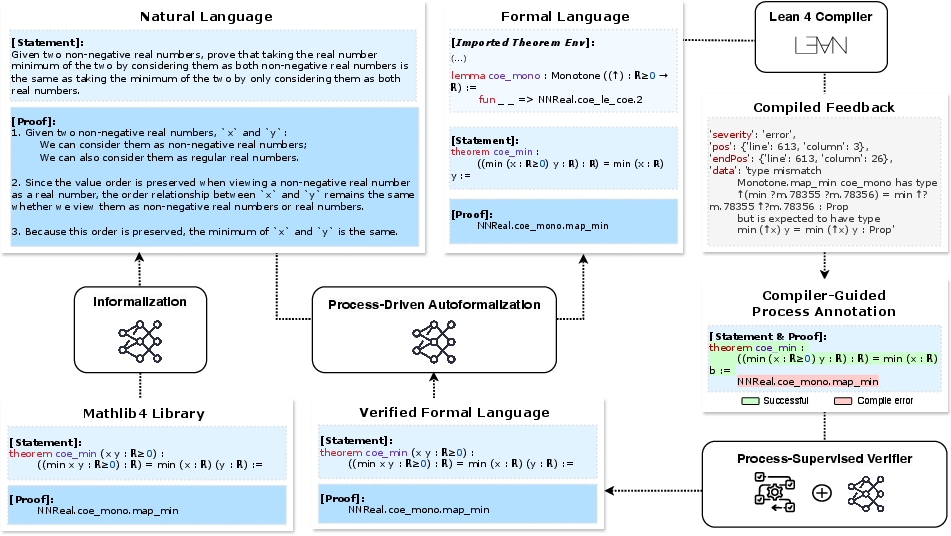
- Use case: Use OSforGFF and related repos as curated corpora for autoformalization and RL-based proof-search systems (e.g., MCP-connected agents, AlphaProof-like pipelines).
- Sector: AI/ML research, formal methods.
- Tools/workflows:
- Process-driven autoformalization datasets (statements + verified Lean code + failure modes).
- Agentic workflows that receive compiler/process feedback via MCP.
- Assumptions/dependencies:
- Proper licensing/attribution of datasets.
- Stable Lean/Mathlib versions for reproducibility.
- Cross-verification with stochastic processes and SDE formalizations
- Use case: Combine the Brownian-motion/Kolmogorov-extension formalizations with Gaussian-field results to validate constructions involving generalized random fields and continuum limits.
- Sector: Mathematical software, probability, quantitative finance.
- Tools/workflows:
- Shared library modules (measures on distribution spaces, characteristic functionals, nuclear spaces).
- Assumptions/dependencies:
- Coordination on naming and module boundaries across repos.
- Performance and maintainability of larger composite proofs.
- Journal and grant pilot programs for proof-carrying research
- Use case: Editors and funders invite/require a formal verification supplement for specific classes of results (e.g., axiomatic foundations, positivity, invariance).
- Sector: Policy for science, research administration, publishing.
- Tools/workflows:
- Submission checklists and CI templates; reviewer access to proof artifacts.
- Assumptions/dependencies:
- Community norms; reviewer training; feasibility limited to currently formalized scope.
Long-Term Applications
As Lean libraries expand (Hilbert space operators, spectral theory, complex analysis), autoformalization improves, and more physics is formalized (fermions, interactions, reconstruction theorems), the following higher-impact applications come into reach.
- End-to-end verified QFT pipelines (Euclidean → Minkowski reconstruction; interacting models)
- Use case: Machine-checked derivations from Euclidean measures satisfying OS/GJ axioms to Wightman theories (CPT, spin-statistics), then to physically testable predictions.
- Sector: Academia, national labs, high-energy theory.
- Tools/products:
- A “Formal QFT Stack” covering OS reconstruction, operator algebras, spectral properties, and scattering.
- Assumptions/dependencies:
- Formalization of the full OS reconstruction theorem; stronger operator/functional analysis in Mathlib; significant engineering effort.
- Proof-carrying lattice-to-continuum workflows for gauge theories
- Use case: Verified reflection positivity, clustering, and continuum limits from lattice Yang–Mills; reproducible arguments for confinement and mass gap in appropriate settings.
- Sector: HPC, defense, energy (plasma physics), national labs.
- Tools/products:
- “Proof-carrying numerics” combining symbolic Lean proofs for structural steps with validated numerical estimates and computer-assisted bounds.
- Assumptions/dependencies:
- Formal operator-algebra tools, RG frameworks, and robust formal treatments of reflection positivity for gauge variables; performance at scale.
- Regulatory standards for reproducibility with formal verification
- Use case: Agencies and journals adopt policies that require formal artifacts for foundational theoretical claims or high-consequence models (e.g., climate components, nuclear/plasma simulations).
- Sector: Policy, government, safety-critical science.
- Tools/products:
- Compliance templates, auditing tools, and repositories for formal proofs tied to model releases.
- Assumptions/dependencies:
- Community buy-in; cost-benefit alignment; workforce training.
- Verified kernel and stochastic model libraries in production ML
- Use case: Guarantee that custom kernels in Gaussian processes (and related models) satisfy positive-definiteness and correspond to legitimate stochastic processes, preventing silent model failures.
- Sector: Healthcare (Bayesian optimization in drug discovery), finance (risk models), industrial engineering (Bayesian calibration).
- Tools/products:
- “Proof-backed kernel registries” integrated with mainstream ML frameworks; SDKs that ship with certified families of kernels/covariances.
- Assumptions/dependencies:
- Mature Lean–Python/Java interop; performant proof checking for deployment workflows.
- Proof-aware scientific notebooks and IDEs
- Use case: Seamless co-development of derivations, code, and proofs (e.g., Jupyter-like frontends with Lean panes that validate derivation steps and axioms).
- Sector: Software, academia, industry R&D.
- Tools/products:
- IDE plugins integrating MCP-based theorem-proving agents, process-driven autoformalization, and CI hooks.
- Assumptions/dependencies:
- Stable APIs, user-friendly UX, and fast feedback loops; continued advances in AITP.
- Verified quantum software and operator algebra stacks
- Use case: Formal verification of operator identities, spectral gaps, and quantum algorithm analyses using a mature Lean library of Hilbert space operators and C*-algebras.
- Sector: Quantum computing, cryptography, condensed matter.
- Tools/products:
- Libraries for verified spectral analysis, Trotterization bounds, and operator inequalities.
- Assumptions/dependencies:
- Significant expansions of Mathlib in operator theory and functional analysis; domain-specific formalizations.
- Expanded formal physics curriculum and MOOCs at scale
- Use case: Worldwide programs teaching modern mathematical physics with machine-checked problem sets and projects (QFT, probability, stochastic PDEs).
- Sector: Education, edtech.
- Tools/products:
- Modular courseware, cloud-based proof servers, and interactive textbooks with embedded verification.
- Assumptions/dependencies:
- Instructor adoption; scalable infrastructure; localization and accessibility.
- AI copilots for physics that produce proof-carrying results
- Use case: LLM agents that write both the physics derivation and the corresponding Lean proof, enabling safe deployment of AI-generated theory in research pipelines.
- Sector: AI/ML, research automation.
- Tools/products:
- Agent frameworks with MCP connectors, Lean-native planning, and error-driven refinement loops.
- Assumptions/dependencies:
- Further gains in autoformalization reliability; robust process supervision and verification.
Notes on feasibility and dependencies across applications:
- Library coverage: Current strengths include measure theory, probability, and nuclear spaces; gaps remain in operator algebras, spectral theory, and complex analysis for CFT.
- Model scope: Present formalization targets the 4D free bosonic Euclidean theory; extensions to fermions, interactions, and reconstruction require substantial new formal proof development.
- Tooling maturity: MCP-based agent workflows and RL proof search are promising but still evolving; performance and stability will determine adoption in production pipelines.
- Community and policy: Success of policy-oriented applications depends on norms, incentives, and training for reviewers and researchers.
Glossary
- Analyticity: A function property meaning it is complex-differentiable (holomorphic) in its variables. Example: "OS0: Analyticity- The functional is analytic."
- Area law: In lattice gauge theory, the scaling of Wilson loop expectation values with the area they enclose, indicative of confinement. Example: "exhibit a mass gap and area law"
- Bochner theorem: A result characterizing when a function is the Fourier transform of a positive measure (often used with positive-definite functions). Example: "proofs of the Bochner and Minlos theorems,"
- Borel probability measure: A probability measure defined on the Borel σ-algebra of a topological space. Example: "there exists a unique Borel probability measure on "
- C* operator algebra: A Banach algebra of operators with an involution satisfying the C* identity, used to model observables in algebraic QFT. Example: "the second in terms of operator algebras."
- Characteristic functional: The Fourier transform of a probability measure on a topological vector space; it determines the measure. Example: "a canonical Gaussian characteristic functional on a nuclear space of test functions."
- Cluster expansion: A series expansion technique in statistical mechanics/gauge theory to analyze correlations at strong coupling. Example: "a simple cluster expansion argument shows that at very strong coupling, lattice Yang--Mills theories exhibit a mass gap and area law"
- Conformal block: A building block of CFT correlators capturing contributions of primary operators and descendants. Example: "conformal-block decomposition"
- Conformal field theory (CFT): A quantum field theory invariant under conformal transformations. Example: "In conformal field theory (CFT)"
- Continuum limit: The limit where lattice spacing goes to zero, recovering a continuum QFT from a lattice model. Example: "the continuum limit and its universality class"
- Crossing symmetry: A consistency condition on CFT correlators equating different OPE channel decompositions. Example: "crossing symmetry constraints (bootstrap equations)"
- CPT theorem: The statement that any local Lorentz-invariant QFT with a stable vacuum is invariant under combined charge conjugation, parity, and time reversal. Example: "one can rigorously prove the CPT theorem"
- Ergodicity: The property that time averages equal ensemble averages; here, for the Euclidean time-translation action on fields. Example: "OS4: Ergodicity- The time translation subgroup acts ergodically"
- Euclidean invariance: Invariance under Euclidean isometries (translations, rotations, reflections) in Euclidean QFT. Example: "OS2: Euclidean Invariance- is invariant under Euclidean symmetries"
- Factorization algebra: A mathematical structure encoding local-to-global properties of observables in QFT. Example: "and factorization algebras."
- Gaussian free field (GFF): A Gaussian random (generalized) field whose covariance is the Green function of a Laplacian-type operator. Example: "We construct the Gaussian free field (GFF) as a generalized random field"
- Generating functional: A functional whose derivatives generate correlation functions (Schwinger functions) of a QFT. Example: "As before denotes the generating functional of the measure "
- Glimm–Jaffe axioms: A measure-theoretic set of Euclidean QFT axioms stronger than OS, tailored for constructive work. Example: "the GlimmâJaffe axioms, a variant of the OsterwalderâSchrader axioms."
- Green function: The integral kernel of the inverse of a differential operator; in QFT, the propagator. Example: "propagator (Green function for )"
- Haag–Kastler axioms: The algebraic QFT framework assigning local C* algebras to spacetime regions. Example: "the Haag-Kastler axioms"
- Hilbert space: A complete inner-product space serving as the state space in the canonical (Wightman) formulation of QFT. Example: "with a Hilbert space, a Hamiltonian and field operators."
- Kolmogorov Extension theorem: A theorem ensuring existence of a stochastic process given consistent finite-dimensional distributions. Example: "contains the Kolmogorov Extension theorem"
- Large-N limit: The limit of gauge theories as the number of colors N→∞, often simplifying dynamics. Example: "the large- limit has has become a complementary organizing principle"
- Minlos’ theorem: A result guaranteeing that a continuous positive-definite functional on a nuclear space is the characteristic functional of a unique probability measure on the dual. Example: "Minlosâ theorem"
- Nuclear space: A locally convex topological vector space where certain maps factor through Hilbert spaces in a trace-class way; crucial for Minlos/Bochner theorems. Example: "real nuclear locally convex topological vector space"
- Operator product expansion (OPE): An expansion expressing a product of local operators as a sum of local operators with singular coefficient functions. Example: "operator product expansions or sewing axioms"
- Osterwalder–Schrader axioms: Euclidean QFT axioms (including reflection positivity) ensuring reconstruction of a Wightman QFT. Example: "OsterwalderâSchrader axioms"
- Path integral: A functional integral over fields used to define QFTs (formally), often made rigorous via measures on distributions. Example: "a path integral over fields on Minkowski space-time"
- Pushforward (of a measure): The image measure under a measurable map; invariance can be stated via equality of a measure with its pushforward. Example: "the pushforward of "
- Quasilocal algebra: The inductive limit of local algebras in algebraic QFT; the global observable algebra. Example: "a vacuum vector that is cyclic for the quasilocal algebra"
- Reflection positivity: A positivity condition in Euclidean QFT that ensures existence of a Hilbert space with positive inner product after Wick rotation. Example: "reflection positivity is the crucial Euclidean remnant of Hilbert space positivity after Wick rotation."
- Reconstruction theorem: The result that OS-compatible Euclidean data reconstructs a Minkowski-space Wightman QFT. Example: "OS reconstruction theorem"
- Schwinger functions: Euclidean correlation functions obtained by analytic continuation of Wightman functions. Example: "The analytically continues objects are called Schwinger functions"
- Schwartz space: The space of rapidly decreasing smooth functions; its dual is the tempered distributions. Example: "Schwartz functions "
- Segal’s functorial axioms: A 2D CFT framework assigning state spaces and amplitudes to boundaries and surfaces, compatible with gluing. Example: "Segalâs functorial axioms encode the assignment"
- Spin–statistics theorem: The theorem relating integer/half-integer spin to bosonic/fermionic statistics in relativistic QFT. Example: "and the spin-statistics theorem"
- Stochastic quantization: A method to construct Euclidean QFTs via stochastic (Langevin/SPDE) dynamics whose invariant measure is the field theory measure. Example: "the stochastic quantization program for constructing Euclidean field theories"
- Tempered distributions: Continuous linear functionals on Schwartz space; a class of generalized functions suitable for Fourier analysis. Example: "tempered distributions "
- Universality class: An equivalence class of theories sharing the same long-distance/critical behavior, independent of microscopic details. Example: "its universality class"
- Wick rotation: Analytic continuation between Minkowski and Euclidean time used to relate different QFT formulations. Example: "Wick rotation procedure"
- Wightman axioms: A set of axioms for QFT in Minkowski space formulated via fields on a Hilbert space satisfying locality, covariance, and spectrum conditions. Example: "the Wightman axioms"
- Wightman distributions: Minkowski-space vacuum correlation distributions defined by field operator expectation values. Example: "the Wightman distributions on "
- Yang–Mills theory: A non-Abelian gauge theory underpinning the strong interaction; central to the mass gap problem. Example: "YangâMills theory"
Collections
Sign up for free to add this paper to one or more collections.