- The paper introduces a new geometric criterion for ETW singularities, demonstrating its broader applicability compared to traditional Gubser and MN tests.
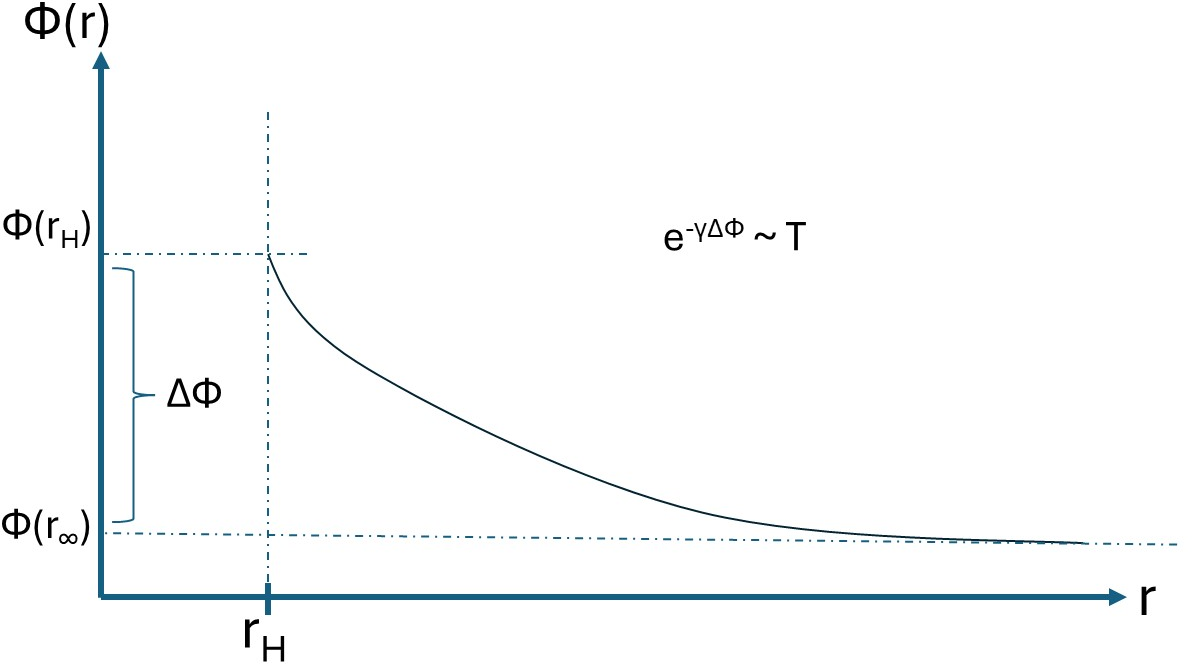
- It analyzes domain wall flows and finite-temperature generalizations, revealing an exponential temperature-field distance scaling in black brane solutions.
- The work links singularity resolution with Swampland and Cobordism Conjectures, outlining consistent UV completions for various string theory scenarios.
Codimension-One End-of-the-World Singularities in Quantum Gravity: Classification and Criteria
Introduction and Motivation
The study addresses codimension-one curvature singularities—so-called End-of-the-World (ETW) branes—that drive scalars over infinite distances in field-space, with particular emphasis on their role in string theory tests of the Cobordism Conjecture and their relevance to the Swampland Distance Conjecture. Such singularities often arise as on-shell solutions in effective supergravity reductions of string theory and can sometimes be uplifted to consistent full string backgrounds. The main aim is to critically assess which classes of ETW singularities are permissible—i.e., potentially consistent with quantum gravity—by confronting them with established and novel criteria for admissibility: Gubser's criteria (potential and horizon), the Maldacena-Nuñez (MN) criterion, and a new geometric criterion motivated by dynamical cobordisms.
Domain Wall Flows and Singularity Diagnostics
The analysis begins by characterizing domain wall-like solutions in D-dimensional gravity theories with generic scalar field content and potential. Both zero-temperature and finite-temperature (blackening) generalizations are considered to examine the possibility of cloaking singularities with horizons as required by some criteria.
- Gubser's Criteria: Gubser's potential criterion demands that the scalar potential remains bounded above as the singularity is approached, motivated by the requirement that the singularity can be "cloaked" by a regular horizon. However, the paper demonstrates that this is too restrictive as a necessary condition, especially for codimension-one singularities that do not admit near-extremal blackening deformations or are not necessarily asymptotically AdS.
- Maldacena-Nuñez Criterion: The MN criterion is formulated in terms of the behavior of the ∣g00∣ metric component in the (10-dimensional) Einstein frame upon approaching the singularity. In its strong form, a non-increasing or bounded ∣g00∣ signals an admissible singularity. The MN criterion is UV-sensitive due to its dependence on the uplifts to the parent string theory, but it is argued that, when applied in the "emergent string" or decompactification frame (per the Emergent String Conjecture), all infinite-distance ETW flows encountered here satisfy its strong form.
- Proposed Geometric Criterion: Utilizing the universal scaling properties of local dynamical cobordism solutions, a geometric generalization of Gubser's criterion is formulated. This new criterion asserts that the Ricci scalar should not diverge faster than an exponential in the proper field-space distance as the singularity is approached, with a critical exponent related to the dimension and field content. This is strictly weaker than Gubser’s potential criterion and successfully captures a broader range of UV-completable singularities, including those violating Gubser's original formulation.
Moduli Space Flows and UV Completion
Flows in true moduli spaces (with V(ϕ)=Λ constant) are analyzed to probe infinite-distance points directly. It is shown that:
- Such flows always result in a timelike naked singularity in the effective theory; all geodesics in moduli space yield the same effective description regarding singularity admissibility.
- These singularities pass Gubser’s potential criterion (since V is constant) but fail Gubser's horizon criterion (absence of blackening horizon generalization)—reinforcing that the latter can only be a sufficient criterion.
- Upon uplift to string theory, explicit examples (such as AdS5×S5 and AdS3×S3×T4) are shown to satisfy the MN criterion for appropriate duality frames.
- Certain flows, e.g., circle reductions yielding orbifold singularities like R1,D−2×C/Zk, are UV-complete in string theory. Unstable winding towers associated with the Distance Conjecture decay into the twisted sectors resolving the singularity, establishing a subtle link between the Swampland conjectures and ETW singularity resolution.
Flows With Nontrivial Scalar Potentials
The analysis of flows with nontrivial scalar potentials (V(ϕ)= const) is presented via several representative string theory solutions and their reductions:
- Klebanov-Tseytlin (KT) and Klebanov-Strassler (KS): The KT solution is shown to violate both Gubser's and the geometric Ricci bound (potential diverges) and fails the MN criterion, whereas the KS solution modifies the asymptotic field-space trajectory, resulting in a regular solution and thus a "good" singularity per all diagnostics. This illustrates that modifying the flow to evade the original singularity is not a true "resolution" and motivates the necessity of criteria that are sensitive to the infinite-distance point actually probed.
- Massive Type IIA Flows: Singularities arising from the strong coupling (nonzero Romans mass) regime in massive IIA are shown to be "bad" by all criteria, with globally well-defined solutions always capping off before these singularities are reached.
- D7-brane and EFT Strings: Codimension-two defects reduced to codimension-one flows (EFT strings, D7-branes) induce scalar potentials that diverge positively near the core, thus violating Gubser’s potential criterion. However, their UV completions are unambiguous and well-understood, underscoring the limitations of potential-based diagnostics and highlighting the robustness of the geometric criterion.
Finite Temperature Generalizations and the Distance Conjecture
By constructing finite-temperature (black) Dp-brane solutions and reducing them on their transverse spheres, the paper explores the temperature- and entropy-field-space-distance scaling in the near-extremal regime:
- It is shown that, for all cases admitting near-extremal generalizations, the temperature at the horizon exhibits an exponential dependence on the field distance traversed,
T∼e−γΔϕ,
where γ is a calculable, order-one (in MPl units) parameter.
Implications, Limitations, and Future Directions
The findings have several theoretical and practical implications:
- Swampland Consistency Diagnostics: The analysis demonstrates that admissibility of ETW singularities cannot rely solely on criteria centered around the scalar potential or the ability to cloak with black holes. A geometric condition on the allowed divergence of curvature invariants with field-space distance provides a more inclusive and physically justified necessary condition.
- Adiabatic vs Dynamical Towers: The connection between dynamical field-space flows, their induced singularities, and the associated towers of states predicted by the Distance Conjecture is made more precise, especially in cases where the "adiabatic" tower is replaced by unstable winding states decaying into the UV sector resolving the singularity.
- Thermodynamics of Flows and Towers: The exponential relation between horizon temperature and field-space distance in black brane setups offers a concrete handle to generalize the Swampland constraints to thermodynamic and non-zero temperature regimes, with potential for cross-talk between Swampland and black hole information-theoretic paradigms.
- Frame and UV Sensitivity: The study highlights the potential frame-dependence in geometric criteria (such as the MN test) and the necessity, in some scenarios, of understanding the precise UV uplift of effective solutions for conclusive diagnostics.
Conclusion
The rigorous analysis and classification of ETW singularities in this work establish that only a geometric (curvature-based) necessary condition, informed by the universality of exponential field-space scaling in string theory, robustly agrees with the known physics of UV-complete backgrounds, including those not captured by earlier conjectural criteria. This geometrization harmonizes local and UV-sensitive diagnostics, expands the classes of admissible infinite-distance flows, and lays the groundwork for future explorations of Swampland constraints in dynamical and thermal settings.