Fourier Splatting: Generalized Fourier encoded primitives for scalable radiance fields
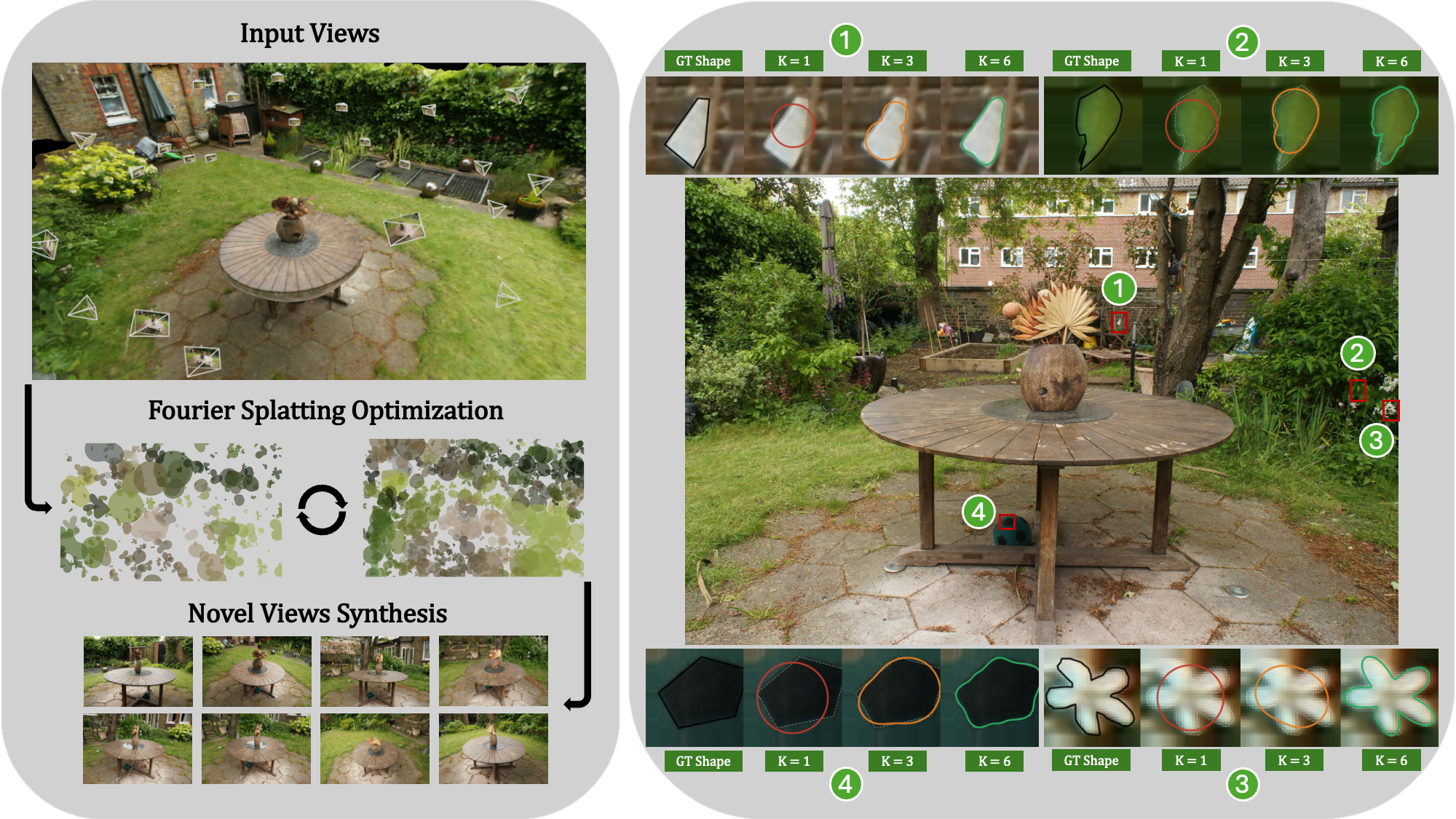
Abstract: Novel view synthesis has recently been revolutionized by 3D Gaussian Splatting (3DGS), which enables real-time rendering through explicit primitive rasterization. However, existing methods tie visual fidelity strictly to the number of primitives: quality downscaling is achieved only through pruning primitives. We propose the first inherently scalable primitive for radiance field rendering. Fourier Splatting employs scalable primitives with arbitrary closed shapes obtained by parameterizing planar surfels with Fourier encoded descriptors. This formulation allows a single trained model to be rendered at varying levels of detail simply by truncating Fourier coefficients at runtime. To facilitate stable optimization, we employ a straight-through estimator for gradient extension beyond the primitive boundary, and introduce HYDRA, a densification strategy that decomposes complex primitives into simpler constituents within the MCMC framework. Our method achieves state-of-the-art rendering quality among planar-primitive frameworks and comparable perceptual metrics compared to leading volumetric representations on standard benchmarks, providing a versatile solution for bandwidth-constrained high-fidelity rendering.

Paper Prompts
Sign up for free to create and run prompts on this paper using GPT-5.
Top Community Prompts
Explain it Like I'm 14
What is this paper about?
This paper is about a faster, more flexible way to make new pictures of a 3D scene from different viewpoints (like moving a virtual camera around). The authors introduce “Fourier Splatting,” a method that uses smart, flat “stickers” with adjustable shapes to paint realistic views quickly. The special thing: you can smoothly turn the quality up or down without retraining the model, like changing a video’s resolution on YouTube.
What questions are the researchers asking?
They focus on three easy-to-understand questions:
- Can we design a single type of flat 3D “sticker” (a primitive) whose shape can become simple or very detailed on demand?
- Can this one model render at different levels of quality just by changing a few numbers at runtime (without retraining)?
- Can we keep training stable and efficient while these shapes get more complex, and split big complex shapes into simpler ones when needed?
How does their method work?
Think of building a picture by layering many semi-transparent, flat stickers in 3D, then looking at them from a camera. Each sticker has a position, a direction it faces, a color, and a boundary (its outline). Traditional methods use simple discs or fuzzy blobs. Fourier Splatting lets each sticker have almost any outline shape.
Here are the core ideas, explained with simple analogies:
The new building block: Fourier-shaped stickers
- Imagine drawing a shape by combining waves around a circle. Add just one smooth wave and you get something close to a circle. Add more waves and you can create wiggly, star-like, or very detailed curves.
- The outline of each sticker is defined by a set of “Fourier coefficients.” You can think of these as knobs that turn certain wave patterns on or off.
- Scalability: If you keep only a few knobs, the sticker is simple (faster, lower detail). If you keep more knobs, the sticker becomes more detailed (slower, higher quality).
- This means one trained scene can be rendered at different qualities just by trimming how many “wave knobs” you use—no retraining and no deleting stickers.
Making learning stable: a gentle “nudge” outside the edge
- During training, the computer needs to adjust the sticker boundaries so they match the scene. But if you strictly ignore everything outside a sticker’s edge, the learning gets stuck because there’s no feedback to expand the shape.
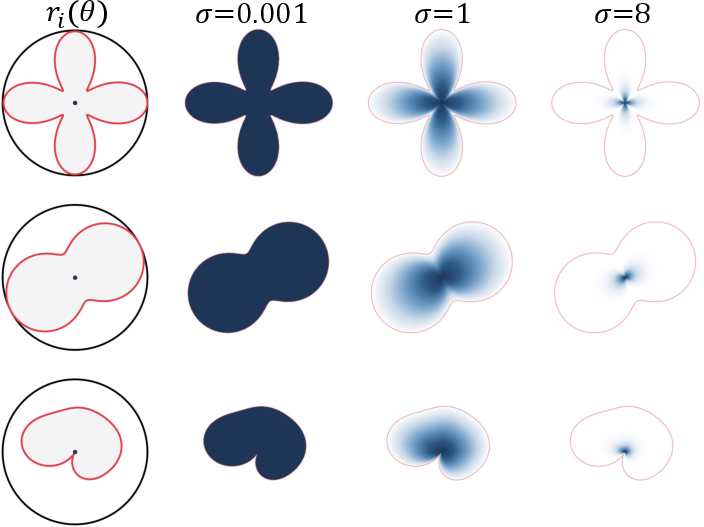
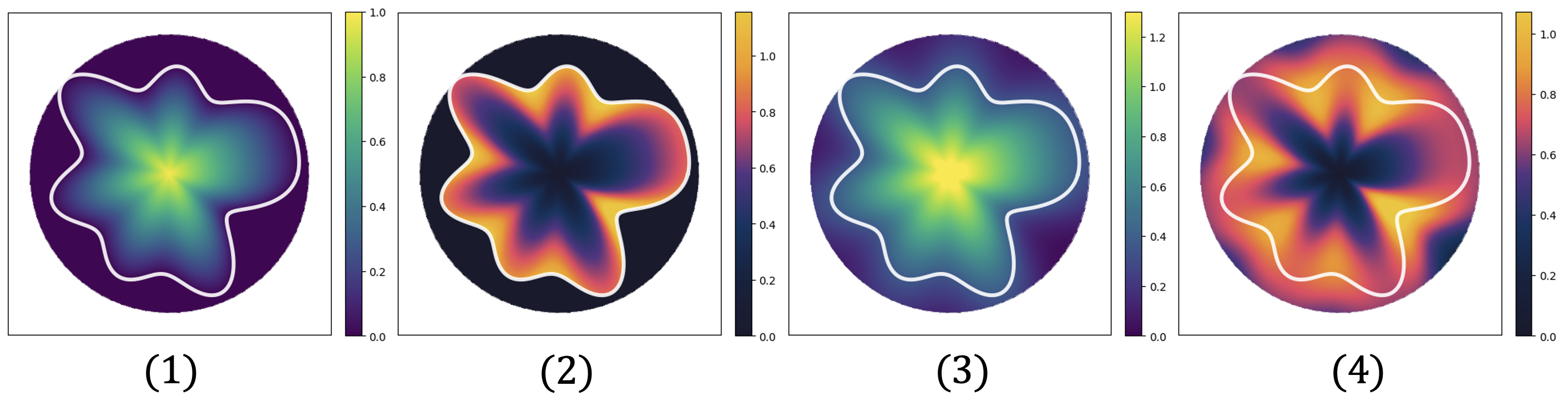
- The authors use a training trick called a straight-through estimator (STE). In plain terms, even outside the sticker’s edge, they let a tiny “ghost” signal flow back during training. That gentle nudge helps the sticker learn whether to grow or shrink and take on the right shape.
Growing more pieces where needed: HYDRA
- Some areas are complicated (thin branches, detailed edges). One big, weird-shaped sticker might struggle there.
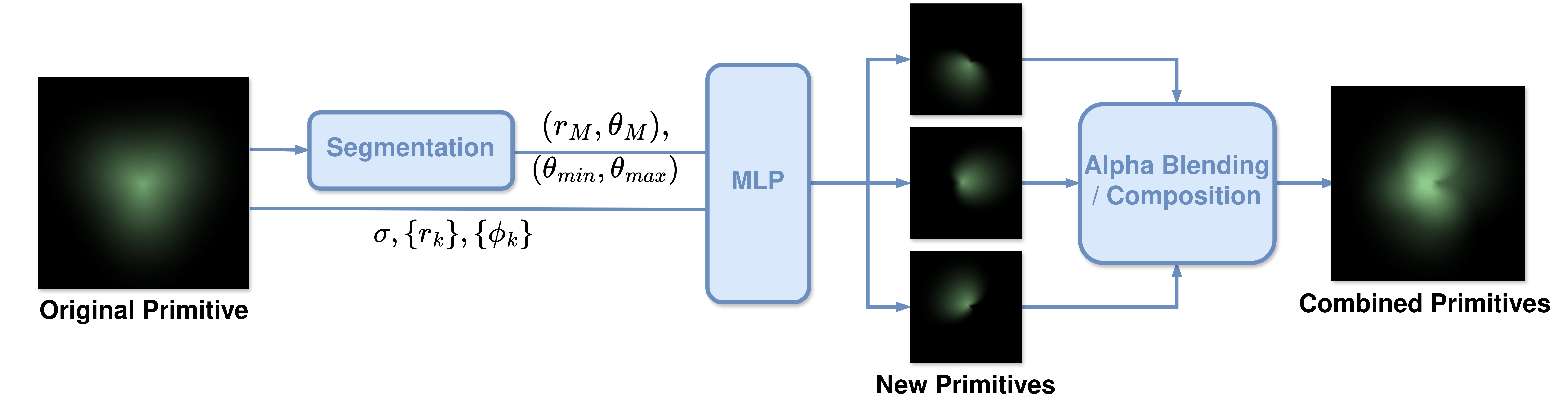
- HYDRA is a strategy to split complex stickers into smaller, simpler ones where detail is high—like cutting a strange cookie into a few smaller cookies that fit better.
- There are two kinds of splits:
- Simple split: shrink and duplicate to cover nearby space more evenly.
- Smart split: when the boundary has multiple bumps or “lobes,” a tiny neural network helps decide how to split the shape into well-placed smaller pieces.
Rendering in simple terms
- For each pixel in the image, the method checks which stickers cover that pixel and how much they should contribute (like stacking transparent stickers from front to back).
- Each sticker naturally fades out at its boundary, and a “sharpness” control decides how soft or crisp the edge looks.
What did they find, and why is it important?
The authors tested their method on well-known 3D benchmarks and found:
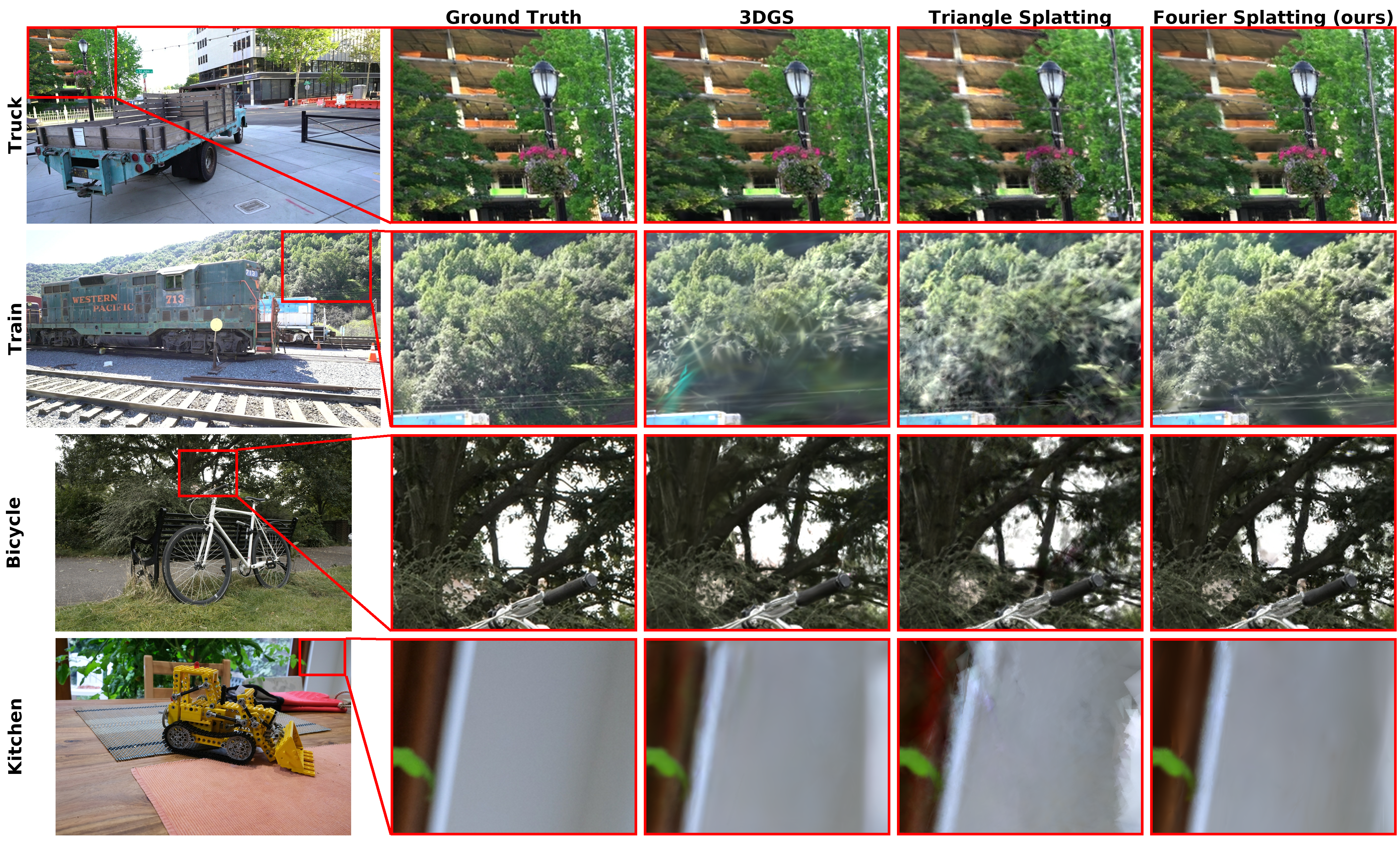
- Among flat-primitive methods (which use surface-like stickers), their approach reached state-of-the-art visual quality.
- It performed competitively with top “volumetric” methods (which use blurry 3D blobs), even though it uses flat stickers.
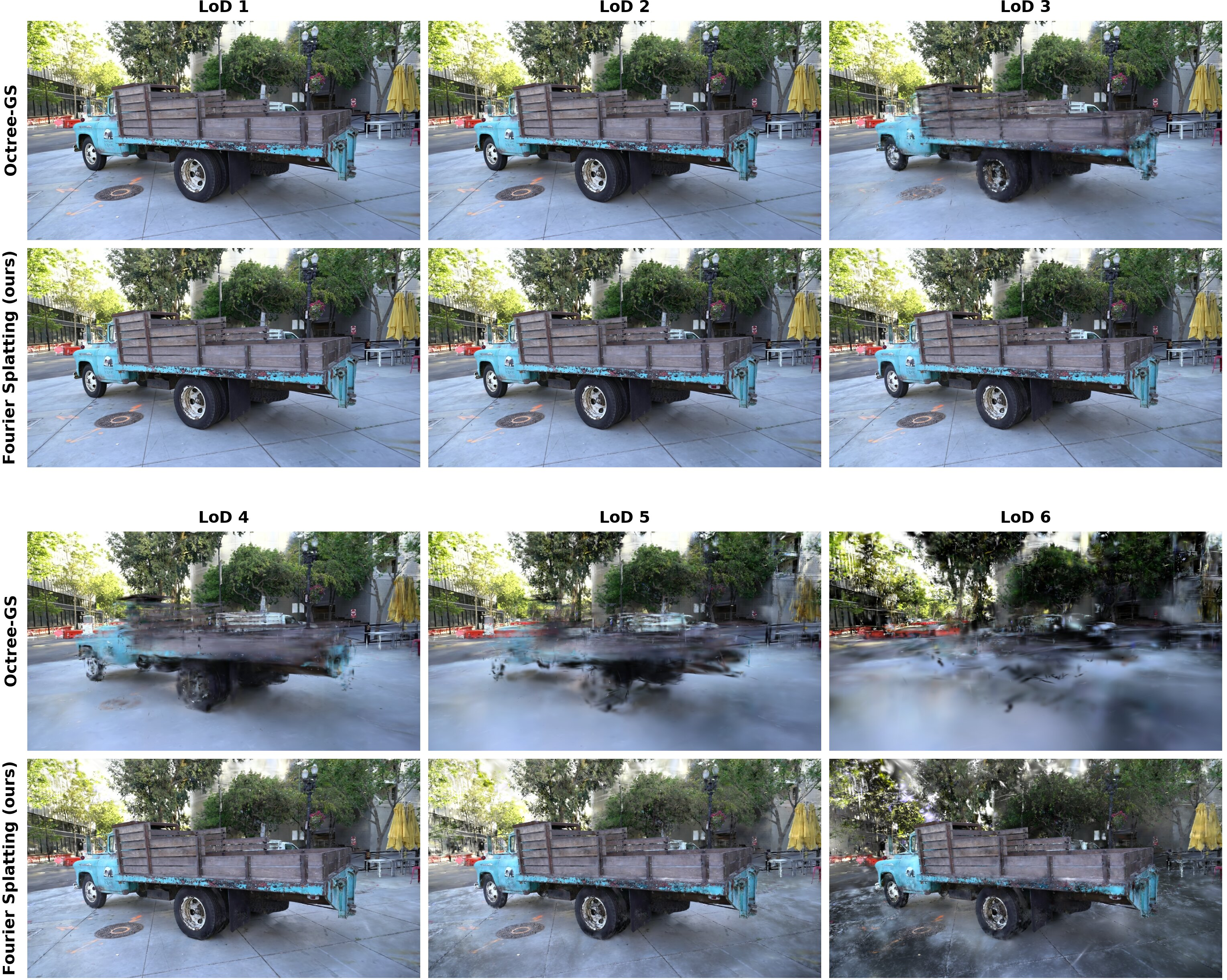
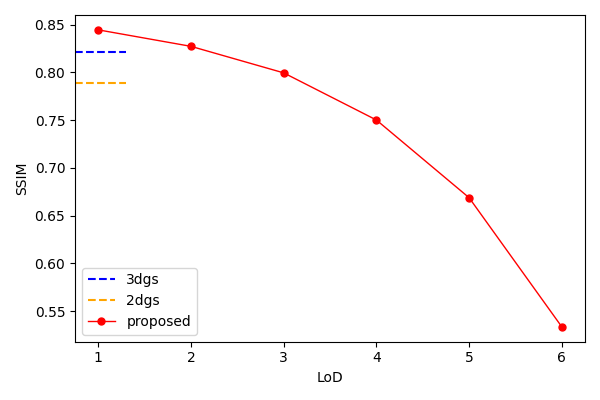
- Most importantly, it’s inherently scalable: the same trained model can be shown at different detail levels by keeping fewer or more Fourier coefficients. When you reduce detail, the picture stays stable and just gets a bit smoother—objects don’t suddenly disappear. This is a nicer, more graceful quality drop than methods that only remove whole stickers.
This matters because it gives you control. If your device or network is slow, you can show a simpler version quickly. If you have more power or bandwidth, turn up the detail instantly—no retraining, no re-authoring.
What’s the potential impact?
This approach could help:
- Streaming 3D scenes over the internet (AR/VR, virtual tours, games) where bandwidth changes—quality can adjust smoothly on the fly.
- Mobile or standalone headsets that need fast, real-time graphics with adjustable detail.
- Content pipelines where one model serves many devices: the same scene can be used on a high-end PC and a phone by just changing how many shape “knobs” are kept.
In short, Fourier Splatting offers a flexible, high-quality, and real-time way to render 3D scenes, with a built-in “detail dial” that makes it practical for many real-world uses.
Knowledge Gaps
Below is a consolidated list of concrete knowledge gaps, limitations, and open questions that remain after this work. Each item points to a specific avenue for future research or validation.
- Shape expressiveness limits: The radial boundary r(θ) defines star-shaped, simply connected sets centered at the primitive; how to represent non-star-shaped silhouettes, deep concavities not visible from the center, or shapes with holes/multiple components within a single primitive?
- Topology handling: HYDRA splits multi-lobed boundaries but does not allow a primitive to model multiply connected regions; can the representation be extended to support interior holes or disconnected lobes without decomposition?
- Boundary basis choice: Are Fourier polynomials the best basis? Compare against alternatives (e.g., B-splines, Chebyshev, wavelets, implicit level-sets) for accuracy, truncation behavior, and anti-aliasing.
- High-frequency artifacts: Quantify and mitigate Gibbs-like ringing at large K; develop regularizers (e.g., curvature or total variation on r(θ)) to prevent spurious boundary ripples.
- Numerical stability: The opacity window divides by r(θ) and uses ρ; specify robust handling of r(θ)≈0 or ρ≈0 (epsilons, clamping) and analyze stability across training.
- Normalization constraint: Squared-ℓ1 normalization removes amplitude scale and pushes size learning into R; study alternative constraints (e.g., ℓ2 norm, soft radius penalties) to decouple shape and scale for better optimization.
- Anti-aliasing and prefiltering: Sharp, hard boundaries can alias under minification; evaluate and design prefiltered rasterization or analytic area coverage to reduce edge aliasing.
- Perspective accuracy: Large planar surfels can violate projective consistency; quantify silhouette/distortion errors for large R and devise adaptive constraints or subdivision criteria for safe extents.
- Geometry fidelity: Report geometric metrics (e.g., Chamfer distance, normal error, depth accuracy) and compare with geometry-focused methods to validate surface quality beyond image metrics.
- Appearance modeling: Per-primitive SH color is spatially uniform over the surfel; investigate learned per-primitive textures or SVBRDFs to capture fine albedo/reflectance variation without proliferating primitives.
- Specular/transparent phenomena: Assess limits of low-order SH for view-dependent effects and explore more expressive, physically motivated reflectance models per primitive.
- Dynamic/relit scenes: Extend to non-static scenes, changing illumination, and dynamic objects; clarify whether STE, HYDRA, and the boundary parameterization remain stable in these regimes.
- STE sensitivity and theory: Analyze sensitivity to β, γ, and σ; study convergence, bias, and gradient leakage introduced by the surrogate; compare alternative straight-through designs or loss-aware surrogates.
- HYDRA MLP details and generalization: Specify training data, supervision, and architecture; evaluate generalization across scenes and ablate S, M, and selection thresholds; quantify failure cases of learned decomposition.
- MCMC correctness and exploration: Provide theoretical guarantees or empirical diagnostics that relocation, splits, and noise preserve the target distribution; study alternative exploration strategies tailored to planar constraints.
- LoD temporal stability: When truncating coefficients on-the-fly, evaluate flicker/temporal inconsistency across viewpoints and time; propose hysteresis or temporal smoothing for progressive streaming.
- Rate–distortion design: Develop a practical bitstream (coefficient ordering, quantization, entropy coding) and report RD curves versus Octree/pruning baselines under matched bitrate budgets.
- Per-primitive adaptive K: Investigate runtime policies that allocate K per primitive based on screen-space importance, visibility, curvature, or residual error rather than a global K.
- Throughput and memory profiling: Report end-to-end FPS, kernel timings, memory bandwidth, and VRAM usage versus K and primitive count; characterize training speed and scalability across GPUs.
- Fairness of comparisons: Provide controlled studies with matched primitive counts, parameter budgets, and training time versus baselines; include per-scene breakdowns and variance.
- Robustness/stress tests: Evaluate under sparse views, calibration noise, motion blur, HDR/exposure changes, and specular/transparent objects to map failure modes and required priors.
- Seams and continuity: Study whether adjacent primitives leave gaps/overlaps at boundaries; explore cross-primitive continuity constraints or boundary snapping to shared surfaces.
- Hybrid primitive design: Explore coupling planar Fourier boundaries with low-order surface curvature (e.g., quadratic surfels) to better model curved geometry while retaining scalable boundary detail.
- Degenerate cases in HYDRA: Analyze decomposition stability when valleys are shallow/noisy; add confidence measures, uncertainty-aware splits, or multi-step refinement policies.
- Automatic frequency schedule: Replace fixed unfreeze at iter 600 with criteria based on loss curvature, boundary stability, or validation error to prevent premature/late high-frequency activation.
- Integration with pruning: Jointly optimize coefficient truncation and primitive pruning; study their combined RD trade-offs and devise global controllers for target bitrate/quality.
- Dataset breadth: Extend evaluation beyond Mip-NeRF 360 and Tanks & Temples (e.g., DTU, BlendedMVS, indoor cluttered scenes) to assess generalization and scalability.
- Open-source reproducibility: Release code and detailed hyperparameters (β, γ, η, τo, τI, Vmin, S, M, optimizer schedules) to enable verification and further ablations.
Practical Applications
Immediate Applications
Below is a set of concrete, deployable use cases that leverage the paper’s primitives, scalability-by-coefficient truncation, and training/optimization techniques. Each item includes sectors, likely tools/products/workflows, and feasibility dependencies.
- Bandwidth-adaptive radiance-field streaming for web/mobile/XR
- Sectors: software, AR/VR, media streaming, telecom
- What: Stream a single trained scene and adjust quality at runtime by truncating Fourier coefficients (varying K) based on network/latency constraints, similar to scalable video coding but for splatting-based radiance fields.
- Tools/products/workflows: “Scalable RF” streaming stack (server encodes base layer K=1 + enhancement layers), WebGPU/WebGL viewer with coefficient-side LoD control, CDN integration for layer selection; integration with existing splatting viewers.
- Assumptions/dependencies: Trained static scenes with max K; client-side GPU rasterizer for Fourier primitives; no standard codec yet (custom bitstream); stable cameras/poses and precomputation.
- LoD control in game engines and XR (distance-, fovea-, or importance-based)
- Sectors: gaming, AR/VR, simulation
- What: Use the same model at multiple LoDs by dynamically truncating coefficients per object, per region, or per gaze region to balance frame rate vs. fidelity without popping artifacts from primitive pruning.
- Tools/products/workflows: Unity/Unreal plugins for splatting with K-driven LoD; foveated LoD schedulers; pairing with Variable Rate Shading pipelines; artist-controllable LoD ladders.
- Assumptions/dependencies: GPU tile-based rasterization; integration effort for engine plugins; eye-tracking for foveated setups.
- Graceful degradation for mobile AR product viewers and ads
- Sectors: e-commerce, advertising, mobile apps
- What: Start with K=1 for instant silhouettes and progressively enable more coefficients as bandwidth/thermal headroom allows, improving edges and textures over time.
- Tools/products/workflows: On-device RF viewer with adaptive K; progressive asset loading; A/B testing frameworks to evaluate QoE vs. battery.
- Assumptions/dependencies: On-device GPU support; pre-trained assets; consistent lighting/view-dependence via SHs as in the paper.
- Thin-structure and silhouette–sensitive reconstructions for AEC and cultural heritage
- Sectors: AEC (architecture/engineering/construction), cultural heritage digitization, surveying
- What: Fourier boundaries capture arbitrarily shaped planar footprints, improving thin features, edges, and silhouettes relative to ellipsoidal Gaussians—useful for inspections, digital twins, and archiving.
- Tools/products/workflows: Photogrammetry-to-Fourier-Splatting pipelines; scene viewers for design review; controlled LoD exports for stakeholders under bandwidth constraints.
- Assumptions/dependencies: Largely static scenes; robust multi-view imagery and calibrated cameras; trained workflow adoption.
- Remote inspection and teleoperation scene sharing
- Sectors: industrial maintenance, drones/UAS, facilities management
- What: Pre-captured industrial sites rendered remotely with adaptive K to maintain real-time responsiveness over variable links (satellite/cellular).
- Tools/products/workflows: Remote viewer with K adaptation; presets for low-latency mode (low K) vs. high-fidelity mode (high K); caching of base coefficients at the edge.
- Assumptions/dependencies: Offline training (not live); compliance with security/IT policies; GPU availability on client.
- Research distribution and teaching with single-model multi-LoD assets
- Sectors: academia, education
- What: Share one trained scene that supports many evaluation LoDs by coefficient truncation; consistent benchmarks without retraining or per-LoD postprocessing.
- Tools/products/workflows: Open-source reference implementation; coursework modules illustrating splatting and Fourier descriptors; reproducible benchmarks with K sweeps.
- Assumptions/dependencies: Community adoption; GPU-equipped student environments.
- Faster iterative creative workflows (previz → final)
- Sectors: VFX, design, media production
- What: Artists preview with low K for speed and move to high K for final shots—one model, no re-export between stages.
- Tools/products/workflows: DCC plugins (e.g., Blender add-on) for Fourier Splatting; LoD scrubbing in viewport; review-and-approve pipelines.
- Assumptions/dependencies: Tooling integration; asset interchange formats for coefficient sets.
- Robotics and simulation backdrops with compute-aware LoD
- Sectors: robotics, autonomy, simulation
- What: Use high-frequency boundaries for cluttered edges in synthetic environments, lowering K when running on embedded hardware to keep frame rates stable.
- Tools/products/workflows: Sim plugins (Gazebo, Isaac Sim, CARLA) with K knobs; scripted distance- or task-phase–based LoD scheduling.
- Assumptions/dependencies: Static or quasi-static backgrounds; GPU presence even on embedded platforms.
- Training pipeline stabilization via STE and HYDRA densification
- Sectors: research labs, startups building RF capture
- What: Adopt the straight-through estimator (STE) to avoid optimization stall at boundaries and HYDRA to decompose complex primitives into simpler lobes, improving convergence without redesigning the renderer.
- Tools/products/workflows: Incorporate STE loss surrogate and HYDRA cases into existing 2D/3D splatting training repos; ablation-friendly configs.
- Assumptions/dependencies: Implementation complexity (gradient routing, hyperparameters); MCMC-based densification framework familiarity.
Long-Term Applications
These opportunities require additional research, engineering, or ecosystem development (standards, hardware, or pipeline maturity).
- Standardized scalable radiance-field codec with Fourier layers
- Sectors: media streaming, standards (MPEG-like bodies), telecom
- What: Define a base layer (low K) with enhancement layers (higher-frequency Fourier coefficients) akin to SVC/SHVC in video, enabling interoperable, bandwidth-adaptive RF delivery.
- Tools/products/workflows: Bitstream spec for primitives, coefficient quantization/entropy coding, client capability signaling; CDN layer selection.
- Assumptions/dependencies: Industry consensus, IPR/standardization, reference software and conformance tests.
- Hardware acceleration for Fourier-primitive rasterization
- Sectors: semiconductors, GPU vendors, XR devices
- What: Dedicated instructions or shader units for complex multiply-add (Horner recurrence) and polar windowing; improving power/performance for on-headset XR.
- Tools/products/workflows: Shader compiler intrinsics, ASIC blocks, XR silicon IP; driver-level support for Fourier-splat kernels.
- Assumptions/dependencies: Demonstrated market demand; stable primitive spec; cross-vendor cooperation.
- Live (near-)real-time capture and streaming with progressive coefficients
- Sectors: telepresence, events, sports broadcast
- What: Online training that streams initial low-K surfaces quickly and refines with higher frequencies as more frames accumulate; “quality ramps” during live sessions.
- Tools/products/workflows: Incremental training with coefficient activation schedules; streaming pipeline with feedback-controlled K; edge compute for early layers.
- Assumptions/dependencies: Further acceleration of training; robust handling of dynamic content; latency constraints.
- Dynamic/deformable scene support (time-varying Fourier boundaries)
- Sectors: volumetric video, XR entertainment, sports analytics
- What: Extend coefficients to be functions of time (or learned dynamics), enabling scalable LoD for moving objects without ballooning primitive counts.
- Tools/products/workflows: Temporal regularizers, motion models over coefficients, streaming of coefficient deltas.
- Assumptions/dependencies: New optimization objectives and stability strategies; memory/compute trade-offs for time-series parameters.
- Hybrid mesh–splat pipelines and conversions
- Sectors: AR/VR engines, content creation, CAD/AEC
- What: Convert Fourier-defined boundaries into piecewise meshes for compatibility with opaque mesh pipelines; or overlay meshes with Fourier splats for view-dependent effects.
- Tools/products/workflows: “Fourier-to-mesh” tessellation tools; hybrid renderers combining mesh and splat passes; authoring UIs to sculpt harmonic descriptors.
- Assumptions/dependencies: Robust tessellation algorithms that preserve silhouette fidelity; pipeline integration.
- Learned compression and perceptual coding of Fourier descriptors
- Sectors: codecs, media technology
- What: Entropy models and perceptual quantizers for coefficient sets (e.g., allocating bits to high-impact angular frequencies), possibly content- or gaze-aware.
- Tools/products/workflows: Learned entropy models; RA/bit-allocation tools; rate–distortion controllers tied to K and coefficient precision.
- Assumptions/dependencies: Large training corpora; deployed decoders; consistent quality metrics.
- Gaze-adaptive and task-aware LoD scheduling in XR and HCI
- Sectors: XR, HCI, accessibility
- What: Couple eye-tracking with per-primitive coefficient budgets (higher K near fovea, lower K in periphery); adapt to user tasks that require high-edge fidelity.
- Tools/products/workflows: Real-time LoD controllers integrated with eye trackers; UI heuristics for task prioritization.
- Assumptions/dependencies: Reliable eye-tracking; latency-sensitive scheduling.
- Robotics perception and SLAM augmentation with boundary priors
- Sectors: robotics, autonomous systems
- What: Use Fourier boundary estimates as strong priors for thin-structure edges and occupancy during mapping/simulation-to-reality transfer.
- Tools/products/workflows: SLAM modules ingesting boundary descriptors; synthetic-to-real domain adaptation with silhouette-aware training.
- Assumptions/dependencies: Bridging radiance fields and geometric pipelines; robustness to dynamic scenes and lighting changes.
- Safety-critical simulations with silhouette fidelity
- Sectors: automotive ADAS/AV, aerospace
- What: High-fidelity silhouettes at controllable compute cost for perception-in-the-loop simulations; tune K to match sensor resolution and test coverage.
- Tools/products/workflows: Scenario libraries with K ladders; validation frameworks (e.g., SOTIF-aligned) measuring perception sensitivity to silhouette changes.
- Assumptions/dependencies: Certification needs; consistent sensor models; documented traceability.
- Sustainability and policy frameworks for 3D media streaming
- Sectors: public policy, telecom, ESG reporting
- What: Use coefficient-based scalability to reduce data transmission and compute energy under constrained conditions; define procurement guidelines for adaptive 3D content.
- Tools/products/workflows: Energy-aware streaming policies; dashboards estimating energy/CO2 saved via K adaptation; green-by-default presets.
- Assumptions/dependencies: Empirical energy models; acceptance by service providers; standardized reporting.
- Advanced authoring tools for harmonic boundary editing
- Sectors: DCC tools, creative technology
- What: User interfaces that expose and edit Fourier coefficients to sculpt silhouettes directly (designing splat shapes rather than only positions/scales).
- Tools/products/workflows: Coefficient-space handles and brushes; procedural shape libraries; constraint solvers to maintain closed boundaries under edits.
- Assumptions/dependencies: Artist training and UX iteration; integration into existing DCCs.
Notes on common assumptions/dependencies across applications:
- Scene nature: The representation assumes mostly static scenes and benefits most when surfaces can be approximated by planar surfels with expressive closed boundaries; volumetric translucent media remain challenging.
- Training inputs: Multi-view RGB with known camera poses (typical for NeRF/3DGS pipelines).
- Runtime: A GPU-capable device with a splatting rasterizer; Horner-based evaluation of boundary polynomials is efficient but still adds per-primitive cost as K increases.
- Quality control: The max usable K is fixed by training; runtime scalability is achieved by truncation to K′ ≤ K without retraining.
- Ecosystem: Broader deployment benefits from standardized bitstreams, engine plugins, and potential hardware support.
Glossary
- 3D Gaussian Splatting (3DGS): A real-time neural rendering framework that represents scenes with many Gaussian primitives splatted via rasterization. "3D Gaussian Splatting (3DGS) offered a compelling alternative:"
- absolute gradient accumulation: A training heuristic that aggregates absolute gradients to guide where to add or split primitives. "We identify high-gradient primitives via absolute gradient accumulation~\cite{ye_absgs_2024}"
- anisotropic Gaussians: Gaussian kernels whose covariance differs by direction, allowing elongated shapes. "an explicit representation composed of millions of anisotropic Gaussians."
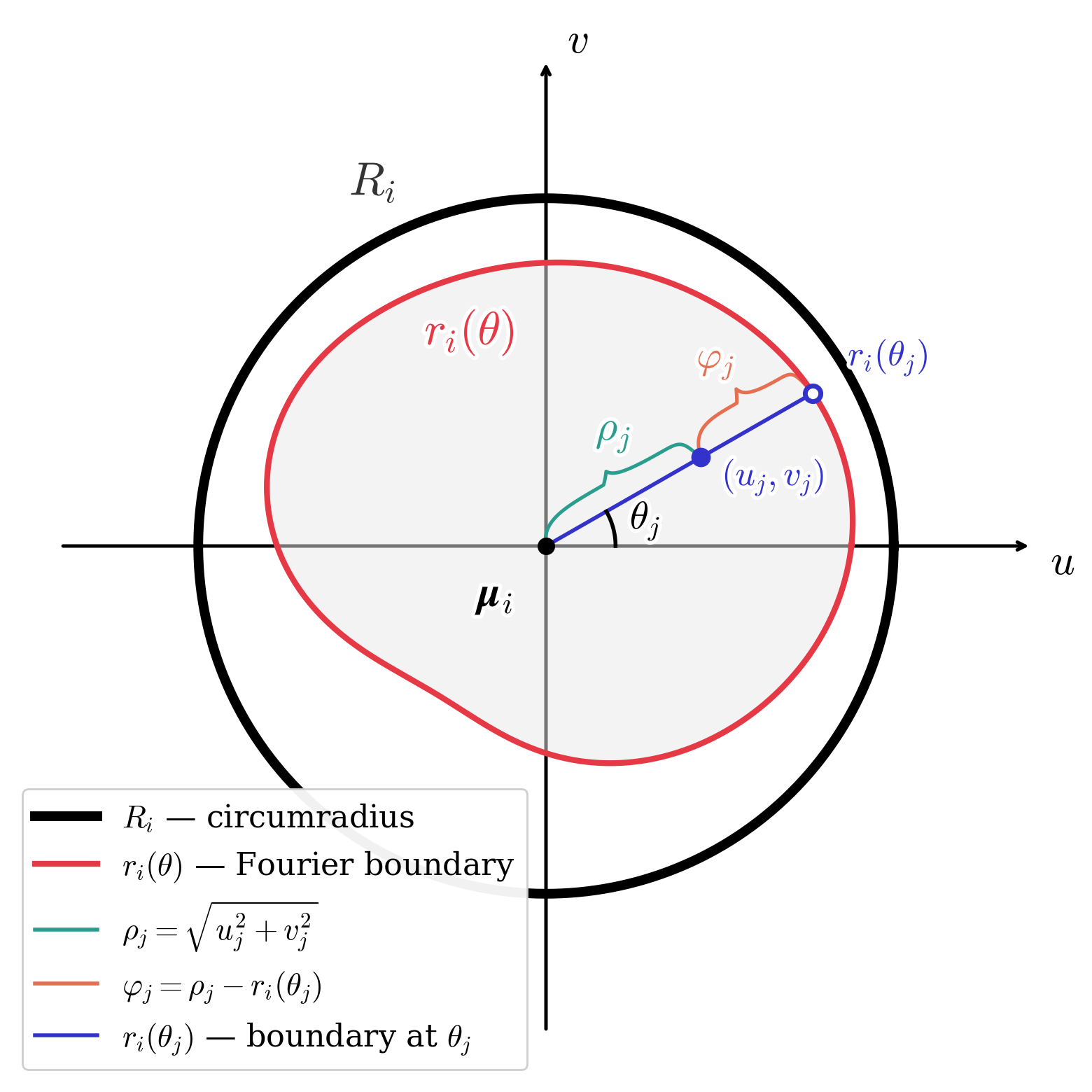
- circumradius: The radius of the smallest circle that encloses a primitive’s boundary; used to bound extent. "a circumradius bounding the primitive extent,"
- compact support: A function being nonzero only within a bounded region; here, opacity vanishes outside the boundary. "points with are discarded, providing compact support."
- compact-support Beta kernels: Finite-support kernels based on the Beta distribution whose shape can be tuned. "replaces Gaussians with compact-support Beta kernels whose shape parameters control the falloff from uniform to peaked."
- constructive interference: Reinforcement when Fourier components align phases, increasing boundary radius. "the maximum constructive interference across all frequencies cannot exceed "
- DC component: The zero-frequency term in a Fourier series setting the average radius. "The term acts as the DC component, setting a uniform base radius,"
- densification: The process of adding/splitting/relocating primitives to increase representational capacity. "and introduce HYDRA, a densification strategy that decomposes complex primitives into simpler constituents within the MCMC framework."
- depth distortion loss: A regularizer that penalizes spread in rendered depth distributions to enforce surface sharpness. "we add a depth distortion loss $\mathcal{L}_{\mathrm{dist}$ penalizing spread in rendered depth distributions,"
- D-SSIM: The dissimilarity version of SSIM used as a perceptual component of the training objective. "We optimize a photometric objective combining and D-SSIM:"
- exponential family: A parametric family of functions used to generalize the kernel’s radial falloff. "generalizes the radial falloff to an exponential family with a learnable shape parameter,"
- Fourier encoded descriptors: A set of Fourier coefficients that parameterize the primitive’s boundary shape. "parameterizing planar surfels with Fourier encoded descriptors."
- Fourier polynomial: A finite Fourier series evaluated as a polynomial in to define the boundary radius. "the modulus of a Fourier polynomial:"
- front-to-back compositing: Rendering accumulation that blends colors in depth order from nearest to farthest. "Colors are accumulated via front-to-back compositing (\cref{eq:compositing})."
- Horner's method: An efficient algorithm for evaluating polynomials (and here, Fourier series) using recurrences. "The Fourier boundary (\cref{eq:fourier_boundary}) is evaluated via Horner's method."
- infinite support: A kernel property of being nonzero everywhere, as with Gaussian footprints. "is rendered as a smooth ellipsoidal kernel with infinite support and fixed shape."
- Jacobian: The matrix of partial derivatives describing how a transformation locally changes coordinates. "and the Jacobian of the local affine approximation of the projective transformation."
- Level-of-Detail (LoD): A strategy to adjust representation complexity for performance/bitrate by varying detail. "Level-of-Detail (LoD) hierarchies."
- Markov chain Monte Carlo (MCMC): A sampling framework; here, it guides relocation and duplication of primitives during training. "within the MCMC framework."
- normal consistency loss: A term that aligns primitive normals with normals inferred from depth for geometric coherence. "and a normal consistency loss $\mathcal{L}_{\mathrm{normal}$ aligning each primitive's normal"
- opacity: A per-primitive alpha parameter controlling transparency. "an opacity ,"
- orthonormality (of the Fourier basis): Basis functions are mutually orthogonal and unit norm, enabling energy-preserving truncation. "Due to the orthonormality of the Fourier basis, the optimal approximation of an -term polynomial using coefficients is obtained by simple truncation."
- photometric objective: The image-space loss combining pixelwise and perceptual terms for optimization. "We optimize a photometric objective combining and D-SSIM:"
- power window: A boundary-aware windowing function that shapes opacity falloff to zero at the primitive edge. "adapting the power window function of Triangle Splatting~\cite{held_triangle_2025} to our polar coordinate formulation."
- quaternion: A 4D rotation representation used to define the primitive’s local tangent frame. "a rotation quaternion defining the local tangent frame"
- radiance field: A function representing view-dependent emitted light in 3D, used for novel view synthesis. "for real-time radiance field rendering."
- rate-distortion trade-off: The balance between bitrate (model size) and reconstruction quality. "providing direct control over the rate-distortion trade-off."
- ray-plane intersection: Computing where a camera ray hits a plane to find surfel-local coordinates. "obtained via ray-plane intersection (\cref{eq:uv_intersection})"
- signed distance: A distance measure that is negative inside and positive outside a boundary. "the signed distance to the Fourier boundary is:"
- spherical harmonic coefficients: Coefficients of spherical harmonics that model view-dependent color. "and spherical harmonic coefficients for view-dependent color~."
- Stochastic Gradient Langevin Dynamics (SGLD): An SGD variant with noise injection interpreted as Langevin dynamics. "interprets SGD updates as Stochastic Gradient Langevin Dynamics (SGLD)"
- straight-through estimator (STE): A technique that uses a smooth surrogate in backprop to pass gradients through non-differentiable or clamped operations. "we draw on the straight-through estimator (STE) and decouple the forward and backward passes."
- surfel: An oriented planar surface element used as a rendering primitive. "oriented planar surfels."
- tangent plane: The plane tangent to a surface at a point; the local parameterization domain of a surfel. "closed boundary within its tangent plane,"
- tile-based rasterization: GPU rendering that processes screen tiles for efficient accumulation of many small primitives. "tile-based rasterization enable real-time rendering,"
- transmittance: The accumulated transparency during compositing, affecting how later primitives contribute. "Expanding the per-child transmittance $(1-o_{\mathrm{new}\,w)^{i-1}$ via the binomial theorem"
- view-dependent appearance: Appearance that varies with viewing direction, modeled by learned coefficients. "spherical harmonic coefficients for view-dependent appearance,"
- viewing transformation (world-to-camera): The mapping from world coordinates into the camera’s coordinate system. "where is the viewing transformation (world-to-camera) and the Jacobian"
Collections
Sign up for free to add this paper to one or more collections.