- The paper proposes a string-theoretic model that achieves an objective wavefunction collapse mirroring the Díosi–Penrose mechanism.
- It introduces toy dipole models and Instant Folded Strings to produce a 1/k² gravitational potential spectrum with colored noise.
- The work analyzes experimental constraints and demonstrates how string dynamics can reconcile rapid collapse with decoherence in cosmological settings.
Objective Collapse, Decoherence, and String-Theoretic Mechanisms
The paper "Wavefunction Collapse in String Theory" (2603.24429) explores the intersection of quantum measurement theory and string cosmology, specifically investigating whether string theory provides a microscopic, UV-complete realization of objective wavefunction collapse mechanisms analogous to the Dí ósi–Penrose (DP) model. The work leverages recent developments suggesting that cosmic acceleration may be sourced by Instant Folded Strings (IFSs) and their decay products, and analyzes the resulting stochastic modifications to the Newtonian gravitational potential as a candidate for collapse-inducing dynamics.
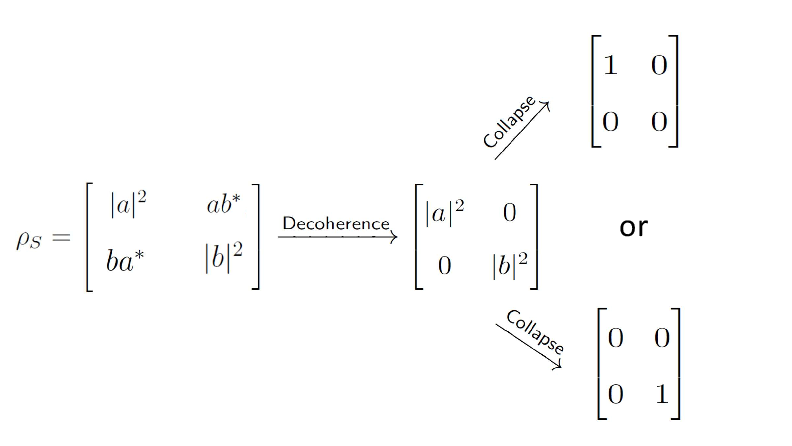
Figure 1: Decoherence approximately diagonalizes the density matrix; in objective collapse models, an additional non-unitary evolution selects a definite outcome.
The Dí ósi–Penrose Model and Constraints
The DP model proposes a stochastic, gravity-induced collapse of the wavefunction, postulating a classical noise field for the Newtonian potential Φ, with white-in-time statistics and a 1/k2 spatial spectrum. The model predicts macroscopic suppression of quantum superpositions via non-unitary terms in the density matrix evolution, parametrized by a smearing length R0 that regularizes UV divergences.
Experimental tests, including matter-wave interferometry and searches for spontaneous radiation, have constrained the DP model's parameters. The smearing scale R0 is tightly bounded by radiative experiments (e.g., XENONnT), rendering the standard DP model phenomenologically unattractive for rapid collapse of macroscopic superpositions. The model's effectiveness and compatibility with laboratory bounds are determined by the interplay between collapse rate and diffusion/heating effects, both scaling inversely with powers of R0.
Toy Dipole Models: Kinematic Foundations
To motivate a string-theoretic analogue, the paper constructs toy models with quanta of balanced positive and negative energies. Simple monopole shot-noise models do not reproduce the DP spatial spectrum (1/k2) and suffer from instabilities. Instead, dipole excitations—microscopically correlated pairs of +E and −E particles—yield the desired 1/k2 scaling in the gravitational potential spectrum. Dynamical (growing or ballistic) dipole models provide approximately white temporal noise at low frequencies, with a natural UV cutoff given by the dipole size.
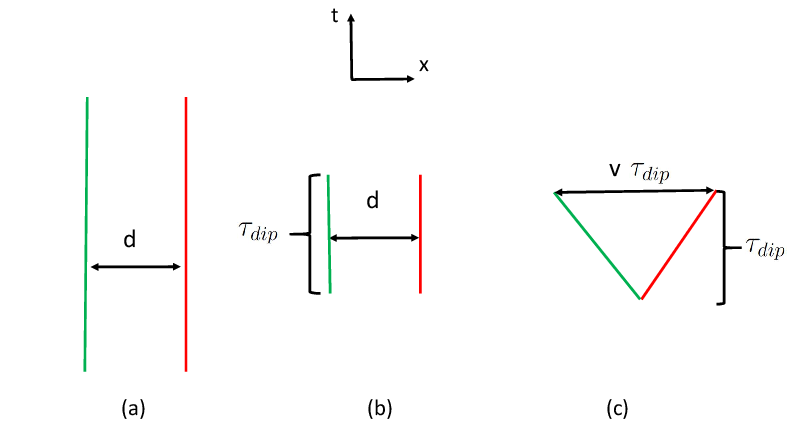
Figure 2: Toy dipole models exhibit the 1/k2 spatial scaling; panel (c) approximates the stringy model with colored noise.
Instant Folded Strings: Stringy UV Completion and Cosmic Acceleration
The stringy model centers on IFSs, non-standard closed string configurations that nucleate dynamically under time-varying string coupling and expand at the speed of light, with vanishing monopole gravitational charge. Their subsequent splitting produces energy-EPR states, analogous to expanding dipoles, and creates a stochastic gravitational environment with a DP-like noise kernel.
These string-induced fluctuations in the Newtonian potential exhibit colored noise—suppressed at high frequencies—thus circumventing stringent bounds from spontaneous emission experiments. The effective DP parameters (Geff,R0,eff) are determined by the string coupling gs, Planck scale, and phenomenological factors associated with splitting dynamics. The production rate of IFSs, if linked to current cosmic acceleration, implies a cosmological abundance of such events, setting the amplitude and temporal cutoff of the colored noise.
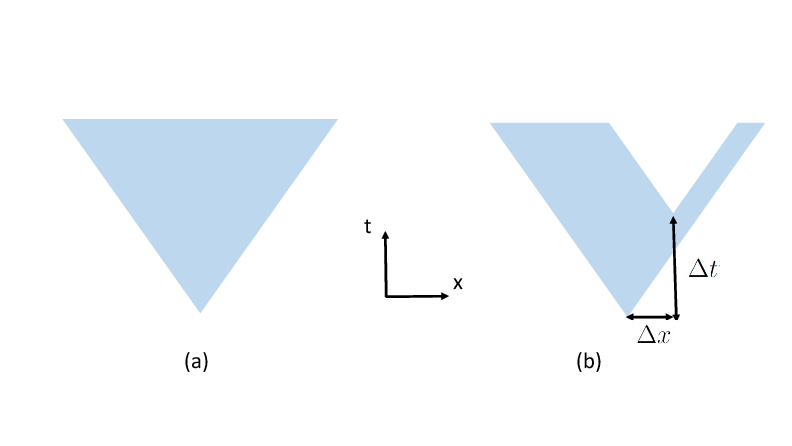
Figure 3: (a) An instant folded string is created and expands classically; (b) upon quantum splitting, it generates an energy-EPR state behaving as an expanding dipole.
Experimental Consistency, Collapse Efficacy, and Scaling Relations
The stringy DP-like model's colored noise structure means that high-frequency radiative bounds are irrelevant, while low-frequency constraints from force-noise experiments (e.g., LISA Pathfinder) are easily accommodated. Collapse rates scale as g0−6, while diffusion and heating scale as g0−2, permitting fast collapse without excessive side effects.
Parameter windows for effectiveness (collapse times) and experimental consistency are outlined. The colored nature allows room for collapse models with macroscopic efficacy that are not excluded by existing data, unlike the standard DP model. Future accelerator searches may probe the string scale implied by relevant values of g0, especially if the suppression factor from dipole interactions is not exponentially large.
Implications: Measurement, Decoherence, and Spacetime Structure
A central interpretational issue addressed is whether the stochastic noise kernel induced by IFS dynamics represents fundamental, irreversible wavefunction collapse, or merely effective decoherence arising from coarse-graining over inaccessible degrees of freedom. The answer is context-dependent, relying on the global structure of spacetime:
- In Minkowski/AdS backgrounds: Stochasticity is purifiable, corresponding to traditional environmental decoherence without genuine non-unitarity.
- In cosmological/de Sitter regimes: Information needed for purification is causally inaccessible, especially during dark energy epochs or cyclic cosmologies, making the distinction between fundamental and effective stochasticity operationally moot.
Thus, the emergence of a DP-type kernel in string cosmology is tied to both IR gravitational effects and horizon structure, potentially linking cosmological dynamics to foundational questions in quantum measurement.
Conclusion
This work demonstrates that string theory, in a cosmological setting dominated by IFSs and their decay products, provides a structurally precise, UV-complete analogue of the DP objective collapse model. The resulting colored noise structure alleviates major experimental constraints and offers a phenomenologically viable collapse mechanism for macroscopic superpositions. The broader theoretical implications pertain to the nature of stochasticity and quantum state reduction in quantum gravity, highlighting how cosmological global observables and horizon structure may determine whether decoherence is operationally equivalent to fundamental collapse. Further exploration of IFS dynamics and their role in cyclic cosmologies may refine our understanding of both cosmic acceleration and quantum measurement in string theory.