- The paper demonstrates that causal quantum channels are nowhere dense in the space of local channels, highlighting the significant restrictions imposed by causality.
- It employs Banach and operator space theory to reveal that causality-compatible unitaries are meagre, with measure zero under Haar random selection in finite dimensions.
- The study’s findings challenge current QFT measurement models and motivate further exploration into constructing physically realizable causal channels.
Summary of "Causality is rare: some topological properties of causal quantum channels" (2603.25315)
Motivation and Context
The paper investigates the structural and topological properties of causal quantum channels—those compatible with relativistic causality constraints—particularly within quantum field theory (QFT). Drawing from Sorkin's impossible operations, which highlighted that locality alone does not guarantee causality, the manuscript explores how much of a restriction causality places relative to locality on quantum channels and quantum operations. Recent advances in AQFT, detector models, and compositional approaches motivate a precise quantification of the "rarity" of causal channels compared to local channels.
Quantum channels are formalized as normal, unital completely positive (nUCP) maps between von Neumann algebras. The analysis leverages Banach and operator space theory to rigorously define the spaces of interest, particularly the space of completely bounded maps with the CB-norm, its predual, and relevant operator topologies (norm, strong/weak operator, σ-weak). This allows for precise statements regarding closure, compactness, and the convex structure of quantum channels.
Local channels are those acting trivially on operators supported in the spacelike complement of a region, while causal channels are those for which, in operational scenarios (Figure 1), interventions in one spacelike region do not influence expectations in another spacelike-separated region—formalized via Sorkin's condition and commutator relations.
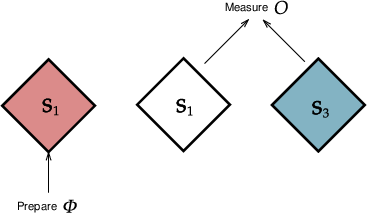
Figure 1: A spacetime scenario with N=3 spacelike separated systems; preparation in the first system should be invisible in the expectation value if the implemented unitary U is causal.
Main Results: Rarity and Topological Properties of Causal Channels
The central claim is that the set of causal channels is extremely "rare" among local channels, made rigorous by the following results:
These results are proved using descriptive set theory, leveraging properties of closed subspaces of Banach spaces and topological groups, and operator theory results on von Neumann algebras.
Numerical and Structural Demonstrations
- For two finite-dimensional spacelike-separated systems, the set of causal unitaries is strictly the subgroup of tensor-product unitaries, which is closed and has Haar measure zero in the ambient unitary group.
- The extension of these arguments to QFT requires operator topological methods, since infinite-dimensional unitary groups lack Haar measure.
Practical and Theoretical Implications
Measurement Models and Channel Realizability
The paper raises pointed questions about explicit measurement models in QFT, where most tractable constructions use unbounded self-adjoint operators (e.g., field operators and Wick polynomials) as generators. The rarity results imply that almost all causal channels and unitaries cannot be approximated by this class of physically motivated couplings, challenging current approaches to constructing causal measurements in AQFT and the FV framework.
Constraints on Channel Construction
The conclusion is that either there exist large classes of coupling models yet undiscovered which can yield causal channels, or that most theoretically causal channels cannot be physically realized via interactions in local QFTs. This has direct implications for attempts to craft a "causality-aware" Stinespring theorem connecting abstract causal channels to dilation via concrete QFT interactions.
Future Directions
The paper outlines areas for further investigation:
- Relaxation of normality and von Neumann algebra assumptions in favor of more general C∗-algebraic approaches, though at a cost of losing topological tractability.
- Broader exploration of measurement and channel dynamics beyond standard Lagrangian-coupling paradigms, given the co-dense nature of the known models in the causal channel space.
- Theoretical development connecting the Banach/CB framework to compositional QFT and boundary formalism approaches.
Conclusion
This work rigorously demonstrates that causality represents a profoundly restrictive property on quantum channels, both in quantum information and AQFT: causal channels and unitaries occupy nowhere dense/meagre subsets within the local channel/unitary spaces. The results sharpen Sorkin's insight—local channels are generically acausal—and have deep implications for the feasibility of measurement models, unitary dynamics, and channel construction in QFT. The possibility of extending physically meaningful dilation constructions to the full space of causal channels remains an open problem.