- The paper demonstrates that the Maldacena-Ludwig wall transforms fermionic wavepackets into exotic, fractionally charged states via non-invertible symmetry operations.
- It employs bosonization and current algebra techniques to derive explicit outgoing wavefunctions, showing a logarithmic divergence in the fermion number operator.
- The study highlights significant implications for both high-energy monopole physics and condensed matter systems, challenging traditional Fock space representations.
Wavepacket Scattering by the Maldacena-Ludwig Wall: Fractionalization and Divergent Multiplicities
Introduction and Problem Statement
The paper addresses the quantum state structure of fermionic wavepackets following their scattering by the topological boundary condition known as the Maldacena-Ludwig (ML) wall. This defect, which arises in the context of s-wave fermion-monopole scattering in four-dimensional QED and the multi-channel Kondo effect, is distinguished by its capacity to transmute elementary excitations into exotic, fractionally charged states. The ML wall’s action is formalized as a non-invertible topological symmetry operation that implements a duality exchanging the 8V and 8S representations of the SO(8) current algebra. This setting encompasses both high-energy monopole phenomena and condensed matter multi-channel impurity physics.
A central unresolved feature in these systems has been the explicit post-scattering quantum state: does it reside within the original Fock space, how are fractional quantum numbers realized, and what is the structure of local and global observable expectations—especially regarding energy, charge, and fermion number?
Hilbert Space Structure and the Maldacena-Ludwig Wall
The ML wall enacts a Z2 gauging that exchanges 8V and 8S and is topological in the IR. In an unfolded 2D setup (after Polchinski), the system consists of right-moving fermions on R, with the ML wall at x=0 mediating the symmetry action. The system on a circle with two ML walls admits a Hilbert space organized as direct sums of SO(8)1 modules—the trivial (χ0), vector (8S0), and spinor (8S1) representations—mapping before and after the application of the wall. The explicit fusion rule of the wall, 8S2, is central for identifying state sectors and for the consistent definition of localized excitations.
Localized wavepackets prepared in the 8S3 vacuum sector can be acted on by the wall's (non-invertible) symmetry operation, implemented as a specific 8S4 with 8S5 and explicit matrix structure (Eq. (gg) in the text). The 8S6-action recasts creation operators and enables a prescription for determining post-scattering wavefunctions.
Explicit Construction and Properties of Exotic Outgoing States
The authors provide an explicit and algorithmic construction for states with two localized excitations (say, a fermion 8S7 and anti-fermion 8S8), culminating in a universal formula for the outgoing wavefunction after application of the ML transformation. The key steps are:
- Preparation of 8S9 localized states.
- Expression using bosonization as a rotation in current algebra: realization as exponentials of integrated currents smeared over SO(8)0 (see Eq. (before) and Eq. (after)).
- Action of the ML wall translates to a nontrivial linear transformation of the bosonized charge operators, encoding the fractionalization phenomenon.
The transformed state is then of the form:
SO(8)1
where SO(8)2 are Cartan currents and SO(8)3 is the characteristic function between SO(8)4 and SO(8)5.
Localization, Fractional Charges, and Physical Observables
Analysis of local observables in the post-scattering state shows:
- Charge and energy densities remain localized around each wavepacket center.
- Local integrals of charge in the region around an excitation acquire fractional values: the four Cartan charges take half-integer values, e.g., SO(8)6, despite total charge quantization.
- These exotic excitations propagate ballistically, preserving localization.
Divergence in the Number Operator
A principal quantitative result is the study of the expectation value of the fermion number operator SO(8)7 (the sum of particle and anti-particle numbers) in the outgoing state. Both theoretical analysis and numerical evaluation show:
- SO(8)8 diverges logarithmically as the support of the initial wavepacket becomes pointlike: specifically, SO(8)9 where Z20 is the width of the wavepacket.
- This increase is confirmed analytically via estimates on singular value decompositions of the transformation matrix, and numerically by discretization of the corresponding integral operator kernel.
The physical content of this result is that in the original Fock space basis, "accounting for" the fractionalized outgoing exotic excitation requires an infinite superposition of elementary-fermion/antifermion pairs when the wavepacket is sharply localized.
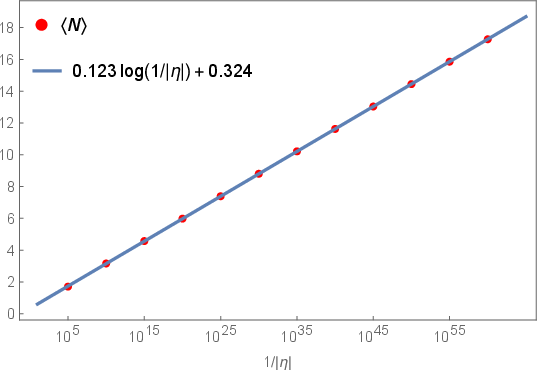
Figure 1: Numerical expectation values of particle number in the state Z21 at various values of Z22, confirming the logarithmic divergence Z23 upon localization.
Sector Structure and Operator Interpretation
The authors clarify that the tensor structure across the four Z24 modules is observer dependent: which sector a state resides in is not locally detectable, but globally assigned by total quantum numbers. As such, within a localized subregion, excitations cannot be assigned an intrinsic superselection label. The wavefunctions of the post-scattering states can always, within any desired accuracy, be chosen to reside in the vacuum sector by augmenting the state with distant compensating excitations.
Operators generating these fractionalized wavepackets are seen as position-space symmetry operations—explicitly, as path-ordered exponentials of the current, generating topological defect lines attached to the locations of the wavepackets.
Theoretical and Practical Implications
Theoretically, the paper provides a definitive resolution of the structure of exotic, fractionally charged outgoing states resulting from topological defect boundary conditions in both high energy and condensed matter settings. It shows that non-invertible symmetries genuinely fractionalize quantum numbers in a sense consistent with local current algebra but at the cost of infinite-multiplicity superpositions in the ultraviolet Fock basis.
Practically, these results suggest difficulties in constructing or measuring the field-theoretic content of such states using only the original fermionic operators—any probe relying on such a Fock space will encounter severe (logarithmic) divergences. On the other hand, local observables tied to conserved currents and energy-momentum tensor expectations remain physically sensible.
The results generalize to the 4D Callan-Rubakov context: the explicit wavefunctions derived for the s-wave sector yield a feasible prescription for the outgoing state, with divergence structure and charge fractionalization inherited directly from the 2D model.
Future Directions include: (1) analysis of full angular-momentum-resolved (beyond s-wave) outgoing states in 4D, (2) construction and measurement protocol design that is sensitive to local fractionalization but not divergent Fock content, and (3) formal development of LSZ-type reduction procedures in the presence of non-invertible symmetry defects.
Conclusion
The work offers an explicit, constructive answer to the fate of fermionic wavepackets scattered by the Maldacena-Ludwig wall: the outgoing states exhibit fractionalization of local charge and a logarithmic divergence in the number of constituent elementary excitations for sharply localized wavepackets. This dichotomy between locally well-defined, physical fractional excitations and ultraviolet Fock space divergence encapsulates the core theoretical subtlety in systems with non-invertible symmetry walls and provides the foundation for practical and foundational advances in both high energy and condensed matter systems with topological defects (2603.25508).

