- The paper introduces a generalized theta-deformed oscillator algebra that interpolates between conventional Bose/Fermi statistics and quon deformations.
- It formulates a relativistic QFT framework predicting atomic transitions that violate the Pauli exclusion principle under noncommutative spacetime.
- The study outlines experimental paths for detecting quantum gravity effects through high-precision tests of forbidden transitions in atomic systems.
Statistical Violations and Particle Indistinguishability in Quantum Spacetime
Introduction
The paper "When identical particles cease to be indistinguishable: violation of statistics in quantum spacetime" (2603.25552) investigates the impact of quantum gravity-induced noncommutative spacetime structures on the fundamental symmetries associated with identical particles. The work constructs a relativistic quantum field theory (QFT) employing the most general oscillator algebra compatible with θ-deformed Poincaré symmetry, thereby extending the conventional twisted statistics framework to a quon-like deformation class that allows non-involutive particle exchanges. The analysis rigorously explores the coherence, dynamics, and phenomenology of such deformations at both the free and interacting levels, with a particular focus on atomic systems and forbidden transitions that violate the Pauli exclusion principle (PEP).
Generalized Oscillator Algebra and Twisted Quon Statistics
The construction centers around the Qθ algebra, an oscillator structure integrating a Lorentz-invariant exchange function η(p,q) and a twist element fθ(p,q). This algebra interpolates between Bose/Fermi statistics and infinite statistics, generalizing previously studied twisted and quon frameworks. Physical consistency—specifically positive-definite Hilbert space norms—necessitates real and bounded exchange functions: −1≤η(p,q)≤1.
The theory reveals that, for ∣η∣<1, multiparticle states arising from permutations of creation operator monomials become linearly independent, obstructing conventional projection onto purely bosonic or fermionic subspaces. The decomposition of generic vectors into irreducible representations of the symmetric group Sn thus involves non-unique sectorization unless twisted symmetry is imposed, leading to block-diagonal density operators and potential preservation of particle indistinguishability only under strict superselection rules (SSRs).

Figure 1: Six-point Green function with deformed statistics; exchange factors Qθ mediate permutations of electrons, reflecting the statistical deformation.
Quantum Field Theory Foundation and Correlation Structure
The Qθ formalism coherently supports both free and interacting field dynamics. For twisted statistics (∣η∣=1), the Hamiltonian retains standard bilinear form, while quon deformations (Qθ0) necessitate infinite-degree expansions due to the absence of commutativity among creation and annihilation operators. The number operator and Hamiltonian thus admit expansion terms of all particle degrees, consistent with relativistic invariance and conservation laws.
Braided Wick contractions enable Qθ1-point functions to be written in terms of two-point correlators, with explicit dependence on the exchange factors. The two-point propagator retains standard structure and spectral representation.

Figure 2: Structure of the amputated correlation function Qθ2; dressed electron (red) and nucleus (purple) propagators are depicted.
Atomic bound states, exemplified by helium-like atoms, are analyzed within a generalization of the Bethe-Salpeter framework. The associated Green functions lose their permutation symmetry under quon deformation but can be symmetrized to recover sectoral structure. Statistical deformation directly modulates the symmetry properties of atomic wavefunctions, and transitions between symmetry sectors become feasible unless SSRs are strictly enforced.

Figure 3: Six-point Green function kernel structure in the commutative limit; all irreducible interactions are depicted within Qθ3.

Figure 4: Deformed six-point Green function for helium-like atom; blobbed lines represent dressed propagators, Qθ4 the correlation function.
Pauli Violation Phenomenology: SSRs and Their Breakdown
The phenomenological consequences diverge sharply depending on the status of SSRs. Assuming SSRs hold, PEP-violating transitions are modulated only by the deformation parameters and the exchange symmetry, and both twisted bosonic and fermionic sectors contribute to transition amplitudes. In twisted-only statistics, the suppression factors vanish, and forbidden transitions occur with rates comparable to allowed ones, in stark contradiction with experiment.
If SSRs are broken and atoms are not constrained to permutation-symmetric sectors, indistinguishability effectively breaks down, and the associated density operators are not permutation-invariant. PEP-violating transitions then depend on the specific form of the quon deformation: for Qθ5 (parameterizing the low-energy expansion of Qθ6), suppression disappears and is excluded phenomenologically; for Qθ7, transition rates are suppressed by powers of the noncommutativity scale, allowing marginal compatibility with experimental limits.
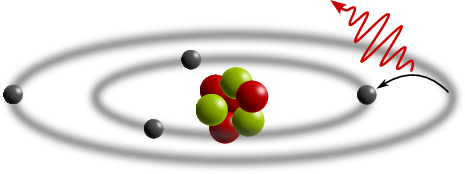
Figure 5: Representation of radiative atomic transition between PEP-allowed and PEP-violating states.
Implications and Future Directions
The findings demonstrate that conventional indistinguishability and SSRs are not guaranteed under generic quantum gravity-induced noncommutative deformations. Twisted-only statistics, although covariant, predict PEP violation at experimentally forbidden rates. A subset of quon deformations suppress forbidden processes—but only if SSRs are violated, leading to effective particle distinguishability. These results indicate the necessity of high-precision PEP tests as probes of noncommutative QG scenarios and highlight the limitations of standard QFT approaches to noncommutative gauge theory, suggesting the need for further exploration of strict braidings and quon structures for UV regularization.
Conclusion
This work rigorously extends relativistic QFT to accommodate the most general Qθ8-deformed statistics, unveiling the foundational role of permutation symmetry and SSRs in atomic systems. The theoretical infrastructure not only links quantum gravity phenomenology to atomic-scale precision tests but also provides a systematic framework for investigating the statistical and dynamical consequences of noncommutative spacetime models. Future research could further quantify suppression mechanisms, map higher-order corrections, and refine experimental constraints, potentially elucidating the compatibility of noncommutative QFT with observed matter statistics and opening new avenues in both fundamental theory and high-sensitivity phenomenology.

