- The paper demonstrates that integrating modular localization with explicit wedge-localized vector construction leads to measurable Bell-CHSH violations in relativistic scalar QFT.
- It reveals that incorporating the modular spectrum into Bell operators is critical for achieving near-maximal quantum correlations, impacting Tsirelson’s bound.
- The work offers a practical framework for tuning Bell tests in local QFT, paving the way for advances in relativistic quantum information and entanglement studies.
Modular Theory and Bell-CHSH Inequality in Relativistic Scalar Quantum Field Theory
Modular Localization and Its Role in Bell-CHSH Violations
This work investigates the interplay between Tomita-Takesaki modular theory and violations of the Bell-CHSH inequality in the context of relativistic scalar quantum field theory (QFT), focusing specifically on wedge localization structures and the construction of modular localized vectors in 1+1 dimensions. Leveraging the Bisognano-Wichmann theorem, the authors formulate explicit wedge-localized vectors in rapidity space and scrutinize their effectiveness for achieving violations of the Bell-CHSH bound. The construction and utility of the classic Summers-Werner vectors are revisited, and the necessity for Bell operators to encode spectral data of the modular operator to reach—or saturate—Tsirelson’s bound is elucidated.
Construction of Modular Localized Vectors
The modular operators (δ,j), with δ=e−2πK (where K is the generator of Lorentz boosts) and j the CPT operation, are utilized to define an anti-linear involution s=jδ1/2. The wedge-localized vectors ψ(θ) are characterized by analytic properties in a strip in complex rapidity and satisfy the modular localization condition sψ=ψ. The explicit projector construction
ω(θ)=21+sϕ(θ)
for suitable analytic ϕ yields modular localized vectors supported in the right and left wedges. The freedom in choosing polynomials in the rapidity variable permits adjustable overlap properties, crucial for fine-tuning the degree of Bell-CHSH violation.
Bell-CHSH Inequality in the Wedge Setting
The Bell-CHSH correlator is
⟨C⟩=⟨0∣(A(f)+A(f′))B(g)+(A(f)−A(f′))B(g′)∣0⟩,
where δ=e−2πK0 are supported in space-like separated wedge regions and δ=e−2πK1 are (bounded) Hermitian operators constructed from smeared fields. The violation occurs for δ=e−2πK2, with the quantum maximal value given by Tsirelson’s bound, δ=e−2πK3.
The paper details explicit constructions using Weyl operators built from modular-localized vectors. For Gaussian-type modular-localized vectors, the authors achieve a maximal violation on the order of δ=e−2πK4, already well above the classical bound but short of saturation.
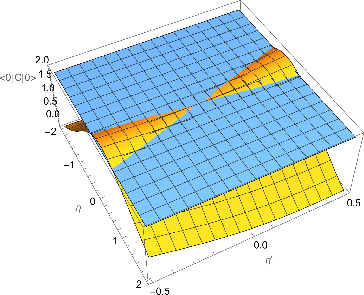
Figure 1: Behavior of the Bell-CHSH correlator δ=e−2πK5 as a function of the parameters δ=e−2πK6 and δ=e−2πK7 for modular-localized vectors; the violation region is marked by orange.
Analysis of Bell Operators and Modular Spectrum
A comparison is drawn between the use of unitary Weyl operators and bounded Hermitian operators, such as those analogous to parity in quantum optics. The latter, when naively transplanted into the QFT setting, only attain the classical Bell bound (i.e., no violation). The critical insight is that Bell operators must encode information about the modular spectrum—otherwise, exponential Gaussian damping precludes large violations.
The authors revisit the Summers-Werner construction, highlighting that only with operators containing explicit dependence on the modular spectrum (normalized wavepackets concentrating near the endpoint δ=e−2πK8 of the modular spectrum) and incorporating scaling factors dependent on δ=e−2πK9 can one approach the Tsirelson bound.
Towards Saturation: Algebraic Constraints and Operator Choices
The canonical Fermi case is reviewed in detail, where the anti-commutation relations allow straightforward construction of dichotomic, Hermitian, and bounded observables directly from the field. The calculation demonstrates exact saturation of the Tsirelson bound in the vacuum limit. In contrast, in the bosonic case, analogous operators typically fail to provide enough spectral selectivity. The authors argue, supported by analytic construction, that only observables sensitive to the modular spectrum and wedge-localized according to modular theory can achieve near-maximal quantum correlations.
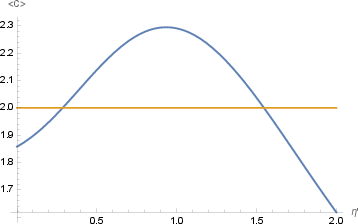
Figure 2: Bell-CHSH correlator K0 as a function of K1 for fixed K2; maximal violation reaches approximately K3.
The analysis points out that, for the bosonic field, constructing Bell operators that both are Hermitian, bounded, and saturate the bound remains challenging. The use of vertex operators from bosonization is suggested as a promising direction, given their effective fermionic algebra and wedge locality.
Implications and Prospects
This work underlines that in full relativistic QFT, Bell-CHSH violations up to or near Tsirelson’s bound are not generic for all operator choices, even for free field theories. Modular localization and spectral properties underlying Tomita-Takesaki theory are essential for the construction of observables capable of maximal non-locality. This has nontrivial implications for analyzes of relativistic entanglement, local quantum operations, and the structure of von Neumann algebras in algebraic QFT, notably of type K4.
The operator constructions presented offer a concrete procedure for “tuning” Bell tests in local QFT. Practically, this framework could guide the search for entanglement witnesses or information-theoretic protocols in relativistic quantum technologies. The emphasis on incorporating the modular spectrum into observable design suggests deep connections to modular chaos, information scrambling, and holography.
Conclusion
The analysis systematically elucidates the essential role of modular theory and wedge localization in relativistic QFT for realizing violations of the Bell-CHSH inequality. While generic classes of bounded Hermitian operators are insufficient for maximal violations in the scalar field case, carefully constructed operators reflecting the modular spectrum can attain near-maximal quantum correlations. This structural insight may have broad theoretical consequences for quantum information in QFT, the classification of operator algebras, and future explorations at the interface of quantum foundations and quantum gravity. The identification of vertex operators from bosonization as potential candidates for saturating Tsirelson’s bound opens promising avenues for further development.