Achieving double-logarithmic precision dependence in optimization-based quantum unstructured search
Published 27 Mar 2026 in quant-ph, math-ph, and math.OC | (2603.26039v1)
Abstract: Grover's algorithm is a fundamental quantum algorithm that achieves a quadratic speedup for unstructured search problems of size $N$. Recent studies have reformulated this task as a maximization problem on the unitary manifold and solved it via linearly convergent Riemannian gradient ascent (RGA) methods, resulting in a complexity of $O(\sqrt{N}\log (1/\varepsilon))$. In this work, we adopt the Riemannian modified Newton (RMN) method to solve the quantum search problem. We show that, in the setting of quantum search, the Riemannian Newton direction is collinear with the Riemannian gradient in the sense that the Riemannian gradient is always an eigenvector of the corresponding Riemannian Hessian. As a result, without additional overhead, the proposed RMN method numerically achieves a quadratic convergence rate with respect to error $\varepsilon$, implying a complexity of $O(\sqrt{N}\log\log (1/\varepsilon))$, which is double-logarithmic in precision. Furthermore, our approach remains Grover-compatible, namely, it relies exclusively on the standard Grover oracle and diffusion operators to ensure algorithmic implementability, and its parameter update process can be efficiently precomputed on classical computers.
The paper introduces a Riemannian modified Newton method that reduces the iteration complexity to O(√N log log(1/ε)) for quantum unstructured search.
It leverages the property that the Riemannian gradient is always an eigenvector of the Hessian, enabling closed-form computation of the Newton direction without extra overhead.
The approach ensures quadratic convergence with Grover-compatible gates, maintaining both high-precision optimization and quantum-query efficiency.
Double-Logarithmic Precision Dependence in Optimization-Based Quantum Unstructured Search
Introduction
This work introduces a Riemannian modified Newton (RMN) method for quantum unstructured search, refining previous manifold optimization approaches by improving the dependence on precision from single-logarithmic to double-logarithmic in the overall iteration complexity. The RMN method operates on the unitary manifold U(N), aligning with the Grover model, and leverages the remarkable algebraic property that the Riemannian gradient is always an eigenvector of the Riemannian Hessian for the projector Hamiltonian underlying the unstructured search problem. This allows direct construction of the Newton direction with no overhead beyond gradient ascent, and thus a complexity of O(Nloglog(1/ε)) for target error ε.
Problem Formulation and Manifold Optimization Framework
The unstructured search problem is expressed as maximizing the expectation of a marked-item projector H over all possible unitaries acting on the initial uniform state. Formally, the optimization reads:
U∈U(N)maxf(U),f(U)=Tr(HUψ0U†),
where H is an orthogonal projector identifying the marked subspace, and ψ0 is the uniform superposition state. All quantum gates are restricted to the Grover-compatible set—that is, oracles and diffusion operators.
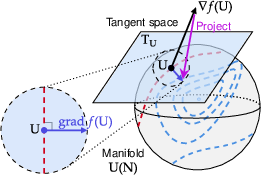
Manifold optimization on U(N) is enabled by the explicit characterization of the tangent space via the Lie algebra u(N). The Riemannian gradient of f is O(Nloglog(1/ε))0, and the search is restricted to a two-dimensional subspace corresponding to the so-called Grover plane, ensuring implementability and simulability with exponential speedup.
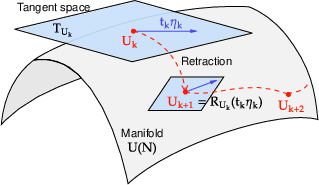
Figure 1: Schematic illustration of a manifold optimization iteration on the unitary manifold O(Nloglog(1/ε))1.
First-Order (Gradient) Versus Second-Order (Newton) Methods
The prior state of the art applied Riemannian gradient ascent (RGA) to this formulation, achieving complexity O(Nloglog(1/ε))2, reflecting linear convergence in the error parameter. Updates involved Grover-compatible retractions based on product formulas, where all iterates and gradients remained confined to the Grover plane. The underlying structure admits efficient classical simulation, as the dynamics reduce to the evolution of two complex amplitudes.
However, RGA is fundamentally limited by single-logarithmic dependence on O(Nloglog(1/ε))3. The Riemannian modified Newton method addresses this bottleneck by exploiting the fact that for projector Hamiltonians, the Riemannian gradient is always an eigenvector of the Hessian—i.e., the Newton direction is collinear with the gradient, with explicit, analytic scaling. Thus, the Newton equation solution is available in closed form on each iteration.
Grover-Compatible Riemannian Modified Newton Method
The RMN algorithm modifies the Newton step with a sign correction and line search, using
O(Nloglog(1/ε))4
where O(Nloglog(1/ε))5 is the current Riemannian gradient, O(Nloglog(1/ε))6 is the current success probability, and O(Nloglog(1/ε))7 is a small positive constant for numerical stability. The parameter update can be precomputed classically, and all necessary gates are Grover-compatible.
The method alternates between gradient and Newton-like steps (depending on proximity to the solution), achieving quadratic convergence locally. Concretely, the cost per iteration is essentially identical to RGA but the convergence to high-precision solutions is highly accelerated.
Numerical Results
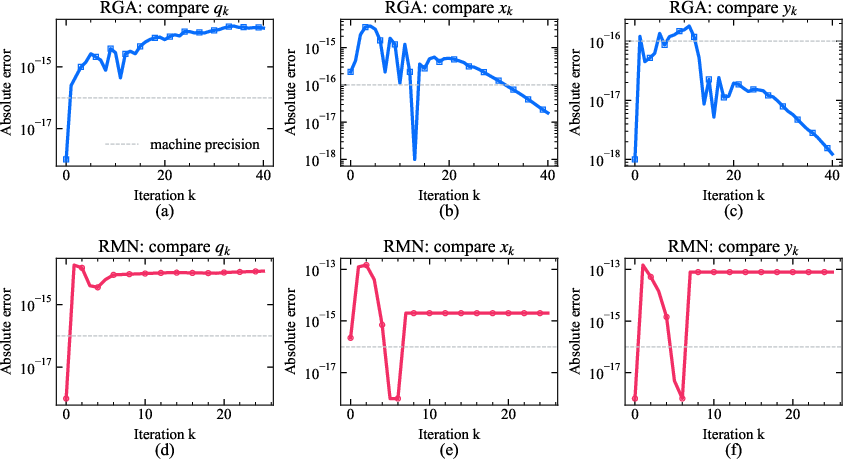
The RMN method exhibits roundoff-level agreement between the gradient-based and Newton-based schemes in classical simulation, confirming theoretical invariance of the Grover plane dynamics.
Figure 2: Absolute errors of the cost value O(Nloglog(1/ε))8 and expansion coefficients O(Nloglog(1/ε))9 between the classical simulation and the explicit full matrix implementation. (a)--(c): RGA; (d)--(f): RMN.
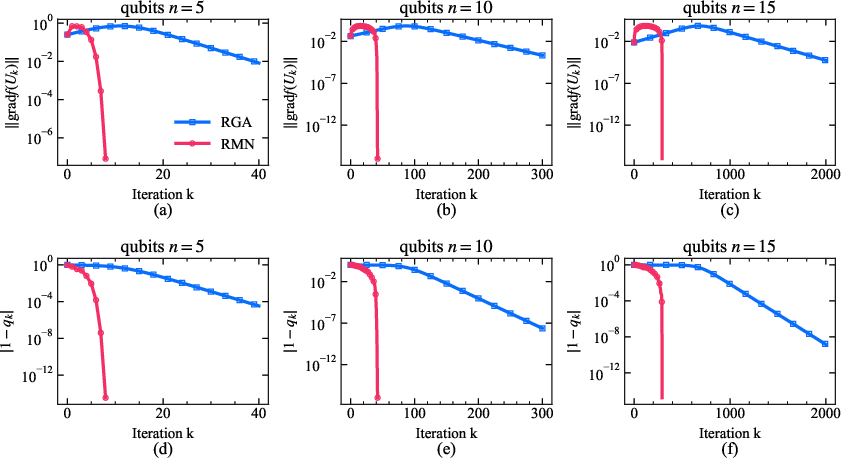
The quadratic convergence of RMN sharply contrasts with the linear convergence of RGA when examined in terms of function value error and gradient norm. For problem instances up to ε0 qubits, RMN rapidly reduces the error over several orders of magnitude in few iterations, while RGA requires a substantially larger iteration count for comparable precision.
Figure 3: Convergence comparison between the RGA and RMN methods for problem sizes of ε1, ε2, and ε3 qubits, demonstrating the quadratic convergence of RMN.
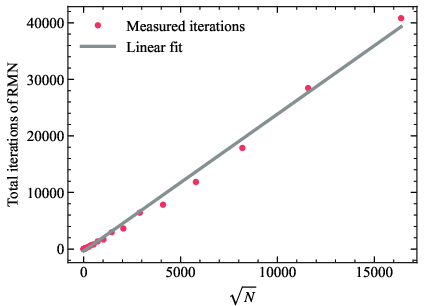
The scaling of the RMN method with problem size ε4 remains ε5 for fixed precision, confirming that the second-order acceleration focuses solely on the error dependence, not the quantum speedup itself.
Figure 4: Iteration complexity of RMN versus the square root of the problem size, demonstrating retention of Grover's quadratic quantum speedup.
Geometric Analysis and Theoretical Implications
The key structural insight underlying the RMN method is that for the unstructured search projector ε6, ε7 for any state ε8, where ε9. This eigenvector relation implies that the Newton step is always a rescaled gradient, precluding the need for explicit Hessian inversion or high-dimensional linear solves. Thus, the unitary manifold geometry naturally encodes the essential aspects of quantum search, and the RMN method efficiently traces the optimal path to the target state in double-logarithmic precision time.
Practical and Theoretical Perspectives
The RMN approach is implementable with Grover-standard gates and allows for classically precomputed parameters, which is relevant for near-term NISQ quantum devices where circuit optimality and gate economy are critical. The RMN algorithm can thus be immediately applied to high-precision quantum search tasks, error-reduced amplitude amplification, and Mannichian extensions of the canonical Grover framework.
From a theoretical perspective, the result reveals a deep connection between the spectrum of projector Hamiltonians and the structure of the Riemannian manifold governing quantum unitary evolution. The method draws a sharp boundary: such double-logarithmic complexity is only available for problems where the gradient is an exact eigenvector of the Hessian, which does not generalize to arbitrary quantum optimization landscapes.
Limitations and Future Directions
The dependence on the projector property H0 is intrinsic—general ground-state preparation, chemistry, and combinatorial quantum algorithms with non-projector Hamiltonians do not generally exhibit collinear Newton directions. Extension to broader quantum tasks will require either identification of auxiliary invariant subspaces or the development of approximate second-order (e.g., quasi-Newton) techniques tailored to the geometry.
Noise resilience and empirical stability on physical hardware must also be evaluated, particularly since high-precision algorithms can be sensitive to fluctuations and device errors. Integration with error-mitigation protocols will be essential for quantum advantage in practical, large-scale deployments.
Conclusion
The Grover-compatible Riemannian modified Newton method yields a theoretically optimal convergence rate—double-logarithmic in precision error—while fully preserving quantum-query efficiency and implementability. This work delineates the exact circumstances under which second-order geometric optimization is both computationally meaningful and physically realizable in quantum search, establishing clear avenues for both further generalization and experimentation in quantum algorithm design.
Figure 5: Riemannian gradient on the manifold; illustration of projection and update geometry on H1.