- The paper presents a cohesive framework that integrates quantum, topological, and twisted graphene configurations to explore novel plasmonic phenomena.
- The methodology combines multilayer modeling and plasmonic crystal designs to reveal enhanced field confinement, tunability, and disorder-resilient edge modes.
- The study highlights practical advances in quantum nanophotonics and optoelectronics, leveraging graphene’s geometry-induced non-Hermitian and topological effects.
Twisted, Topological, and Quantum Phenomena in Graphene Plasmonics
Introduction
This work delineates the emerging paradigms in graphene plasmonics by developing a cohesive perspective on the quantum, topological, and moiré-engineered (twisted) aspects of graphene-based plasmonic systems. The analysis integrates models and recent results from monolayer and multilayer architectures, twisted bilayer graphene, modulated plasmonic crystals, and strain- and geometry-induced topological effects, culminating in an overview of opportunities for quantum nanophotonics using graphene.
Fundamentals of Plasmonics and Graphene
The review contextualizes plasmonics within the nanophotonics framework, highlighting the hybridization of light and collective electron excitations as a key mechanism for deep subwavelength optical localization and enhanced light-matter interactions. Surface plasmon polaritons (SPPs) and localized surface plasmons (LSPs) are classified based on geometry and propagation, with graphene supporting both due to its unique two-dimensional Dirac electronic structure. The tunability of graphene plasmonic response, dominated by the intraband conductivity for THz/mid-IR, and the Drude-like nonlocal corrections are addressed through Kubo, semiclassical, and hydrodynamic approaches.
The enhancement over classical noble metal plasmonics is clearly articulated: graphene SPPs (GSPPs) in the THz/mid-IR range achieve higher field confinement, longer propagation length, and electrostatic gating–responsive tunability. This underlies practical advances in nanoscale optoelectronics and quantum sensing.
Topological Photonics and Bulk-Edge Correspondence
The paper expounds on the framework of topological invariants and their manifestation in condensed matter and photonics, with a focus on Chern number–engineered band structures and bulk-edge correspondence. Robust edge modes in photonic and plasmonic lattices, even in the presence of disorder, are identified as a hallmark of nontrivial topology. Notably, finite-size photonic systems can be engineered to support disorder-resilient edge states when the corresponding bulk topological invariant is quantized.
Multilayer and Twisted Graphene Architectures
Detailed modeling of graphene bilayers and multilayers is provided, with distinctions drawn between AB/AA stacking, double-layer, and twisted geometries. The electronic band structure, tunable band gaps, and coupling to substrate phonons (e.g., talc or SiC) are carefully linked to plasmonic and polaritonic properties. In AB-stacked bilayer graphene, bandgap creation by gating and the resulting changes in plasmonic Fano resonance structure at the optical phonon frequency are discussed.
Twisted bilayer graphene (TBG) is dissected as a platform for emergent moiré superlattices and flat electronic bands near the magic angle, which enable strongly correlated electron phenomena such as superconductivity (2603.26152). The corresponding plasmonic response includes quasi-flat plasmonic bands, chiral and slow plasmons [stauberQuasiFlatPlasmonicBands2016, huangObservationChiralSlow2022], and interaction with phonon polaritons in van-der-Waals heterostructures, such as with talc substrates.
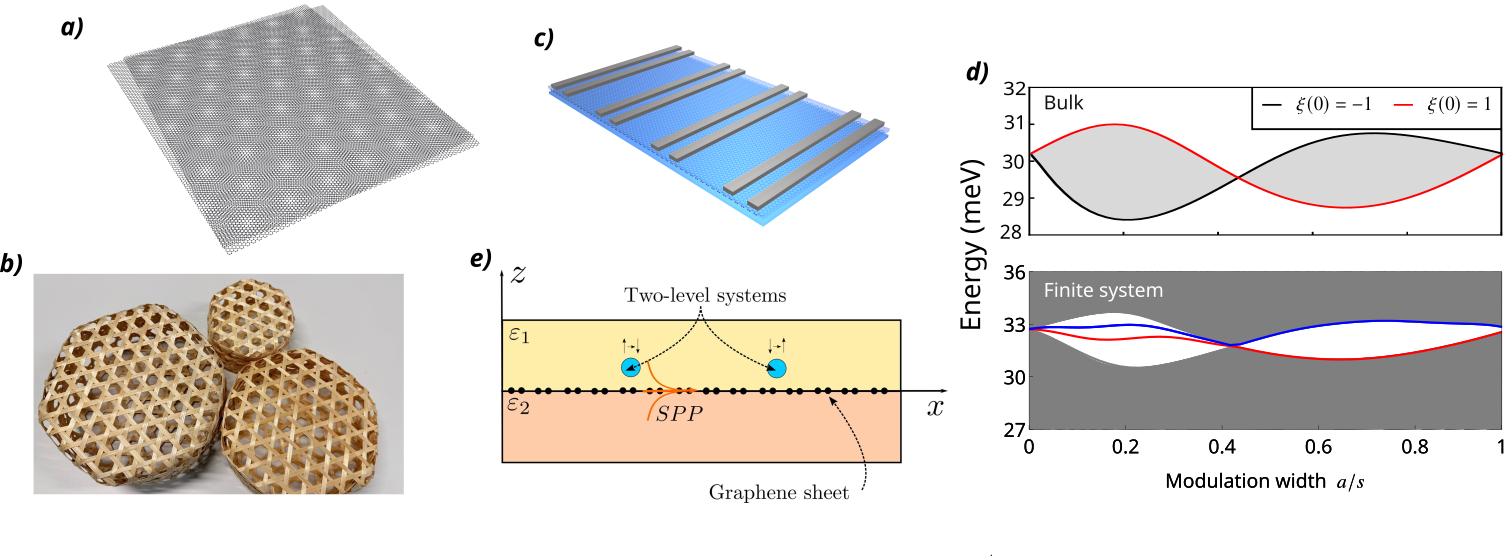
Figure 1: Schematic representations of key graphene plasmonic systems—twisted bilayer, kagomé lattice, SSH-like plasmonic crystals, as well as Kronig–Penney–type and emitter-coupled systems—illustrating geometrical and topological regimes.
Graphene Plasmonic Crystals: Spatial and Temporal Modulation
By leveraging the analogy with photonic crystals, various plasmonic crystal (PlC) architectures based on spatial modulation of the graphene’s electrostatic environment, periodic metallic gratings, or Fermi energy control are explored. This includes coupling between graphene nanoribbons and superlattices, as well as the realization of SSH-like 1D topological phases via plasmonic band engineering. Theoretical extensions to temporally modulated plasmonic/material systems—"plasmonic time crystals"—are included, with attention to momentum bandgap formation and the departure from frequency conservation [asgariTheoryApplicationsPhotonic2024, feinbergPlasmonicTimeCrystals2025].
Topological Plasmons in Modulated Graphene Structures
The explicit realization of topological plasmonic phases is discussed through two primary routes:
- External magnetic field (breaking time-reversal symmetry): Magnetoplasmonic edge states, including the extension to graphene antidot/superlattice geometries, support protected edge orbits in the GHz—mid-IR regime [jinTopologicalMagnetoplasmon2016, panTopologicallyProtectedDirac2017, jinInfraredTopologicalPlasmons2017].
- Intrinsic modulation: Periodic spatial modulation (e.g., via Fermi level) enables 1D topological plasmonic behavior, with SSH analogues in graphene plasmonic crystals [mirandaTopologyOnedimensionalPlasmonic2024, tatianag.rappoportTopologicalGraphenePlasmons2021]. Band inversion and edge-state emergence consistent with bulk-edge correspondence are characteristic signatures [breyQuantumBandStructure2025, soaresScreenedTopologicalPlasmons2025].
Quantum Plasmonics in Graphene
The manuscript provides a critical view on the transition from semiclassical to quantum plasmonics in graphene. Electronic quantum finite-size corrections become pronounced in sub-10 nm nanostructures [thongrattanasiriQuantumFiniteSizeEffects2012], but global quantization of plasmon modes and their coupling to quantum emitters and two-level systems dominate in nanophotonics experiments. The quantization protocols span canonical and hydrodynamic approaches, including master-equation–driven open quantum system models [ferreiraQuantizationGraphenePlasmons2020, cardosoApplicationMadelungHydrodynamics2025, breyQuantumPlasmonsDouble2024, soaresScreenedTopologicalPlasmons2025].
Graphene plasmonic qubits and their entanglement via GSPPs [sunGrapheneSourceEntangled2022], as well as circuit QED and photonic quantum logic proposals [alonsocalafellQuantumComputingGraphene2019, calajoNonlinearQuantumLogic2023], are emphasized.
Non-Hermitian, Open-System Effects and Loss
A substantial section is devoted to non-Hermitian modeling in plasmonic systems, driven by intrinsic losses (dielectric environment, phonon coupling, edge roughness) and environmental decoherence. Loss mechanisms are parametrized in the complex conductivity or derived via many-body theory [sharmaOpticalConductivityDamping2024, principiIntrinsicLifetimeDirac2013]. In the quantum regime, non-Hermitian Hamiltonians and Lindblad-formalism master equations are employed to correctly describe dissipative coupling between GSPPs and quantum emitters [antaoTwolevelSystemsCoupled2021, cortesNonHermitianApproachQuantum2020, simObservablesNonHermitianSystems2025].
Practical and Theoretical Implications, Outlook
The work closes with a prospective analysis positioning graphene as a leading platform for application-specific nanophotonics, including topological photonics in the mid-IR range, quantum information science, and on-chip photonic circuitry. The potential of kagomé and other designer lattices for supporting higher-order topological states (e.g., corner states) is highlighted as a future direction with implications for robust quantum sensing [wangIntriguingKagomeTopological2025]. As advances in material quality, nanofabrication, and quantum/non-Hermitian modeling continue, the prospect of fully functional quantum optoelectronic devices based on 2D plasmonics appears within reach [turunenQuantumPhotonicsLayered2022].
Conclusion
This paper thoroughly integrates the fields of quantum plasmonics, topology, and engineered moiré/twisted graphene phenomena, presenting a systematic overview that connects fundamental condensed matter models to breakthrough applications in nanophotonics and quantum technologies. The explicit treatment of quantum and non-Hermitian effects, topological band structure design, and the interplay between geometry, stacking, and substrate environment situate graphene as the central material for next-generation plasmonic science and technology.