- The paper shows that every CFT₃ exhibits an infinite LΛw₁+∞ symmetry realized through the ANEC and its conformal descendants.
- It employs light ray operators and Fourier mode expansions to construct a closed wedge algebra consistent with SO(3,2) isometries.
- These findings bridge quantum gravity in AdS₄ with holography, offering deep structural insights into the universal symmetry of 3D CFTs.
LΛw1+∞ Symmetry in Every CFT3
Introduction and Motivation
The research establishes that every three-dimensional conformal field theory (CFT3)—including strongly coupled and quantum CFTs—realizes an explicit action of the deformed soft symmetry algebra LΛw1+∞, previously discovered in the context of tree-level AdS4 Einstein gravity and its celestial holographic correspondence. In the bulk AdS4, soft graviton symmetries are described by a Λ-deformed version of the w1+∞ algebra, which incorporates a non-trivial Jacobi-satisfying extension compatible with SO(3,2) isometries but not with conventional conformal invariance due to the presence of a nonzero cosmological constant.
The work is motivated by a succession of developments in flat holography, asymptotic symmetries, and celestial CFT, where soft gauge or graviton modes generate infinite-dimensional symmetry algebras at null infinity. Recently, these ideas have been mapped conformally to AdS4, but a major open problem remained: whether the corresponding quantum (not just tree-level) boundary duals—including for arbitrary CFT3—realize these infinitely generated symmetry algebras.
Light Ray Operators and Algebraic Structure
A key technical element is the analysis and organization of light ray operators, particularly the family generated by the averaged null energy condition (ANEC) operator and its conformal descendants in CFT30.
The ANEC operator in flat space is defined as:
31
with generalizations 32 and 33 that integrate various moments and stress tensor components. Under conformal mapping from flat 34 to the 35 Einstein cylinder (EC36), these operators correspond to integrals along null trajectories connecting antipodal points on the boundary, providing a geometric parameterization by an angle on the 37.
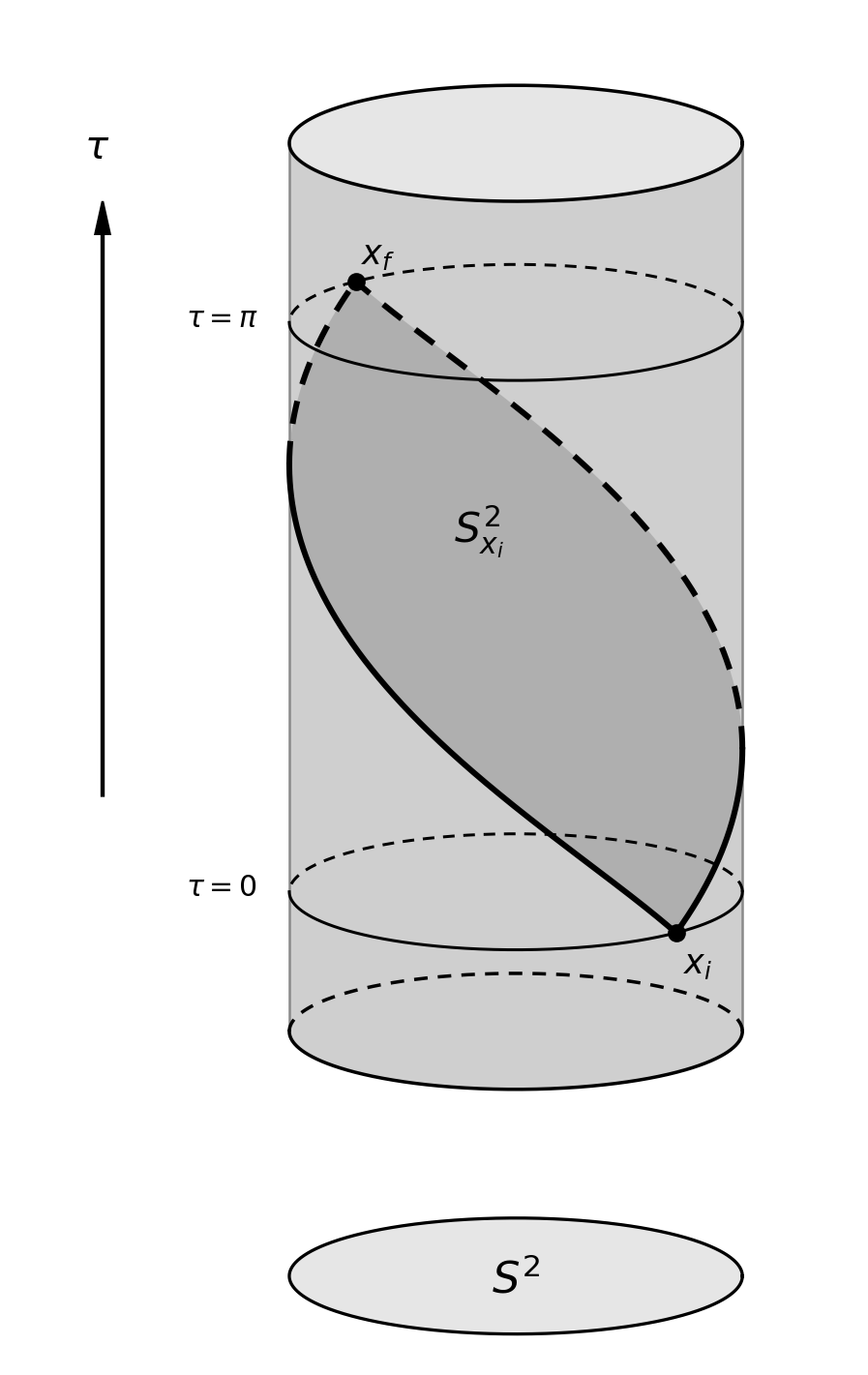
Figure 1: The set of all light rays (null 38) on the 39 Einstein cylinder, forming a Cauchy surface relevant to boundary operator construction.
Mode expansions (Fourier transforms in the 30 coordinate) lead to a basis 31. Their commutators, computed for general CFT32, yield a closed subalgebra:
33
34
These are extended by systematically taking conformal descendants and iterated commutators, leading to a wedge algebra forming a closed sector isomorphic to (a subalgebra of) 35.
Crucially, the algebra is labeled by three integer indices 36 reflecting 37 weights and with support on a specific wedge in this index lattice, where the lowest weights correspond to ANEC modes. The complete construction is visualized as a two-dimensional lattice.
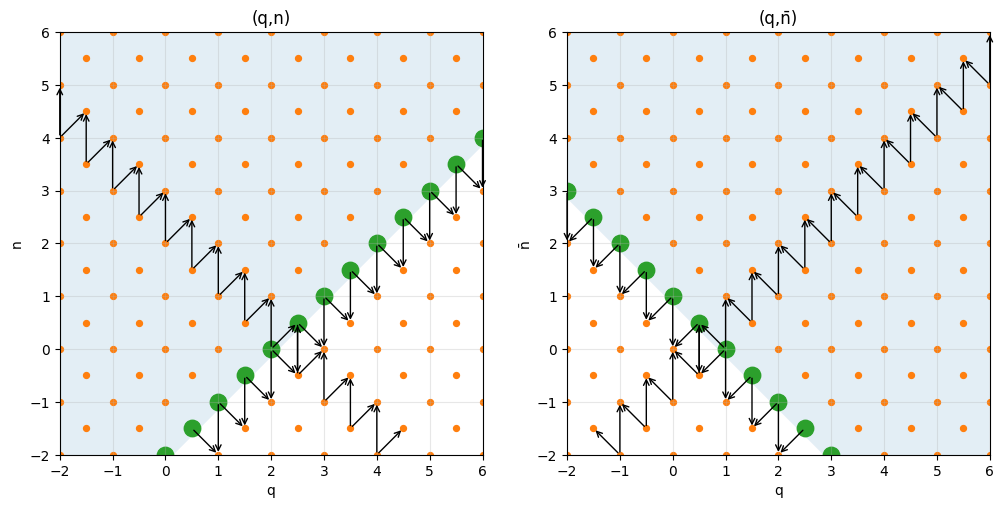
Figure 2: Lattice of states in the wedge algebra: green dots depict the ANEC modes at the extremal edge, while the shaded region is generated by conformal transformations and commutators.
The action of the full 38 isometry group on light ray operators is worked out in detail, constructing a module whereby the entire wedge algebra is generated by conformal descendants of the ANEC. The set of operators with quantum numbers in the wedge
39
close under the extended commutator, which in the mode basis reads:
LΛw1+∞0
The commutator structure is unique for each operator in the wedge and is constructed recursively from the ANEC using the conformal raising/lowering operators. The full constructive algorithm is demonstrated with explicit formulas and visualized in the lattice figure.
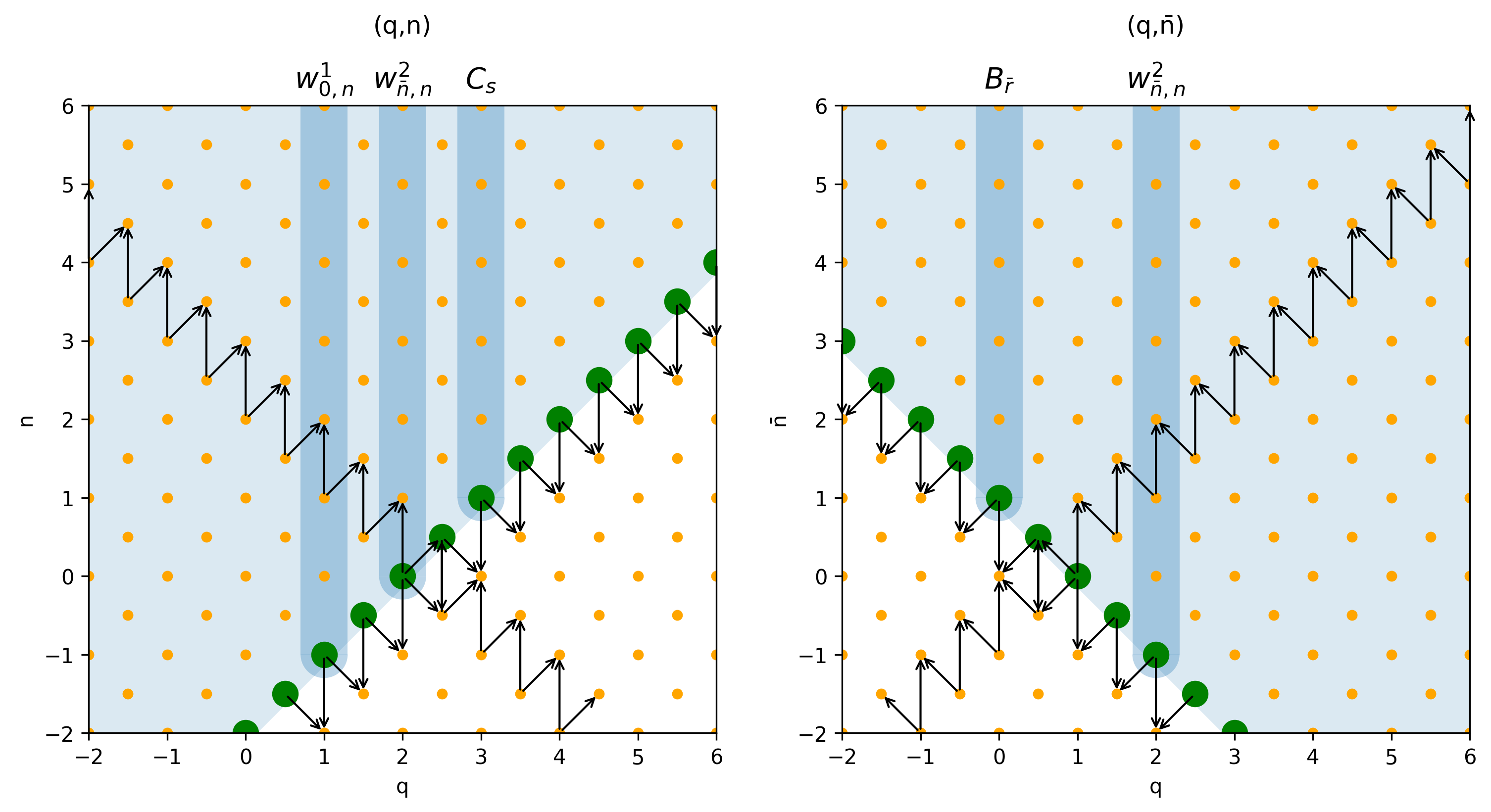
Figure 3: Construction overview—green dots represent ANEC modes, vertical strips are built from commutators and conformal transformations, illustrating the allowed and forbidden transitions in the lattice.
This derivation confirms all CFTLΛw1+∞1 models possess this infinite symmetry algebra at the quantum level, extending previous results that held only for tree-level perturbative gravity in AdSLΛw1+∞2.
Implications and Future Directions
This result implies a universal hidden symmetry structure in all unitary 3D conformal field theories, regardless of their coupling, spectrum, or integrability properties. Since the ANEC and its descendants are physical, state-independent operators in CFTLΛw1+∞3 (tied to causality and positivity of energy), the presence of this wedge algebra is a deep structural property of quantum field theory in three dimensions.
On the holographic side, the result strongly supports the conjecture that the deformed LΛw1+∞4 symmetry in (quantum) gravity on AdSLΛw1+∞5 is not an artifact of perturbation theory, but rather a robust, non-perturbative feature encoded at the operator level in the boundary CFTLΛw1+∞6.
The explicit construction also provides a powerful technical tool for studying constraints on correlation functions, OPE data, and modular Hamiltonians and for investigating the interplay between boundary and bulk symmetries, including effects of boundary conditions not captured in the self-dual sector.
A future problem is the extension to higher-dimensional CFTs, generalizations to other bulk boundary dualities involving positive cosmological constant (de Sitter), and the explicit construction of bulk analogs respecting standard AdSLΛw1+∞7 boundary conditions.
Conclusion
This work demonstrates that every 3D conformal field theory possesses a non-trivial, infinite-dimensional symmetry described by the wedge subalgebra of the deformed LΛw1+∞8 algebra, generated by the ANEC light ray operator and its conformal descendants. The construction unifies and rigorously extends celestial holographic symmetry ideas into the deep quantum regime and establishes a correspondence between non-abelian asymptotic symmetries in gravity and operator algebras in arbitrary CFTLΛw1+∞9 (2603.26459).
The identified symmetry should have lasting consequences for the study of holography, quantum gravity, and the structure of conformal field theories going forward.

