Static and Dynamic Approaches to Computing Barycenters of Probability Measures on Graphs
Published 27 Mar 2026 in stat.ML, cs.LG, and math.PR | (2603.26940v1)
Abstract: The optimal transportation problem defines a geometry of probability measures which leads to a definition for weighted averages (barycenters) of measures, finding application in the machine learning and computer vision communities as a signal processing tool. Here, we implement a barycentric coding model for measures which are supported on a graph, a context in which the classical optimal transport geometry becomes degenerate, by leveraging a Riemannian structure on the simplex induced by a dynamic formulation of the optimal transport problem. We approximate the exponential mapping associated to the Riemannian structure, as well as its inverse, by utilizing past approaches which compute action minimizing curves in order to numerically approximate transport distances for measures supported on discrete spaces. Intrinsic gradient descent is then used to synthesize barycenters, wherein gradients of a variance functional are computed by approximating geodesic curves between the current iterate and the reference measures; iterates are then pushed forward via a discretization of the continuity equation. Analysis of measures with respect to given dictionary of references is performed by solving a quadratic program formed by computing geodesics between target and reference measures. We compare our novel approach to one based on entropic regularization of the static formulation of the optimal transport problem where the graph structure is encoded via graph distance functions, we present numerical experiments validating our approach, and we conclude that intrinsic gradient descent on the probability simplex provides a coherent framework for the synthesis and analysis of measures supported on graphs.
The paper introduces static and dynamic algorithms for computing barycenters on graphs using entropic regularization and Riemannian dynamic formulations.
The synthesis and analysis techniques leverage geodesic approximations and primal-dual optimization to achieve sub-percent relative error in barycentric coordinate recovery.
The experimental results on grid and geographic graphs confirm the practical viability of these methods for graph signal processing and network analysis.
Static and Dynamic Approaches to Computing Barycenters of Probability Measures on Graphs
Introduction and Theoretical Motivation
The paper "Static and Dynamic Approaches to Computing Barycenters of Probability Measures on Graphs" (2603.26940) addresses computational and analytic frameworks for the synthesis and analysis of barycenters of probability measures supported on discrete spaces, specifically graphs. Classical optimal transport (OT) theory, rooted in the geometry induced by the Wasserstein metric, provides a rigorous approach to quantifying distances and averaging between distributions in continuous domains. However, directly applying such methods to discrete structures, such as graphs, leads to degeneracies: the classic W2 metric fails to provide meaningful geodesics or barycenters when the measure domain is discrete. This work innovatively develops both static (entropic regularization of Kantorovich OT) and dynamic (Riemannian metric on discrete simplicial probability spaces) algorithms for barycentric interpolation and addresses both synthesis and analysis problems in the barycentric coding model for measures on graphs.
Optimal Transport and Barycenters: From Continuous to Discrete
Classical Setting
In Euclidean spaces, optimal transport induces the L2-Kantorovich (W2) metric, where barycenters can be constructed as minimizers of a variance functional involving Wasserstein distances to a set of reference measures under simplex-constrained barycentric weights. The barycenter minimization inherits convexity properties in the continuous case, enabling well-posed synthesis (from barycentric coordinates to measure) and analysis (from measure to coordinates) problems.
Degeneracy on Discrete Spaces
On graphs and general discrete metric spaces, the W2 metric becomes degenerate, leading to spaces lacking non-trivial geodesics and rendering classical barycenter theory inapplicable. The degeneracy is most evident in simple cases (such as the two-point graph) and is fundamentally linked to the lack of meaningful structure in ([0,1],∣x−y∣).
Dynamic (Riemannian) Formulation for Barycenters on Graphs
To circumvent degeneracy, the authors leverage discrete generalizations of the Benamou–Brenier dynamic formulation, as established in [maasGradientFlowsEntropy2011] and [erbarRicciCurvatureFinite2012]. Here, the probability simplex over graph nodes is endowed with a Riemannian structure induced by a dynamic transport action functional; geodesics are understood as energy-minimizing flows respecting modified continuity equations on the graph. This construction permits the formulation of geodesically meaningful barycenters and supports intrinsic Riemannian optimization.
Algorithms for Synthesis and Analysis
Geodesic Computation via Galerkin and Primal-Dual Methods
The synthesis of barycenters involves iteratively updating candidate measures along intrinsic gradients of the variance functional, computed via approximation of geodesic flows using a Galerkin time-discretization and a primal-dual Chambolle-Pock algorithm. The core insight is that, despite the lack of explicit exponential and logarithmic maps on the simplex, the momenta computed from geodesic solving can be used to approximate Riemannian gradients and their inverses.
Synthesis: Intrinsic Gradient Descent
The dynamic approach to synthesis initializes at a reference measure, then uses approximations of the Riemannian exponential map to move along geodesic directions computed as weighted averages of geodesic tangents to the references. Step size and convergence tolerances are controlled via explicit parameters, and the iterative process exploits the structure of the graph-induced Riemannian geometry.
Analysis: Barycentric Coordinate Recovery
Given a synthesized barycenter, the analysis problem is solved as a quadratic program on the simplex, with the Gram matrix of geodesic tangents (computed via the inverse map approximation) encoding pairwise inner products under the graph's Riemannian metric tensor. The practical pipeline is fully reproducible, relying on public code and explicit algorithmic descriptions.
Static (Entropic Regularization) Approach
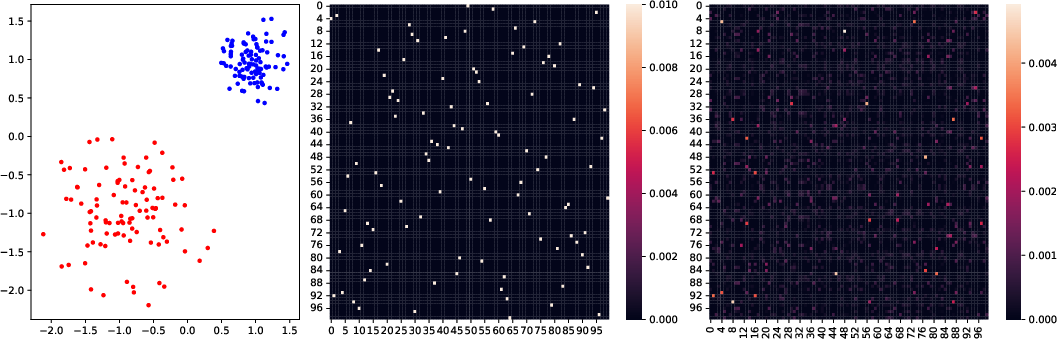
In parallel, the static approach uses regularized OT with a canonical cost function (usually squared shortest path or diffusion distance on the graph), optimized via scalable Sinkhorn-Knopp (Bregman projection) iterations. Entropic regularization yields rapid convergence and allows barycenter computations in high-dimensional histogram spaces, but introduces nontrivial smoothing effects, as visually apparent by comparing the optimal plan with the regularized plan.
Figure 1: Comparison of classic versus entropically regularized OT plans on synthetic data, highlighting the diffusive effect of entropy regularization.
Numerical Results and Comparative Evaluation
The paper presents a comprehensive suite of numerical experiments validating algorithmic soundness, stability, and accuracy:
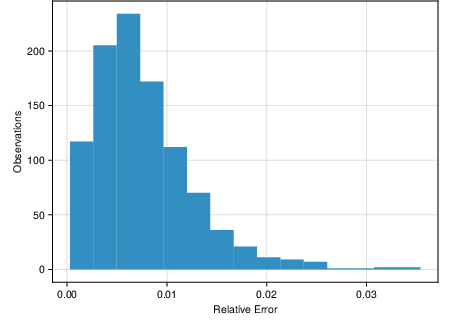
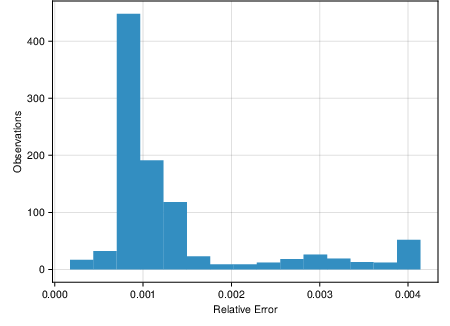
Synthesis and Recovery Accuracy: Tests with synthetic measures and random coordinate recovery show that intrinsic gradient descent produces barycenters whose analysis yields recovered barycentric coordinates with sub-percent relative error in the majority of cases.
Figure 2: Distribution of relative errors in barycentric coordinate recovery for synthesized barycenters on a grid graph.
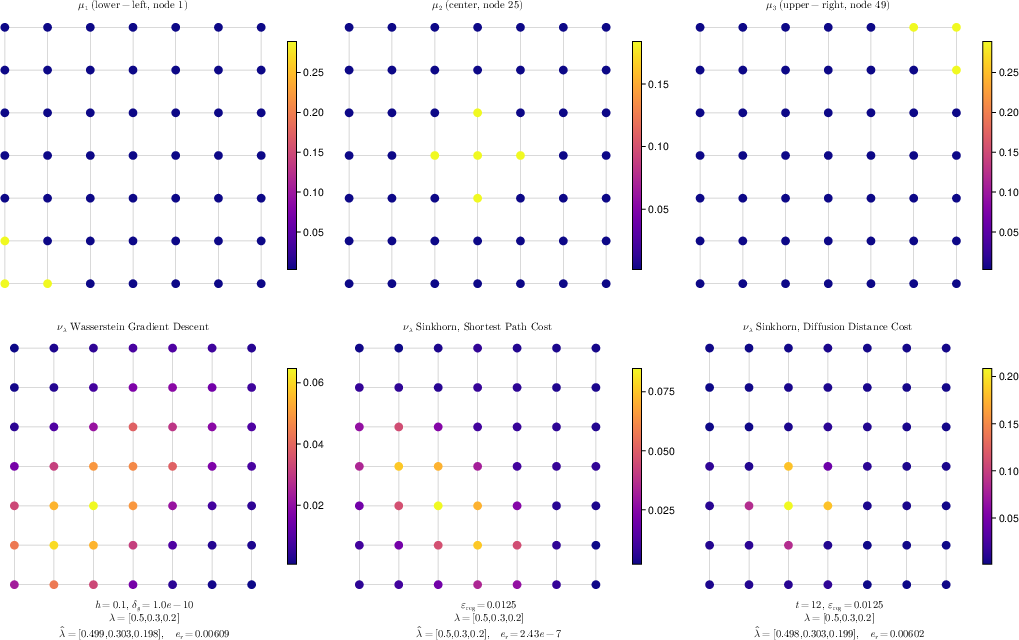
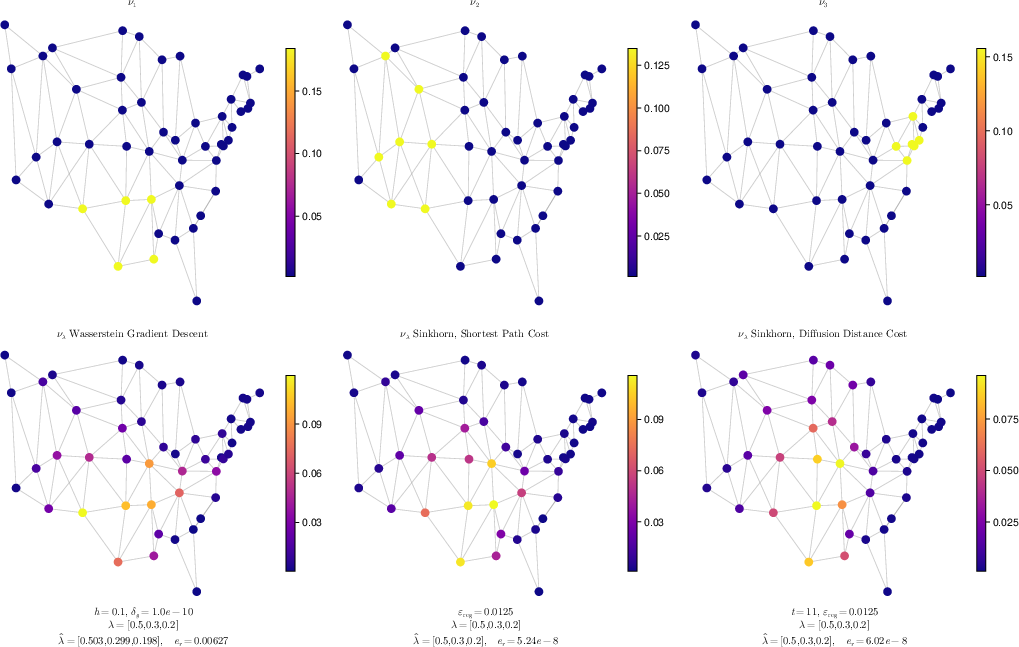
Static vs Dynamic Barycenters: Visual and quantitative analysis of barycenters on grid and geographical graphs demonstrates qualitative differences between dynamic barycenters and those obtained statically with various cost matrices (shortest path, diffusion distance). Dynamic barycenters reflect the structure imposed by the Riemannian geometry, while static barycenters are more sensitive to metric selection and regularization choices, often leading to excessive smoothing or blurring of the measure support.
Figure 3: Comparison of barycenters on a grid graph using dynamic intrinsic gradient descent, entropic regularization with shortest path and diffusion distance costs.
Figure 4: Comparison of barycenters on a geographic graph of U.S. states using dynamic and static approaches.
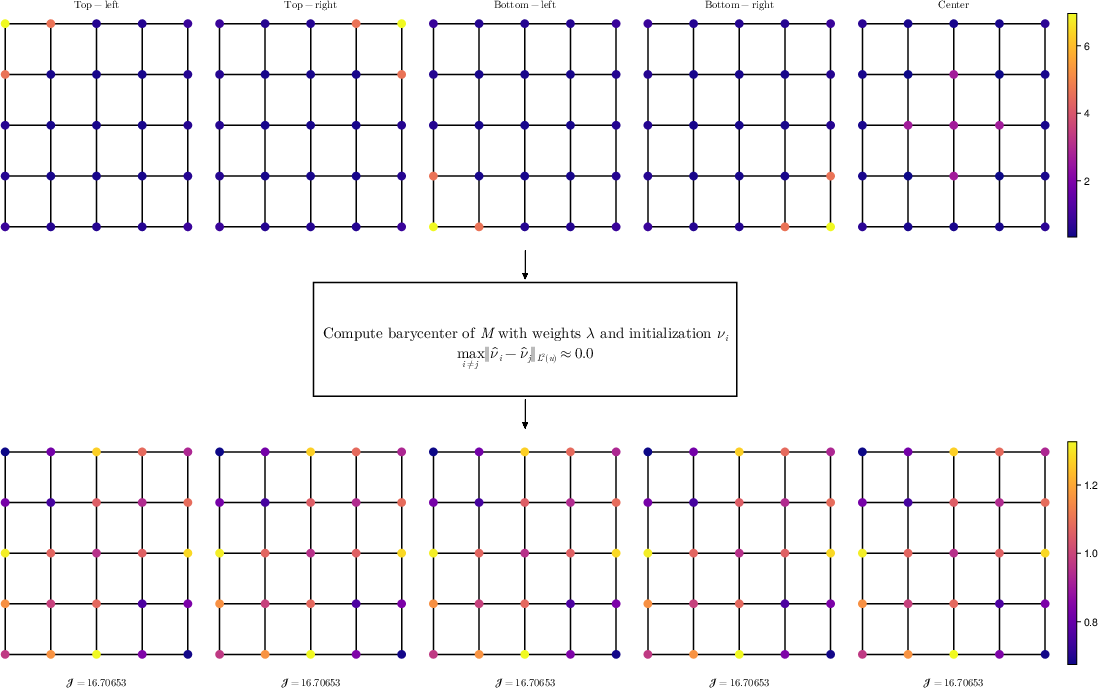
Robustness with Initialization: Experiments varying the initial measure for gradient descent demonstrate that the final barycenter is invariant up to machine precision across initialization points, suggesting strong stability properties despite the lack of convexity guarantees.
Figure 5: Consistency of barycenters for alternative initializations on a grid graph.
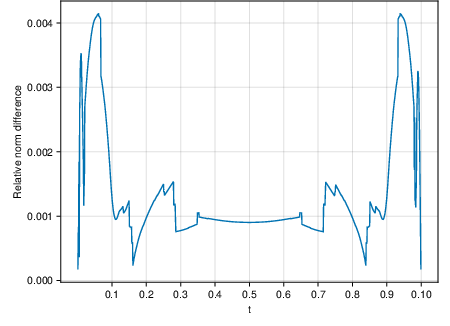
Geodesic Consistency: When recomputing barycenters with two references and comparing their trajectory to the direct geodesic (via primal-dual methods), relative error remains negligible, confirming that intrinsic descent is a valid proxy for true geodesic interpolation in the graph transport metric.
Figure 6: Histogram of relative norm differences between geodesic interpolation and barycenters on a triangle graph.
Implications and Theoretical Contributions
The work provides a systematic framework for barycentric coding and decomposition for probability measures on graphs that avoids the non-uniqueness and degeneracy of naive W2 approaches, while retaining computational tractability. Notably:
Canonical Handling of Graph Structure: The dynamic approach, grounded in the Markov chain representation and discrete calculus, does not depend on non-canonical metric choices and is robust to graph topology.
Algorithmic Stability and Flexibility: The methods allow tunable hyperparameters (stepsize, geodesic discretization, convergence criterion) with empirically verified stability across a range of parameter settings.
Practicability for Graph Signal Processing: The barycentric coding model supports dictionary-based signal synthesis and decomposition in domains such as spatial statistics, network analysis, and sensor networks, where observations are best modeled as distributions over discrete entities linked by a graph.
Open Theoretical Directions: The study raises several fundamental questions—such as the geodesic convexity of the variance functional, boundary and support properties of discrete barycenters, and the existence of analogous entropic regularizations in the dynamic setting.
Future Developments and Applications in AI
The robust computation of barycenters of probability measures on graphs has profound ramifications for a suite of machine learning subfields involving graph-valued data. Potential avenues include:
Graph Neural Networks: Enhanced representation learning via optimal barycentric aggregation of node or community-level probability distributions.
Unsupervised Learning and Clustering: Improved generative modeling and interpolation of distributions over graphs in structured probabilistic models.
Optimal Transport in Non-Euclidean Settings: Extension to product spaces or manifolds, and vector-valued measure settings, leveraging vector-valued optimal transport advancements [craig2025vector].
Fast Algorithms and Acceleration: Integration with recent developments in Riemannian acceleration methods [alimisisMomentumImprovesOptimization2021] and adaptive optimization [becigneulRiemannianAdaptiveOptimization2019].
Conclusion
This work establishes rigorous, reproducible, and versatile methodologies for barycentric operations on probability measures supported on graphs, reconciling the static efficiency of entropic OT with the geometric fidelity of dynamic Riemannian approaches. The algorithms demonstrate strong empirical accuracy and stability, revealing the feasibility of deploying optimal transport-based signal processing on complex discrete domains. The framework serves as a foundational tool for tasks across machine learning, statistics, and network science, and opens several open problems in discrete geometric analysis and optimization awaiting further investigation.