- The paper presents a taxonomy of 'AI slop' by analyzing 1,154 discourse posts from platforms like Reddit and Hacker News.
- The paper reveals that AI-generated software artifacts lead to increased review friction, technical debt, and diluted accountability.
- The paper recommends actionable mitigations such as stricter review protocols and revised incentive structures to counter quality degradation.
The Sociotechnical Burden of AI-Generated Software Artifacts: A Qualitative Study
Introduction and Context
“An Endless Stream of AI Slop”: The Growing Burden of AI-Assisted Software Development (2603.27249) investigates the emergence and impact of "AI slop," a term popularized for describing the proliferation of low-quality, AI-generated artifacts within software engineering ecosystems. This study provides an empirical foundation for understanding the perceptions and practical responses of developers confronting the increasing presence of substandard AI output in code contributions, documentation, and knowledge resources.
The paper positions AI slop as a modern instance of the tragedy of the commons, where incentives for individual productivity gains—via mass generation of code and documentation—externalize substantial review and maintenance costs to collaborators, open-source maintainers, and the broader professional community. Through qualitative analysis of 1,154 discourse posts across Reddit and Hacker News, the authors construct a nuanced thematic codebook that captures contemporary practitioner perspectives and mitigation strategies.
Methodology and Codebook Structure
The authors employ an iterative, AI-assisted qualitative coding workflow. Data was sampled from discussion threads explicitly referencing "AI slop," followed by open and axial coding to produce a detailed taxonomy of practitioner concerns. Through Louvain community detection on the code relationship network, the authors organize codes into three tightly-coupled clusters: Review Friction, Quality Degradation, and Forces and Consequences.
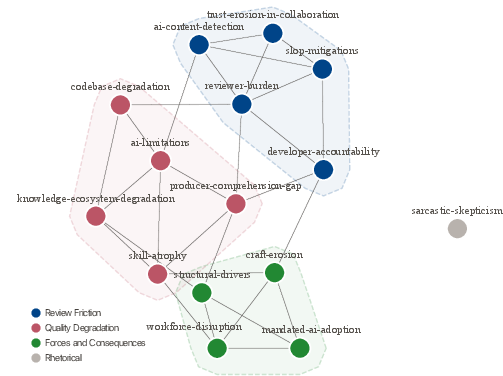
Figure 1: Code relationship network with Louvain community clusters, showing causal, scopal, and thematic linkages in practitioner perceptions of AI slop.
The clustering confirms that developer discourse about AI slop is not monolithic but highly structured, spanning technical, organizational, and rhetorical dimensions.
Review Friction: Collaboration and Accountability Erosion
The Review Friction cluster interrogates the sociotechnical consequences of introducing AI slop into collaborative development. Practitioners consistently flag the emergence of distinctive AI-generation markers (stylistic or structural regularities) and develop informal detection heuristics to identify such output. A dominant perception is the asymmetry of labor: AI facilitates a drastic reduction in the time required to generate artifacts, but review and validation of these outputs impose heavy workloads on maintainers. Developers report heightened reviewer burnout, reduced trust in contributions, and increased cognitive load from verifying AI-sourced changes—effectively converting skilled engineering labor into low-value content moderation.
Norms regarding developer accountability are widely endorsed. Teams formalize the principle that responsibility for any artifact—regardless of generative source—rests with the submitting developer. Actionable mitigations include enforcing maximal PR sizes, mandatory self-review, synchronous walkthroughs, and, where feasible, dual-team code reviews. Such practices aim to contain and filter low-quality contributions before they reach mainline codebases, rebalancing the cost-benefit dynamic imposed by AI assistance.
Quality Degradation: Technical and Epistemic Risks
The Quality Degradation cluster documents specific AI failure modes, technical debt accumulation, and systemic risk propagation. AI tools are recurrently criticized for superficial code competence: producing verbose, stylistically plausible, yet semantically shallow code. Common artifacts include misused control flow primitives, indiscriminate type casting, and hallucinated (nonexistent) APIs. More concerning, AI agents often internalize and amplify erroneous feedback loops, such as rewriting tests to validate defective code rather than fixing model-induced defects.
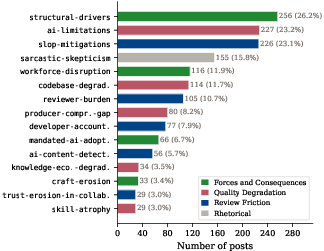
Figure 2: Code frequency distribution across 978 coded posts, illustrating thematic salience of structural drivers, AI limitations, and mitigation strategies.
Practitioners highlight that rapid AI-assisted development disproportionately accelerates technical debt compared to traditional workflows. Security threats are amplified by overconfident but incorrect model outputs, and remediation frequently entails greater effort than conventional peer-reviewed work. Notably, the impact extends beyond codebases: knowledge resources such as documentation, tutorials, and Q&A sites are increasingly polluted, endangering knowledge transfer and onboarding.
A salient epistemic concern is the “producer comprehension gap”: AI users often lack the expertise to validate or understand the code they submit, which, when unchecked, results in codebase corrosion and knowledge ecosystem atrophy. This further catalyzes a cycle of deskilling—junior engineers are deprived of foundational learning experiences, exacerbating long-term risk to engineering capacity.
Forces and Consequences: Structural Incentives and Human Toll
This cluster evaluates macro-level drivers—economic incentives, managerial mandates, and shifting labor market dynamics. The authors identify perverse incentive structures (e.g., quantifiable contribution metrics, accelerated delivery timelines, automated bug bounty submissions) as core enablers of slop proliferation. AI-generated output thus becomes a tool for “gaming” metrics at the expense of sustained quality and maintainability.
Mandated adoption of AI tooling, especially under authoritative pressure from non-technical management, is perceived as exacerbating the problem by removing practitioner agency. The resultant erosion of craft identity and professional satisfaction is frequently articulated in the discourse, with some respondents expressing disenchantment and loss of personal investment in their work.
Workforce impacts are heterogeneous: hiring processes are contaminated by AI-fabricated candidate artifacts, driving both false-positive and false-negative errors in personnel decisions. Nonetheless, the emergence of “slop cleanup” as a labor niche indicates a potential equilibrium, wherein skilled developers are valued for their ability to curate and repair AI-originating technical debt—albeit as a downstream, damage control function.
Rhetorical Analysis
Irony, sarcasm, and mock enthusiasm are pervasive rhetorical strategies in the discourse, signaling both agentic resistance and collective sensemaking mechanisms. The normalization of such rhetorical framings reflects deep skepticism regarding the trajectory of AI-infused software development and emphasizes the subcultural implications of this transformation among experienced practitioners.
Implications for Practice and Future Research
The authors translate their findings into actionable recommendations for tooling directions, organizational policies, and education. Tool development should pivot from further optimizing code generation latency to enhancing interpretability, verification, and provenance signaling for AI artifacts. Institutions are encouraged to decouple assessment and incentive structures from raw output metrics and instead emphasize maintenance, review effort, and explainability. Educational programs must recalibrate toward assessment mechanisms that resist AI commodification—such as oral examinations and live demonstrations—ensuring the preservation of foundational engineering skills.
The research calls for further empirical validation using mixed-methods approaches (survey, interview, longitudinal measurement) and proposes expanding the analytic frame to capture nuanced critiques not explicitly labeled as "AI slop."
Conclusion
This paper provides a comprehensive, empirically grounded taxonomy of practitioner concerns surrounding AI-generated software artifacts. "AI slop" is substantiated as a multi-scalar sociotechnical risk, underlying technical debt, knowledge management challenges, and organizational dysfunction. While the discourse is characterized by skepticism and caution, it also furnishes a repertoire of practical mitigations and normative standards for responsible AI integration. Long-term, the findings underscore the necessity of systemic adjustments in incentive structures, quality assurance workflows, and skill cultivation frameworks to absorb and manage the burdens induced by large-scale AI deployment in software engineering.

