- The paper demonstrates that time-delayed coherent feedback induces non-Markovian modifications in the resonance fluorescence of a superconducting transmon qubit.
- Experimental data and QTDW simulations reveal phase-sensitive suppression and asymmetry in the Mollow triplet side peaks due to feedback-induced interference.
- The study implies significant applications in quantum reservoir engineering, single-photon source enhancement, and long-distance quantum communication.
Resonance Fluorescence of an Artificial Atom Subject to Time-Delayed Coherent Feedback
Context and Motivation
This work addresses non-Markovian light-matter interaction effects in superconducting circuit QED, specifically exploring how the emission spectrum of a single transmon artificial atom is modified by a coherent feedback loop with a time delay comparable to the qubit's radiative lifetime. The Markovian approximation, though standard in quantum optics, is inadequate for systems where electromagnetic feedback occurs at timescales similar to characteristic atomic decay processes. The experiment reported here provides the first direct observation and systematic study of the Mollow triplet in this distinctly non-Markovian regime, with theoretical analysis supported by the quantum trajectory discretized waveguide (QTDW) method.
System Architecture and Theoretical Model
The system consists of a transmon qubit capacitively coupled to a one-dimensional superconducting open waveguide, terminated by a mirror at one end to form a feedback loop. The round-trip length L0 and associated delay τ are engineered to be on the order of the intrinsic qubit relaxation time 1/Γ, ensuring access to the non-Markovian regime (Γτ>0.1). The round-trip phase ϕ and effective Rabi frequencies are controllable via the qubit and pump frequencies, as well as externally applied magnetic flux.
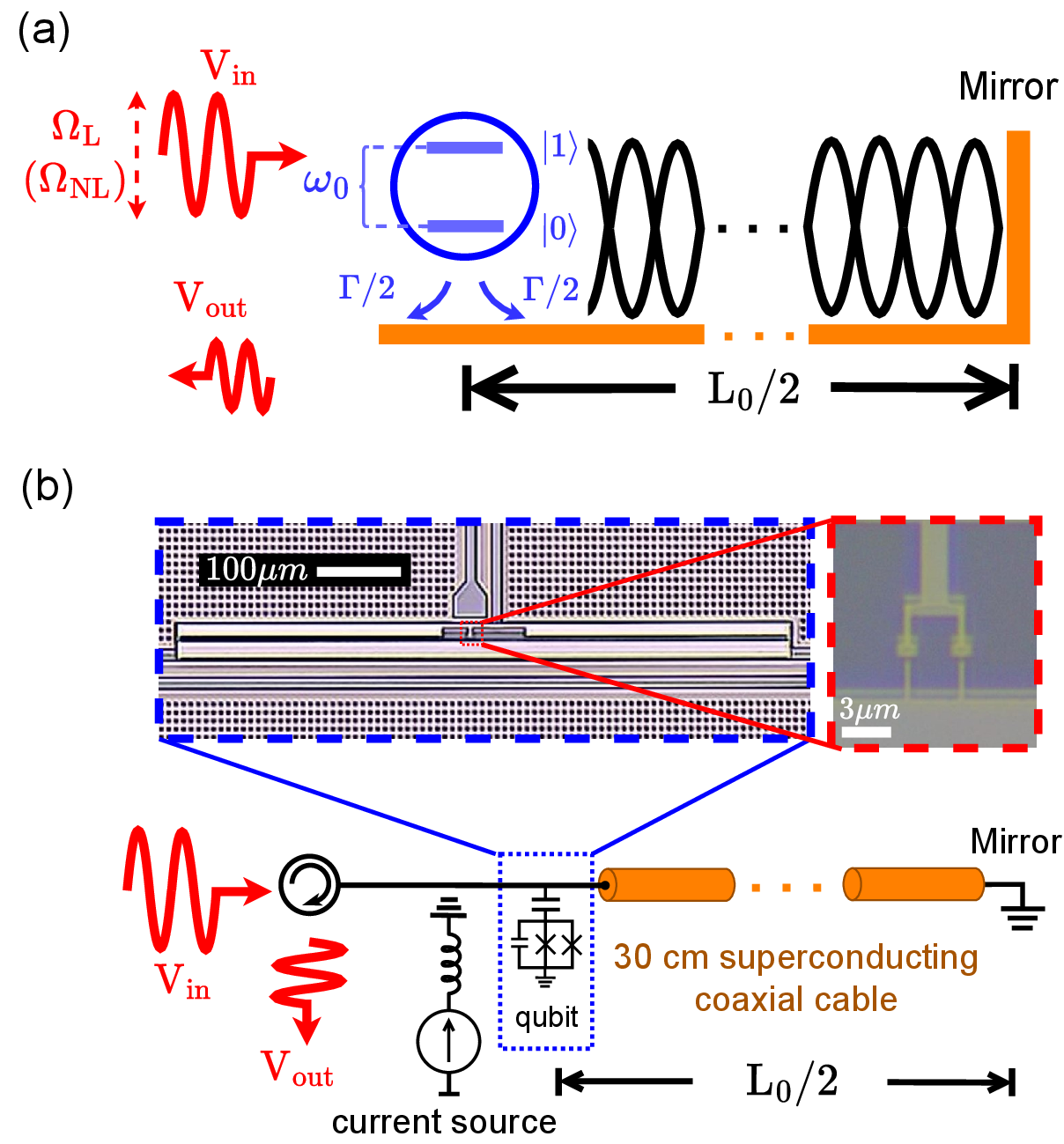
Figure 1: Schematic of the qubit-mirror feedback system with optical micrograph of the transmon coupled to a 1D transmission line, showing tunability and the mirror termination to realize time-delayed feedback.
The full Hamiltonian, detailed in the supplemental material, incorporates bidirectional coupling, round-trip phase, and both elastic and inelastic decoherence channels, plus phenomenological loss. The QTDW model enables robust simulation of retardation effects and feedback-induced correlations even in the presence of strong nonlinearity.
Experimental Methods and Baseline Characterization
Device characterization occurs first in the linear (low-power) regime by probing the elastic reflection coefficient r as a function of both qubit and pump frequencies, mapping the response over several standing wave nodes and antinodes of the feedback loop. The resulting spectroscopy reveals strong dependence of both the amplitude and phase of r on the round-trip phase ϕ, with maximal reflection (∣r∣≈1 and π phase flip) at antinodes and transparency at nodes, consistent with constructive and destructive wave interference at the location of the artificial atom.

Figure 2: Reflection coefficient magnitude and phase as functions of τ0 and τ1 (experiment and simulation), including Markovian/non-Markovian comparison and frequency shift due to feedback.
A salient non-Markovian feature is the feedback-induced tilt and asymmetry in the complex-plane trajectory of τ2, distinct from the symmetric Lorentzian expected for Markovian systems. The qubit resonance frequency is shifted from τ3 to τ4 due to delayed self-interaction, with the amount of tilt directly proportional to τ5. These features validate the system's entry into a regime where standard master equation approaches break down.
Nonlinear Spectroscopy: Resonance Fluorescence and Non-Markovian Mollow Triplet
Upon strong resonant CW pumping (τ6), the system exhibits nonlinear resonance fluorescence. In a Markovian scenario, this yields three peaks (Mollow triplet): one central (at the dressed qubit frequency) and two symmetric sidebands (offset by τ7). When time-delayed feedback operates in the non-Markovian domain, crucial qualitative modifications emerge. The experimental and QTDW simulation results demonstrate:
- Periodic suppression ("nodes") of Mollow side peaks as pump power is increased. These nodes correspond to destructive interference of feedback at the sideband frequencies, occurring at phase offsets τ8.
- Non-Markovian sideband suppression is phase-sensitive; for τ9 (antinode), the suppression is symmetric, whereas for 1/Γ0 (non-antinode), the suppression becomes asymmetric due to phase-dependent changes in both the radiative relaxation rate and wave interference conditions.
- Feedback-induced spectral reorganization: at specific detunings, additional peaks arise between the main Mollow features, attributed to Fabry-Pérot resonances of the feedback loop, providing further evidence of environment dressing beyond the three-peak Mollow structure.

Figure 3: Experimental and simulated resonance fluorescence spectra of the qubit under strong pumping, showing Mollow triplet modification, sideband suppression nodes, and the emergence of additional feedback-induced resonances.
Simulation and experiment are in good qualitative agreement, although central peak intensity discrepancies are noted due to limitations in filtering the coherent pump from emitted fluorescence, and nontrivial renormalization of dephasing and relaxation rates in the nonlinear, non-Markovian regime.
Implications and Future Directions
This work demonstrates direct, phase-controlled manipulation of quantum emission spectra using engineered non-Markovian feedback. Practical implications include:
- Quantum reservoir engineering: The system functions as a minimal, highly controllable non-Markovian bath, enabling tailored decoherence and memory effects for quantum technologies.
- Single-photon source enhancement: Interference conditions can be harnessed to increase the quantum efficiency or emission purity by leveraging destructive or constructive feedback at targeted frequencies.
- Long-distance quantum communication: By tuning delay, such systems offer a route to entanglement distribution or non-local coupling between spatially separated qubits ("giant atom" coupling, quantum networks).
- Cluster state generation and exotic photonic correlations: Time-delayed feedback facilitates unconventional many-photon entangled states, essential for scalable quantum information applications.
Theoretically, this platform offers a unique testbed for open quantum system theory beyond conventional Lindblad formalism, including environment-induced nonlocality, quantum memory, and the breakdown of instantaneous system-bath separation.
Experimental expansion to multi-qubit or multidimensional feedback geometries is a natural next step, as is further investigation of feedback-modified quantum phase transitions, persistent entanglement, and non-Hermitian Hamiltonian engineering in driven-dissipative quantum systems.
Conclusion
By combining comprehensive experiment and simulation, this study elucidates coherent time-delayed feedback as a pivotal resource for controlling and exploiting non-Markovian phenomena in quantum optics. The observation of non-Markovian Mollow triplets and feedback-induced spectral nodes establishes a new paradigm in quantum emission control at the single-atom level, with ongoing relevance for both foundational quantum optics and the advancement of quantum information science.