- The paper proposes a novel design using movable pinching antennas to achieve beamforming gains and angular diversity in ISAC systems.
- It develops an alternating optimization and majorization-minimization framework to jointly tune antenna positions, time-slot allocation, and user scheduling.
- Numerical results demonstrate that adaptive antenna clustering significantly reduces sensing outage probability while managing the sensing–communication trade-off.
Problem Context and Motivation
The paper "Clustered Movable Pinching Antennas: Realizing Beamforming Gains and Target Diversity in ISAC Systems with Look-Angle-Dependent RCS" (2603.28264) studies advanced integrated sensing and communication (ISAC) system design for next-generation 6G dual-function radar-communication (DFRC) base stations. Conventional MIMO ISAC architectures are limited by fixed antenna arrays, offering restricted spatial adaptability and suboptimal resilience to environmental reflections and target signatures, especially under angularly variable radar cross-section (RCS) phenomena. Recent progress in reconfigurable physical-layer architectures such as fluid and movable antennas motivated the investigation of pinching antennas (PAs) arranged in movable clusters along a dielectric waveguide, providing fine PA-level beamforming and cluster-level angular diversity for improved sensing and communications reliability.
The fundamental physical insight addressed is that the RCS of practical targets varies continuously and unpredictably with the look angle, introducing significant randomness in radar returns. By illuminating the target from multiple independently chosen perspectives across time, a form of angular (spatial) diversity is introduced, enhancing sensing robustness. However, this comes with non-trivial constraints: computational complexity, non-convex mixed integer nonlinear programming (MINLP), and a trade-off between communication throughput and sensing performance under joint resource allocation.
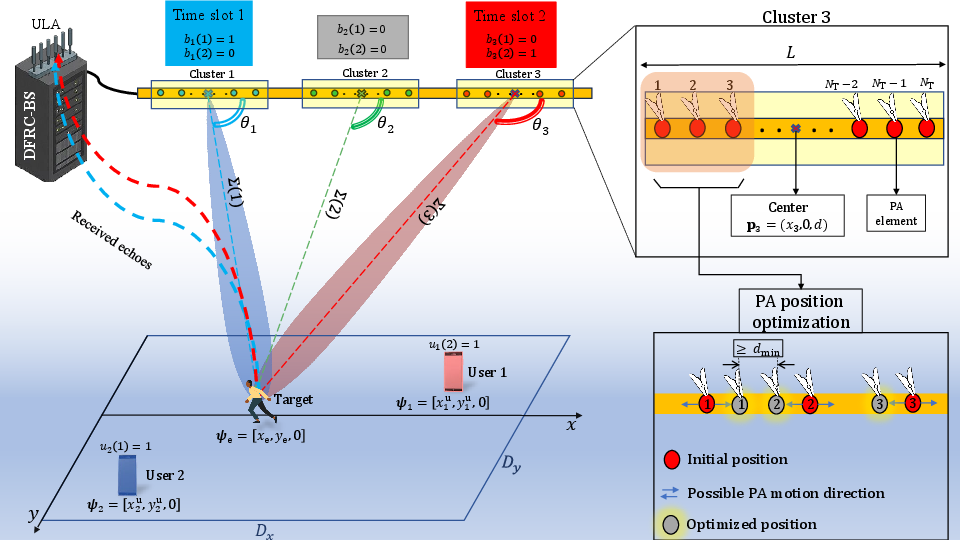
Figure 1: System-level illustration of the downlink PA-assisted ISAC system featuring clustered movable PAs, user locations, radar receiver, and a target with look-angle-dependent RCS Σ(m).
The studied system comprises a DFRC-BS operating in the mmWave band (e.g., fc=30 GHz), with a dielectric waveguide of length Dx supporting M spatially distributed PA clusters. Each cluster contains NT movable antennas constrained to a limited aperture, permitting intra-cluster sliding for real-time transmit beamforming. Time is slotted, with only one cluster active per slot, serving a single communication user and illuminating a radar target simultaneously. Each cluster provides a unique spatial look-angle toward the target, with RCS modeled as a correlated complex Gaussian vector Σe, where correlation decays exponentially with angular separation.
The key physical channels include guided wave propagation along the dielectric, followed by free-space transmission from PAs to users or the target. The sensing channel includes round-trip propagation and reflection via look-angle-dependent RCS. Communication and sensing links are coupled through shared PA actuation, transmit power, and allocation of time slots.
Outage probability is adopted as the performance metric for sensing, defined as the probability that the accumulated SNR, aggregated over all time slots and look-angles, falls below a fixed detection threshold Γth. The non-convex resource allocation problem co-optimizes: (1) binary cluster activation per time slot, (2) intra-cluster PA positions, (3) slot durations, and (4) user assignment, all under average rate QoS constraints for each user, channel and power limitations, and mechanical positioning restrictions.
Methodology: Tractable Surrogate and Optimization
Given the intractable exact calculation of sensing outage due to correlated non-identically distributed exponential sums, the authors employ a Chernoff bound to upper bound the outage probability by an analytic surrogate involving the determinant of a function of the per-cluster weights qm and RCS covariance. This enables reformulation of the original MINLP as a succession of convex or tractable subproblems via alternating optimization (AO) within a majorization-minimization (MM) scheme. Discrete binary variables are relaxed with penalty techniques (big-M and DC representations), and convex solvers are deployed iteratively, including sequential convex approximation for non-convexities arising from beamforming parameterizations and cluster scheduling.
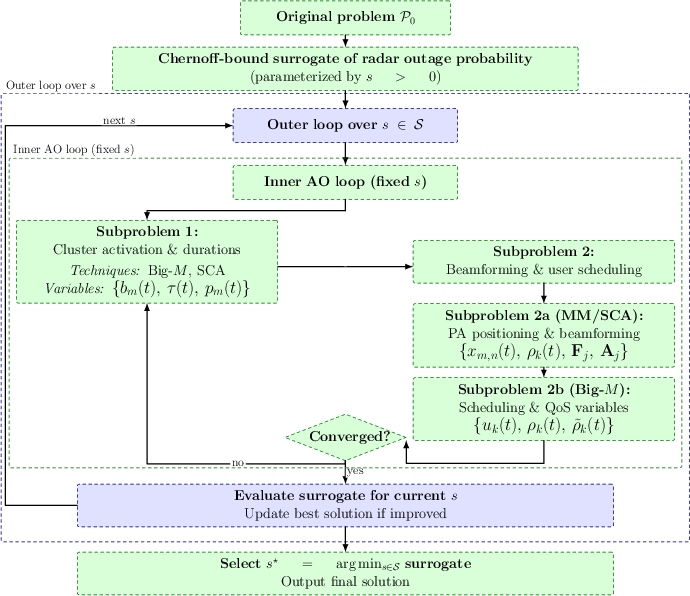
Figure 2: Schematic of the AO-MM-based solution structure, including subproblem partitioning, iterative updates for PA positions, cluster selection, time allocation, and user scheduling.
Complexity analysis demonstrates the approach remains practical for moderate system sizes (dominated by beamforming SDP blocks of order (NTM)3 per AO iteration).
Numerical Results
Outage Probability Versus Transmit Power and Design Parameters
Sensing outage probability is evaluated under system-level Monte Carlo simulation, with a 10-meter waveguide, 8 ms time budget, up to 10 clusters and 6 antennas per cluster, and mmWave carrier. Results highlight several findings:
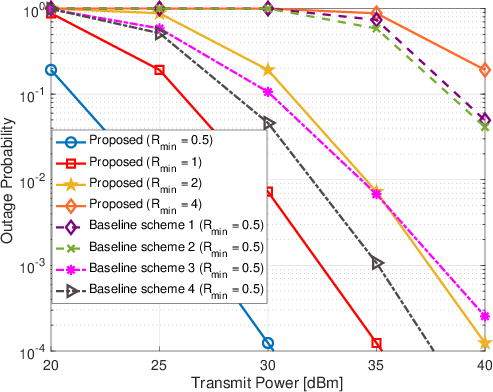
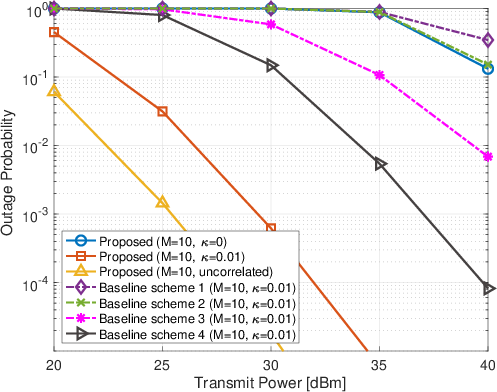
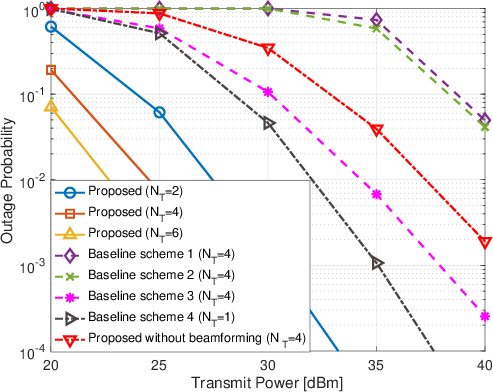
- Activating distinct PA clusters over time and optimizing intra-cluster antenna positions yields marked reductions in outage probability compared to all baselines (fixed ULAs, repeated cluster activation, or no intra-cluster beamforming), validating the core hypothesis that both angular diversity and spatial beamforming are essential.
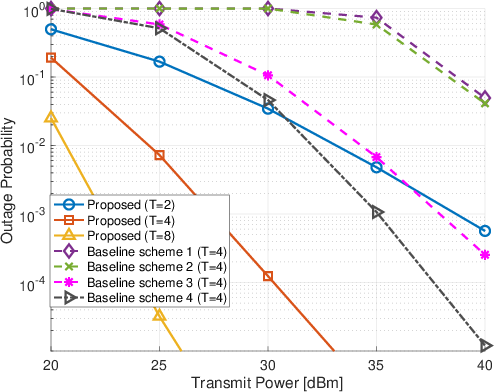
Figure 3: Sensing outage probability versus transmit power; proposed scheme dominates across T=2,4,8 over all baselines.
Sensing–Communication Trade-off
Spatial Power Distribution
Optimized antenna positioning within each cluster yields focused directional energy toward the target and user, as compared to geometric-only or uniform placement. Constructive and destructive field interference patterns are observable, and only the joint optimization balances both communication and sensing objectives effectively.
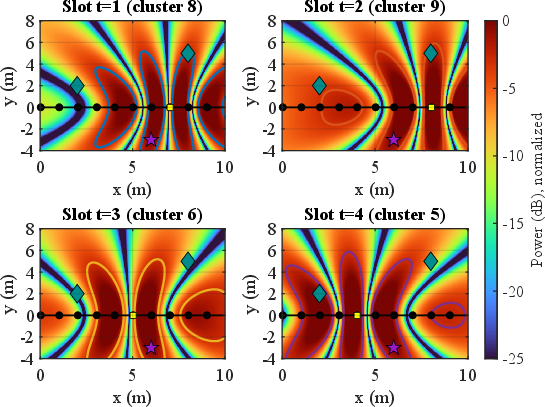
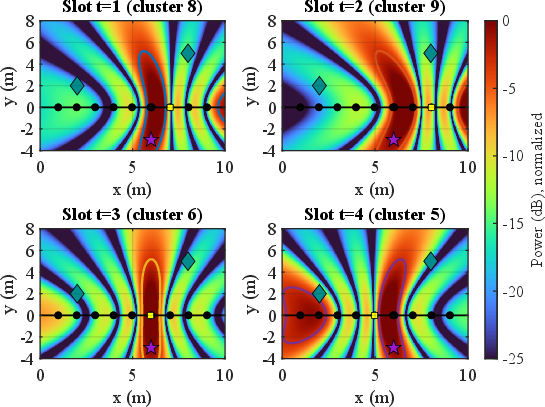
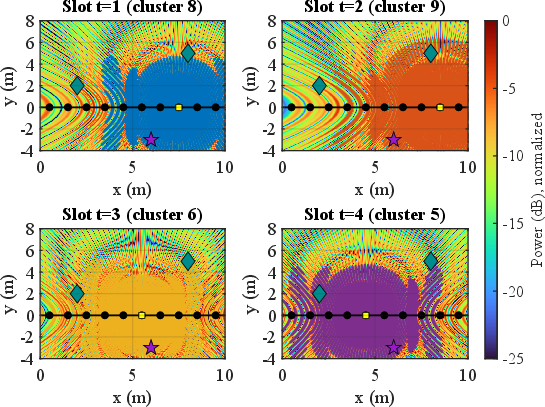

Figure 7: Comparison of spatial radiated sensing power for (a) proposed, (b) target-aligned, and (c) uniform cluster strategies.
Implications and Future Directions
The clustered movable PA concept introduced enables efficient physical-layer ISAC design by leveraging flexible, real-time reconfigurability at both the spatial (beamforming) and angular (diversity) dimensions. For ISAC systems where the target RCS exhibits non-trivial angular variation—which holds in most practical environments—such adaptive architectures provide direct gains in sensing reliability, with rigorous control over communication QoS via joint optimization.
The work demonstrates the necessity of modeling RCS correlation both for accurate performance prediction and for algorithmic design: ignoring this (as in much recent ISAC literature) leads to overoptimistic reliability estimates. The findings also underscore that complexity- and cost-effective angular diversity can be realized via PA clusters, without resorting to large geographically distributed antenna infrastructures.
The framework supports scalable extension to broader ISAC modalities, including dynamic (moving) targets, multipath-rich scenarios, or even multi-target configurations. An open question is the impact of hardware non-idealities, such as actuation latency, mutual coupling, or limited channel state information, as well as integration with higher-layer resource management (e.g., multi-cell coordination).
Conclusion
This work provides a formal analysis of ISAC employing dynamically activated, spatially diverse PA clusters, demonstrating significant improvements in sensing outage probability under practical constraints and real-world target models. By tightly integrating cluster scheduling and PA position optimization within a mathematically rigorous surrogate, and quantifying the inherent trade-offs, the results advance physical-layer ISAC design and open avenues for further research on flexible hardware architectures and robust joint radar-communications systems.