Bogoliubov flat bands in twisted layered materials
Published 30 Mar 2026 in cond-mat.supr-con | (2603.28490v1)
Abstract: Flat bands have attracted considerable interest in condensed matter physics because they provide a fertile platform for realizing strongly correlated and topological quantum phases. To date, however, most studies have focused on flat bands in normal-state electronic structures, such as those found in graphene and transition metal dichalcogenides. In this work, we investigate the emergence of flat bands in the superconducting Bogoliubov quasiparticle spectrum of twisted layered $d$-wave superconductors. We show that when the superconducting order parameter is odd under the in-plane $\mathrm{C}_2$ rotation, Bogoliubov flat bands can be engineered in the vicinity of the rotation axis. By analyzing a low-energy effective Hamiltonian, we demonstrate that the Berry connection of single layer system provides a clear criterion for the formation of the Bogoliubov flat bands. Our results establish a new paradigm of superconducting twistronics, in which the twist angle acts as a powerful tuning parameter for designing gapless flat-band superconductors.
The paper reveals that tuning interlayer coupling and twist angle in d-wave superconductors induces flat Bogoliubov bands protected by symmetry and topology.
The authors used a Bogoliubov–de Gennes Hamiltonian analysis to show that suppressed tangential group velocity at a critical tₙ leads to an enhanced zero-energy density of states.
The study illustrates practical implications, including control over gapless superconductivity and the promotion of quantum geometric effects in engineered superconducting devices.
Bogoliubov Flat Bands in Twisted Layered d-Wave Superconductors
Introduction
Twistronics, leveraging moiré superlattices created by rotational misalignment between atomically thin crystals, has proven essential for realizing correlated and topological phases, especially in graphene and transition metal dichalcogenide systems. The focus has predominantly been on flat bands in normal-state electronic structures. In "Bogoliubov flat bands in twisted layered materials" (2603.28490), the authors systematically investigate the emergence of flat bands in the superconducting Bogoliubov quasiparticle spectrum of twisted layered d-wave superconductors. This work elucidates conditions under which the intertwining of superconducting order and geometric twist yields flat, low-energy Bogoliubov bands, establishing a symmetry- and topology-guided route for engineering gapless superconducting states.
Model: Twisted Bilayer d-Wave Superconductors
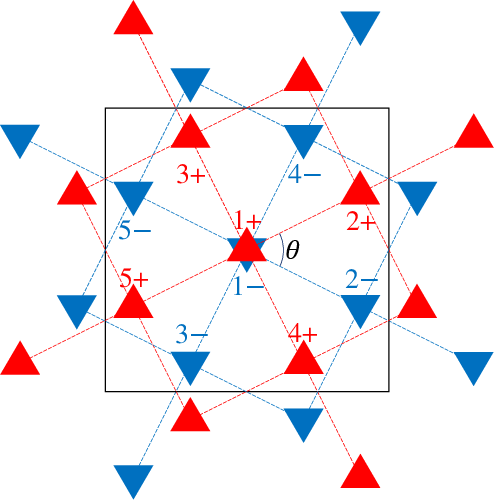
The study considers a bilayer system of 2D square lattices, twisted with a relative angle θ about the z-axis. The atomic configurations realize moiré periodicity when tan(θ/2) is rational (for instance, tan(θ/2)=1/2 yields a 5a superlattice). The tight-binding model incorporates intralayer hopping t and interlayer hopping tz exclusively between aligned atomic sites:
Figure 1: Structure of the twisted bilayer square lattice, showing the moiré unit cell.
The normal-state Hamiltonian is block-diagonal in a partially diagonalized (PD) basis, allowing effective treatment of interlayer coupling when the superconducting pair potential (considered of the d0-wave type) is included. The total system is governed by the Bogoliubov–de Gennes (BdG) Hamiltonian, facilitating a systematic quasiparticle spectrum analysis as a function of d1 and d2.
Quasiparticle Spectra and Bogoliubov Flat Bands
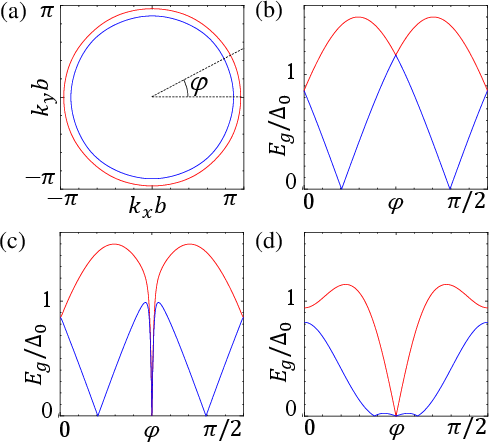
Diagonalizing the BdG Hamiltonian, the authors reveal the evolution of the quasiparticle energy gaps and the Fermi surface topology as d3 is tuned:
For d4, the gap nodes reflect a single-layer d5-wave spectrum, located at generic off-axis points.
As d6 increases (d7), new nodal points appear precisely along the d8 rotation axis (d9).
Figure 2: Fermi surfaces and evolution of the energy gap as a function of d0; new nodes emerge as interlayer coupling increases.
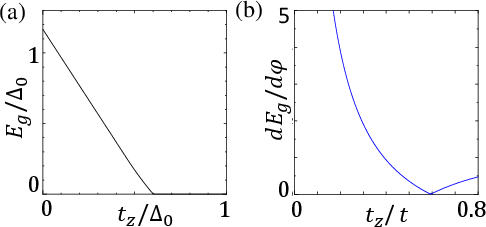
Crucially, at intermediate d1, the tangential group velocity at the node (i.e., the dispersion perpendicular to the d2 axis) is strongly suppressed and vanishes at a critical value (d3). This produces a nearly dispersionless—flat—Bogoliubov band segment, which is distinctly anisotropic compared to the flat bands in twisted bilayer graphene that extend over the entire Brillouin zone.
Figure 3: (a) Evolution of the energy gap at the node with d4. (b) The tangential group velocity, proportional to d5, is suppressed with increasing d6.
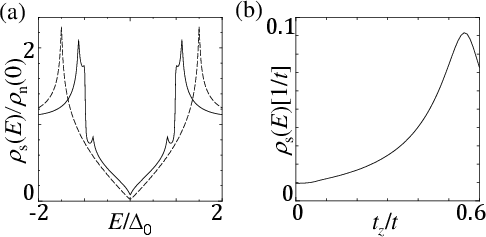
The density of states (DOS) corroborates this: while the d7-shaped DOS minimum (expected for d8-wave nodal systems) persists, the zero-energy DOS is enhanced at the parameter values where band flattening occurs.
Figure 4: (a) DOS for d9 and θ0. (b) Maximum in zero-energy DOS as a function of θ1 signals the flat band regime.
Topological Mechanism of Flat Band Formation
Central to the emergence of Bogoliubov flat bands is the role of symmetry and topology. The effective low-energy Hamiltonian along the θ2 invariant axis simplifies substantially, allowing analytical extraction of the nodal and flat band conditions. The existence of new nodes at θ3 and flat dispersion is protected and characterized by the Berry connection of the single layer.
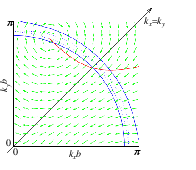
Figure 5: Formation of nodes with zero group velocity, showing the Fermi surface evolution upon turning on θ4, and the Berry connection alignment condition for flat bands.
The analytic criterion is that the Berry connection θ5 at the node must be parallel to the θ6 axis for the group velocity (perpendicular to the axis) to vanish. This connects the occurrence of flat Bogoliubov bands to the underlying topological structure (winding number) of the parent superconducting layer. The twist angle and θ7 can thus be used to tune into the flat band regime.
Implications and Outlook
This work establishes that moiré engineering in nodal superconductors can induce tunable Bogoliubov flat bands, with pronounced effects on DOS and nodal topology. From a theoretical standpoint, it elevates twistronics to the superconducting domain, providing explicit symmetry-derived criteria for flat band genesis and relating superconducting gap structure to single-layer topological invariants.
Practical consequences include:
Twist-angle control of gapless superconductivity: Flat bands can be accessed by tuning θ8 and θ9, potentially enabling robust, engineered gapless superconducting devices.
Connection to quantum geometric effects: Enhanced flatness may amplify quantum metric contributions to superfluid stiffness, potentially affecting critical currents, vortex structure, or even the robustness of Majorana excitations.
Odd-frequency pairing correlations: The persistence of gapless excitations implies that odd-frequency superconductivity will inevitably be generated, enriching the phenomenology accessible in moiré superconducting structures.
Future work should address the self-consistency of such pairing states, explicitly compute the quantum geometric contributions to superfluid weight, and study edge/boundary phenomena linked to these topological Bogoliubov flat bands.
Conclusion
The theoretical analysis in (2603.28490) demonstrates that engineering flat Bogoliubov bands is feasible in twisted layered z0-wave superconductors, controlled via symmetry, topology, and interlayer coupling. This adds a powerful paradigm to the toolbox of moiré quantum materials, bridging normal-state and superconducting twistronics, and opening numerous avenues for the study of nontrivial superconducting phases, quantum geometry, and exotic pairing symmetries.