- The paper introduces Quantum Riemannian Hamiltonian Descent (QRHD), a quantum algorithm that integrates position-dependent metrics to extend optimization onto Riemannian manifolds.
- It modifies the kinetic term using the Laplace-Beltrami operator and demonstrates accelerated convergence through geometric preconditioning.
- The framework provides both theoretical insights and practical quantum circuit strategies for constrained optimization in non-Euclidean spaces.
Introduction and Motivation
The paper "Quantum Riemannian Hamiltonian Descent" (2603.28624) introduces Quantum Riemannian Hamiltonian Descent (QRHD), a quantum algorithmic framework for continuous optimization on Riemannian manifolds that generalizes Quantum Hamiltonian Descent (QHD). QRHD is motivated by the geometric limitations of QHD, which is fundamentally restricted to parameter search within Euclidean geometry—implementing only canonical kinetic terms using Cartesian coordinates. QRHD introduces a position-dependent metric in the kinetic term, thereby enabling parameter search over arbitrary Riemannian manifolds and providing a principled mechanism to integrate prior geometric knowledge and constraints into quantum optimization dynamics.
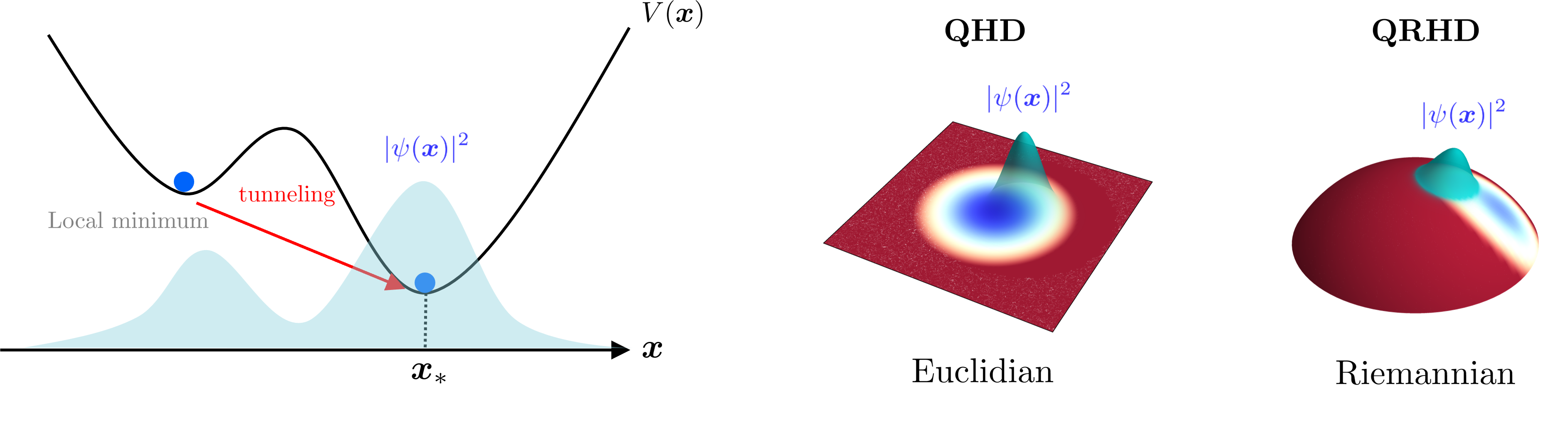
Figure 1: (Left) Quantum optimization dynamics as parameter wavefunction evolution, illustrating tunneling-based escape from local minima; (Right) Contrasting QHD's flat parameter space with QRHD's Riemannian manifold search.
The QRHD framework extends the particle-based analogy underlying QHD to curved spaces by modifying the kinetic energy term in the system's Lagrangian. The resulting dynamics for parameters x∈MN are governed by:
L(x,x˙,t)=a(t)(2mi,j=1∑Ngij(x)x˙ix˙j−η(t)V(x))
where gij(x) is a positive-definite, position-dependent metric tensor encoding the geometry of the search space. The associated classical equations of motion encode geodesic flow, friction, and movement along the natural gradient.
Canonical quantization in curved space yields a quantum Hamiltonian with a Laplace-Beltrami kinetic operator and quantum geometric corrections stemming from operator ordering:
H^(t)=a(t)1(−2m1Δg)+a(t)η(t)V(x^)
with Δg the Laplace-Beltrami operator on MN and quantum corrections to the potential of the form ℏ2 × curvature terms. This structure ensures invariance under coordinate transformations and encapsulates nontrivial quantum effects, such as geometric quantum corrections and tunneling, subject to quantum-classical transition dictated by the time-dependent dissipation parameter a(t).
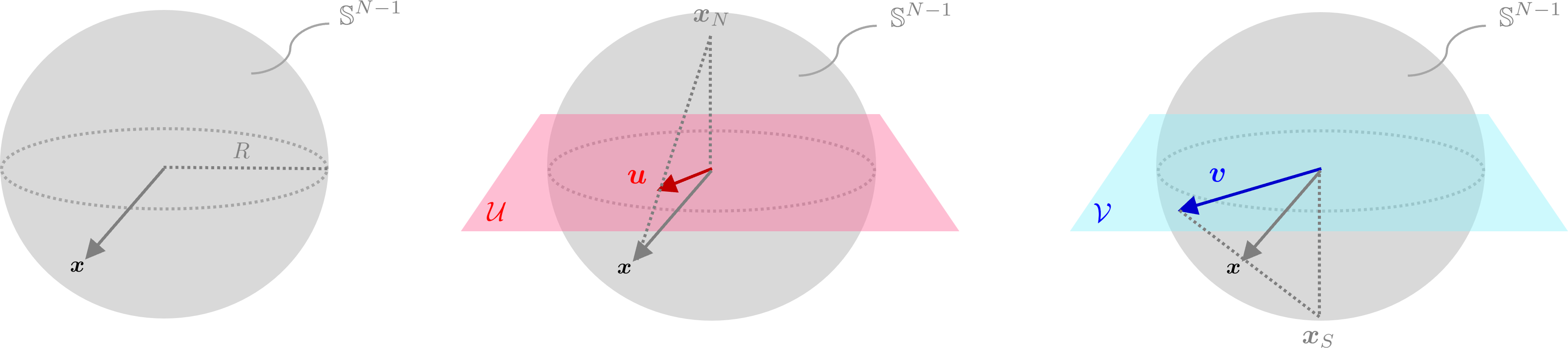
Figure 2: Schematic illustration of conformally flat coordinate systems on the sphere, facilitating coordinate-regular quantum simulation on curved manifolds.
Convergence Analysis and Quantum Corrections
The convergence dynamics of Q(R)HD are rigorously analyzed within both operator and path integral paradigms. Derivation of Schwinger–Dyson equations leads to quantum-modified equations of motion for the expectation value of the parameters. Importantly, the quantum corrections—originating from the measure in the path integral and operator ordering ambiguities—appear as higher-order terms in $1/a(t)$ and decay exponentially with time if a(t) is selected as a rapidly increasing function (e.g., L(x,x˙,t)=a(t)(2mi,j=1∑Ngij(x)x˙ix˙j−η(t)V(x))0).
Thus, the classical potential dominates the late-time convergence regime, while quantum effects (including quantum geometric corrections and tunneling) are significant only at early times. Lower bounds on local convergence time L(x,x˙,t)=a(t)(2mi,j=1∑Ngij(x)x˙ix˙j−η(t)V(x))1 are established for both QHD and QRHD in the vicinity of optimal points, with the sharp bound in QRHD given by:
L(x,x˙,t)=a(t)(2mi,j=1∑Ngij(x)x˙ix˙j−η(t)V(x))2
where L(x,x˙,t)=a(t)(2mi,j=1∑Ngij(x)x˙ix˙j−η(t)V(x))3 is the covariant Hessian at the optimum and L(x,x˙,t)=a(t)(2mi,j=1∑Ngij(x)x˙ix˙j−η(t)V(x))4 the lower branch of the Lambert W function. This formalism captures the essential dependence of convergence on both the geometric structure (via L(x,x˙,t)=a(t)(2mi,j=1∑Ngij(x)x˙ix˙j−η(t)V(x))5) and the landscape's curvature.
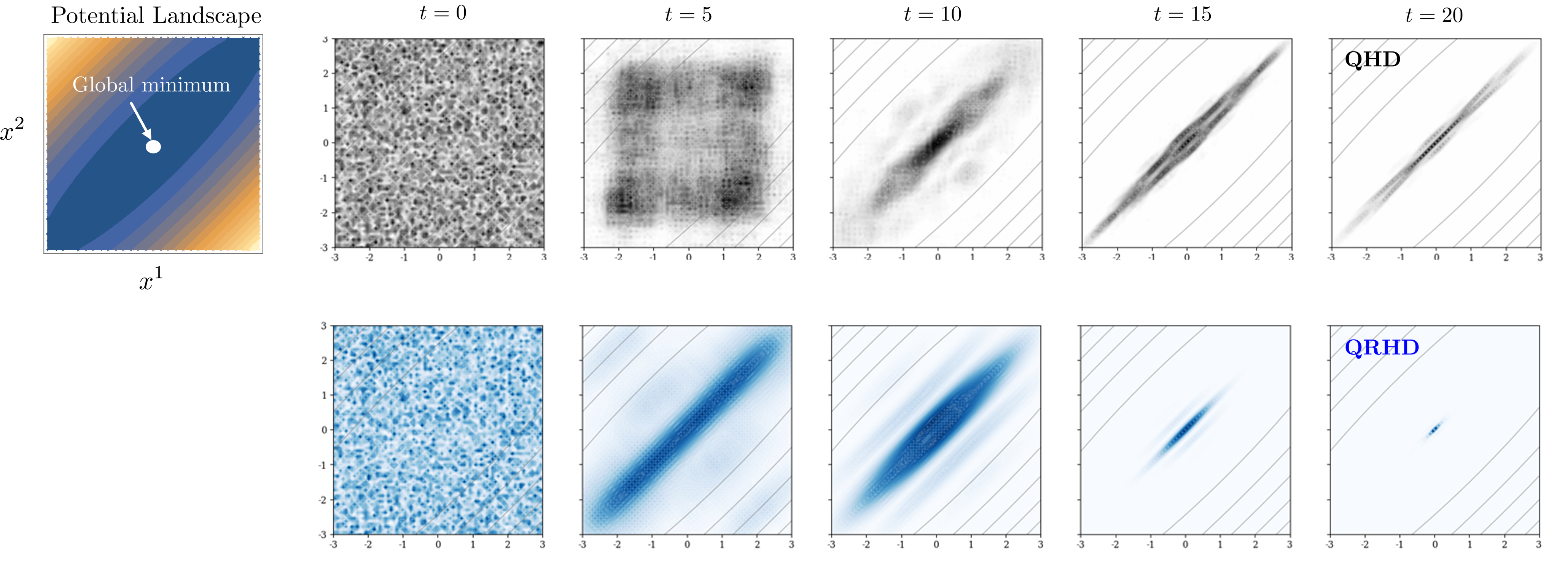
Figure 3: Comparative convergence for two-dimensional quadratic optimization: QHD (top, slower, isotropic) versus QRHD (bottom, accelerated convergence via geometric adaptation), visualized by wavepacket localization.
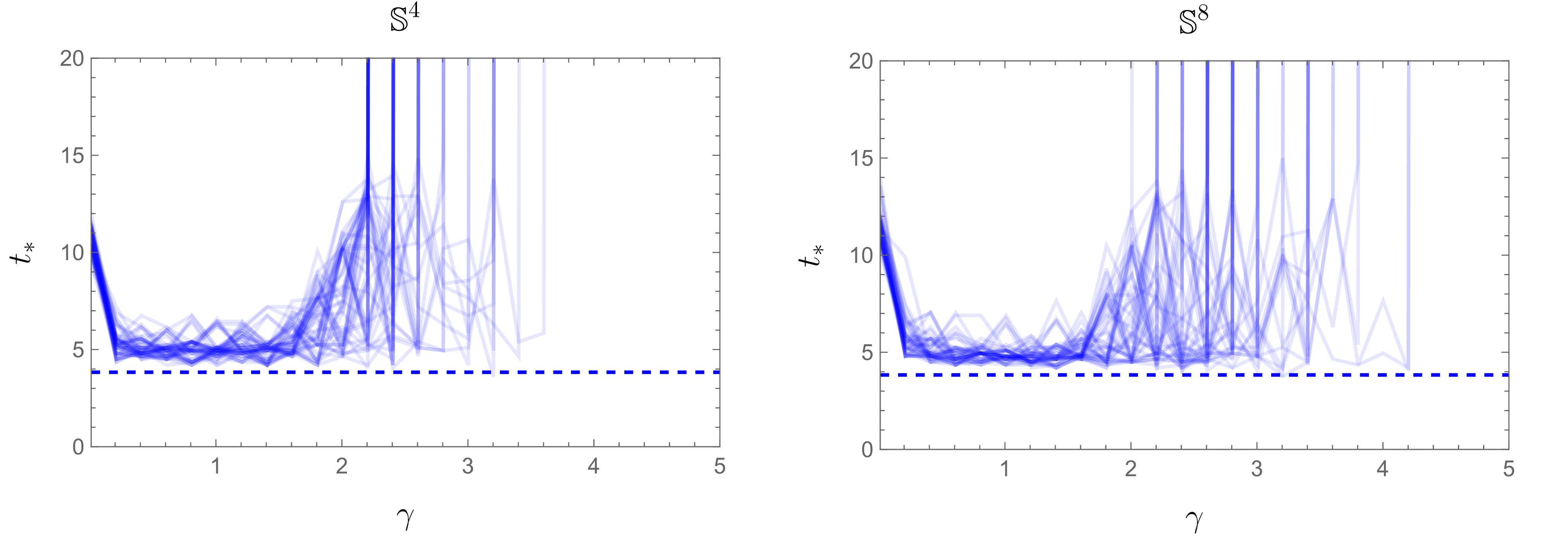
Figure 4: Numerical analysis: dependence of convergence time L(x,x˙,t)=a(t)(2mi,j=1∑Ngij(x)x˙ix˙j−η(t)V(x))6 on the dissipation parameter L(x,x˙,t)=a(t)(2mi,j=1∑Ngij(x)x˙ix˙j−η(t)V(x))7, with the analytic lower bound illustrated (dotted curve).
Numerical Demonstration and Geometry-Induced Acceleration
Comprehensive numerical simulations demonstrate QRHD's efficacy in two domains: conventional flat quadratic optimization and constrained optimization on the sphere. For the flat case, selection of the metric L(x,x˙,t)=a(t)(2mi,j=1∑Ngij(x)x˙ix˙j−η(t)V(x))8 as the Hessian of the potential achieves effective preconditioning, decreasing the condition number of the corresponding natural gradient flow and thus accelerating wavefunction localization and convergence.
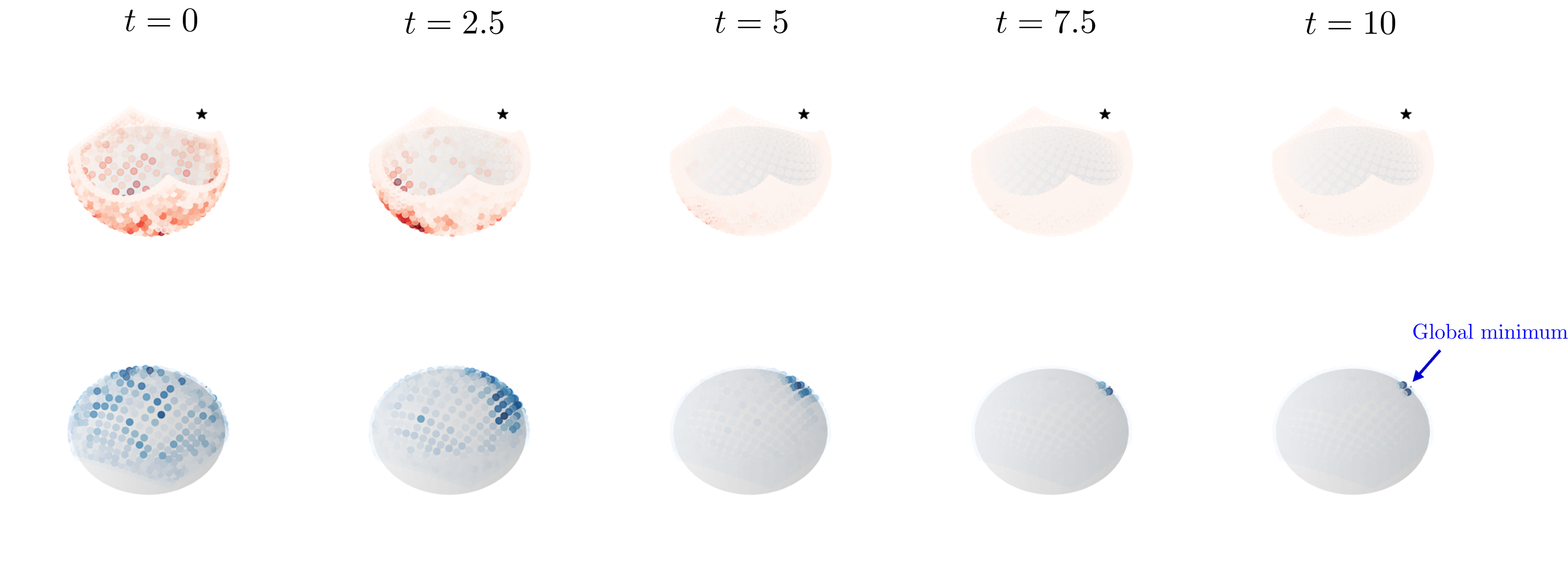
Figure 5: Numerical time-evolution for convex optimization constrained to a two-dimensional sphere: heatmaps show wavefunction concentration towards the optimal point in two stereographically projected coordinate systems, highlighting the geometric flexibility of QRHD.
For the Rayleigh quotient problem, QRHD is instantiated on the L(x,x˙,t)=a(t)(2mi,j=1∑Ngij(x)x˙ix˙j−η(t)V(x))9-dimensional sphere using conformally flat coordinates. This circumvents coordinate singularities endemic to traditional spherical coordinates and allows parallel coordinate chart simulation. The established framework supports coordinate-adaptive quantum dynamics and natural enforcement of constraints.
Quantum Circuit Realization and Complexity
Implementation of QRHD proceeds via time-dependent Hamiltonian simulation with interaction-picture-based algorithms, leveraging phase oracles for the cost function and sparse oracle access to the Laplace-Beltrami operator. The dominant cost is characterized by the product gij(x)0, where gij(x)1 quantifies kinetic operator norm and gij(x)2 the maximum potential amplitude.
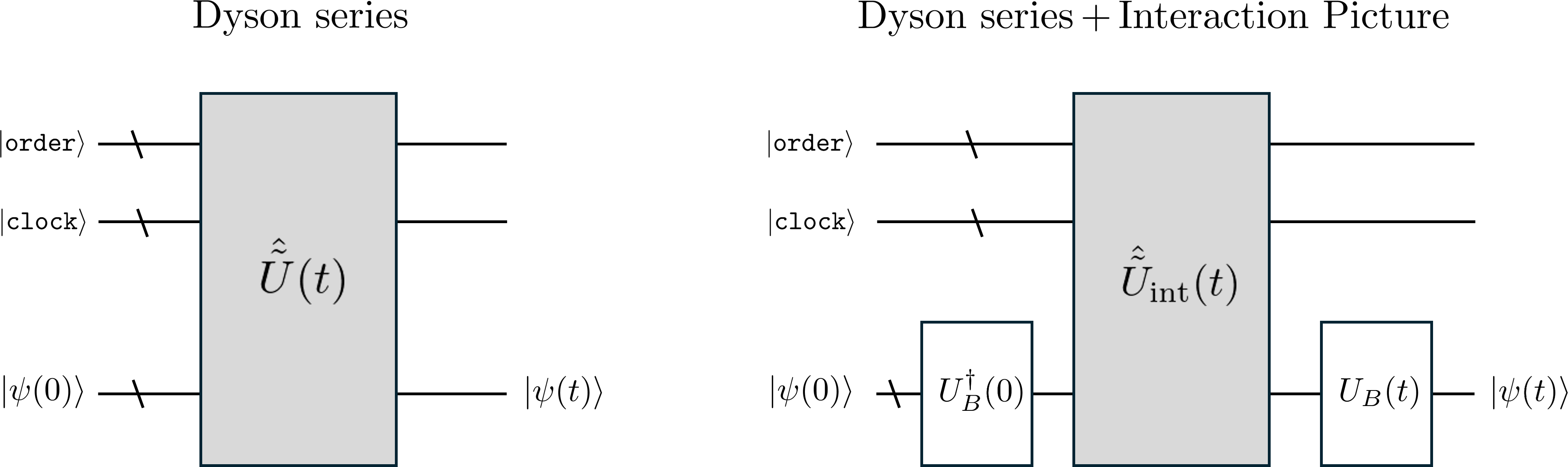
Figure 6: QRHD quantum circuit schematic for time-dependent Hamiltonian evolution, supporting interaction-picture expansion and time ordering.
For quadratic, flat-space problems, the improved convergence time afforded by geometric preconditioning is offset by an increased operator norm, rendering the overall query complexity approximately invariant under change of metric—a manifestation of complexity being determined by the action integral, reflecting a deeper connection between geometry and quantum information processing.
Theoretical and Practical Implications
This work extends quantum optimization capabilities to structured and constrained parameter spaces, enabling the direct incorporation of geometric priors into quantum optimization procedures—crucial for problems in manifold-constrained machine learning, geometric deep learning, and quantum simulation of systems with nontrivial configuration spaces. The separation of quantum geometric corrections from classical potential effects further clarifies the operational regime of quantum advantage and points towards new directions for exploiting early-time quantum effects in non-Euclidean settings.
The generality of QRHD provides a foundational framework for understanding the intersection of differential geometry and quantum dynamics in optimization, potentially informing future algorithmic developments for constrained quantum control, structured variational quantum eigensolvers, or geometry-induced landscape smoothing.
Conclusion
Quantum Riemannian Hamiltonian Descent offers a comprehensive, geometric generalization of quantum gradient-based optimization. By elevating the kinetic energy to a Riemannian form, QRHD introduces explicit metric control, supports natural enforcement of constraints, and links optimization dynamics to underlying parameter-space geometry. The analytic bounds on convergence time highlight the nontrivial interplay between geometric structure and quantum dynamics, while the quantum circuit and complexity analyses demonstrate that geometric flexibility can be achieved without increased asymptotic query cost. The framework opens multiple avenues for research at the confluence of quantum algorithms, optimization theory, and information geometry, and positions QRHD as a unifying approach for quantum dynamical optimization in complex structured spaces.