Efficient and Practical Black-Box Verification of Quantum Metric Learning Algorithms
Published 30 Mar 2026 in quant-ph | (2603.28687v1)
Abstract: Quantum metric learning enhances machine learning by mapping classical data to a quantum Hilbert space with maximal separation between classes. However, on current NISQ hardware, this mapping process itself is prone to errors and could be fundamentally incorrect. Verifying that a quantum embedding model successfully achieves its promised separation is essential to ensure the correctness and reliability. In this paper, we propose a practical black-box verification protocol to audit the performance of quantum metric learning models. We define a setting with two parties: a powerful but untrusted prover, who claims to have a parameterized unitary circuit that embeds classical data from different groups with a guaranteed angular separation, and a limited verifier, whose quantum capabilities are restricted to performing only basic measurements. The verifier has no knowledge of the implementation of the prover, including the structure of the model, its parameters, or the details of the prover measurement setup. To verify the separation between different data groups, the proposed algorithm must overcome two key challenges. First, the verifier is ignorant of the prover's implementation details, such as the optimization cost function and measurement setup. Consequently, the verifier lacks any prior information about the expected quantum embedding states for each group. Second, the destructive nature of quantum measurements prevents direct estimation of the separation angles. Our algorithm successfully overcomes these challenges, enabling the verifier to accurately estimate the true separation angles between the different groups. We implemented the proposed protocol and deployed it to verify the QAOAEmbedding models. The results from both theoretical analysis and practical implementation show that our proposal effectively assesses embedding quality and remains robust in adversarial settings.
The paper introduces a protocol that enables a verifier with minimal quantum capabilities to audit quantum metric learning embeddings without accessing the model’s internals.
It leverages mutually unbiased projective measurements to reconstruct state density matrices and accurately estimate the Bures angle between class states with error diminishing as O(1/√N).
The protocol extends to multi-class and multi-qubit settings, offering robust certification for quantum machine learning on NISQ hardware in adversarial environments.
Efficient Black-Box Verification of Quantum Metric Learning Algorithms
Introduction and Motivation
Quantum Metric Learning (QML) leverages the high-dimensional geometry of quantum Hilbert spaces to create data embeddings that maximize state separation between classes. This paradigm shift—focusing on data embedding rather than solely on classifier complexity—has potential to lower quantum circuit depth, a critical advantage for NISQ hardware. Verification of such embeddings, ensuring the claimed angular class separations, is essential for the reliability of quantum machine learning pipelines, especially in adversarial or untrusted settings. The paper "Efficient and Practical Black-Box Verification of Quantum Metric Learning Algorithms" (2603.28687) proposes a protocol that enables a weak verifier, with minimal quantum capabilities and no access to the prover's model, to robustly audit and certify the class separation achieved via quantum embeddings.
Fundamentals of Quantum Metric Learning
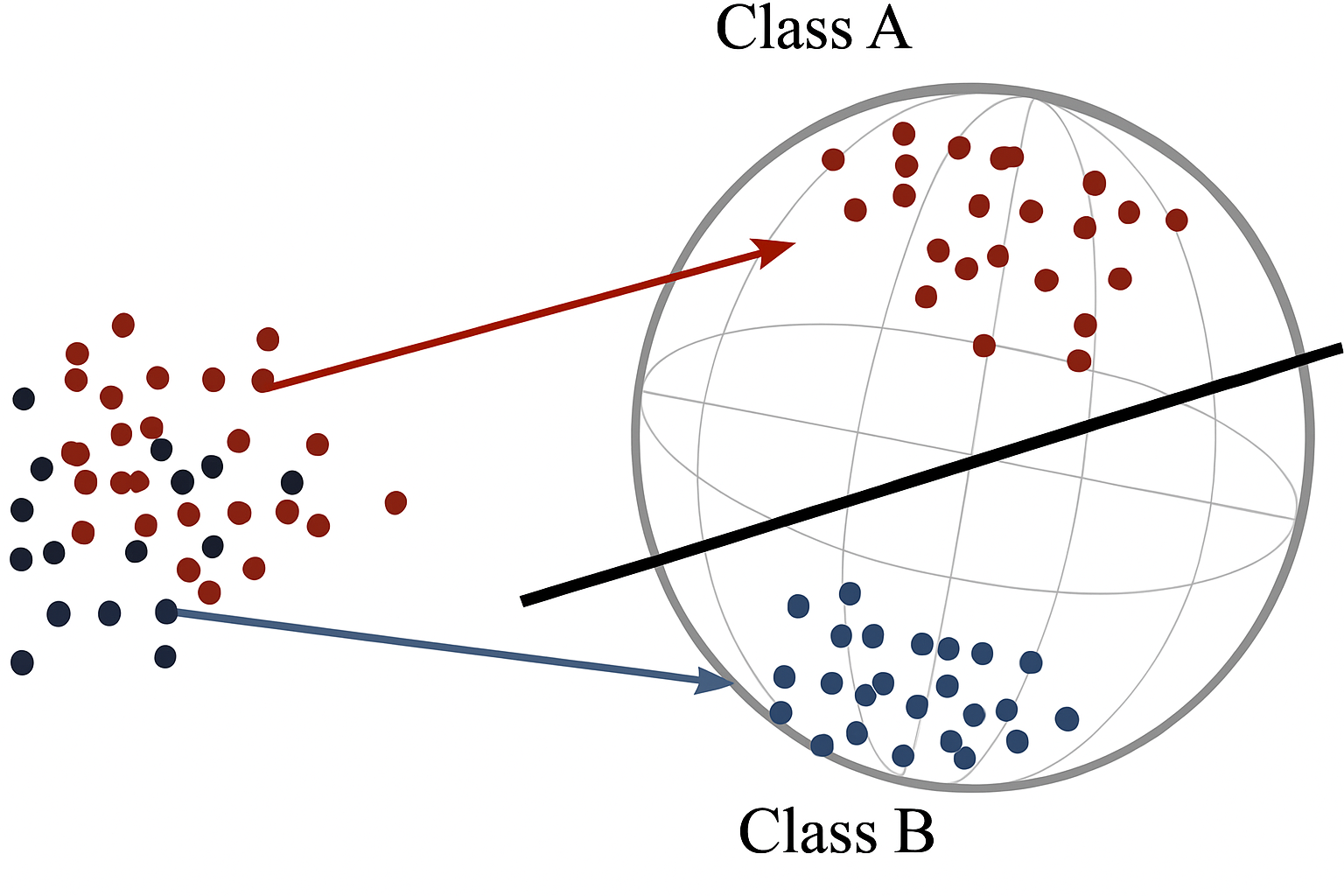
Quantum metric learning algorithms optimize parameterized quantum circuits to map classical data from different classes into quantum states whose ensemble densities (ρ and σ) are maximally separated according to metrics such as trace or Hilbert-Schmidt distance. Increased separation directly impacts the performance of downstream tasks, allowing simple measurements (e.g., Helstrom measurement under maximal trace distance) to achieve optimal discrimination error. The variational approach updates the embedding parameters to ensure that intra-class states coalesce (low average angle), whereas inter-class states are nearly orthogonal (average angle →π/2).
Figure 1: Example of quantum metric learning — two-class classical data maximally separated via learned quantum embedding.
Black-Box Verification Protocol Architecture
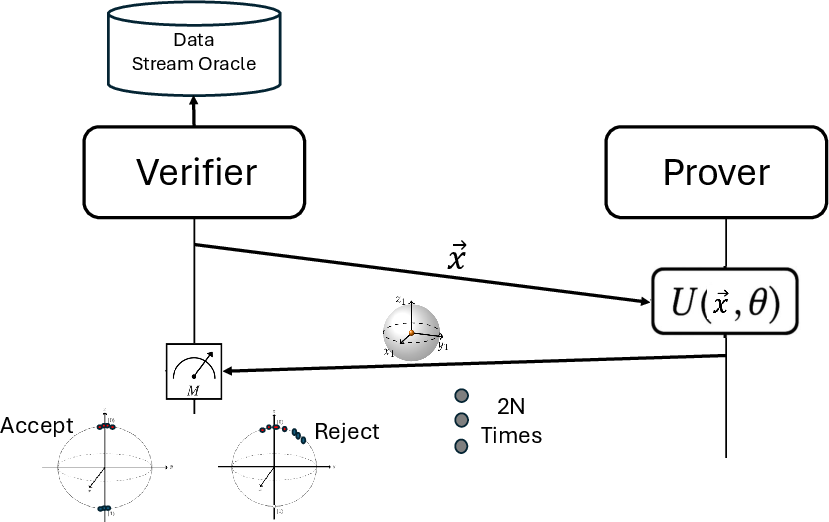
The verification protocol formalizes the interaction between a computationally unbounded (but potentially adversarial) prover P, and a severely restricted verifier V. The verifier can only access a data oracle and perform projective measurements; the prover claims to realize a parameterized unitary U(x,θ) that separates classes by an angular margin.
Protocol Summary:
The verifier selects $2N$ data points from the oracle, divides them into two class-labeled groups, and (blinding the labels) sends them to the prover.
For each x, the prover returns U(x,θ)∣0⟩.
The verifier splits each group’s returned qubits into thirds, measuring each subgroup in one of three mutually unbiased bases: computational, Hadamard, or circular.
Measurement results statistically reconstruct each group’s density matrix; quantum fidelity is then calculated.
The Bures angle between groups arccos(F) serves as the estimator of angular separation; acceptance or rejection is then determined based on a threshold.
Figure 2: The proposed verification protocol — interactive prover-verifier arrangement for black-box metric learning audit.
The critical theoretical insight is that, under a maximally separating quantum embedding, all class-σ0 samples are mapped to (approximately) the same pure state, enabling accurate state reconstruction from empirical measurement statistics. Estimation of angular separation thus reduces to single-qubit state tomography for each group using only the minimal set of projective measurement bases.
Theoretical Guarantees: Completeness and Soundness
The protocol demonstrates completeness: if the prover honestly implements an embedding producing orthogonal (maximally separated) state ensembles, the reconstructed Bures angle converges to σ1 with error vanishing as σ2.
Conversely, soundness is ensured even in adversarial settings: if the prover attempts to cheat (for example, without actually achieving separation or by remapping labels), the impossibility of matching the true label partitioning without oracle access implies that the empirical density matrices for the reconstructed groups will collapse toward mixtures, reducing the Bures angle, with the probability of a successful attack quantifiably negligible in σ3.
Empirical Evaluation
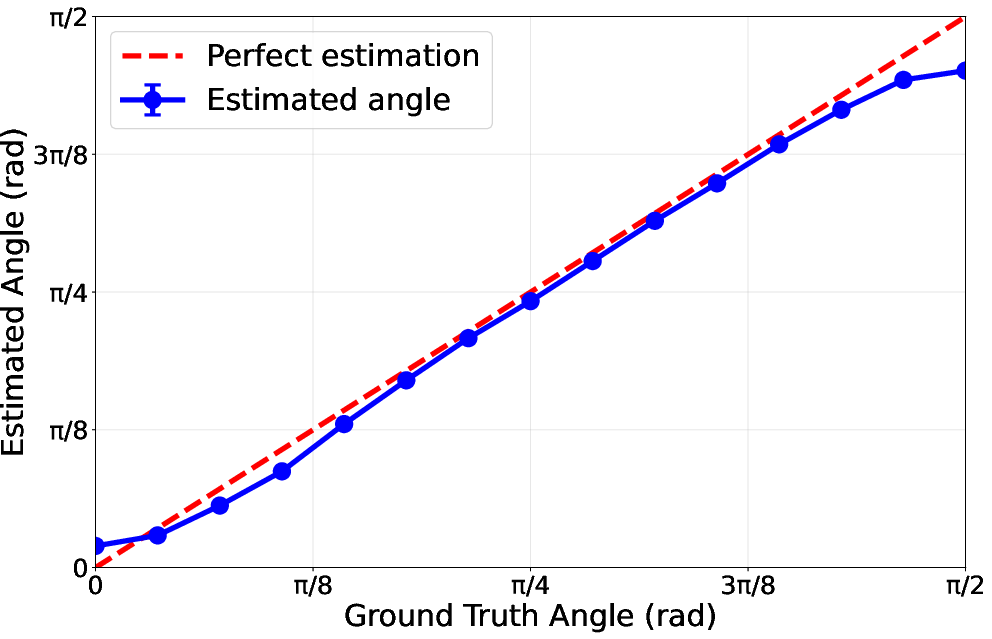
Simulations confirm that the protocol yields unbiased estimates for angular separation across a continuum from σ4 to σ5. This remains robust even with realistic intra-group state fluctuations, as confirmed by the precise tracking of estimated vs. true angles.
Figure 3: Angle estimation quality for the different theoretical models — estimated and true angular separations align under simulation.
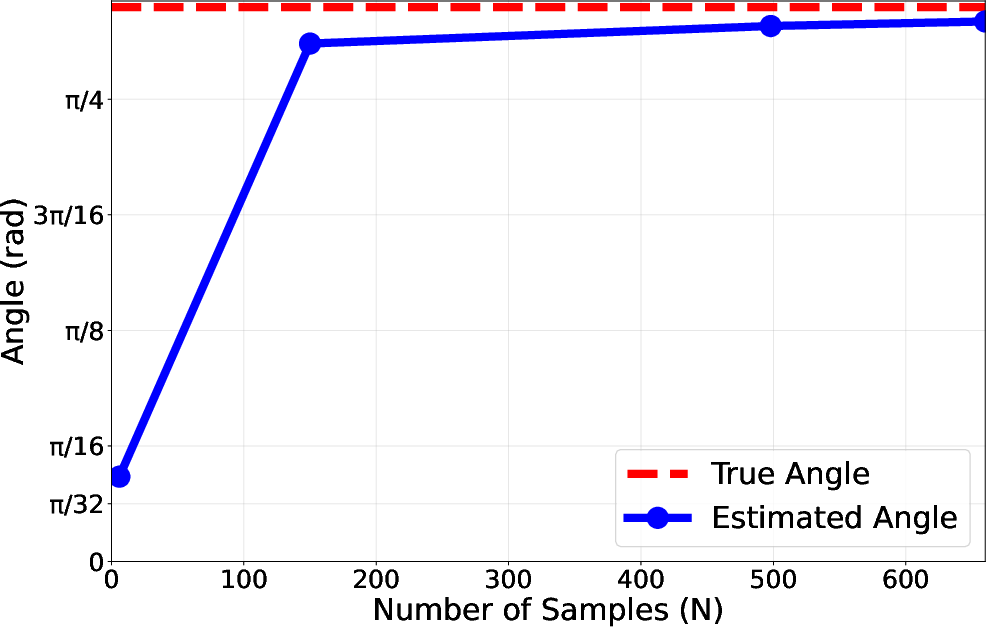
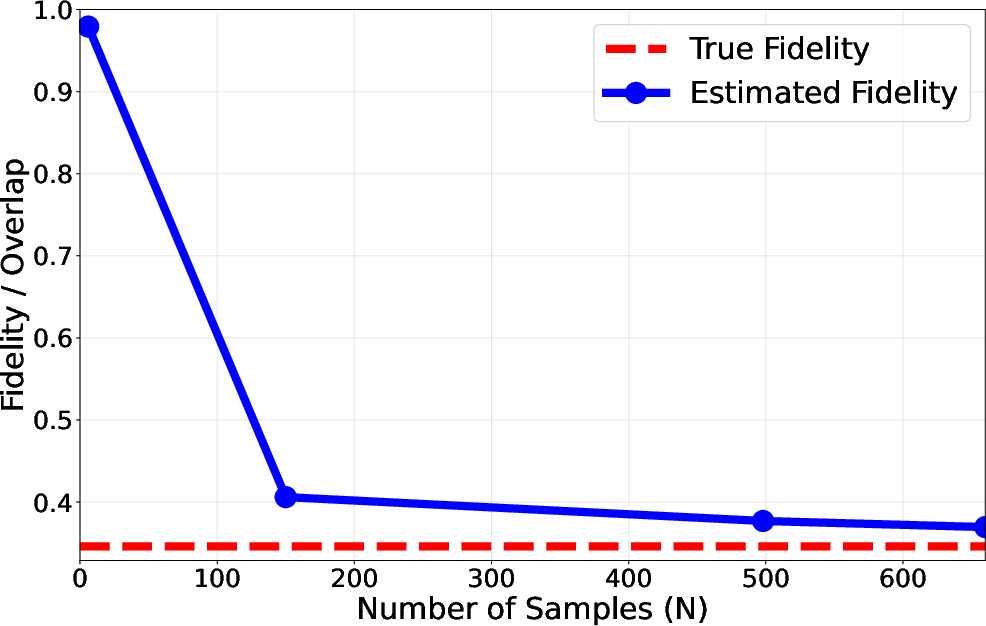
Applying the protocol to the PennyLane QAOAEmbedding model, measurements in three bases reconstruct the empirical density matrices for each class. Larger sample sizes (σ6) yield improved fidelity and angle estimates, demonstrating the statistical convergence rates predicted.
Figure 4: Effect of the number of samples σ7 on angle estimation — increased σ8 yields more accurate angle estimates for QAOAEmbedding.
Figure 5: Effect of the number of samples σ9 on fidelity — larger →π/20 improves fidelity estimates between density matrices of groups.
Protocol Extensibility and Practical Implications
Multi-Class Extension: The protocol naturally generalizes to →π/21 classes; pairwise separations are reconstructed using the same triple-basis tomography, then fidelity/angle is estimated for all →π/22 pairs.
Higher-Dimensional States: For input vectors of dimension →π/23, the protocol employs Pauli tomography (scaling with →π/24 settings) to reconstruct each group’s →π/25-qubit density matrix, maintaining the fidelity-based angular separation test.
Scalability: The protocol requires only →π/26 measurements, and the rejection or acceptance probability can be tuned via →π/27 to meet application-specific precision/security thresholds.
This verification tool is crucial when deploying quantum models in adversarial/non-transparent settings (e.g., cloud quantum ML services), or for trusted audit of externally trained quantum embeddings. Its reliance on measurement statistics alone, absent any assumption or knowledge of the internal model (architecture, parameters, or training procedure), is especially suited for the era of quantum cloud computing and for federated quantum model certification.
Conclusion
This work advances the state-of-the-art in verification for quantum machine learning by presenting a black-box statistical protocol that robustly audits the angular separation achieved by quantum metric learning circuits. Its minimal quantum requirements, strong theoretical guarantees, and extensibility to multi-class and multi-qubit settings make it immediately relevant for practical deployment and certification of quantum-enhanced learning systems. Future directions involve efficient extensions to even larger Hilbert spaces and adaptation to other quantum ML primitives such as quantum clustering and kernel methods.
“Emergent Mind helps me see which AI papers have caught fire online.”
Philip
Creator, AI Explained on YouTube
Sign up for free to explore the frontiers of research
Discover trending papers, chat with arXiv, and track the latest research shaping the future of science and technology.Discover trending papers, chat with arXiv, and more.