- The paper demonstrates that the extended exciton model, incorporating intrachromophoric mixing parameters, reveals how short-time coherence boosts rapid energy transfer.
- It uses Lindblad dynamics and correlation metrics to quantify nonequilibrium coherence and exciton delocalization in the FMO complex, directly linking simulations with 2DES spectroscopic signatures.
- The study offers actionable design principles for engineering artificial light-harvesting materials by optimizing internal electronic structure for enhanced energy trapping.
Time-Resolved Excitonic Coherence and Delocalization in Photosynthetic Energy Transport
Introduction
This paper addresses a fundamental problem in photosynthetic energy transfer: dissecting how quantum coherence and exciton delocalization, modulated by internal chromophore structure, determine energy transport efficiency in pigment-protein complexes. While classical Frenkel exciton models treat each pigment as a structureless site, the authors introduce an extended excitonic Hamiltonian that resolves each chromophore into two internal electronic degrees of freedom with tunable mixing. This enables a systematic interrogation of how internal correlations influence the balance between coherence-enhanced ultrafast delocalization and efficient trapping of excitation at the reaction center (RC).
Extended Exciton Network Model
The paper generalizes the conventional Frenkel framework by decomposing each chromophore into two intrachromophoric sites connected by an electronic mixing parameter Ui. The resulting network maintains the original site connectivity but introduces additional intra-chromophoric transport pathways and reorganizes local excitonic eigenstates, splitting them into bright and dark superpositions (Figure 1).
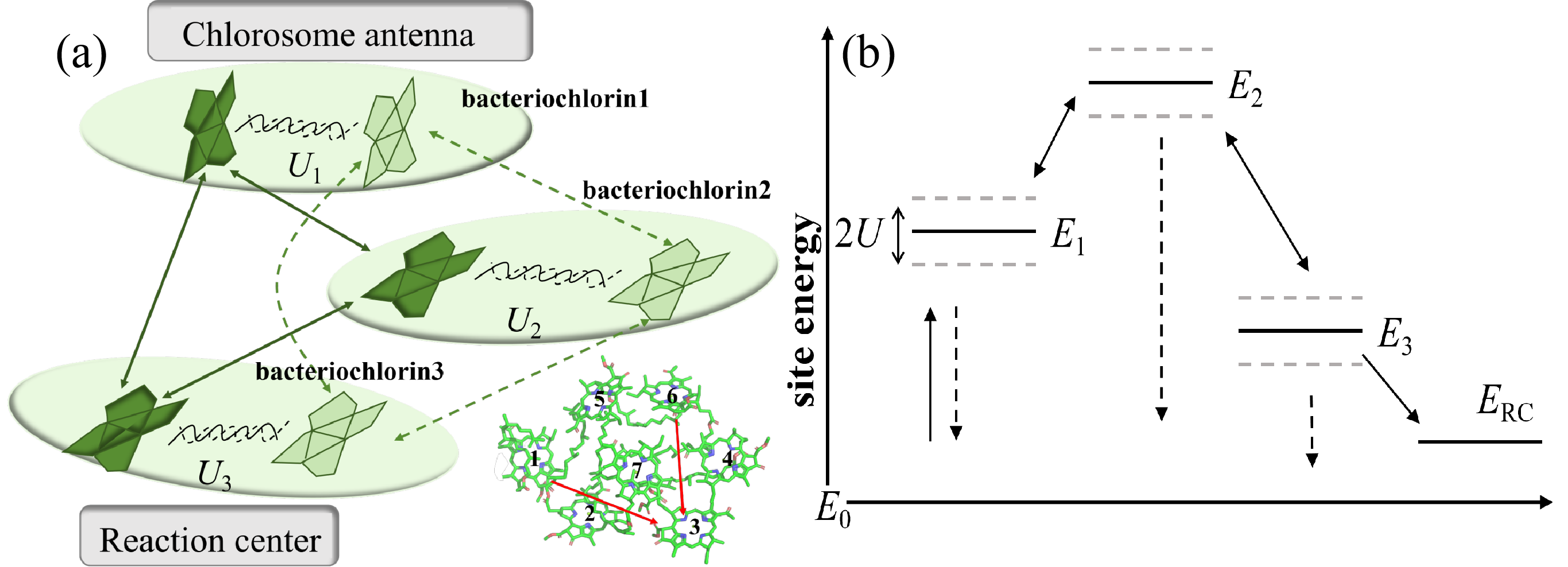
Figure 1: Minimal extended FMO network with two intrachromophoric sites per chromophore, highlighting how Ui splits and mixes local states, modifying transport topology and the energy landscape.
The dynamics of excitation transfer is formulated within a Lindblad master equation. This allows efficient simulation of the open quantum system, incorporating dissipative environmental effects while enabling direct access to time-resolved density matrix observables. Two key metrics are used to quantify the nonequilibrium excitation: the relative entropy of coherence (measuring quantum phase correlations and off-diagonal density matrix structure), and the exciton delocalization length (codifying the effective number of sites involved in the coherent superposition).
Correlation Analysis and Mechanistic Insights
A focused analysis for the Fenna–Matthews–Olson (FMO) complex, specifically the dominant S1→S3 energy transfer pathway, systematically maps how the three intrachromophoric couplings U1, U2, U3 affect dynamical observables. Pearson correlation matrices reveal that increasing U1 (antenna-side coupling) strongly amplifies short-time coherence and delocalization, significantly enhancing early-time RC population growth; conversely, large values of U3 (RC-proximal mixing) promote long-lived coherence and excessive delocalization, suppressing final trapping efficiency (Figure 2).
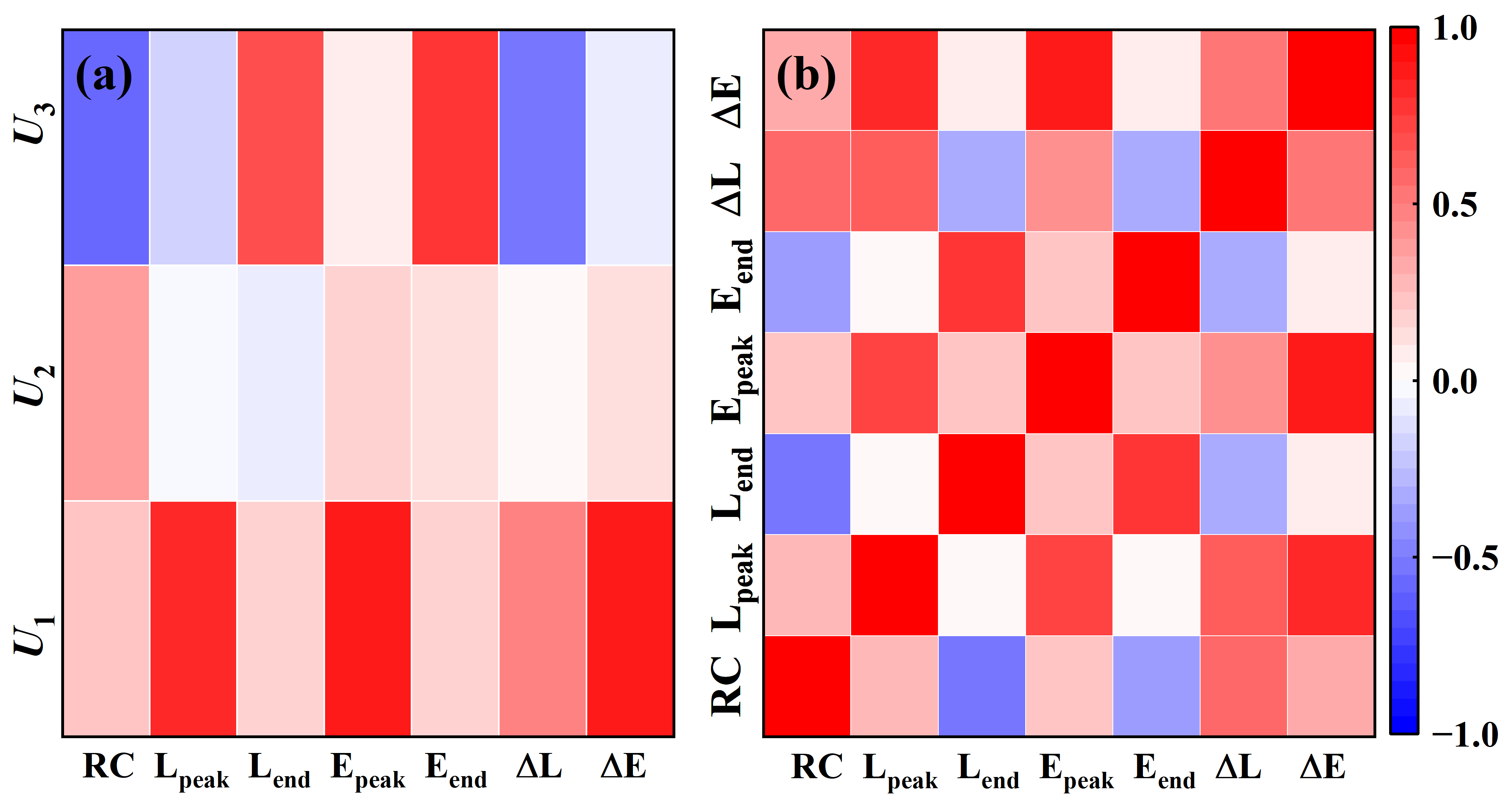
Figure 2: Correlation matrices establishing the distinct roles of intrachromophoric mixing parameters with respect to dynamical observables, coherence, and population trapping.
The analysis supports a mechanistic schema: short-time coherence and delocalization facilitate rapid and directional population transfer by increasing the sampling of energy transport pathways and enhancing barrier surmounting; in contrast, persistence of long-lived coherence near the RC under high U3 maintains the excitation in a delocalized manifold, opening decay and relaxation channels, and thereby reducing population yield at the sink.
Two-Dimensional Electronic Spectroscopies: Spectroscopic Signatures
To connect theoretical findings with experimentally accessible observables, the paper complements its dynamical analysis with simulated two-dimensional electronic spectroscopy (2DES). The spectra focus on the stimulated emission (SE) contribution, which is highly sensitive to excited-state populations and coherence. Comparison of standard and extended FMO models reveals that internal chromophoric mixing produces marked changes in 2DES cross peak intensity and frequency shifts (Figure 3).
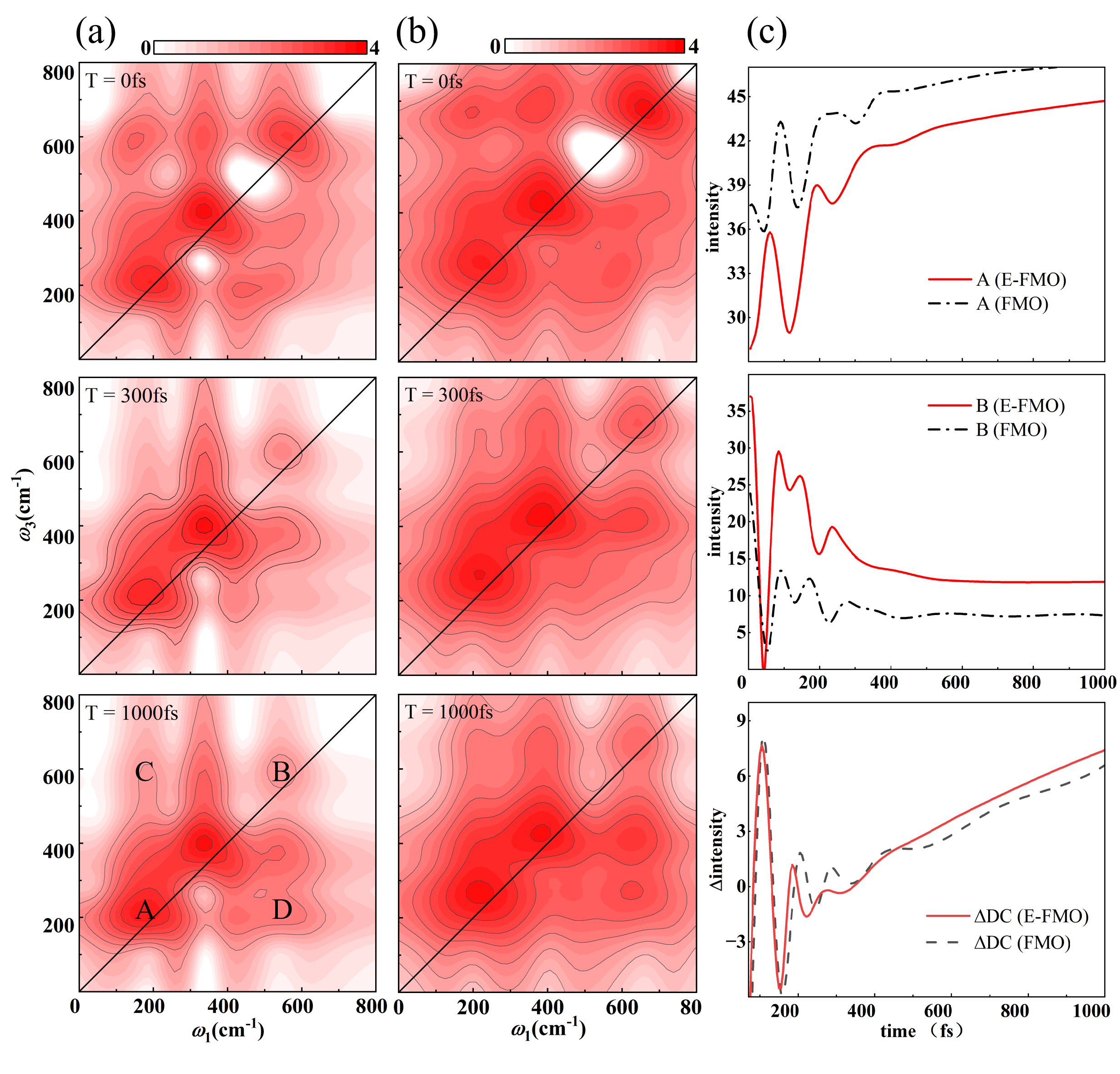
Figure 3: SE-path 2DES spectra showing enhanced population transfer and coherence-driven signal evolution in the extended FMO model compared to the standard model.
Spectral features—especially the temporal growth of cross peaks and net donor-acceptor population transfer—are systematically modified by the internal mixing parameters:
- Enhanced short-time cross-peaks: Increasing U1 and Ui0 (antenna-side/injection region) produces stronger and temporally sharper cross-peaks at early waiting times, reflecting rapid, coherence-driven excitation injection (Figure 4).
- Suppressed forward transfer by Ui1: Increasing Ui2 (near RC) attenuates the net donor-to-acceptor cross-peak, indicative of reduced forward energy funneling and coherent population trapping in the delocalized eigenmanifold (Figure 5).
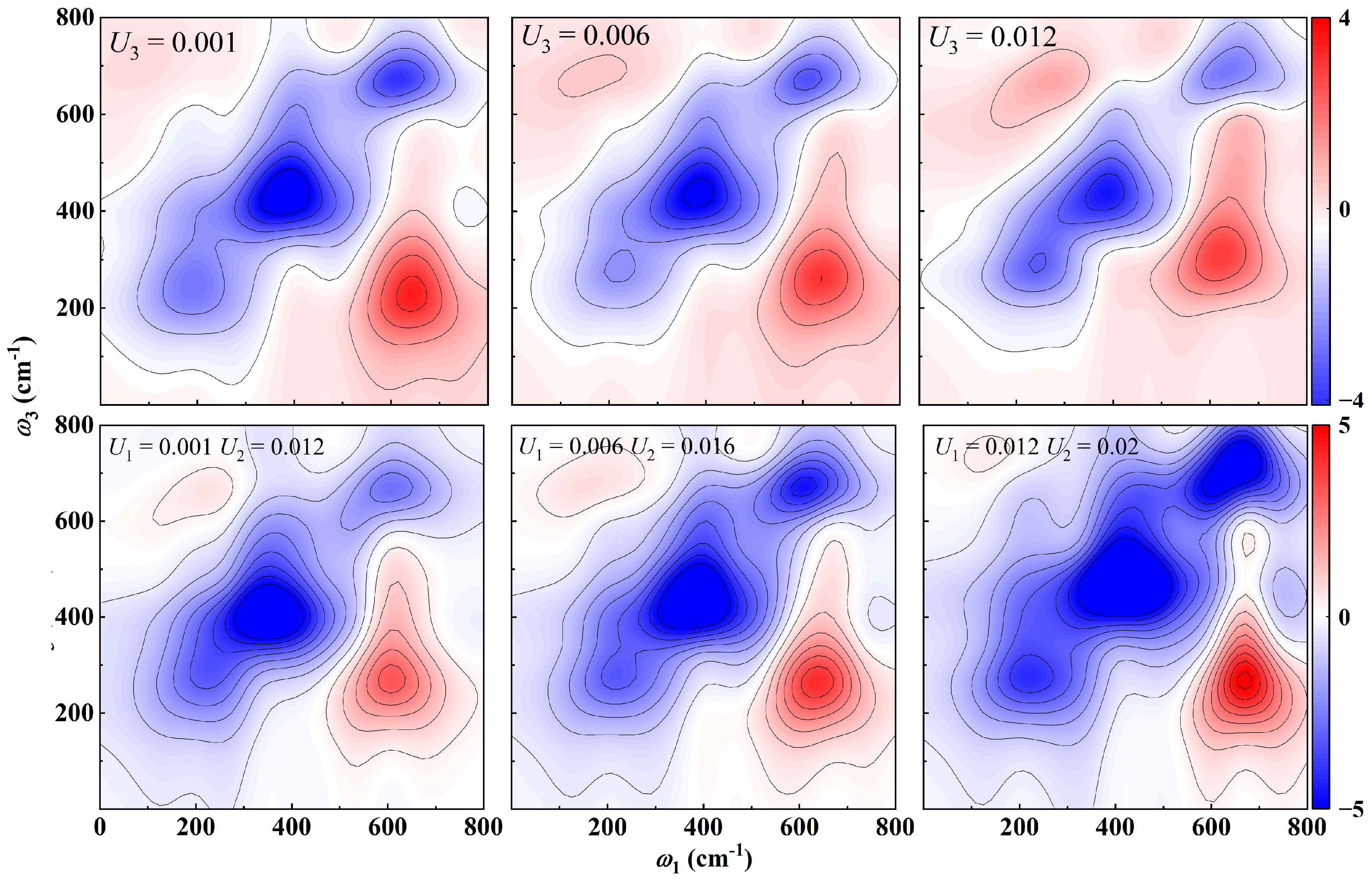
Figure 5: SE-path 2DES difference spectra of the E-FMO model quantifying transfer dynamics and revealing the antagonistic roles of Ui3 versus Ui4 on population flow and net efficiency.
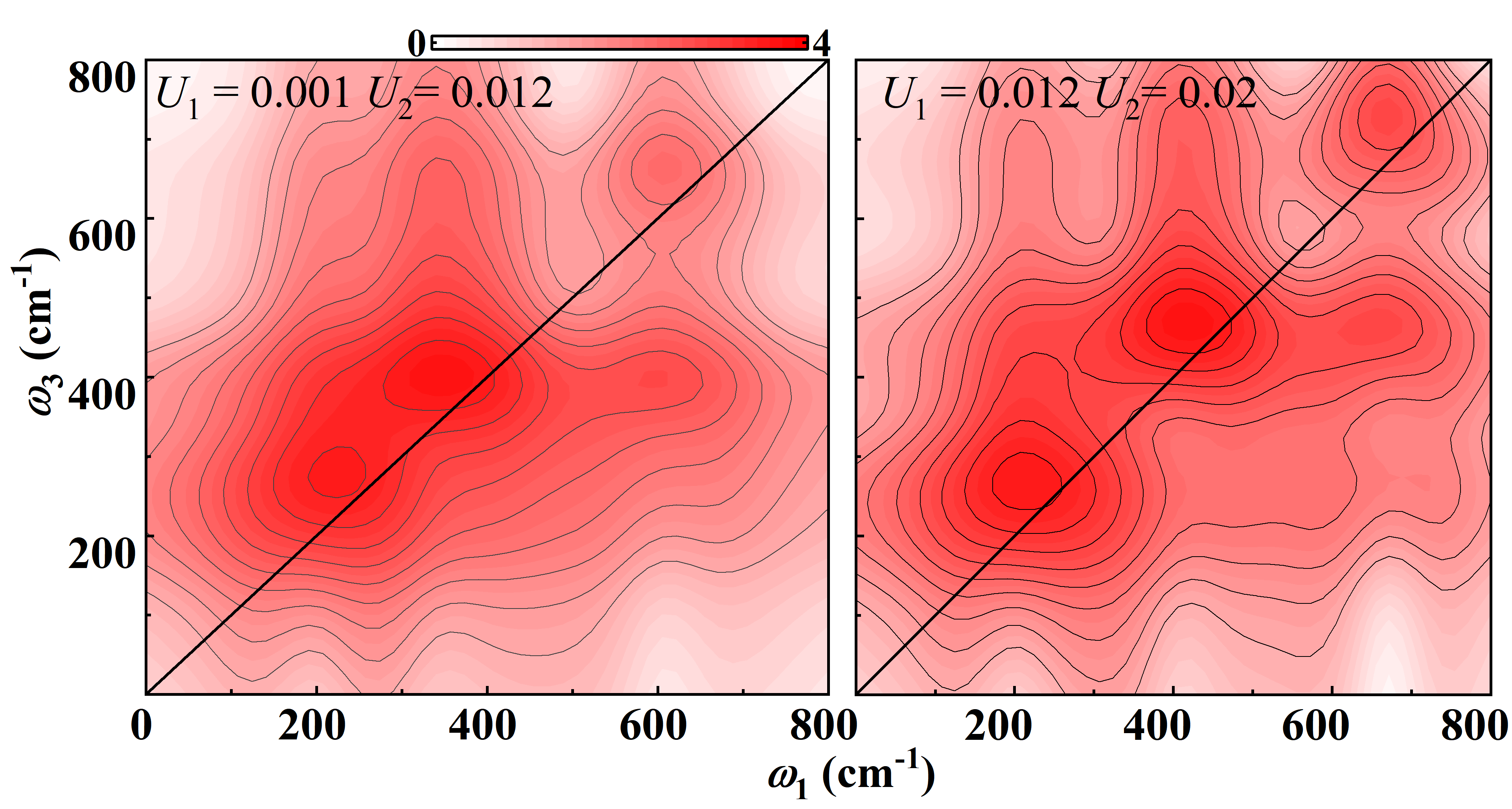
Figure 4: Sensitivity of SE-path 2DES cross-peak amplitude to antenna-side intrachromophoric mixing Ui5, correlating with enhanced coherence and delocalization at early times.
Furthermore, the time evolution of rephasing SE-path cross-peaks displays robust anti-phase oscillations between forward and reverse transfer channels, a nontrivial signature of coherent phase correlations dominating the transport mechanism, distinct from incoherent hopping dynamics (Figure 6).
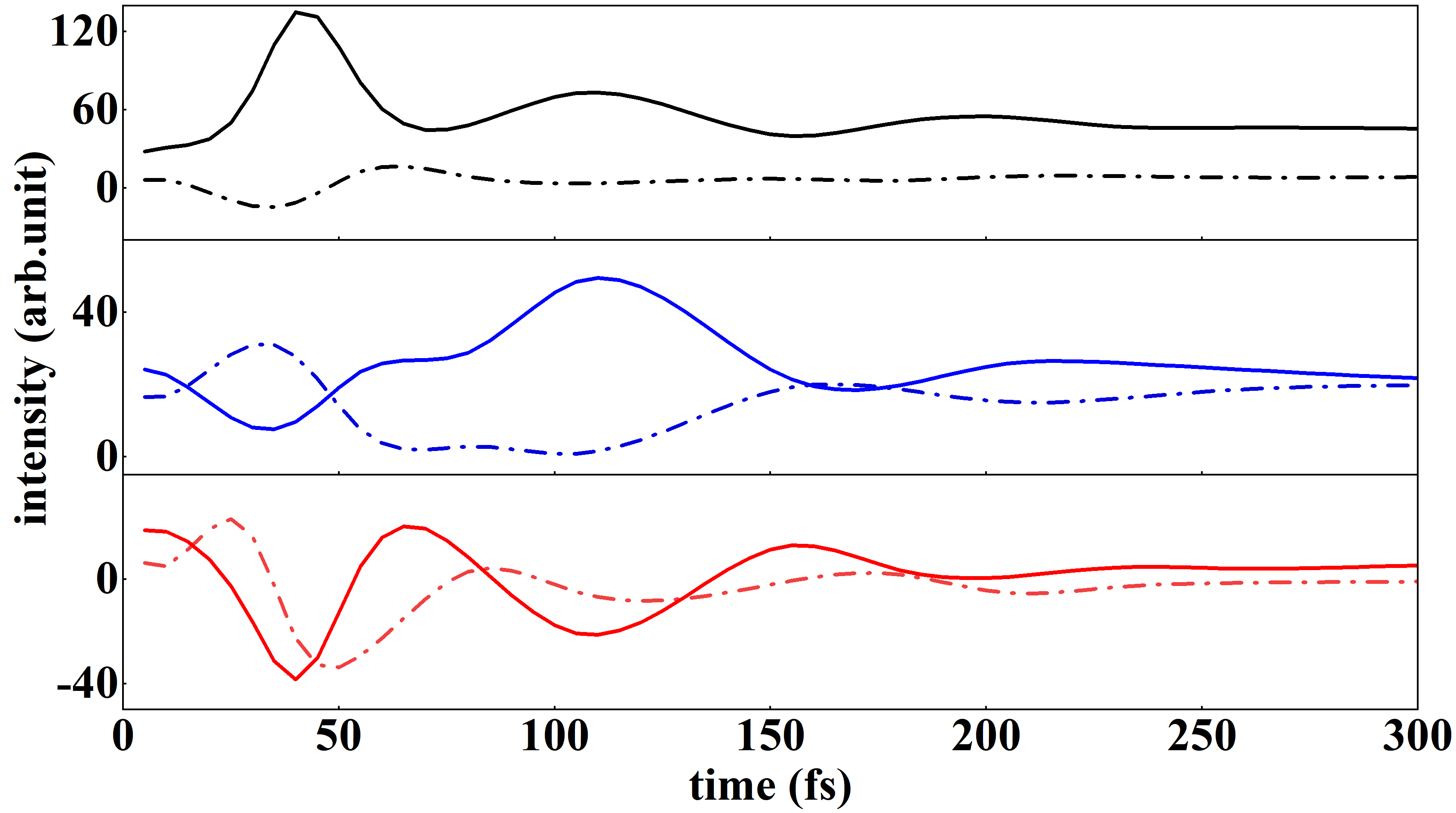
Figure 6: Cross-peak dynamics in 2DES displaying anti-phase behavior: compelling evidence that quantum coherence dictates the energy transfer dynamics between site pairs in the extended network.
The spectroscopic response is formally decomposed into ground-state bleaching, stimulated emission, and excited-state absorption pathways (Figure 7), which is essential for interpreting phase-resolved 2DES data and attributing spectroscopic features to underlying quantum transport channels.
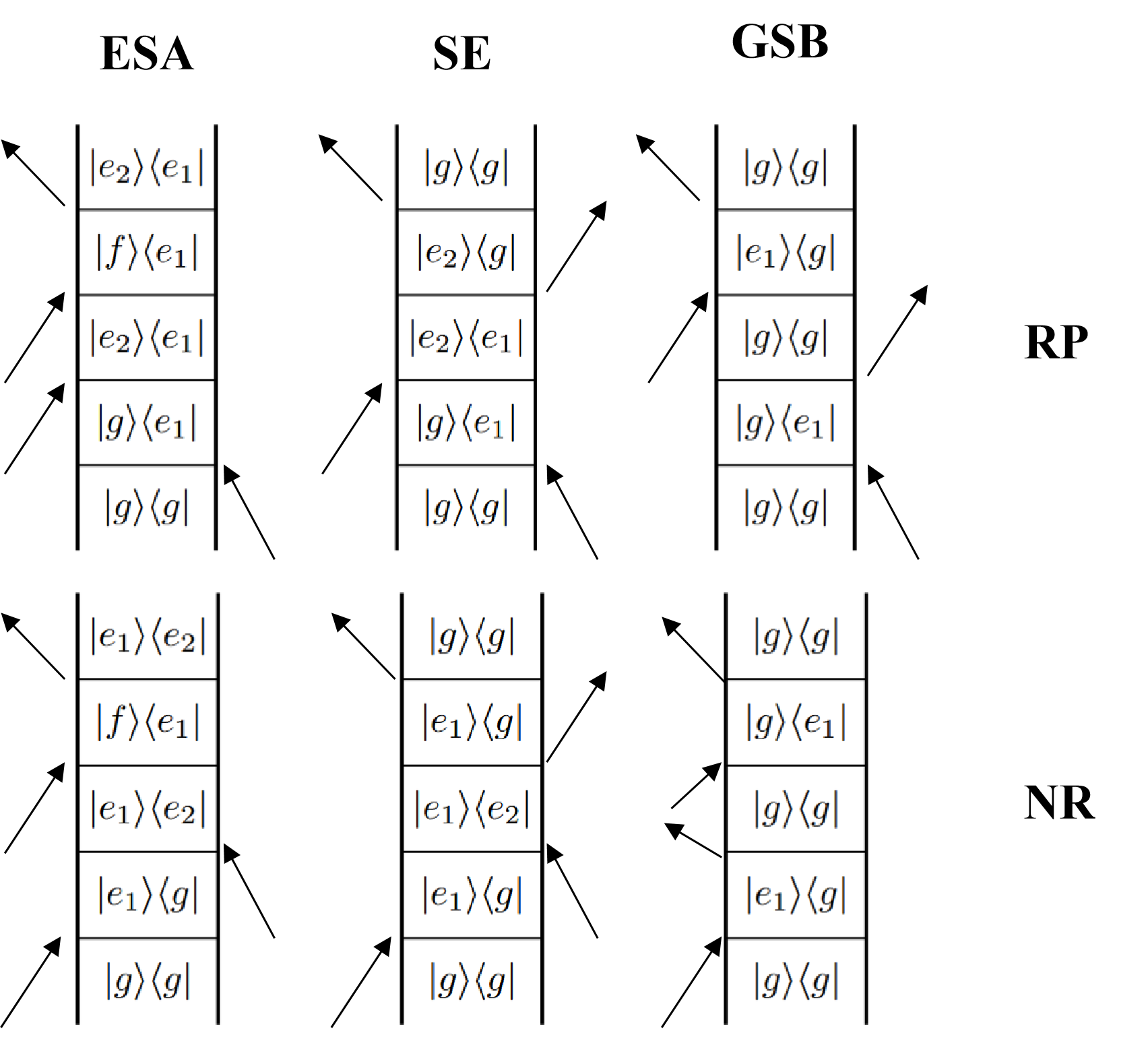
Figure 7: Liouville pathway diagrams for ESA, SE, and GSB contributions to phase-sensitive 2DES spectra, clarifying the mapping from quantum kinetics to experimental observables.
Implications and Prospects
The study provides a comprehensive theoretical framework and explicit dynamical–spectroscopic correspondence for understanding and engineering quantum transport in photosynthetic systems. The findings demand a revision of canonical "coherence always enhances trapping" narratives and supply experimentally testable predictions—specifically, that optimal energy transport requires maximizing short-time coherence and delocalization (improving uphill injection and pathway sampling) while suppressing their persistence near the RC to avoid dissipative losses.
From a practical perspective, these design principles inform the targeted chemical engineering of artificial light-harvesting materials, guiding the deliberate modulation of local electronic structure to achieve directed, efficient transport. On the theoretical side, the results motivate further exploration beyond the Markovian Lindblad regime and towards more realistic descriptions that incorporate multilevel chromophore structure and non-Markovian environmental effects.
Conclusion
By extending the standard exciton model to include chromophore-internal electronic structure and systematically probing its impact on the complete energy transfer pathway, the paper clarifies the time-dependent, site-dependent roles of quantum coherence and delocalization in photosynthetic transport. The use of numerical simulations and spectroscopic modeling not only reveals nontrivial design principles for efficient transfer, but also offers concrete predictions for experimental validation and technological exploitation in quantum-enhanced energy materials.