- The paper's main contribution is proposing an experiential, context-aware AI literacy model that bridges theoretical knowledge with real-world workplace application.
- It employs interactive workshops, reflective use-case generation, and collaborative critique to enable participatory AI design and ethical evaluation.
- The approach enhances functional AI literacy, promotes responsible AI practices, and lays a foundation for scalable, sector-specific AI integration.
An Experiential Approach to AI Literacy: Embedding Practical Understanding in Workplace Contexts
Introduction
The prevalence of AI tools across diverse sectors—healthcare, education, government—has not translated directly into workplace readiness or informed adoption. Persistent uncertainty remains regarding AI's applicability, capabilities, limitations, and integration strategies. The disconnect between abstract AI literacy instruction and practical implementation represents a significant impediment for workforce stakeholders, amplifying misconceptions and hesitancy toward automated solutions. "An Experiential Approach to AI Literacy" (2603.29238) addresses this translational gap, proposing a model wherein experiential, context-aware pedagogies are central to deepening end-user competencies and facilitating participatory AI design.
Contextualizing AI Literacy Gaps
AI literacy is increasingly delineated as a multi-dimensional construct comprising critical evaluation, effective communication, collaboration with AI, and informed utilization in workplace settings [long_co-designing_2021; ng_conceptualizing_2021]. Despite a diversity of frameworks, extant educational paradigms overwhelmingly emphasize the transmission of abstract or tool-specific knowledge, with little anchoring in daily workplace realities. Stakeholders without technical backgrounds particularly struggle to map general AI concepts onto tangible pain points, workflow opportunities, or contextualized risks [babashahi_ai_2024]. The practical consequences include overestimation of automatable tasks, exaggerated threat perceptions related to job displacement, and missed opportunities for constructive co-design.
Experiential Pedagogical Model
The crux of the proposed approach is a participatory, experiential learning cycle, structurally divided into three discrete yet interconnected phases:
- Foundational Interactive Workshop: Participants receive a non-technical, context-relevant introduction to AI—its mechanisms, ethical dimensions, and illustrative applications. Rather than focusing on fast-evolving tool specifics, this session frames AI in terms of high-level functional affordances, fostering robust and adaptable mental models.
- Experiential Reflection and Use-Case Generation: Over a multi-week period, participants iteratively identify, reflect on, and articulate plausible AI use cases rooted directly in their work routines and observed challenges. Structured design resources—such as card decks and ideation toolkits—are deployed to scaffold this process, supporting ideation without cognitive overload [sadeghian_workai_2025; smith_codesigning_2025].
- Collaborative Sharing and Critique Workshop: Culminating in group storytelling, participants present their conceived use cases, critiquing feasibility, ethical ramifications, and implementation barriers. The social dimension fosters critical dialogue, refinement of scenarios, and explicit focus on ethical attributes such as fairness, transparency, and alignment with organizational values.
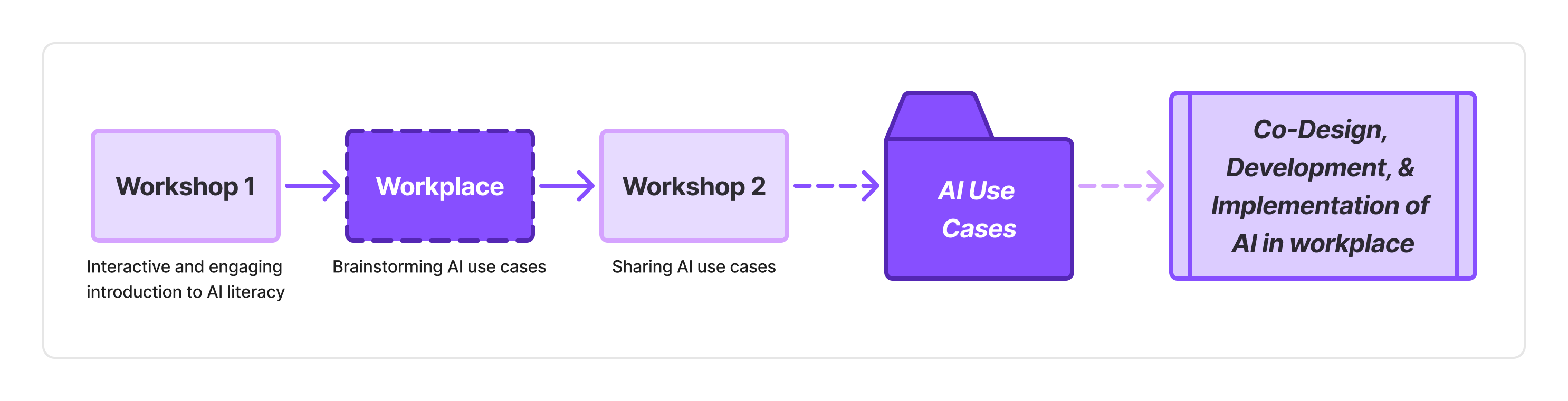
Figure 1: AI literacy model centering participants' workplace contexts, structured around initial grounding, iterative use case development, and collaborative refinement.
Key Claims and Outcomes
The paper advances several claims with strong implications for the operationalization of AI integration in non-technical sectors:
- Bridging the Knowing–Doing Gap: The authors argue that embedding AI literacy in experiential, highly contextualized processes is necessary to translate theoretical understanding into actionable workplace strategy. This directly targets deficiencies identified in prior literature regarding the limitations of abstract or tool-centric instruction.
- Grounded Participatory AI Development: The methodology inherently supports participatory AI design practices, enabling co-design opportunities where stakeholders' lived expertise and domain constraints substantively shape resulting AI solutions [birhane_power_2022]. This is in contrast to top-down development cycles that risk misaligned automation.
The practical outputs of this approach are twofold: (1) enhancement of functional AI literacy across diverse occupational cohorts, and (2) a curated repository of domain-grounded, ethically annotated AI use cases to inform subsequent system prototyping or piloting efforts.
Implications for Future AI Practice and Research
The integration of experiential and contextual pedagogies in AI literacy has several long-term repercussions for both theory and application:
- Workflow-Aligned AI Adoption: By centering stakeholder expertise, adoption trajectories are more likely to result in workflows where human-AI complementarity is optimized rather than arbitrary.
- Scalability Across Sectors: The flexible, discipline-agnostic structure of the model means it is extensible to various organizational sectors experiencing technological displacement or augmentation.
- Ethical Deliberation Embedded in Practice: Concrete use-case co-design, augmented by iterative ethical critique, operationalizes responsible AI principles at the point of ideation, not merely at post hoc evaluation.
This participatory, experiential model aligns with recent critiques emphasizing the necessity of a stakeholder-first approach for responsible AI literacy [dominguez_figaredo_responsible_2023], and the imperative to move beyond K-12 and expert audiences to reach broader adult and professional cohorts [laupichler_artificial_2022].
Conclusion
"An Experiential Approach to AI Literacy" articulates a structured, context-driven pedagogy that explicitly addresses the persistent chasm between conceptual AI knowledge and real-world adoption. By harnessing reflection, storytelling, and co-design, the model positions participants as informed evaluators and collaborators in the AI deployment pipeline. As AI continues to reconfigure professional practice, embedding literacy in lived experience will be essential for both effective integration and the realization of equitable, participatory, and ethical AI systems tailored to sector-specific realities.