- The paper establishes that a Richardson variety is toric if and only if its Bruhat interval avoids a 2-crown and forms a lattice.
- It employs combinatorial and polyhedral geometry to classify ‘unexpected’ toric varieties, including those with dimensions exceeding n–1.
- The work connects torus actions with moment polytope decompositions, linking geometric representation theory and cluster algebra structures.
Unexpected Toric Richardson Varieties in the Complete Flag Variety
Introduction and Main Results
This work investigates the structural and combinatorial properties of Richardson varieties Rv,w for GLn, specifically characterizing those that are (possibly unexpectedly) toric varieties with respect to some torus action. The analysis establishes an equivalence between the open Richardson variety Rv,w being isomorphic to an algebraic torus and the closed Richardson Rv,w being toric, demonstrating that the torus action on Rv,w extends canonically to its closure. Classification is accomplished via purely combinatorial properties of the Bruhat interval [v,w]; notably, such intervals must avoid the existence of a 2-crown (i.e., a subinterval isomorphic to the S3 Bruhat graph) and must be lattices.
The classification uncovers a broad spectrum of "unexpected" toric Richardson varieties—those of dimension exceeding n−1, which are not T-toric with respect to the standard maximal torus in SL(n). Instead, these appear as toric varieties under alternative torus actions, not inherited from the ambient flag variety.
Combinatorial and Geometric Classification
The conditions for a closed Richardson GLn0 to be toric are shown to be strictly combinatorial, encoded in the structure of the Bruhat interval GLn1:
- GLn2 is a torus GLn3 GLn4 is a toric variety
- GLn5 GLn6 contains no subinterval isomorphic to GLn7
- GLn8 GLn9 is a lattice
In particular, the presence of a 2-crown is a complete obstruction: a Richardson variety is toric if and only if no such subinterval exists.
Explicit examples and infinite families are constructed, including intervals of hypercube type, leading to toric Richardson varieties of dimension Rv,w0 for Rv,w1, with moment polytopes combinatorially equivalent to high-dimensional cubes.
Moment Polytopes and Orbit Decomposition
The geometry of these toric Richardson varieties is intimately linked to combinatorial models, specifically the moment polytope Rv,w2, whose face lattice is isomorphic to the lattice of subintervals of Rv,w3. Each face corresponds to a subinterval, and the 1-skeleton coincides with the Hasse diagram of the interval.
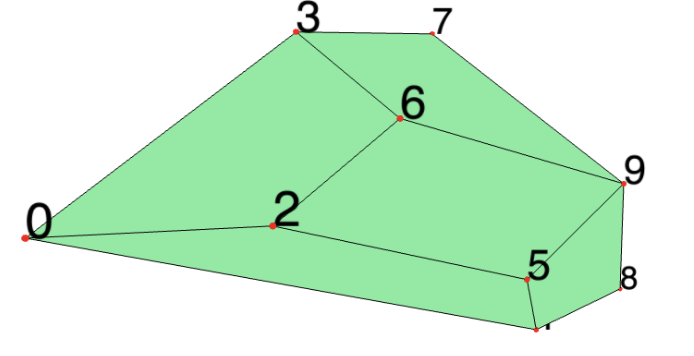
Figure 1: The polytope Rv,w4, whose face structure reflects the interval lattice associated to Rv,w5.
A key result is that Rv,w6 decomposes into a finite number of orbits under the acting torus Rv,w7; each open Richardson Rv,w8 (for Rv,w9) forms a single orbit. The faces of the moment polytope are thus in bijection with the Richardson orbits, and the interplay between subgroup structure in Rv,w0 and orbit stratification is made explicit.
The moment polytope itself admits a Minkowski sum decomposition in terms of positroid polytopes, via the Grassmannian projections: Rv,w1
where Rv,w2 is the image under the torus moment map of the positroid variety Rv,w3 corresponding to the Rv,w4-th constituent matroid of Rv,w5.
Projections to Grassmannians and Positroid Structure
Under the Grassmannian projection, the image of a toric Richardson variety is a positroid variety that is toric with respect to an appropriate subtorus. The associated plabic graphs for these positroid varieties are always forests, reflecting the frozen-variable structure of the associated cluster algebra; mutable cluster variables would introduce cycles and hence mutable directions, which cannot occur for tori.
Explicit affine relations between the positroid polytopes Rv,w6 in standard coordinates and the corresponding subpolytopes Rv,w7 inside the Richardson moment polytope are described, with matrices Rv,w8 and translation vectors Rv,w9 giving the transformation: Rv,w0
Numerical and Structural Properties
A crucial phenomenon is the existence of toric Richardson varieties with dimensions greatly exceeding those derived from Rv,w1-toricness, confirming the main claim: Richardson varieties can be toric for non-standard tori of arbitrarily high dimension, and their moment polytopes can have face lattices combinatorially identical to large hypercubes.
Contradicting folklore expectations, the work identifies explicit cases where the maximal torus of Rv,w2 does not suffice and where the toric structure is not inherited from the ambient flag variety. Smoothness of such Richardsons corresponds precisely to the cube-type intervals, and thus explicit control over singularity can be achieved combinatorially.
Theoretical Implications and Future Directions
These results have broad implications for the combinatorial study of toric degenerations and cluster structures on varieties in type Rv,w3. The explicit connection with cluster frozen-variable counts, ExtRv,w4 dimensions in category Rv,w5, and topological invariants of Rv,w6 signals possible avenues for categorification and further representation-theoretic analysis.
The construction and combinatorial classification of toric Richardson varieties invite extensions to other types and partial flag varieties, and may inform the study of total positivity and mirror symmetry. The precise algebraic realization via Laurent monomials for all nonvanishing flag minors allows application to degenerations and Newton–Okounkov bodies.
Conclusion
This work provides a comprehensive classification of toric Richardson varieties, including a family of “unexpected” examples of large dimension, using Bruhat interval combinatorics and polyhedral geometry. The explicit descriptions of both the acting tori and their associated moment polytopes connect geometric representation theory, total positivity, and cluster algebra structures, opening a pathway for new developments in the study of algebraic group actions and their orbit structures on flag varieties.