- The paper demonstrates an empirically significant excess of prime-member galaxy groups compared to Riemann Zeta function predictions.
- It employs DESI Legacy Imaging Surveys DR9 data and categorizes groups by membership count to control statistical noise and validate findings.
- The results challenge the cosmological principle, suggesting a novel intersection of number theory and cosmic structure formation.
Statistical Evidence for Primality Preference in Cosmic Structure
Introduction
This work rigorously challenges the universality of the cosmological principle by investigating whether the population of member galaxies in galaxy groups exhibits a statistical preference for primality. The analysis leverages the largest available extragalactic group catalogs to empirically test for non-random, number-theoretic regularities in the structure formation process. By drawing a direct connection between the empirical abundance of prime-number-grouped galaxy systems and the predictions of the Riemann Zeta function, the paper initiates a novel paradigm at the intersection of analytic number theory and cosmological statistics.
Data and Methodology
The study utilizes the DESI Legacy Imaging Surveys DR9 group catalog, which aggregates group membership in both the south and north galactic caps (SGC and NGC, respectively), yielding over 5.7 million galaxy groups. Groups with at least three members are considered to suppress noise from poor groups and statistical outliers.
The methodology consists of enumerating group membership counts, labeling groups as “prime” or “composite” based on their membership size, and calculating empirical prime fractions within three specified bins: [10, 40), [40, 70), and [70, 100). The theoretical expectation for the fraction of prime integers in each bin is computed using the Riemann function R(x), which closely tracks the prime counting function via
R(x)=1+k=1∑∞k!kζ(k+1)(lnx)k
where ζ is the Riemann Zeta function.
The analysis proceeds identically for SGC and NGC, removing potential hemispherical bias and leveraging spatial isotropy.
Empirical Results
The results reveal a systematic and statistically robust excess of prime-multiplicity groups compared to predictions based solely on the prime number theorem applied to the integer interval. Across all bins and both sky regions, the observed prime group fraction consistently exceeds Riemann function predictions:
- [10, 40): Observed ∼33%, predicted 27%
- [40, 70): Observed ∼26%, predicted 23%
- [70, 100): Observed ∼22%, predicted 20%
This pattern exhibits a monotonic decrease in prime fraction with increasing group richness, closely following but always exceeding theoretical curves. The global discrepancy is extremely significant, exceeding 4.1σ in a Poissonian framework.
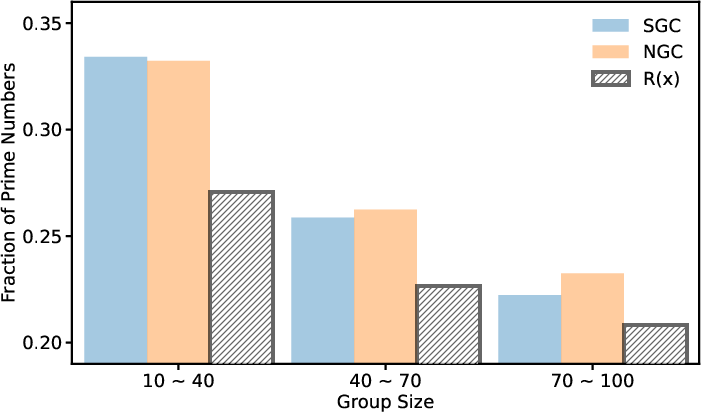
Figure 1: The distribution of group member counts for SGC and NGC, with empirical prime group numbers compared to Riemann function-based predictions.
These results are robust to region, group finding methodology, and the statistical approach to fractional estimation.
Theoretical Implications
The consistent and significant excess of prime-member galaxy groups over number-theoretic expectations constitutes strong empirical evidence against the pure randomness of group multiplicity. This point symmetry breaking signals the need for revisiting the cosmological principle in light of higher-order features of the multiplicity space, moving beyond isotropy/homogeneity arguments. The result supports the existence of cosmological selection mechanisms sensitive to primality—potentially related to symmetry breaking or combinatorial constraints in hierarchical merging.
Crucially, this work pioneers a connection between the analytic properties of the Riemann Zeta function and the statistical features of large-scale structure, proposing a nascent research direction dubbed "Cosmozetaology." The implication is that number theory, specifically the fine structure of the distribution of primes, might be relevant in physical processes governing structure formation. This sharply expands the mathematical apparatus relevant to cosmology.
Practical and Future Directions
If a physical mechanism favoring primality exists, it could impact the statistical modeling of group catalogues, including predictions for group merger rates, satellite accretion histories, or mass-to-number scaling relations. Alternative structure-finding algorithms should be tested for susceptibility to such number-theoretic footprints. Future work should investigate the emergence of similar effects in simulated universes and examine whether baryonic or dark matter physics might induce such statistical biases.
Deepening the empirical link between physical processes and the primes (potentially via zeta-regularized cosmological models, as suggested in prior theoretical studies such as [Dittrich 2019], [Arefeva2007], [Elizalde2021]) represents an important future direction. Theoretical frameworks based on symmetry, modular invariance, or algorithmic randomness may be required to account for this effect.
Conclusion
A statistically robust and scale-persistent excess of prime-member galaxy groups is detected in the DESI DR9 sample relative to number-theoretic expectations, exceeding 4.1σ significance. This observation empirically challenges the randomness assumed in standard cosmological models and suggests a deep connection between cosmic structure and the analytic distribution of prime numbers. The findings mandate further investigation into cosmo-number-theoretic correlations and potentially necessitate a reformulation of the cosmological principle in a higher-dimensional context. The study provides a compelling foundation for future theoretical development in Cosmozetaology.
Reference: "The Universe Favors Primes: A Study in the Primality of Cosmic Structures" (2603.29321)