- The paper establishes that higher-order moments (variance, IoD, skewness) provide reliable diagnostics for measurement-induced phase transitions beyond mean entropy.
- It employs both DPRE mapping in the volume-law regime and a Bell-pair stochastic model in the area-law regime to characterize entropy distributions.
- The study demonstrates that finite-size scaling and moment analysis accurately pinpoint the critical measurement rate in monitored quantum circuits.
Entanglement Entropy Distributions and Measurement-Induced Phase Transitions in Hybrid Quantum Circuits
Introduction
This paper presents a comprehensive analysis of the full distribution of entanglement entropy in one-dimensional hybrid quantum circuits subject to both random unitary evolution and stochastic local measurements, focusing on ensembles where unitary gates are sampled from the two-qubit Clifford group and accompanied by projective measurements at variable rates. The work is motivated by the rich phenomenology of measurement-induced phase transitions (MIPT), where prior analyses have predominantly treated only the mean entanglement entropy and its scaling properties. Here, the authors emphasize the necessity of characterizing higher-order statistical moments, such as variance, index of dispersion (IoD), and skewness, to achieve a full statistical description of entanglement dynamics, and to successfully identify and characterize the MIPT.
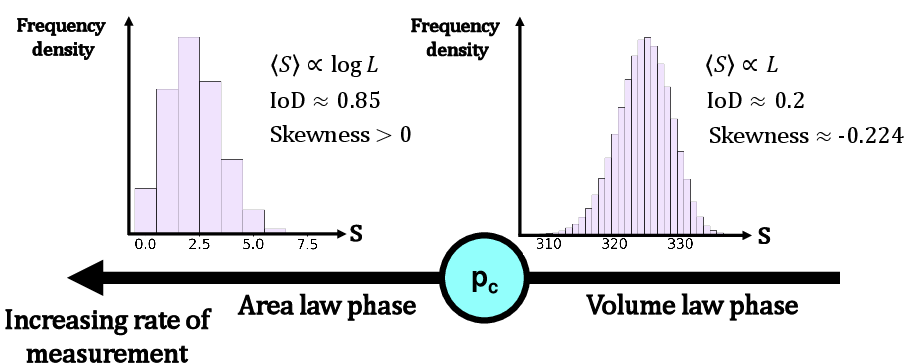
Figure 1: Schematic diagram showing the evolving shape of the entanglement entropy distribution across the MIPT, parameterized by skewness and index of dispersion.
Hybrid Quantum Circuit Model and Entanglement Scaling
The system consists of L qubits arranged in a one-dimensional chain, initialized in a simple product state. Unitary evolution is implemented via randomly chosen two-qubit Clifford gates acting in a brickwork pattern, alternated with probabilistic projective measurements at rate p per site. This circuit is representative of the class of monitored quantum circuits and supports two distinct phases separated by a critical measurement rate pc.
The archetypal result in this context is that the mean bipartite entanglement entropy, ⟨S⟩, obeys a volume law (⟨S⟩∼L) for p<pc, an area law (⟨S⟩∼O(1)) for p>pc, and exhibits logarithmic scaling ⟨S⟩∼logL at criticality. Data collapse via finite-size scaling enables accurate determination of pc and critical exponents.
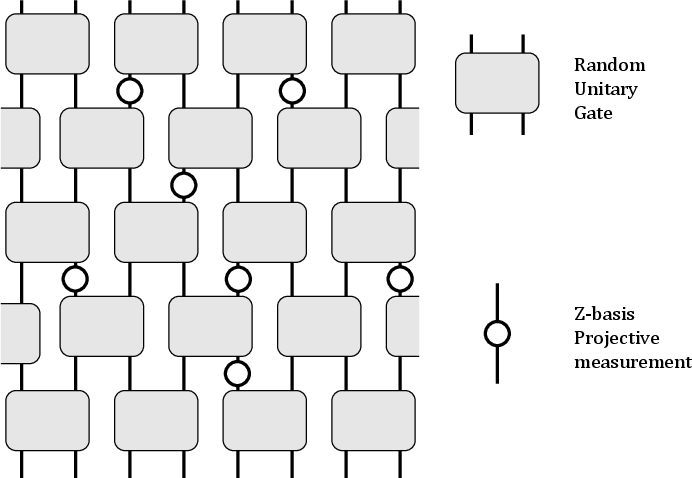
Figure 3: Circuit architecture: alternating layers of Clifford random two-qubit gates (brickwork layout) and local measurements.
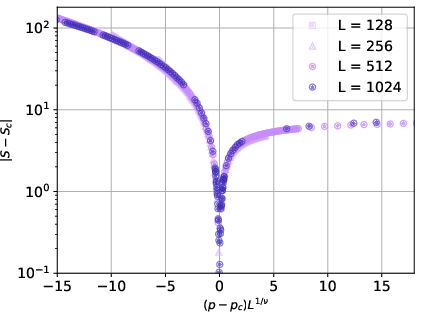
Figure 2: Finite-size scaling collapse of entanglement entropy for various system sizes, reaffirming the scaling form and critical point.
Beyond the Mean: Higher-Order Moments
Variance as an Indicator of MIPT
The analysis first addresses the variance of entanglement entropy as a candidate for diagnosing the MIPT. Although a peak in the variance is observed near the transition for finite systems, upon increasing system size the maximum shifts away from the true critical measurement rate and may not coincide with p0, especially for Clifford circuits. This deviation arises because the support of the entropy distribution is bounded below by zero, so the reduction of mean entanglement in the area-law regime necessarily suppresses variance. Thus, variance alone is not a reliable universal diagnostic of the transition.
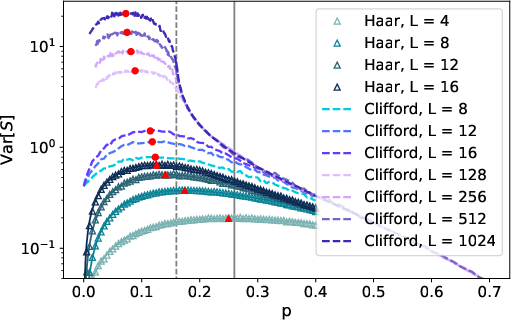
Figure 4: Variance curves for Haar and Clifford random circuits; peaks do not track the critical point robustly.
Index of Dispersion: IoD
To address this limitation, the IoD is introduced:
p1
This measure normalizes variance relative to the mean and highlights qualitative differences across the two phases. In the volume-law phase, IoD is strongly system-size dependent; in the area-law phase it becomes size-independent, saturating to unity, signaling Poissonian-like statistics. Importantly, the IoD exhibits a discontinuity across the transition, and the jump occurs near the known p2.
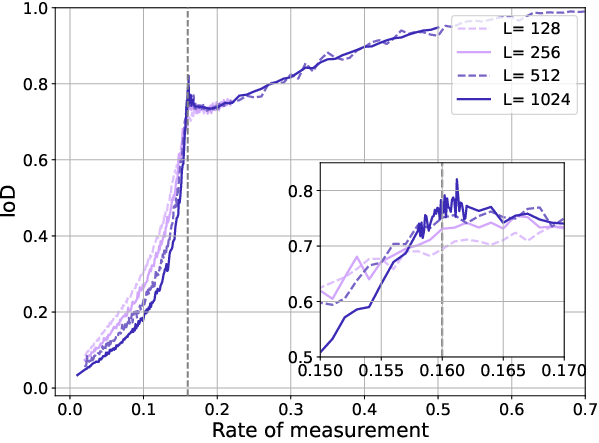
Figure 5: Curves of IoD vs measurement rate showcase two distinct regimes and a sharp transition near p3.
Skewness: Universal Diagnostic
The skewness of the entropy distribution, defined as
p4
furnishes a higher-order, scale-invariant probe of the distribution's asymmetry. In the volume-law phase, skewness is system-size-independent and fixed at p5, matching the prediction from the Tracy-Widom distribution of the Gaussian Unitary Ensemble (GUE). In the area-law phase, skewness follows a power-law growth in p6. The transition is associated with a rapid, nearly discontinuous jump in skewness near the critical point. This transition can be fitted with auxiliary smooth functions to extract p7 with high precision.
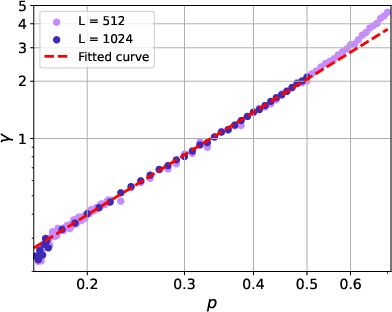
Figure 6: Skewness vs measurement rate for various sizes; a size-invariant plateau in the volume-law regime and growth in the area-law regime.
Figure 7: Log-log scaling of skewness in the area-law phase, illustrating a consistent power-law across system sizes.
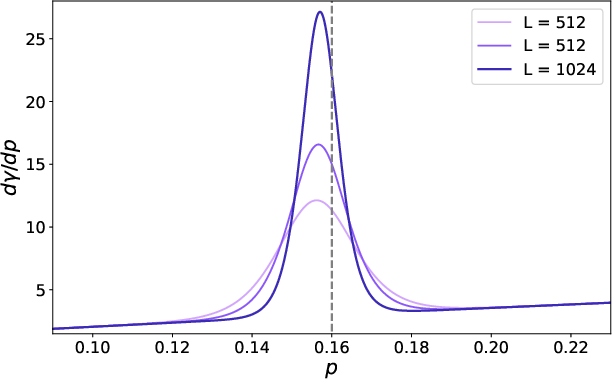
Figure 8: Numerical derivative of a fitted auxiliary function to skewness, pinpointing the locus of maximal change—precisely the transition point.
Effective Descriptions: DPRE Mapping and Coarse-Grained Model
Volume-Law Phase: Directed Polymer in Random Environment
For p8, the volume-law phase is quantitatively described by an exact mapping to the free energy of directed polymers in a random environment (DPRE). The entanglement entropy is given by
p9
where pc0 is a GUE Tracy–Widom random variable. Accordingly, the skewness, variance, and IoD of pc1 acquire universal forms, with the skewness locked to that of the Tracy–Widom distribution, and the IoD scaling as pc2.
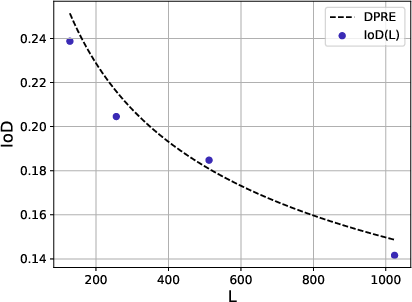
Figure 9: IoD vs system size at fixed pc3 in the volume-law regime, following the DPRE model's prediction.
Area-Law Phase: Bell-Pair Stochastic Model
For pc4, the authors propose a coarse-grained stochastic model, leveraging the stabilizer formalism's Bell pair picture. Entanglement is treated as a count of Bell pairs, with local measurements probabilistically destroying such pairs. The evolution of the entropy distribution is then governed by an effective Fokker–Planck equation for pc5, with analytically tractable moments. The stationary distribution is computed perturbatively (to second order) in the parameter controlling the pair-destruction process.
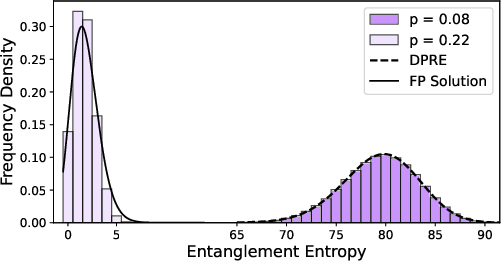
Figure 10: Comparison of entropy histograms in area-law and volume-law regimes to theoretical predictions (DPRE and Fokker–Planck solutions).
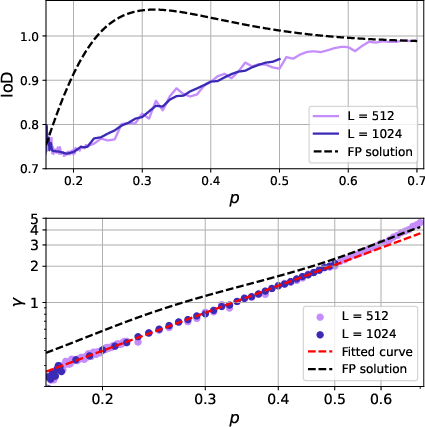
Figure 11: IoD and skewness from Fokker–Planck theory compared to numerics in the area-law regime.
Despite small quantitative discrepancies, the model accurately captures the gross qualitative features of the entropy statistics in the area-law phase, but, as shown below, fails to capture the regime near criticality.
Quantitative Model Assessment
Kullback-Leibler divergence between simulated and modeled distributions quantifies this: both DPRE and Fokker–Planck models describe their respective phases well, while discrepancies are maximized near pc6.
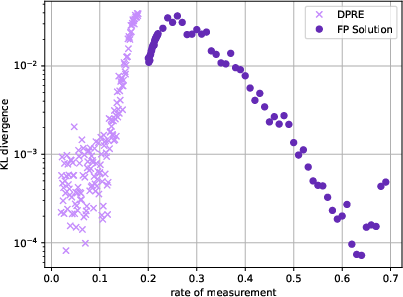
Figure 12: KL divergence between numerics and theory for the full entropy distribution, highlighting failure near criticality.
Implications and Prospects
The results establish that higher moments of the entanglement entropy distribution serve as reliable, universal, and practically accessible diagnostics for measurement-induced phase transitions, outperforming mean-based criteria. The universality of these statistics in the volume-law regime, specifically skewness matching the GUE Tracy-Widom value, provides nontrivial numerical validation for the DPRE mapping paradigm. The detailed stochastic/Bell-pair model for the area-law regime demonstrates that minimal phenomenological modeling suffices to capture essential features, although the transition region remains analytically challenging.
These findings have several implications:
- Experimental diagnosis of MIPT can reliably use finite-size measurements of IoD and skewness for transition point characterization, which is significant for noisy intermediate-scale quantum (NISQ) devices implementing monitored dynamics.
- Theoretical frameworks: The success of the DPRE mapping for the full entropy distribution suggests a pathway to classify universality in monitored circuits beyond average scaling laws, inviting investigation of other models (e.g., higher-dimensional, other symmetry classes, or conservation laws).
- Extension to other observables: The approach is applicable to dynamical quantities such as operator spreading, entanglement growth rate statistics, or magic, as well as to circuits with additional structure (conservation laws, noisy gates, long-range connections, etc.).
Conclusion
This work delivers a rigorous, moment-based statistical characterization of entanglement distributions in hybrid quantum circuits, elucidating the inadequacy of mean and variance as diagnostics and establishing the robustness of IoD and skewness across the MIPT. The theoretical constructions—DPRE mapping for the volume law and a coarse-grained model for the area law—are validated numerically and shown to provide near-complete descriptions away from criticality. The methodology and conceptual advances here set a precedent for universality studies in monitored quantum dynamics and inform both experimental diagnostics and theoretical developments in quantum information science.
The framework invites further investigation of other universality classes, more refined models in the critical region, and application to complex observables in hybrid circuits.
[See full paper on (2603.29323)]