- The paper demonstrates that finite-size effects render global baryonic vortices energetically viable by regularizing their normally divergent energy.
- It employs SU(2) chiral perturbation theory with electromagnetic and WZW terms to contrast local and global vortex configurations under rotation and chemical potential.
- The study reveals a critical phase transition between vortex states, offering insights applicable to quark-gluon plasma and neutron star research.
Baryonic Vortices in Rotating Nuclear Matter: Topological Solitons and Energetic Competition
Introduction
The study presented in "Baryonic vortices in rotating nuclear matter" (2603.29325) systematically investigates topological excitations—specifically baryonic vortices—in rotating nuclear matter using chiral perturbation theory (ChPT). The analysis identifies two distinct vortex configurations (local and global), elucidates their baryonic topological origins, and comprehensively examines their stability and energetic competition as a function of baryon chemical potential μ, rotation Ω, and finite system size R, imposed by relativistic causality.
A substantive outcome is the demonstration that finite-size effects regularize the otherwise divergent energy of the global vortex solution, rendering it a viable candidate for topological excitations in contexts such as QGP and neutron stars. The energetic landscape and transitions between local and global vortices, mediated primarily by electromagnetic and topological anomaly-induced effects, are explored with full account for gauge field dynamics and the Wess-Zumino-Witten (WZW) term.
Theoretical Framework and Topological Structures
The work leverages SU(2) ChPT in the chiral limit, with explicit inclusion of dynamical U(1) electromagnetic fields and the WZW term responsible for anomaly-induced baryon number currents. The rotational background manifests as a modified metric with axial angular velocity Ω, and the causality constraint R≤Ω−1 enforces a physically meaningful system size.
Two key vortex types are defined:
- Local (gauged) vortices: Characterized by charged pion condensation and phase winding at the periphery (analogous to ANO vortices), coupled to a nontrivial Aϕ gauge field and exhibiting nonzero baryon number due to neutral pion modulation in the vortex core.
- Global vortices: Predominantly neutral pion condensation and phase winding on the boundary, with charged pions varying internally along the rotation axis. While global vortices classically entail logarithmically divergent energy in infinite systems, causality-imposed finite size regularizes their energy, reviving their physical relevance.
Both solutions are topologically protected via π3(S3), with the baryon number intimately tied to the winding number through the WZW current.
Solutions, Energetics, and Baryon Number
The ansätze for the vortex fields are variationally optimized to minimize the string tension T, defined as the energy per unit length. The variational minimization involves both the field profiles and the longitudinal period Ω0, constrained to ensure integer baryon number per vortex and compatibility with electromagnetic and topological boundary conditions.
The baryon chemical potential Ω1 couples directly to the topological charge via the WZW term, lowering the free energy for nonzero baryon number configurations. The local and global vortex solutions differ in their spatial distribution of phase winding and the associated electromagnetic field configuration (Ω2), leading to distinct energetic and density profiles.
Zero and Finite Rotation: Numerical Results
Zero Rotation Case
In the Ω3 limit, the analysis demonstrates that at small system size Ω4, neither local nor global vortices are stable due to the inability to form energetically favorable configurations; as Ω5 increases, a regime emerges where both vortex types are viable, with an intersection point (Ω6) marking a critical system size for phase transition between local and global dominance.
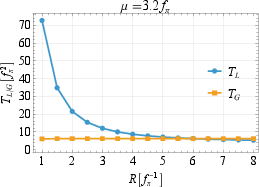
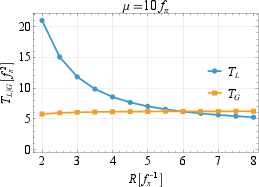
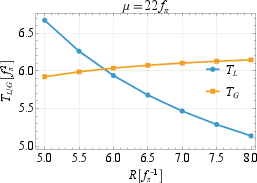
Figure 1: The string tension of local/global vortex solutions at zero rotation Ω7 and several baryon chemical potentials Ω8. For small Ω9, monotonic R0 implies no stable finite-size solution.
Finite Rotation and System Size Dependence
For R1, the inclusion of rotation leads to additional structure due to the causality constraint. The critical phenomenon persists: there exists a narrow window in R2—on the order of R3 of R4—where the string tensions of local and global vortices intersect as a function of R5. The critical angular velocity R6 at which this occurs typically lies in the phenomenologically relevant range for QGP (R7–R8 MeV).
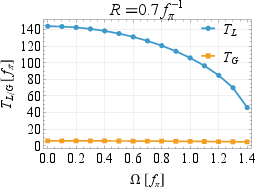
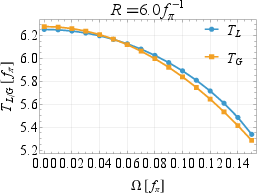
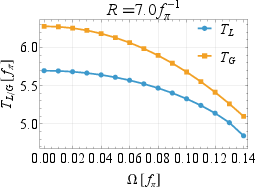
Figure 2: The string tension of local/global vortex solutions as a function of R9 at fixed SU(2)0 and baryon chemical potential, illustrating SU(2)1–SU(2)2 crossing at critical SU(2)3.
Crucially, for small SU(2)4, the global vortex is energetically favored due to the prohibitive electromagnetic energy cost of compressing the local vortex; for large SU(2)5, the local vortex dominates as the kinetic energy of the global vortex grows logarithmically. This competition defines the observable topological structure in various contexts.
At the transition point, physical observables such as critical angular velocity SU(2)6, energy density SU(2)7, and vortex-induced baryon density SU(2)8 exhibit characteristic signatures:
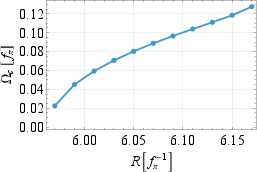
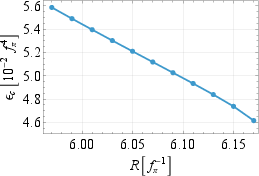
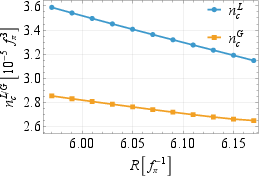
Figure 3: Critical angular velocity SU(2)9, energy density U(1)0, and baryon density U(1)1 at the transition as a function of system parameters at fixed U(1)2.
Implications and Theoretical Consequences
This analysis demonstrates that global vortices, previously dismissed due to infinite energy in unbounded systems, are physically realized in finite, causally-bounded rotating nuclear matter. The stabilizing effect of the WZW term under finite U(1)3 is essential, and the results clarify the landscape of topological excitations relevant for both QGP and compact stars.
The study’s findings have several important implications:
- Finite-size regularization enables new classes of baryonic topological excitations, potentially influencing observable response (e.g., in vortex lattices in neutron stars or QGP).
- Energetic phase transition between local and global vortices is sharply controlled by the interplay of electromagnetic, kinetic (logarithmic), WZW (topological), and finite-size effects—a structure likely robust under inclusion of higher-order derivative (e.g., Skyrme) terms and finite-temperature corrections.
- The presented methods and insights have applicability beyond ChPT, especially to other gauged and global vortex systems with topological charges.
Prospects for Further Research
The results motivate three primary directions for deeper investigation:
- Extension to higher-order ChPT (including the Skyrme term) to quantitatively refine the longitudinal structure and density of vortex-Skyrmion states.
- Generalization to vortex lattices, embedding these solutions in realistic nuclear matter geometry and exploring implications for transport and collective modes.
- Incorporation of finite-temperature effects for direct phenomenological connection to heavy-ion collision experiments and the astrophysics of baryon-dense objects.
Conclusion
This work establishes the viability and competitive role of global baryonic vortices in rotating nuclear matter, regularized by finite-system-size effects and stabilized by the WZW anomaly term. The energetic hierarchy between local and global vortex states is shown to be sharply dependent on rotation, system size, and U(1)4, underpinning a rich topological phase structure with clear implications for both the theoretical modeling of QCD matter and phenomenology in heavy-ion and astrophysical settings.