- The paper establishes explicit analytic error bounds for Koopman eigenfunction approximations used in constructing Lyapunov functions.
- It employs monomial polynomial approximations and classical Taylor expansion techniques to control truncation errors in the Lyapunov function and its derivative.
- The results enable optimization-free inner approximations of the region of attraction, validated through numerical examples like the scalar system and Van der Pol oscillator.
Error Bounds on Analytic Koopman-Based Lyapunov Functions
Introduction
This work develops a rigorous theoretical framework for the validation of Lyapunov functions constructed via eigenfunctions of the Koopman operator, focusing on analytic vector fields and monomial polynomial approximations. The central challenge addressed is the quantification of errors introduced by finite-dimensional approximations of the infinite-dimensional Koopman operator, a key issue when deploying Koopman-based stability analysis in nonlinear dynamical systems. While previous approaches have leaned on numerical SOS-based validations, this work establishes analytic error bounds for both the Lyapunov function and its orbital derivative. These bounds are leveraged to provide optimization-free, theoretically justified inner approximations of the region of attraction (ROA) for equilibria.
Koopman Eigenfunction Construction and Approximation
Let F(x) be an analytic, Lipschitz continuous vector field on X⊂Rn with a hyperbolic equilibrium at the origin. The Koopman operator Kt induces a linear semigroup on observables, and its principal eigenfunctions {ϕλi}, corresponding to eigenvalues λi with ℜ(λi)<0, allow the systematic construction of a Lyapunov function as V(x)=∑i=1n∣ϕλi(x)∣2.
As L, the infinitesimal generator, operates on an infinite-dimensional function space, practical computations utilize a projection PN onto subspaces of monomials up to order N. The resulting finite-dimensional operator X⊂Rn0 yields approximate eigenfunctions X⊂Rn1 via spectral decomposition of the induced matrix X⊂Rn2. The candidate Lyapunov function X⊂Rn3 thus relies on the truncation error of the Taylor expansion of X⊂Rn4.
Theoretical Error Bounds for Eigenfunctions
The paper develops explicit, computable error bounds for the truncation X⊂Rn5 of analytic eigenfunctions, exploiting classical results in approximation theory and properties of multi-indexed Taylor expansions.
Let X⊂Rn6, with X⊂Rn7 the domain of analyticity (X⊂Rn8). If X⊂Rn9 are the Taylor coefficients of Kt0, two notable error bounds are derived:
- Uniform bound (Proposition 1): If Kt1 on Kt2, then
Kt3
- Coefficient-based bound (Proposition 2): If Kt4, then
Kt5
- Kt6-type bound (Proposition 3): Using Cauchy-Schwarz over the coefficient sequence.
A practical method for estimating the domain of analyticity is provided via the Cauchy–Hadamard theorem, relating the radius of convergence to Kt7.
Error Propagation to Lyapunov Functions and Orbital Derivatives
The error in the eigenfunction estimates propagates nontrivially to both the Lyapunov function and its time derivative, each critically impacting the ROA approximation.
The error between true and approximate Lyapunov functions can be bounded as:
Kt8
This ensures convergence as Kt9 over the domain of analyticity.
For the orbital derivative, using the generator and the structure of the eigenfunction provides an analogous error bound for {ϕλi}0, shown to again vanish as {ϕλi}1, given explicit control over truncation and generator application errors.
Region of Attraction: Rigorous Inner Approximations
Utilizing the established error bounds, the work formulates sufficient conditions to guarantee that the sublevel set {ϕλi}2 is an inner approximation of the true ROA. The explicit formula for {ϕλi}3 incorporates both Lyapunov and derivative error terms and the maximal real part of the principal Koopman eigenvalues.
This provides a strong formal guarantee: as truncation improves (with increasing {ϕλi}4), the computed inner ROA converges to the true ROA within the analyticity domain. An alternate construction using surrogate vector fields, for which the approximate eigenfunctions are exact, is presented—though practical realization hinges on invertibility and further numerical investigation.
Numerical Examples
Two instructive examples demonstrate the error analysis and ROA inner approximation workflow:
Scalar Analytic System
The scalar system {ϕλi}5 admits a closed-form principal eigenfunction
{ϕλi}6
with analytic domain {ϕλi}7. The computed error bounds sharply control the discrepancy between the true and approximate Lyapunov function, as verified numerically.
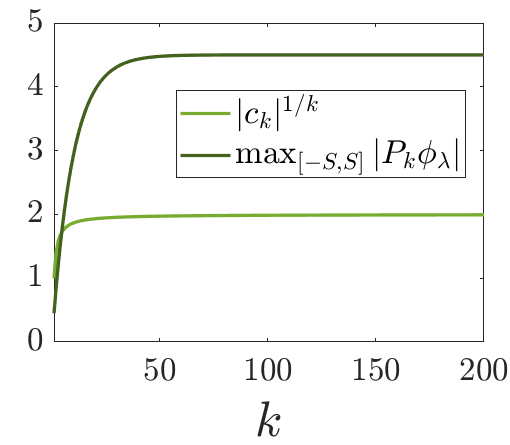
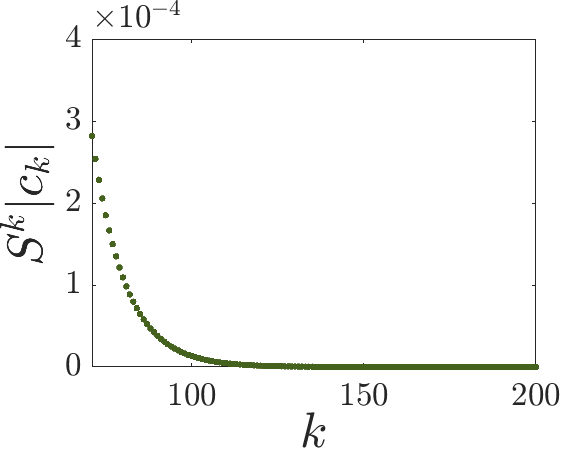
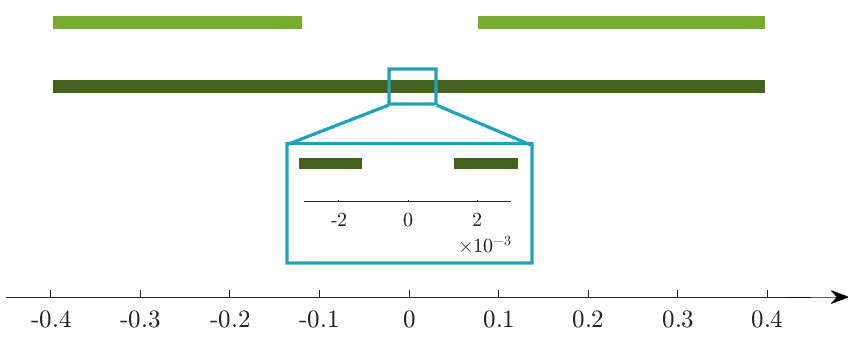
Figure 1: Convergence and bound illustrations for eigenfunctions and their Taylor coefficients enabling quantification of the region of analyticity and error in the 1D scalar example.
Van der Pol Oscillator
For the planar Van der Pol oscillator with weak nonlinearity, complex conjugate principal Koopman eigenfunctions are approximated. The error bounds derived are shown to yield conservative but valid inner ROAs that closely reflect the level sets of the analytic Lyapunov function within the domain of convergence.
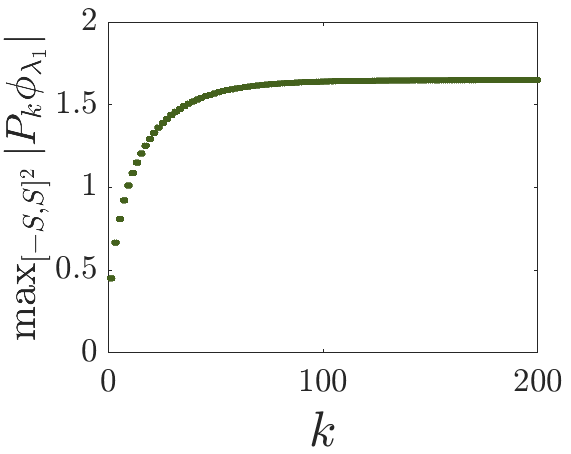
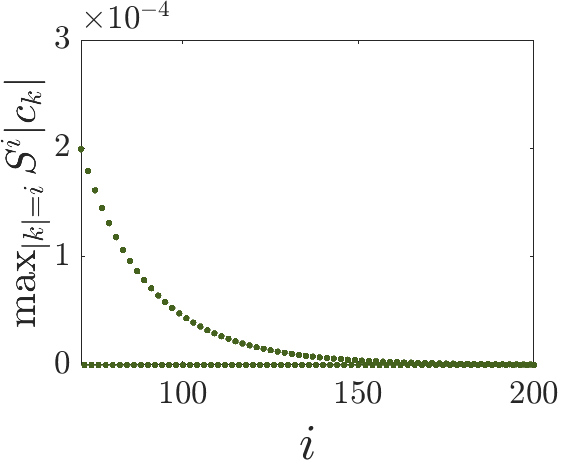
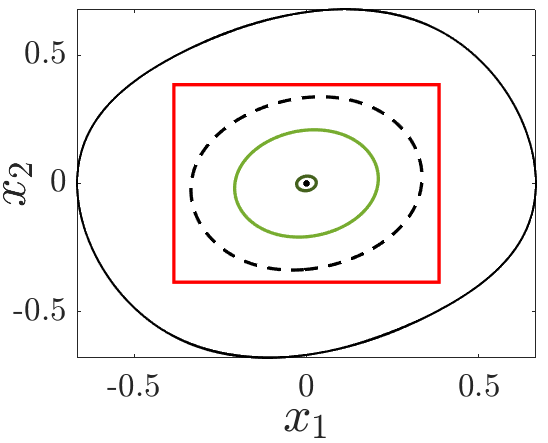
Figure 2: Bounding behavior of the approximate Koopman eigenfunctions and the resulting inner approximation of the region of attraction for the 2D Van der Pol system.
Practical and Theoretical Implications
- Analytic Quantification: The methodology provides the first analytic error bounds (without recourse to SOS or optimization), increasing the reliability of Koopman-based stability certificates.
- Restriction to Analytic Domains: The bounds are restricted by the eigenfunction analyticity domain—conservativeness arises near domain boundaries or in systems with nearby unstable equilibria.
- Surrogate System Construction: The possibility of defining surrogate dynamics for which the approximated Lyapunov function is exact offers a novel interpretative lens, suggesting new avenues for stability analysis and controller synthesis.
- Computation Scalability: The framework scales with polynomial basis order, but intrinsic curse of dimensionality remains for higher-dimensional systems.
Conclusion
This work provides a rigorous and computable framework for validating Koopman-based Lyapunov functions by deriving explicit error bounds for analytic systems. The approach yields certified, optimization-free inner approximations of the ROA, and the examples validate the practical tightness of these bounds within analytic domains. Extending this analysis beyond purely analytic settings, relaxing the basis function restrictions, and deeper exploration of the surrogate system paradigm remain open directions with significant potential for both theoretical and applied advances.