- The paper introduces a closed-form solution framework for propagating orbital uncertainty by solving the Fokker-Planck equation.
- The method leverages a Taylor map diffusion approach to accurately capture full non-Gaussian PDF structures, including rare-event probability tails.
- Numerical validation shows that the approach matches Monte Carlo results with significantly less computation, offering efficient risk analysis for orbital operations.
Motivation and Context
Space operations depend critically on precise probabilistic modeling of spacecraft trajectories under uncertainty. Conjunction assessment, collision avoidance, and SDA require accurate evaluation not only of mean states but the non-Gaussian tails of distributions, as actionable thresholds often correspond to probabilities as small as 10−5. Gaussian-based approaches misrepresent these tails due to linearized dynamics, resulting in erroneous risk evaluations in operational contexts. Monte Carlo techniques, though accurate, are computationally prohibitive, especially for high-dimensional states and rare-event probabilities. Previous attempts to propagate full PDFs via the Fokker-Planck equation are stymied by the curse of dimensionality or restrictions to deterministic settings. This work introduces a closed-form, grid-free solution framework for the Fokker-Planck equation in nonlinear stochastic orbital dynamics, enabling analytical PDF evolution and direct access to distribution tails.
Theoretical Framework: Taylor Map Diffusion
The central methodological advance is the "Taylor Map Diffusion" ansatz, which expresses the evolving PDF as an exponential-of-quadratic-form composition with a nonlinear flow map:
p(x,t)=N(t)μ(x,t)exp(−F(x,t)⊤Q(t)F(x,t))
where F is a time-dependent, smooth, invertible Taylor map centering the distribution, Q is a precision matrix, and μ is a scalar density correction. The authors derive a coupled ODE system for (F,Q,μ), directly substituting the ansatz into the Fokker-Planck equation and demonstrating structural preservation under advection and diffusion (see Theorem: Quadratic Form Conservation).
For conservative dynamics (∇⋅f=0), only F and Q evolve, with μ≡1. The ODEs admit finite-dimensional representations by truncating the Taylor map at a given order, yielding scalable, grid-free integration with complexity determined by the expansion degree. The method is exact at the continuous level, with precision governed solely by map truncation.
Numerical Implementation and Validation
For demonstration, the framework is applied to a planar, eccentric Keplerian orbit comprising a four-dimensional state: position and velocity. The Taylor map is truncated at second order, representing the nominal trajectory, Jacobian, and Hessian. Under continuous stochastic velocity forcing, the ODE system governing p(x,t)=N(t)μ(x,t)exp(−F(x,t)⊤Q(t)F(x,t))0 (total dimension 94) is integrated over 9.5 orbital revolutions. Validation is performed against an ensemble of 400,000 Monte Carlo SDE simulations.
The Taylor Diffusion method reproduces Monte Carlo results with high fidelity across both phase-space position and velocity marginals, even after prolonged nonlinear evolution and repeated passage through regions of strong dynamical distortion. Close agreement is observed in both 2D joint distributions and 1D marginals, including accurate modeling of asymmetric, non-Gaussian tails and stochastic broadening.
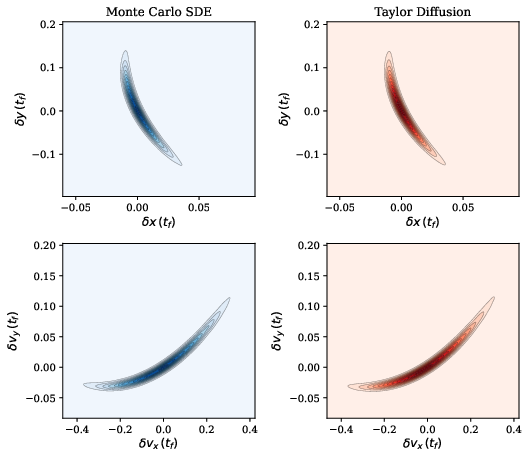
Figure 1: Two-dimensional marginal PDFs at p(x,t)=N(t)μ(x,t)exp(−F(x,t)⊤Q(t)F(x,t))1 (p(x,t)=N(t)μ(x,t)exp(−F(x,t)⊤Q(t)F(x,t))2 9.5 orbits), contrasting Monte Carlo SDE reference and Taylor Diffusion in both position and velocity subspaces.
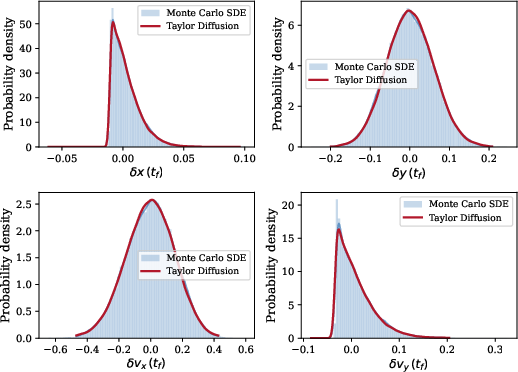
Figure 2: One-dimensional marginal PDFs for each state component, illustrating close agreement between Monte Carlo and Taylor Diffusion, particularly in tail skew and non-Gaussian structure.
Remarkably, the analytical method requires less than one second of computation, versus one minute for Monte Carlo, with order-of-magnitude disparity in scalability as sample requirements increase for rare-event probability resolution.
Strong Claims and Operational Implications
A pronounced claim in the paper is that Taylor Map Diffusion yields a closed-form expression for the PDF at any location in state space—including deep in the non-Gaussian tails—without recourse to sampling or spatial discretization. This enables direct evaluation of collision probabilities on operational timescales. The structural preservation result is mathematically rigorous: the ansatz produces zero residual in the FPE under the derived evolution equations, with no approximations (other than truncation order) at the continuous level.
The computational efficiency is striking for practical applications: the integration of only p(x,t)=N(t)μ(x,t)exp(−F(x,t)⊤Q(t)F(x,t))3 (e.g., 94 for p(x,t)=N(t)μ(x,t)exp(−F(x,t)⊤Q(t)F(x,t))4, 279 for p(x,t)=N(t)μ(x,t)exp(−F(x,t)⊤Q(t)F(x,t))5) ODEs suffices to produce the full PDF for highly nonlinear, stochastic dynamics. This operational advantage becomes critical as state dimensionality and rare-event sample requirements increase.
Theoretical Extensions and Future Developments
The Taylor Map Diffusion mechanism opens several avenues for advancement:
- Extension to Non-conservative Systems: Incorporation of dissipative effects (e.g., atmospheric drag, solar radiation pressure) requires evolving the volume parameter p(x,t)=N(t)μ(x,t)exp(−F(x,t)⊤Q(t)F(x,t))6, extending applicability to general orbital regimes.
- Higher-order Expansions: Increasing Taylor map orders enhances accuracy for long propagation horizons and more intense nonlinearities.
- Orbital Element Representations: Utilizing coordinate sets such as GEqOE would reduce effective nonlinearity and improve map accuracy in challenging orbital contexts.
- Direct Collision Probability Evaluation: Enabling analytic computation of conjunction risk without Monte Carlo, transforming screening and avoidance protocols.
- Nonlinear Orbit Determination: Potential for a closed-form, non-Gaussian prior for sequential filtering that remains robust under sparse measurement regimes and long propagation intervals, outperforming Gaussian-based filters.
Conclusion
The paper establishes a mathematically rigorous, computationally tractable approach for uncertainty propagation in nonlinear orbital dynamics with stochastic forcing, capturing full non-Gaussian PDF structure and tails via a closed-form, grid-free solution to the Fokker-Planck equation. Taylor Map Diffusion permits efficient rare-event probability evaluation, substantially reducing computational load relative to sampling approaches. The method's scalability and systematic improvability position it as a strong candidate for next-generation orbital risk analysis, conjunction assessment, and nonlinear filtering. Further development in orbital element coordinates and higher-order expansions will expand its range and accuracy in real-world operational settings.