- The paper demonstrates that the Kitaev interaction alone can induce unconventional superconductivity in the doped chain, with distinct singlet and triplet channels.
- It employs advanced DMRG methods, analyzing TLL parameters and pair-binding energy to map a complex phase diagram that includes topological superconducting and Mott insulating regimes.
- The study highlights how magnetic frustration and bond-directional exchanges drive dimerization and emergent Mott physics, offering insights for quantum matter engineering.
Ground State Phases of the Doped Kitaev-Heisenberg Chain: Superconductivity, Dimerization, and Magnetic Frustration
Introduction
This essay provides a technical synthesis of the principal results and insights from "Ground State Properties of the Doped Kitaev-Heisenberg Chain: Topological Superconducting and Mott Insulating Phases Driven by Magnetic Frustration" (2603.29551). The study applies high precision DMRG analysis to exhaustively characterize the rich phase diagram emerging upon hole doping the one-dimensional Kitaev-Heisenberg (KH) model. By systematically dissecting the Hamiltonian's parameter space, the authors elucidate the cooperative, competing, and emergent phenomena induced by interplay between bond-directional (Kitaev) and isotropic (Heisenberg) exchanges, the resultant ground states, and the role of magnetic frustration in facilitating unconventional superconductivity and Mott physics.
Model and Computational Approach
The KH chain is modeled via the projected t-J-K Hamiltonian, hosting kinetic, Heisenberg, and Kitaev terms and constrained to single electron occupancy. The chain's bond structure is depicted in Fig. 1, highlighting the nontrivial alternation of x and y Kitaev bonds, which underpin the frustration mechanism and, in the Mott state, yield two symmetry-breaking dimerized configurations.
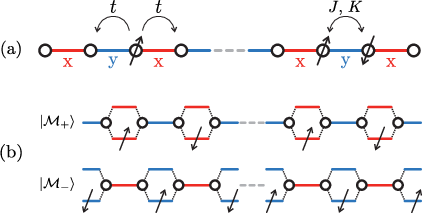
Figure 1: (a) Lattice structure of the KH chain; (b) two translation-symmetry-breaking Mott states, each bonding orbital singly occupied by one fermion.
The authors employ state-of-the-art DMRG, retaining up to 12000 states with open boundary chains up to L=400, ensuring minimal truncation error. The analysis leverages the Tomonaga-Luttinger liquid (TLL) parameter Kρ from the static charge structure factor for diagnosing superconductivity (Kρ>1), and evaluates additional diagnostics including the pair-binding energy ΔB, charge gap Δc, Majorana end-to-end correlator J0, and connected correlation functions.
Superconductivity Induced by Kitaev Exchange
A key finding is that the Kitaev interaction, independent of Heisenberg exchange, is sufficient to induce superconducting (SC) correlations in the doped chain. The phase diagram for J1 in the J2-J3 space demonstrates extensive regions of J4, with the nature of the dominant SC channel determined by the sign of J5: singlet for J6 (AFM Kitaev), triplet for J7 (FM Kitaev). This dichotomy is a direct consequence of the local energetics of the bond-directional exchanges and is corroborated by the analysis of the two-electron wavefunction on adjacent sites.
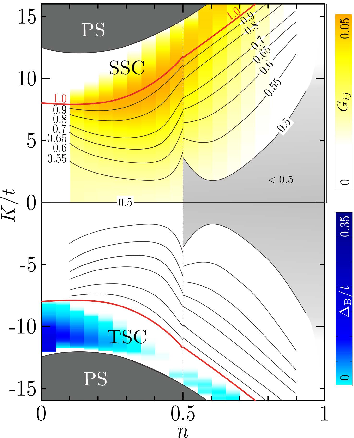
Figure 2: Phase diagram of the J8-J9 chain (K0) in the K1-K2 plane, with TLL parameter contours and color maps for the Majorana correlator (K3) and pair-binding energy (K4).
The study demonstrates finite pair-binding energies and the presence of finite-size Majorana correlator K5, suggesting regimes of topological superconductivity within the chain. Importantly, the Hamiltonians for K6 and K7 are unitarily equivalent under a staggered K8-rotation, mapping singlet to triplet SC, a feature robust to the inclusion of additional bond types in higher-dimensional analogs.
Full Kitaev-Heisenberg Phase Diagram: Competition, Frustration, and Filling Dependence
When both K9 and x0 are active, the ground-state phase structure becomes nontrivial. For equal-sign exchanges (x1 or x2), Heisenberg and Kitaev interactions synergize to stabilize SC phases at sufficient exchange strength, with the symmetry of the order parameter (singlet or triplet) set by the sign.
In stark contrast, when the exchanges have opposite signs, a pronounced filling dependence emerges. At commensurate x3 (quarter filling), the interplay of AFM Kitaev and FM Heisenberg leads to a robust dimerized Mott insulating state with a finite charge gap x4 and spontaneous bond dimerization. This Mott state is sharply bounded by a BKT (Berezinskii-Kosterlitz-Thouless) transition for weak x5, and a first-order transition on the strong coupling side.
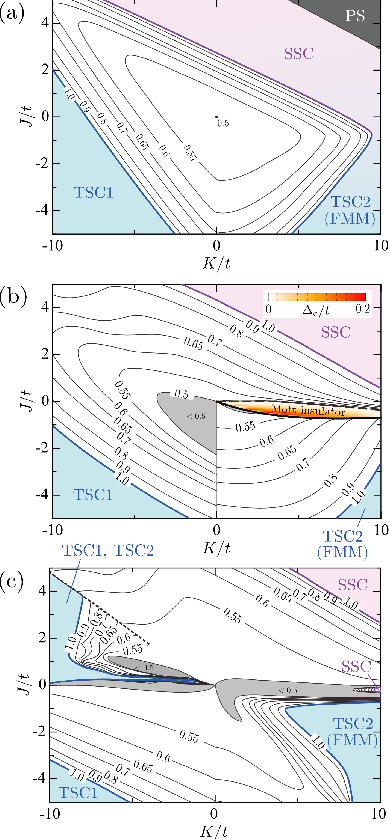
Figure 3: Phase diagrams of the x6-x7-x8 chain in the x9-y0 plane at fillings y1. The color map at y2 displays the charge gap y3 for the Mott-insulating phase.
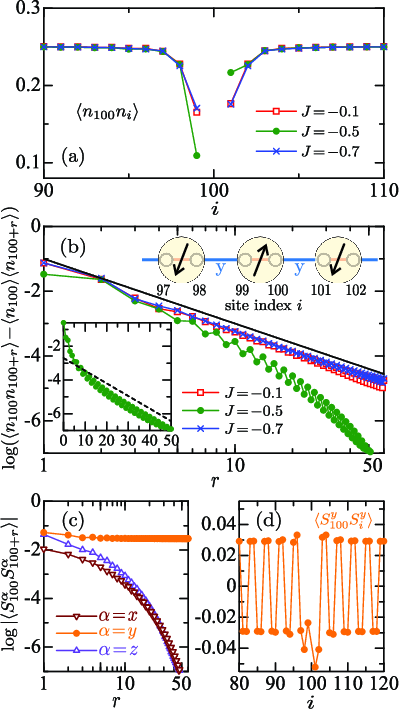
Figure 4: Density and spin correlation analysis on an open chain, visualizing dimerization and long-range order in the Mott regime.
Outside commensurate filling, competition between y4 and y5 leads to regions of strongly suppressed y6 and moves the system into regimes where relatively weak exchanges can nonetheless trigger superconductivity. This phenomenon is tightly linked to magnetic frustration, which can prime the ground state for pairing or, at commensuration, for Mott localization.
Dimerized Mott Physics at Quarter Filling
The charge-insulating phase at y7 exhibits spontaneous kinetic dimerization—manifesting as alternating strong and weak bonds observed directly in density-density correlations (Fig. 4a–b). The pattern is twofold degenerate, favoring dimerization either on y8 or y9 bonds and visible as spatially resolved real-space textures. The insulating character is substantiated by the exponential decay of L=4000 and a well-developed spin order parameter in the L=4001 direction, supporting an effective low-energy Ising chain dominated by the combined Kitaev-Heisenberg interaction.
Pairing Channels and Symmetry Analysis
The study systematically determines the dominant pairing symmetry across the phase diagram via analysis of the decay properties of singlet and triplet pair-pair correlation functions (SSC and TSC, respectively), benchmarked against density correlations. In all cooperative regimes (L=4002 or L=4003), the slowest decaying pair correlation defines the SC tendency type, with the Kitaev interaction lifting triplet channel degeneracies (T1 vs. T2) in certain regimes.
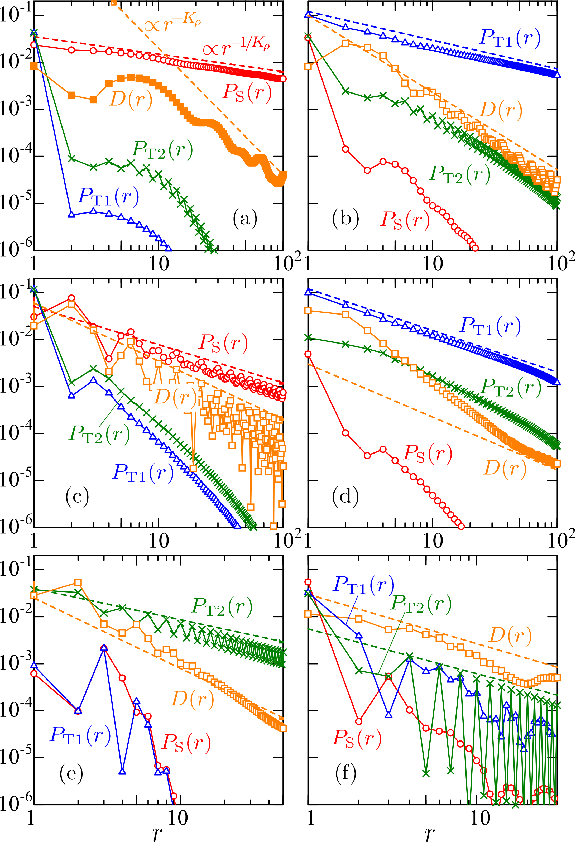
Figure 5: Pair-pair correlation functions L=4004 for L=4005, on log-log scale for parameter sets spanning SSC and TSC regions.
Additionally, for L=4006 and L=4007 at L=4008, the TSC2 triplet channel is realized with partial spin polarization, whereas for L=4009 and Kρ0 near Kρ1, a nearly degenerate enhancement of both triplet channels is observed.
Implications and Outlook
The analysis provides a detailed and unbiased mapping between frustration mechanisms, superconductivity, and bond-order Mott phases, with obvious implications for interpreting experiments in candidate Kitaev materials and guiding synthetic strategies in quasi-1D and higher-dimensional settings. The strong SC tendencies driven by purely bond-directional interactions, the presence of robust triplet pairing, and the possibility of Majorana edge modes are directly relevant for topological quantum matter design. The verified realization of interaction-driven dimerization at quarter filling also raises the possibility of engineered Mott states stabilized by frustration in ultracold atomic chain setups.
From a theoretical perspective, these results further cement the correspondence between 1D and higher-dimensional KH models and identify key open questions, including the microscopic origins of the strong metallic TLL suppression under magnetic frustration. The study's methodology and findings provide a solid platform for future investigations of domain wall dynamics, non-Abelian excitations, and their doping dependence.
Conclusion
This work systematically demonstrates that the ground state phase diagram of the doped KH chain hosts a coexistence of topologically nontrivial superconductivity, robust singlet and triplet SC regimes dictated by exchange signs, and dimerized Mott insulators driven by frustration. The results robustly connect the physics of Kitaev bond-directionality, competition/cooperation with Heisenberg exchange, and magnetic frustration, clarifying their influence on pairing symmetry, Mott localization, and quantum phase transitions. The findings have direct significance for tailoring superconductivity, engineering topological phases, and understanding frustration-driven phenomena in complex quantum matter (2603.29551).