- The paper demonstrates that discrete rotational symmetries yield an isotropic superfluid response even in complex optical potentials.
- It employs perturbative analysis and numerical Gross–Pitaevskii simulations to validate Leggett’s bounds across diverse lattice geometries.
- The results provide optimized experimental strategies and extend analytical methods for measuring superfluid fractions in ultracold bosonic systems.
Superfluid Response and Leggett's Bounds in Composite Optical Potentials
Introduction
The study of superfluid response in ultracold bosonic systems under complex two-dimensional (2D) potentials is fundamental for understanding many-body quantum phenomena where lattice symmetry, disorder, and commensurability effects are paramount. The paper "Superfluid response of bosonic fluids in composite optical potentials: angular dependence and Leggett's bounds" (2603.29603) systematically analyzes how a dilute bosonic fluid responds to a wide family of 2D optical potentials, emphasizing the role of discrete rotational symmetries and the application of Leggett's variational bounds to superfluid fractions.
Composite Optical Potentials and Symmetry Structure
The authors consider optical potentials engineered via interference of multiple laser beams, forming superlattices, Kagomé, quasicrystal, and other composite lattices. These configurations correspond, in Fourier space, to superpositions of regular polygons (or "shells") of delta-like peaks. The generic structure is
V(r)=l=1∑MVlj=1∑Nl/2cos(qlj⋅r),
where each l denotes a shell with Nl components, leading to nested polygons in k-space.
The left panel highlights the discrete momentum structure for M=2 with inner and outer shells yielding square and hexagonal lattices, while the right panel visualizes the resulting potential landscape in real space.
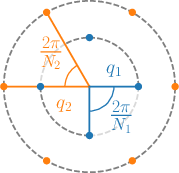
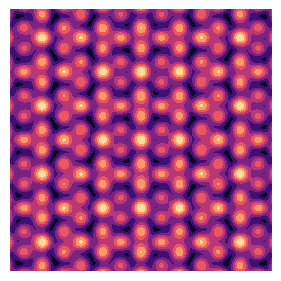
Figure 1: Composite optical potentials: left shows the momentum space structure (nested polygons); right displays the associated real-space potential.
Superfluid Fraction Tensor: Isotropy from Discrete Symmetries
The central theoretical construct is the superfluid fraction tensor fij, defined via the many-body response to a slow drag. Using Bogoliubov theory and perturbation in the potential strength, the superfluid fraction is expressed as
fij=δij−V4k∑(εk+2μ0)2∣V(k)∣2k^ik^j,
where k^i are components of the unit lattice vectors.
The analysis rigorously demonstrates that for all composite potentials whose Fourier components form regular polygons, all off-diagonal components and differences (fyy−fxx, fxy, l0) vanish in all orders of perturbation theory. This yields a fully isotropic superfluid response (l1), which persists even for arbitrarily strong potentials.
This finding is substantiated by numerical Gross–Pitaevskii calculations for BECs in a Kagomé lattice and a five-fold quasicrystal. The ground states, momentum distributions, and computed superfluid fractions (both analytic and numerical) under intense lattice depth confirm complete angular isotropy.
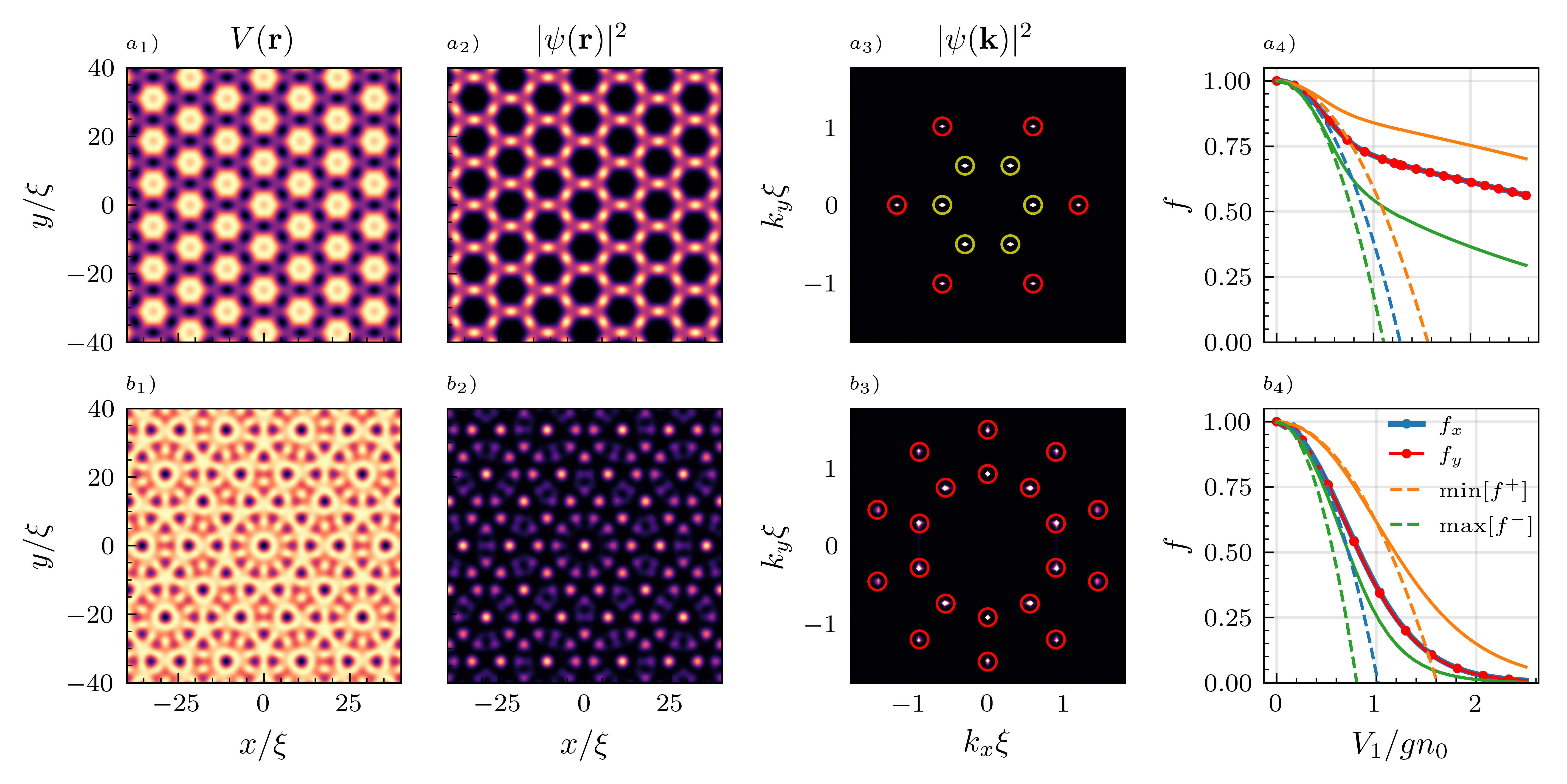
Figure 2: Ground state density, Fourier spectrum, and superfluid response for a BEC in Kagomé and quasicrystal potentials—demonstrating isotropy across all regimes.
Angular Dependence of Leggett's Bounds
Leggett's bounds (l2, l3) on the superfluid fraction provide practical estimates based on static density profiles. The paper presents closed-form perturbative expressions capturing their full angular dependence for any rotation of the measurement axis:
- The upper bound l4 is minimized (tightest) when the measurement is aligned with dominant reciprocal lattice vectors.
- The lower bound l5 is maximized when measured perpendicularly to these vectors.
The strongest result is the analytic identification of specific directions for optimal validity of each bound, and the demonstration that for square and rectangular (separable) lattices, the gap between l6 and l7 vanishes identically in the perturbative regime—a significant refinement for experimental deployment of Leggett's protocol.
The angular structure of these bounds for a five-fold quasicrystal is displayed below. The numerical superfluid fraction (dashed red), analytical upper (orange), and lower (green) bounds are plotted versus measurement axis, with background density of Fourier peaks further illustrating the protocol.
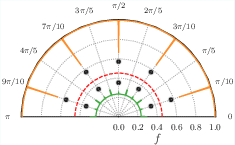
Figure 3: Angular dependence of Leggett's bounds in a five-fold quasicrystal; the directions of optimal agreement correspond to the lattice’s dominant Fourier vectors.
Higher-Order Perturbative Structure and Geometrical Protection
An important theoretical contribution is the extension of isotropy to all orders in the perturbative expansion. The set of multi-indexed vectors generated in high-order corrections corresponds to concentric shells of regular polygons, retaining the parent lattice’s discrete rotational symmetry and hence the isotropy of observable quantities like l8.
A technical visualization of the resulting power spectra for various l9-gon arrangements is provided, which is essential for experimental design and for understanding the relationship between optical lattice geometry and many-body response.
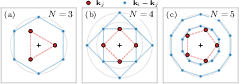
Figure 4: Spectrum of a potential generated by Nl0 interfering beams with Nl1 (from left to right), illustrating nested polygonal (Fourier space) structures.
Implications and Outlook
The main implication is that the superfluid density’s isotropy is "geometrically protected" by the symmetry properties of the potential in Nl2-space, transcending the lower symmetry of the real-space interference pattern. This result is particularly relevant for artificial lattices in ultracold atom experiments, where engineering complex potential landscapes is routine.
From a practical standpoint, the analytic characterization of Leggett's bounds’ angular dependence informs optimal experimental measurement strategies for superfluid fraction in arbitrary lattice geometries. The identification of conditions under which bounds are tight (especially for separable and certain quasicrystal lattices) provides a rigorous foundation for precision measurement of superfluidity.
The authors conjecture that the presented isotropy results and angular properties of Leggett's bounds hold for arbitrary interaction strengths and finite temperature—a hypothesis open to future validation, particularly in the strongly correlated regime or for finite-temperature depleted condensates.
Conclusion
This study gives a comprehensive analytical and numerical account of the superfluid response tensor and Leggett's bounds for bosonic fluids in a general class of composite optical potentials (2603.29603). The work establishes that rotational isotropy of the superfluid response is robustly preserved by underlying Nl3-space symmetries, even when the real-space lattices feature only discrete symmetry. The systematic analysis of Leggett's bounds provides sharp criteria for their optimal application in experimental platforms. These results represent a significant advance in the theoretical characterization of superfluidity in complex lattice systems and inform future experimental and computational investigations into quantum fluids in engineered potentials.