- The paper demonstrates that analytic continuation from bound states to QNMs succeeds under localized perturbations but fails when perturbations are asymptotically distant.
- It employs rigorous perturbation theory and numerical methods to quantify the convergence limitations of the mapping scheme.
- The study highlights critical implications for gravitational wave data analysis and black hole spectroscopy in the face of spectral instability.
Mapping Bound States to Black Hole Quasinormal Modes Under Spectral Instability
Introduction and Motivation
This paper presents a rigorous study of the correspondence between bound states and black hole quasinormal modes (QNMs) established through analytic continuation, emphasizing its limitations and behavior under spectral instability (2603.29704). The analytic continuation mapping between bound-state eigenvalues of potential wells and QNMs of analogous potential barriers has been a longstanding tool, particularly for analytically tractable potentials such as the Pöschl-Teller. However, recent developments in gravitational wave astronomy, particularly the detectability of high overtone QNMs and their susceptibilities to minute perturbations, demand a deeper scrutiny of the reliability of these mappings—especially when generic, spatially localized metric or potential deformations are present.
The authors systematically address the legitimacy and breakdown of this analytic correspondence and extend seminal approaches by performing a detailed perturbation analysis with explicit comparison to matrix-based and semi-analytic methods for specific model potentials. They also carefully analyze the impact of the mapping for both localized (near the barrier's extremum) and asymptotically distant deformations.
Analytic Continuation Framework and Its Constraints
A central element in this study is the precise description of the analytic continuation map that connects the bound-state spectrum (on a potential well) with the QNM spectrum (on the corresponding barrier) by complexifying the relevant parameters and performing a Wick rotation on the spatial coordinate. This approach, originally proposed by Blome, Ferrari, and Mashhoon, is algebraically explicit for the Pöschl-Teller potential and has been utilized in the development of practical (sometimes numerical) QNM extraction frameworks.
However, the authors show that for such analytic continuation to deliver physically relevant QNMs, the region of continuation must lie within the convergence radius of the Taylor expansion employed in the mapping. Crucially, if the transformation associated with the mapping of parameters pushes the evaluation point outside the disk of convergence, the method ceases to be reliable—even if the formal analytic continuation still yields the correct spectrum in analytically tractable scenarios.
Spectral Instability and Perturbed Potentials
The manuscript scrutinizes the impact of spectral instability in two explicit settings: the perturbed delta-function barrier and a modified Pöschl-Teller potential featuring a step discontinuity. The delta-function example, being analytically soluble, precisely illustrates how the number and distribution of bound states and QNMs differ and how analytic continuation can be formally extended to yield an infinite QNM spectrum from a finite bound-state set—albeit with the consequence that analytically continued "bound states" may not correspond to normalizable wavefunctions.
The modified Pöschl-Teller set-up enables a controlled perturbation theory analysis. Two cases are systematically explored: (1) The discontinuity is placed near the potential maximum, where first-order perturbation theory is quantitatively accurate and the analytic continuation mapping faithfully reproduces the QNM spectrum and its deformation (including explicit agreement with known analytic results). (2) The discontinuity is localized far from the peak (asymptotically far from the black hole analog), where the analytic continuation yields a grossly deformed, non-physical spectrum. For the latter, the eigenvalues generated via analytic continuation do not reproduce the echo/unstable QNM spectrum, as these modes display qualitatively distinct asymptotic behavior and spacing.
Numerical Investigation and Results
Extensive numerical verifications are presented, comparing the analytically continued spectra to results obtained through direct eigenmode computation and matrix-based methods for the modified Pöschl-Teller barrier. The figures below demonstrate the comparative structure as the location of the perturbation is varied:
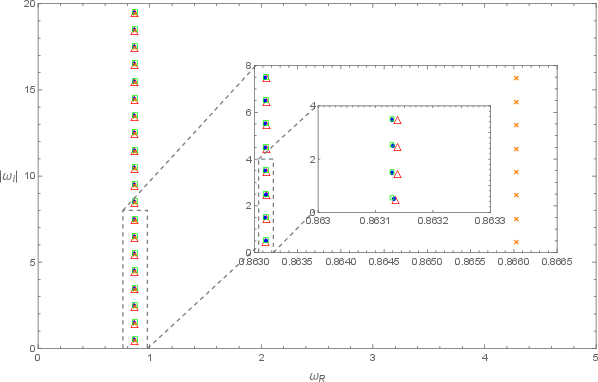
Figure 1: QNMs for the modified Pöschl-Teller effective potential with a discontinuity at the origin, showing excellent agreement between analytic continuation, matrix, and semi-analytic methods.
As the discontinuity is moved outward, systematic deviations are observed:
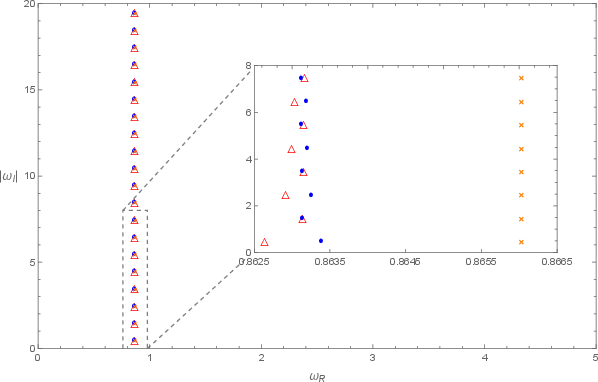
Figure 2: QNMs for a discontinuity near the origin; initial departures in the higher overtones manifest.
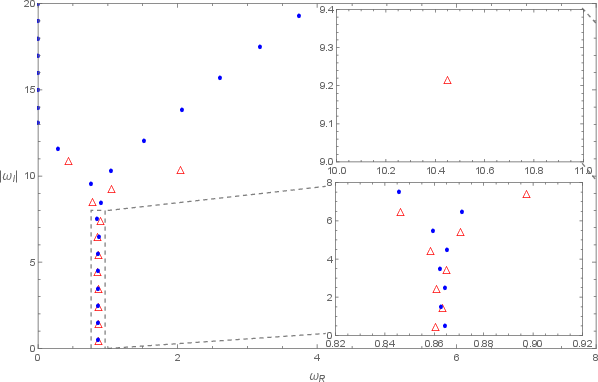
Figure 3: QNMs for a discontinuity at yc=−0.5; bifurcation and mismatch in QNM locations increase.
When the discontinuity lies close to infinity, the mapping's breakdown becomes unambiguous:
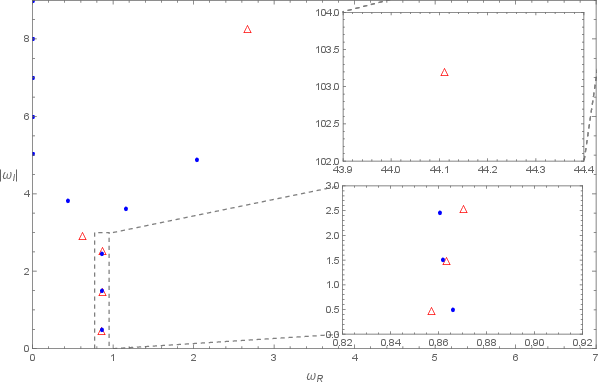
Figure 4: QNMs for a discontinuity at yc=0.62; analytic continuation substantially deviates from numerically exact spectra.
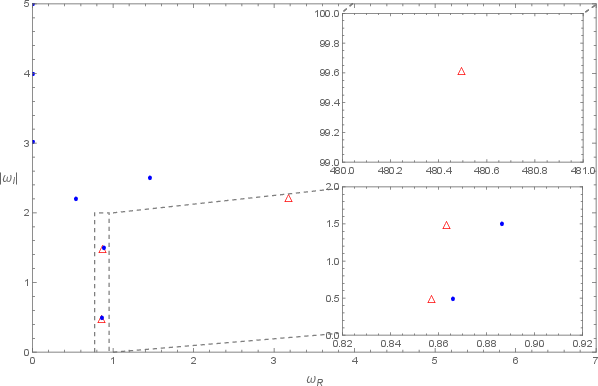
Figure 5: QNMs for a discontinuity at yc=0.96; analytic mapping loses correspondence with the true QNM distribution.
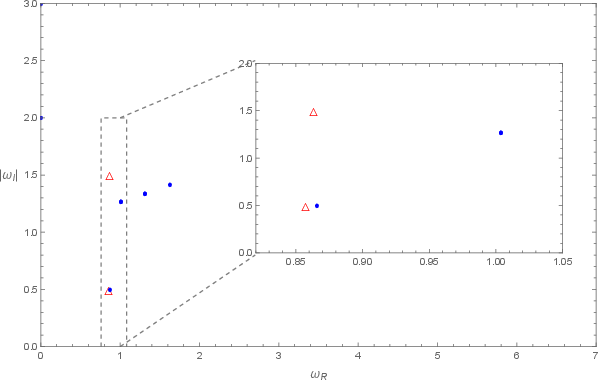
Figure 6: QNMs for a discontinuity approaching spatial infinity; the analytic continuation fails to reproduce the intricate QNM bifurcations present in the exact result.
These results substantiate the claim that accuracy of the analytic continuation scheme, both in its traditional configuration and Völkel's numerically-motivated implementation, is contingent upon the convergence of the underlying expansion and on the locality of the metric/potential perturbation relative to the maximum.
Theoretical and Practical Implications
This comprehensive analysis reveals several critical theoretical insights:
- The mapping between bound states and QNMs, while powerful, is not universally robust under generic deformations or spectral instability. Localized perturbations near the potential extremum can be captured within analytic continuation and perturbation theory, but those placed asymptotically far fail to provide correspondence, reflecting the nonlocal nature of black hole resonance spectra.
- The analytic continuation may formally generate a countably infinite set of “QNMs” from a finite bound state spectrum by abandoning physical normalizability, but this process lacks a clear physical interpretation for the continued states.
- Numerical analytic continuation for QNM extraction is reliable only when the mapped parameters remain within the disk of convergence determined by the bound-state energy expansion.
Practically, these findings delimit the applicability of analytic continuation-based QNM extraction—especially in the context of black hole spectroscopy and gravitational wave data analysis, where nontrivial matter effects or metric perturbations that extend to large radii may play a role.
Conclusion
This paper establishes that the correspondence between bound states and QNMs via analytic continuation is fundamentally bounded by considerations of convergence and spectral (in)stability. While analytic continuation provides a consistent framework for small, localized potential deformations, it cannot, without additional refinement, capture the full phenomenology of QNM spectral instability induced by generic or distant perturbations. The findings highlight that care must be exercised both in the numerical and analytic application of these mappings, informing future methodologies in black hole perturbation theory and gravitational wave data interpretation. Further research may be warranted to explore generalized perturbative frameworks capable of bridging the gap in spectrally unstable regimes and to understand the deeper spectral theory implications of these mappings.