- The paper demonstrates that void morphology remains robust across various void-finding methods and observational systematics.
- It utilizes both geometric and watershed algorithms to quantify void size distributions, showing significant effects from redshift-space distortions and tracer selection.
- The findings validate constrained simulation techniques like ELUCID for precise cosmological void studies in the local universe.
Robustness Analysis of Cosmic Void Statistics in SDSS DR7 and ELUCID Constrained Simulations
Introduction
Cosmic voids—underdense regions in the large-scale structure—are crucial cosmological probes due to their relative dynamical simplicity and sensitivity to fundamental physics such as modified gravity and dark energy. However, extracting robust cosmological information from voids is hindered by ambiguities in their identification, observational systematics (e.g., redshift-space distortions, tracer bias), and the impact of the adopted void-finding methodology.
This study utilizes galaxies from the SDSS DR7 and subhaloes from the ELUCID constrained N-body simulation, enabling a direct comparison between observational datasets and a simulated universe tailored to large-scale structures observed in the local Universe. By systematically analyzing void statistics with multiple algorithms and data realizations, the paper rigorously quantifies the robustness of void morphology and abundance statistics, and elucidates the physical and methodological origins of observed trends.
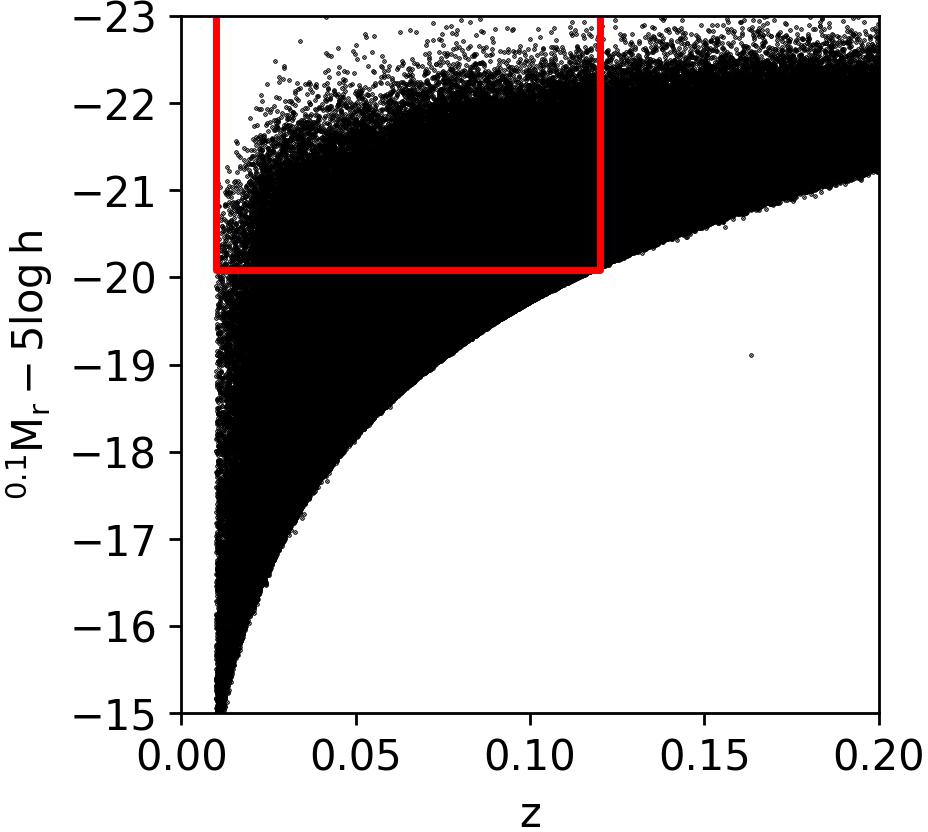
Figure 1: Illustration of selection boundaries in the absolute magnitude–redshift plane for the volume-limited SDSS sample used for void identification.
Data, Simulations, and Void Identification Algorithmics
The primary tracer sample comprises ∼160,000 SDSS DR7 NGC galaxies in a restricted volume-limited sample (0.01≤z≤0.12, 0.1Mr−5logh<−20.09), carefully matched in both angular and redshift coverage to the ELUCID constrained simulation. ELUCID produces a high-fidelity realization of the local dark matter distribution by initializing its initial density field to match the observed large-scale galaxy group distribution, achieving high positional accuracy of major structures and enabling an 'apples-to-apples' comparison of voids in observation and simulation.
Void detection leverages the VAST toolkit, which implements both geometric (VoidFinder) and watershed-based (REVOLVER, VIDE, ZOBOV) algorithms. This dual-algorithm approach is critical for disentangling algorithmic from physical/statistical effects. Subhalo mass matching ensures tracer density consistency. The study also exploits the full ELUCID box for enhanced statistics and to quantify cosmic variance.
Void Size Function: Sensitivity to Systematics and Methodology
The void size distribution reveals strong dependencies on observational systematics, tracer selection, and—most notably—void definition methodology. Watershed-based methods (REVOLVER) consistently yield larger, fewer voids and stronger compensation ridges relative to the geometric (VoidFinder) spheres. Specifically, with matched tracer selections and masking:
- REVOLVER identifies voids with mean radius ⟨re⟩∼18.5h−1Mpc, whereas VoidFinder yields ⟨re⟩∼14h−1Mpc.
- Redshift-space distortions suppress void abundance by ∼15−17%, as peculiar velocities partially fill low-density regions along the line of sight. The ELUCID reconstructed volume—free from RSD—recovers the intrinsic void size distribution and abundance.
- The reconstructed SDSS-matched ELUCID volume demonstrates high statistical consistency with the full box, with volume fraction and abundance scaling nearly linearly, indicating negligible cosmic variance effects on void statistics in the selected volume.
A systematic monotonic increase of void size with tracer mass is observed; higher-mass subhalo tracers delineate larger voids due to enhanced bias, but algorithmic definitions modulate whether this results in more numerous or fewer voids.
Void Morphology: Sphericity, Triaxiality, and Physical Interpretation
Morphological analysis is restricted to watershed-based catalogues to avoid the intrinsic spherical bias of geometric sphere-packing approaches. Across all data realizations, algorithms, and tracer mass regimes, voids are found to be highly regular:
- Mean sphericity s=⟨c/a⟩≈0.85 and triaxiality T≈0.3 are observed, with >98.5% of voids in all samples exhibiting s>0.7 (near-spherical).
- The overwhelming majority of voids are oblate rather than prolate, with 0.01≤z≤0.120 dominating in all regimes.
- Morphological statistics are stable against RSD, reconstruction artifacts, and tracer bias, underscoring the geometric regularity of voids in the gravitationally driven cosmic web.
A methodological note: the high sphericity values relative to prior works are traced to conventions within the VAST/VIDE pipeline—specifically, the use of a fourth-root scaling when mapping inertia tensor eigenvalues to shape axes. However, this systematic does not affect relative trends or comparative robustness conclusions across the sample set.
Stacked Void Radial Density Profiles and the Impact of Tracer Bias
Universal functional forms (generalized Hamaus et al. 2014) describe the stacked radial density profiles. Major findings:
- The REVOLVER void profiles are well-fit (0.01≤z≤0.121) by this form, while VoidFinder voids exhibit significant residuals in the same analytic framework (0.01≤z≤0.122), confirming the superior dynamical and structural fidelity of topologically-based void definitions.
- The transition (compensation) radius is invariant across tracer mass for watershed voids, but the compensation wall amplitude and central underdensity increase with tracer mass, reflecting physical biasing effects: more massive subhaloes preferentially reside in denser structures, depopulating void interiors and exaggerating boundaries.
- ELUCID reconstruction slightly suppresses the amplitude of compensation walls, a direct consequence of inherent small-scale smoothing, yet the gross profile structure is accurately reproduced between observations and simulation.
Hierarchy of Void Statistic Robustness and Theoretical Implications
Key results delineate a hierarchy in void statistic robustness. Void morphology (sphericity, triaxiality) is highly robust, with negligible susceptibility to redshift-space distortions, tracer bias, or void-finding methodology. In contrast, both void size statistical measures and radial density profiles exhibit strong dependencies on algorithmic choices (particularly in boundary definition and merging logic) and more moderate sensitivity to tracer selection effects.
The high fidelity of ELUCID in reproducing all void statistical features demonstrates the efficacy of constrained initial condition techniques for cosmological large-scale structure studies, providing a critical laboratory for systematic control and forward modeling for new survey data.
Practical and Theoretical Implications
The findings emphasize the importance of carefully matching void-finder algorithms and tracer selection when comparing observation and simulation. For cosmological parameter inference and tests of gravity using void statistics, researchers are cautioned to focus on geometric/morphological observables, which present minimal sensitivity to observational systematics and method-dependent ambiguities.
The methodological distinction—where size and abundance are algorithm-dependent but morphology is robust—invites a re-evaluation of which statistics are meaningful for constraining cosmological models and physical processes (e.g., galaxy formation, feedback in low-density environments). Tracer bias corrections must be incorporated for analyses of density profiles, particularly when using highly-massive galaxy or halo samples.
Constrained simulations such as ELUCID are confirmed as critical in preparing for forthcoming spectroscopic surveys (e.g., DESI), including for next-generation void cosmology and environmental galaxy evolution studies.
Conclusion
This comprehensive statistical study rigorously establishes that the morphology of cosmic voids in SDSS DR7 and ELUCID is largely invariant under the principal sources of systematic uncertainty—distinct void-finding algorithms, observational distortions, and tracer selection. In contrast, void size and profile statistics can vary substantially, with strong dependencies on identification methodology and tracer bias. The demonstrated agreement between ELUCID simulations and observations affirms the utility of constrained realizations for precision cosmology, and the results provide a robust framework for the analysis and interpretation of future large-scale void catalogues (2603.29706).