- The paper leverages XRISM/Resolve’s high-resolution X-ray spectroscopy and advanced reflection models to precisely determine elemental abundances near a supermassive black hole in the Circinus Galaxy.
- It reveals distinct abundance ratios with Fe/H at 2.3 times solar, sub-solar Ar/Fe and Ca/Fe, and super-solar Ni/Fe, indicating a core-collapse supernova-dominated nucleosynthetic history.
- The findings support a stellar mass cutoff at ~20 M☉ for CCSN progenitors, offering insights into AGN feedback, torus structure, and galaxy evolution.
Accurate Determination of Chemical Abundances near a Supermassive Black Hole
Introduction
The paper "Accurate Determination of Chemical Abundances near a Supermassive Black Hole" (2603.29748) utilizes the XRISM/Resolve spectrometer's unprecedented X-ray energy resolution to derive elemental abundances in the Circinus Galaxy's central region. The metallicity and abundance ratios of galactic nuclei are critical for reconstructing the star formation and nucleosynthetic history, revealing the process of mass transfer and enrichment near supermassive black holes (SMBHs). The study exploits X-ray fluorescence diagnostic techniques, which are minimally affected by uncertainties associated with density distributions, ionizing continuum shapes, and dust depletion that impact optical/UV photoionization modeling.
Observational Strategy and Data Analysis
The Circinus Galaxy, at 4.2 Mpc and hosting the nearest Seyfert 2 nucleus, was observed with XRISM/Resolve (309 ks exposure), complemented by NuSTAR and XMM-Newton for broader spectral and spatial coverage. The spectrum, covering a 3′×3′ region around the nucleus, reveals numerous emission lines from metals (Ar, Ca, Cr, Mn, Fe, Ni) in the 2.8–10 keV range.

Figure 1: XRISM/Resolve spectrum of the Circinus galaxy in the 2.8–10 keV range highlighting multiple fluorescent lines from cold torus material.
High-resolution enlarged views centered on specific fluorescence lines allowed precise measurements of line intensities and profiles for different elements, enabling robust abundance estimates.
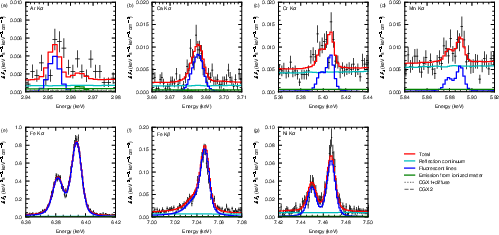
Figure 2: Enlarged XRISM/Resolve spectral regions around the major fluorescence lines with best-fit reflection and emission models overlaid.
Torus Geometry, Line Broadening, and Location of Reflecting Material
Reflection spectrum modeling employed the updated XCLUMPY clumpy torus framework, accounting for non-uniform geometries. Fluorescence line profiles incorporated laboratory-determined natural widths to fully utilize the spectrometer's resolution and precisely model Doppler broadening and fine structure effects.
The Fe Kα line, previously overestimated in width due to spectral degeneracies and insufficient intrinsic profile modeling, was measured with FWHM of 210±10 km s−1, enabling accurate localization and dynamical assessment of the reflector. Keplerian broadening constrained the innermost emitting region to >0.024 pc from the SMBH, coincident with the dust sublimation radius and supporting torus origin.
Significant detection and modeling of the Compton shoulder at 6.24 keV confirmed scattering by cold, non-ionized material. The measured centroid energy is consistent with stationary neutral atoms, implying the bulk of the reflecting torus is quiescent relative to the host galaxy.
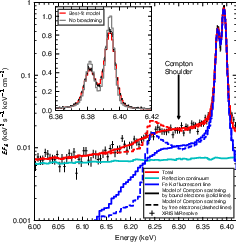
Figure 3: Zoom into the Fe Kα band, showing the narrow intrinsic width and Doppler-broadened model fit.
Elemental Abundance Patterns and Supernova Contributions
Joint fits of broadband XRISM and NuSTAR spectra yielded confident abundance ratios. Fe/H was measured at 2.3±0.1 times solar, with sub-solar Ar/Fe and Ca/Fe ratios ($0.6$–$0.8$), and super-solar Ni/Fe ($1.3$). The derived abundance patterns differ from those found in galaxy clusters and the Milky Way's nuclear star clusters, indicating localized nucleosynthetic history.
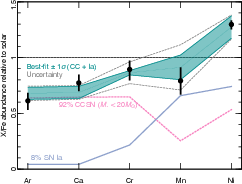
Figure 4: Elemental abundance ratios relative to iron, compared to CCSN nucleosynthesis models with α0 as upper mass limit.
Linear combinations of core-collapse supernovae (CCSN) yields and Type Ia SNe nucleosynthesis models were tested. Models allowing CCSN upper-mass progenitors above α1 could not statistically or physically reproduce the observed pattern without unrealistically high SN Ia fractions. By restricting CCSN progenitors to α2, the best-fit scenario required α3% CCSNe and α4% SN Ia in number fraction. This reflects dominant enrichment by young, relatively low mass CCSN progenitors, with minimal SN Ia contribution.
The results support the hypothesis that in metal-rich environments, stars exceeding α5 undergo direct collapse to black holes or yield faint SNe without significant heavy metal ejection. This scenario addresses the observed deficit of CCSNe from high-mass red supergiants (the "RSG problem"). It also suggests that current gas fueling the SMBH is replenished from the outer disk enriched by young stellar populations, consistent with ongoing starburst and AGN activity.
This mass cutoff for CCSN progenitors has broader theoretical implications for nucleosynthetic modeling, galaxy evolution, and SMBH growth. While in early, metal-poor epochs more massive stars would produce larger quantities of alpha elements through CCSN, current nuclear metallicity informs how AGN feedback processes regulate enrichment.
Robustness and Model Validation
Systematic tests using alternative torus geometries, clump size and number variations, different SN Ia and CCSN nucleosynthesis models, IMF slopes, hypernova contributions, and progenitor metallicities consistently corroborated the high CCSN fraction and low SN Ia scenario. Broad consistency with torus inclination and column density estimates from other wavebands was observed.
Contamination from diffuse emission and background sources was rigorously modeled using XMM-Newton and Chandra imaging and spectroscopic data. The contributions to neutral line fluxes from contaminating sources were found negligible compared to statistical uncertainties.
Conclusion
This study provides an authoritative measurement of elemental abundances in the immediate environment of a supermassive black hole, leveraging high-resolution X-ray spectra and advanced reflection models. It strongly supports a young, CCSN-dominated nucleosynthetic history with a stellar mass cutoff for CCSN progenitors at α6 in the Circinus nucleus, consistent with direct black hole formation or faint SNe for higher-mass stars in metal-rich environments. These findings refine our understanding of chemical enrichment, SMBH feeding, and the fate of massive stars, with significant implications for theoretical and observational studies of AGN feedback, torus structure, and galaxy evolution.