- The paper presents experimental evidence of abrupt, Barkhausen-like switching-current jumps in Se-doped InAs/Al nanowire Josephson junctions under low perpendicular magnetic fields.
- The paper employs comprehensive four-wire transport measurements, effective field modeling, and random-field Ising model simulations to characterize the discrete magnetization reconfigurations.
- The paper rules out alternative mechanisms such as Zeeman-induced 0–π transitions and highlights potential applications in reconfigurable superconducting devices.
Magnetically Induced Switching-Current Jumps in InAs/Al Josephson Junctions
Device Architecture, Materials, and Experimental Approach
The study presents experimental evidence of abrupt, Barkhausen-like switching-current jumps in n-doped InAs/Al nanowire (NW) Josephson junctions (JJs) under low, perpendicular magnetic fields. The devices consist of Se-doped InAs NWs (diameter ∼80–90 nm, length ∼1.5 μm) grown by Au-catalyzed chemical beam epitaxy and contacted with Ti/Al (10/100 nm) electrodes with interelectrode separation L≈70 nm. The four-wire transport measurements are performed at temperatures ranging from 30 mK up to 900 mK, using a perpendicular magnetic field as the control parameter.
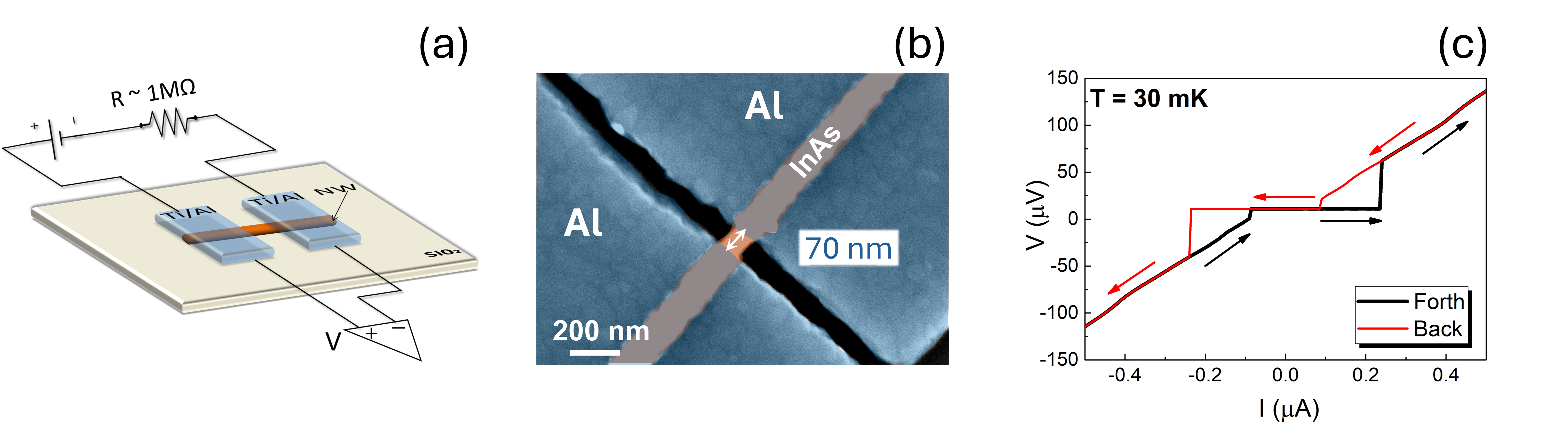
Figure 1: Schematic of the InAs/Al NW JJ, false-colour SEM of the junction, and V-I characteristic at T=30~mK with switching current Isw.
Device preparation includes ammonium polysulfide treatment to remove the native oxide from the NW prior to metal deposition. The V–I characteristics exhibit pronounced switching and retrapping features, consistent with underdamped JJ dynamics.
Magnetic Interference Phenomena and Switching-Current Discontinuities
The signature experimental observation is a modulation of the switching current ∼0 as a function of out-of-plane magnetic field, displaying a central Fraunhofer-like envelope with an abrupt (∼10.13 μA) transition at ∼2 3 mT, separating two distinct switching-current branches.
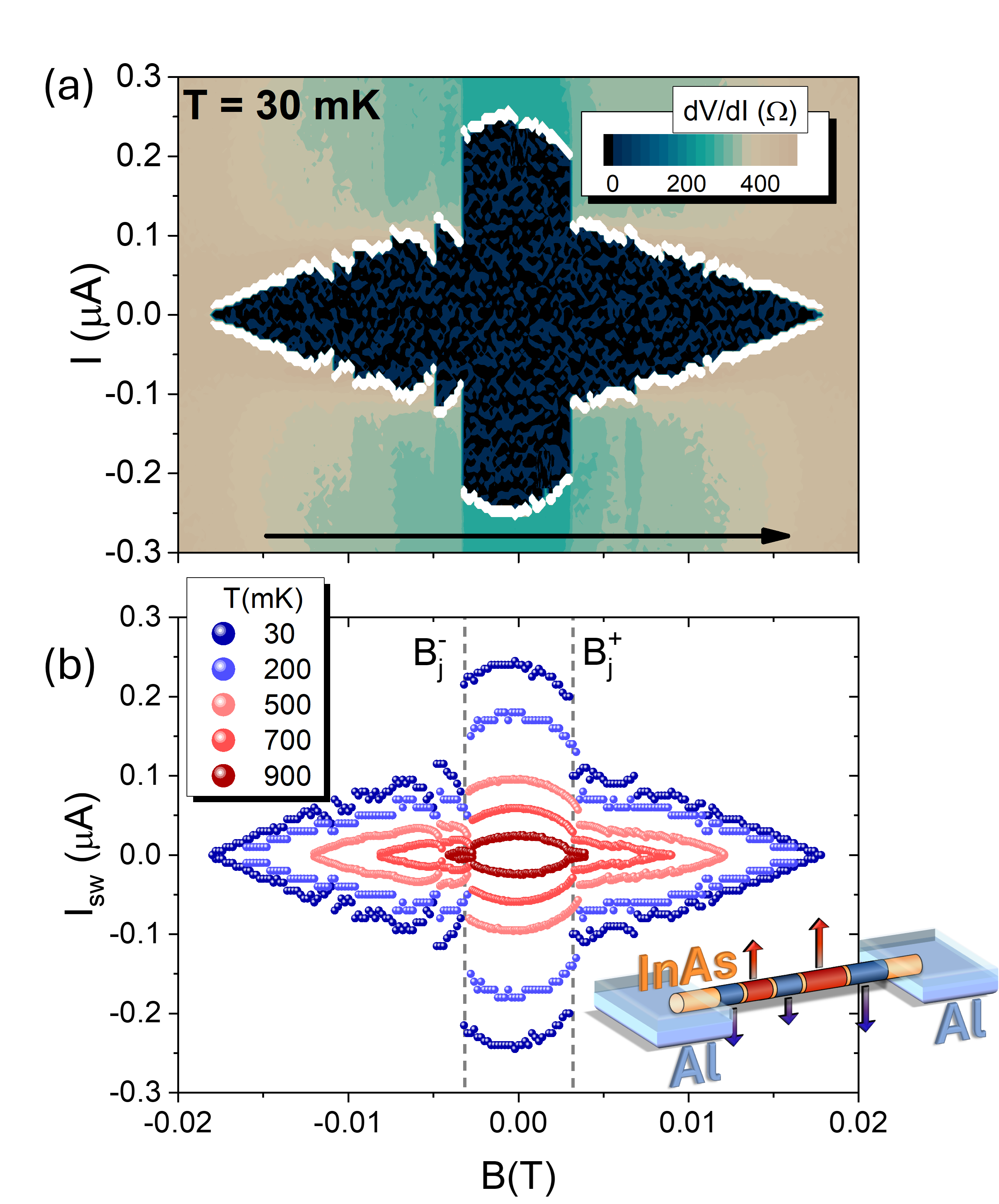
Figure 2: Differential resistance map ∼3 at 30 mK, showing the superconducting to resistive transition and abrupt ∼4 jumps; ∼5 at various ∼6, with central Fraunhofer-like modulation and discrete switching-current jumps, cartooning the underlying local domain reconfigurations.
Classically, ∼7 follows a Fraunhofer pattern due to interference of supercurrents with phase winding proportional to the local flux, with enhanced focusing effects caused by the device geometry and the thin-film nature of the Al contacts. The robustness of the observed discontinuity, its reproducibility in both magnetic field sweep directions, and manifestation across different devices confirm the nontrivial, intrinsic origin of the effect.
The threshold field for the switching-current jump (∼8 mT) displays negligible temperature dependence up to 900 mK, contrasting with the monotonic suppression of the superconducting critical field (∼9) with increasing ∼0, as expected for thin Al contacts.
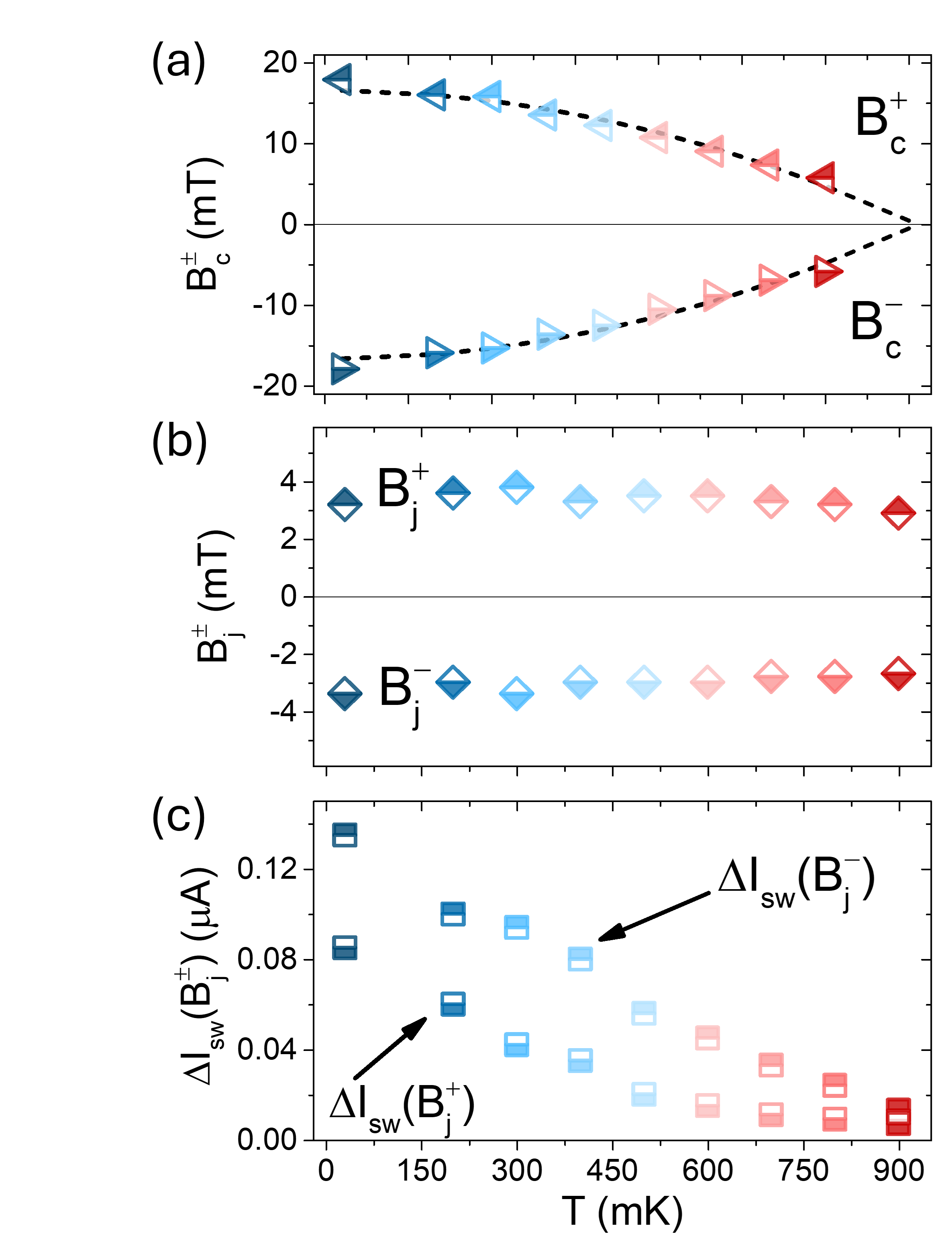
Figure 3: (a) ∼1 (parabolic fits), (b) ∼2 (temperature-independent at ∼3~mT), (c) Jump amplitude ∼4 vs ∼5.
A pronounced sweep-direction hysteresis emerges in the ∼6 maps, with the principal ∼7 jump near ∼8 mT and smaller additional discontinuities occurring at device- and sweep-history-dependent fields. This reflects the presence of metastable domain configurations and avalanche-like dynamics, as expected for Barkhausen-type switching in magnetically disordered systems.
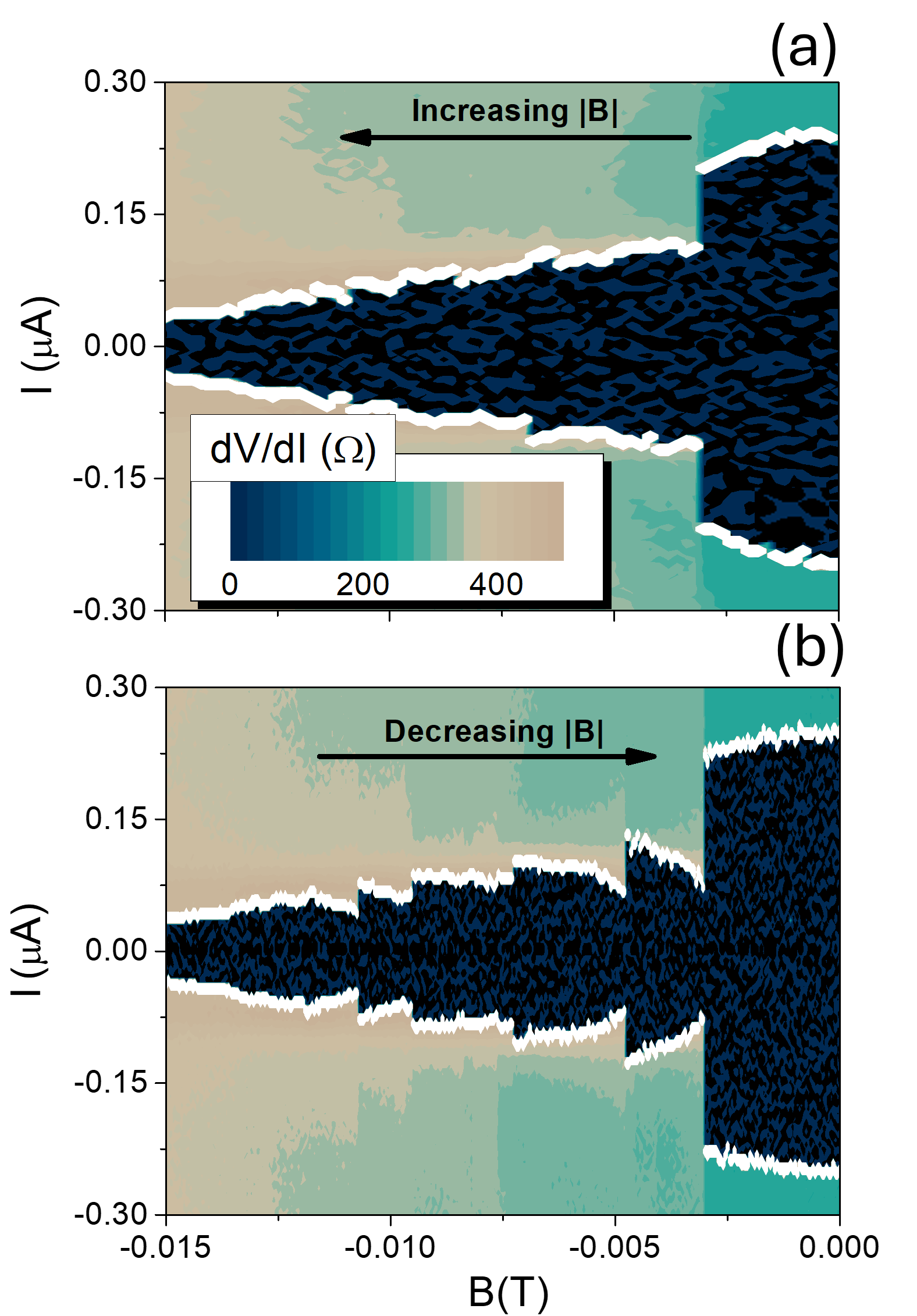
Figure 4: ∼9 maps for opposite sweep directions showing main and secondary switching-current jumps, highlighting metastability and history dependence.
Simultaneous observation across multiple devices underlines the generality of the phenomenon.
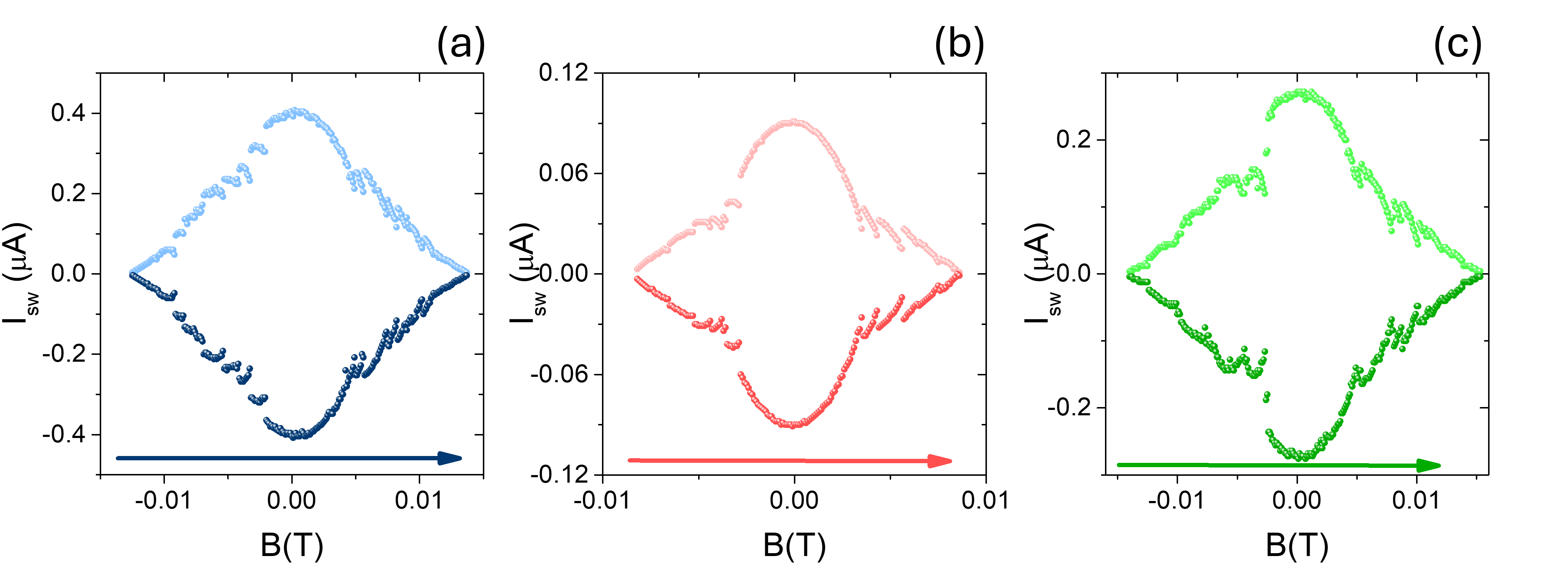
Figure 5: L≈700 for three devices, all showing Fraunhofer-like modulation plus abrupt jumps, underlining device-to-device reproducibility.
Flux Focusing, Effective Field Modeling, and Domain Contributions
Device geometry induces strong flux focusing, enhancing the effective field at the weak link. This is accounted for by a focusing parameter L≈701, derived from lithography and thin-film penetration considerations (L≈702).
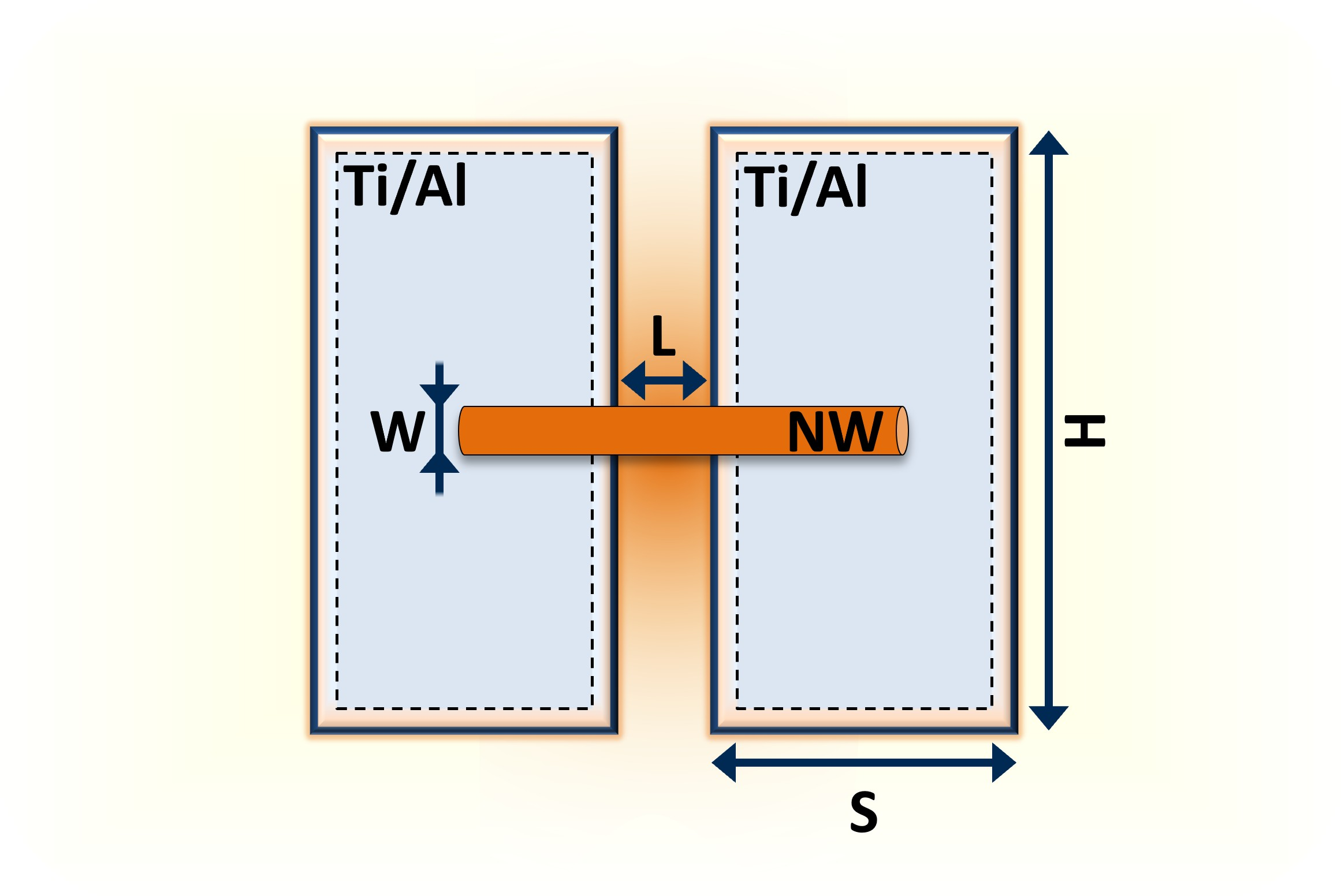
Figure 6: Schematic showing geometry for flux focusing calculations with effective dimensions.
The authors propose an effective-field perspective:
L≈703
where L≈704 encapsulates the influence of a local magnetically active texture or domain arrangement. In this framework, Barkhausen-like jumps in L≈705 result in discrete L≈706 shifts, directly reshaping the interference response and resulting in the observed L≈707 jumps.
The switching dynamics and metastable avalanche physics are captured via a quasi-adiabatic, zero-temperature random-field Ising model (RFIM) for discrete domain flips, including finite anisotropy and disorder. Numerical implementations based on strip-like geometries show magnetization response curves with reproducible, step-like jumps mirroring experimental L≈708 discontinuities.
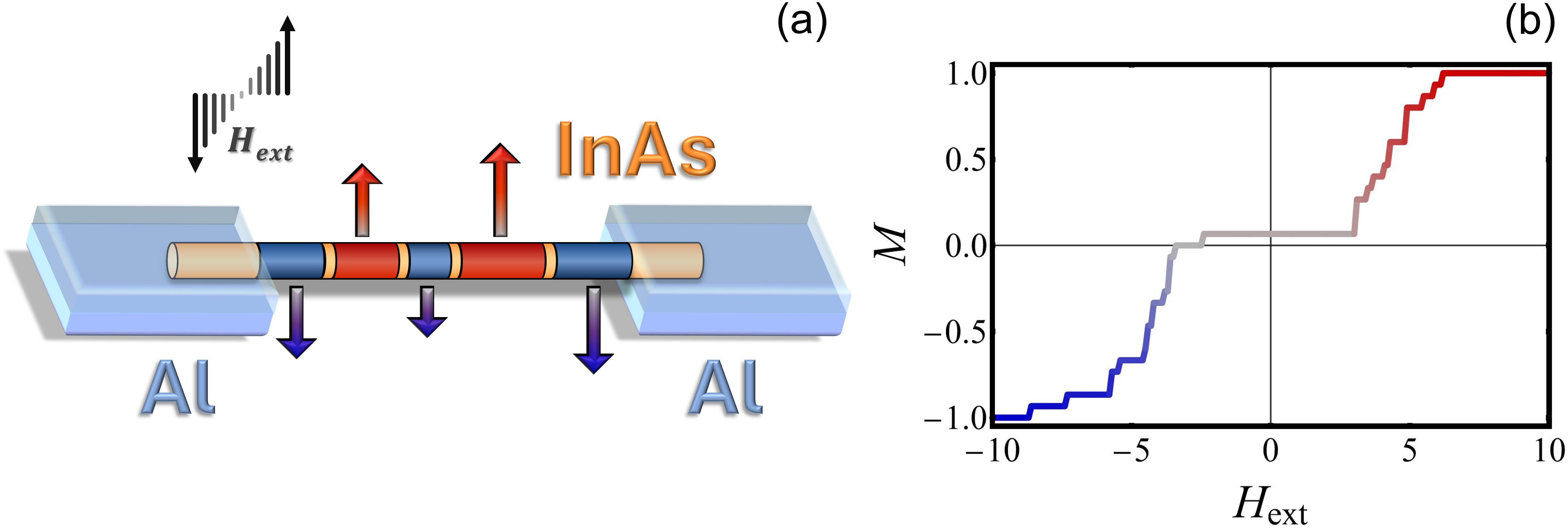
Figure 7: (a) Cartoon of NW domain arrangement; (b) RFIM magnetization curve under quasi-adiabatic sweep showing stepwise transitions analogous to Barkhausen jumps.
These results support a phenomenology where discrete, metastable reconfigurations of local magnetic domains are responsible for the sharp current switching features, rather than superconducting-vortex trapping, which would not account for the observed temperature independence or robust scan-to-scan reproducibility.
Exclusion of Zeeman-Induced 0–L≈709 Transition and Alternative Mechanisms
Alternative explanations, such as Zeeman-induced V0–V1 phase transitions or vortex entry, are quantitatively ruled out. Estimated Zeeman-field scales required for a V2–V3 transition in InAs NWs are at least several tesla, orders of magnitude larger than the observed V4 mT threshold. Flux trapping and conventional Abrikosov vortex physics would also yield strong temperature dependence and irreproducible switching, in disagreement with experiment.
Theoretical and Practical Implications
This work demonstrates that InAs/Al JJ devices function as highly sensitive interferometric probes of intrinsic, mesoscopic magnetic reconfigurations. The observation of Barkhausen-type switching-current jumps at millitesla fields reveals that even in homogeneous semiconductor–superconductor hybrids, local magnetically active domains or surface moments (not explicitly engineered ferromagnetic inclusions) can play a pivotal role in the Josephson transport landscape.
On the practical side, these findings suggest new avenues for phase-controlled superconducting devices, with potential applications in reconfigurable superconducting memories, logic, and multiterminal hybrid architectures with field-/history-tunable characteristics. Further, the results make a strong case for the role of intrinsic disorder or inhomogeneity in the design and interpretation of nanowire superconducting hybrids, especially regarding topological or spin-orbit phenomena.
Conclusion
The study provides definitive evidence for magnetically induced, Barkhausen-type switching-current jumps in InAs/Al nanowire Josephson junctions. Experimental results, phenomenological modeling, and exclusion of standard superconducting mechanisms support an interpretation in terms of avalanche-like, metastable reconfiguration of magnetic domains coupled to the weak link. This physics introduces history dependence and discrete, robust current switching features within otherwise conventional Fraunhofer-like interference patterns. These results broaden the understanding of magnetism–superconductivity interplay in hybrid systems and motivate the exploration of controllable, switchable Josephson functionality for quantum and classical device engineering.
(2603.29757)