- The paper demonstrates a threefold enhancement of the Sommerfeld coefficient and distinct specific heat anomalies at two superconducting transitions under pressure.
- It employs high-precision calorimetry in a piston-cylinder cell to achieve direct, absolute measurements of thermodynamic properties in UTe₂.
- It reveals that quantum critical fluctuations of weak magnetic order, rather than antiferromagnetism, mediate unconventional superconductivity.
Quantitative Calorimetry Study of Superconducting and Normal States in UTe2 under Pressure
Introduction
UTe2 is singular among heavy-fermion materials for its robust superconductivity proximate to both ferromagnetic and antiferromagnetic instabilities, the stabilization of multiple superconducting phases, and the probable realization of spin-triplet pairing. Pressure tuning of UTe2 enables detailed studies of the interplay between superconductivity, electronic correlations, and emergent magnetic order. This work presents a direct, quantitative determination of the pressure dependence of the Sommerfeld coefficient γ, specific heat jumps at two distinct superconducting transitions, and the associated phase diagram, providing critical thermodynamic insights into the mechanisms underlying superconductivity and its competition with magnetic order.
Experimental Approach and Specific Heat Measurements
A large single crystal of UTe2 was subjected to hydrostatic pressure in a piston-cylinder cell, enabling high-precision quasi-adiabatic calorimetry after careful subtraction of background contributions. This approach yields absolute specific heat values and reliable determination of γ as a function of pressure—capabilities that ac calorimetry in diamond anvil cells and resistivity-based studies have as yet not matched.
At ambient pressure, only the low-temperature superconducting phase (SC1) is present, with a transition at Tc1≈1.75 K. Upon increasing pressure, a second superconducting phase (SC2) emerges above 0.2 GPa, its Tc2 exceeding Tc1. Both superconducting transition temperatures, as well as the normal state specific heat, display pronounced pressure dependencies.
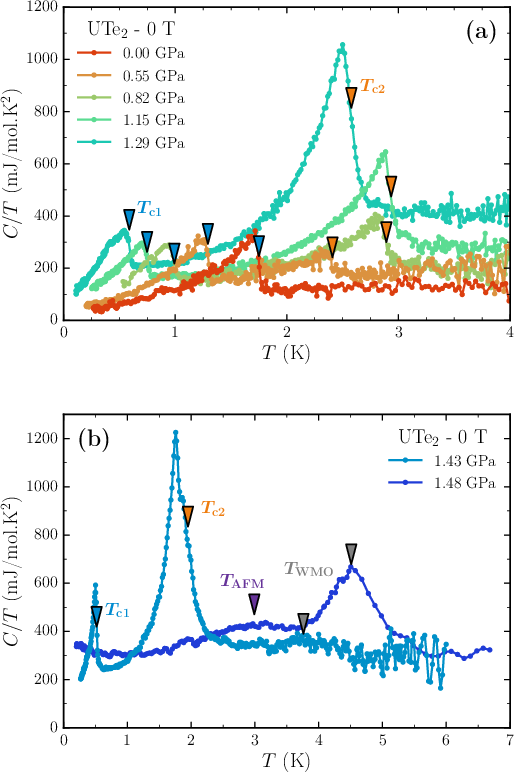
Figure 1: Specific heat as a function of temperature at different pressures, highlighting superconducting (SC1, SC2) and magnetic transitions (AFM, WMO).
Pressure-Temperature Phase Diagram: Superconductivity, WMO, and AFM Order
Pressure stabilizes a complex sequence of phases (Figure 2). With increasing pressure, SC2 attains a dome-shaped Tc2(p) and survives over a broad pressure range. Above approximately 1.2 GPa, a weak magnetic order (WMO) phase develops at temperatures above both superconducting transitions, and long-range antiferromagnetism (AFM) replaces superconductivity above 201.45 GPa.
A notable feature is the stabilization of WMO over a significant pressure range preceding the onset of AFM order. The maximum 21 occurs near an extrapolated critical pressure for the WMO phase (22), suggesting a special role for quantum critical fluctuations associated with WMO, rather than AFM criticality, in enhancing superconductivity.
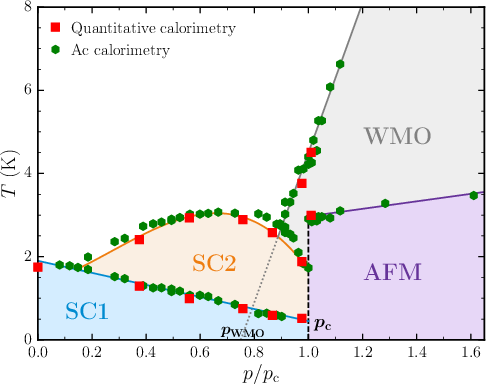
Figure 2: Zero-field 23 phase diagram of UTe24 from specific heat (red squares) and ac calorimetry (green circles), with pressure normalized to the onset of AFM order. WMO is stabilized over a large range below AFM.
Sommerfeld Coefficient, Specific Heat Jumps, and Fermi Surface Fraction
Direct determination of the Sommerfeld coefficient 25 reveals its near tripling as pressure approaches the critical region—unambiguous thermodynamic evidence for strong electronic mass renormalization. The specific heat jump 26 associated with both SC1 and SC2 transitions exhibits complex, non-monotonic pressure dependence:
- For SC1: 27 initially decreases with pressure, diverging from expected BCS scaling.
- For SC2: 28 is vanishingly small at the SC2/SC1 boundary and increases rapidly with pressure, exceeding BCS values near the peak in 29.
This apparent decoupling is inconsistent with simple strong-coupling scenarios where all Fermi surface sheets are affected equally. A model in which SC2 nucleates initially only on a fraction 20 of the Fermi surface—growing with pressure—reconciles the observed 21, 22, and 23 with thermodynamic constraints. Notably, when 24 for SC2 vanishes at the meeting point of SC1 and SC2 lines, thermodynamic consistency is maintained when three second-order phase transitions intersect.
Beyond the maximum in 25, both 26 and 27 decrease, but the size of the specific heat jumps increases sharply near the border to AFM order, especially where WMO is present, suggesting an entropy redistribution at the superconducting transition involving strong magnetic fluctuations.
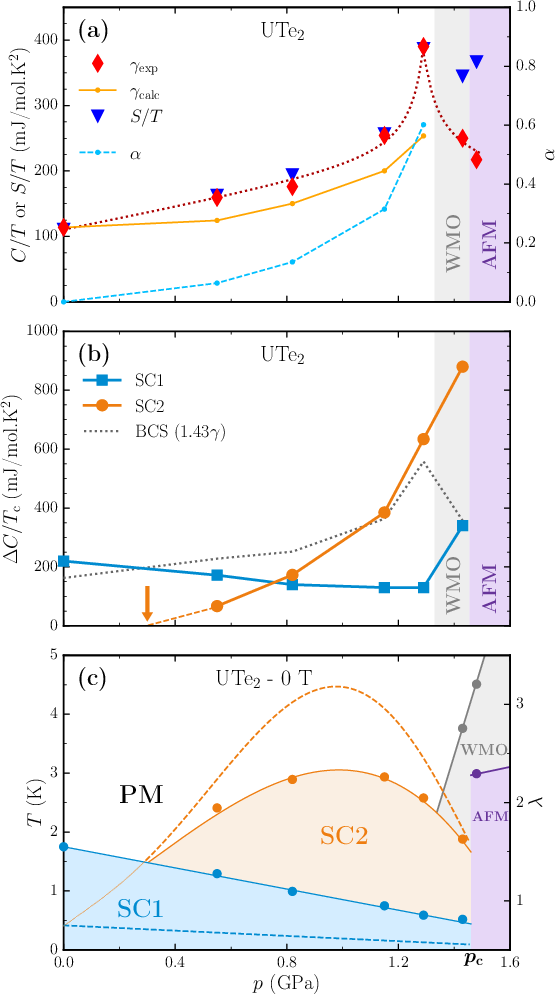
Figure 3: Evolution of Sommerfeld coefficient, entropy, and jump sizes at the superconducting transitions as a function of pressure commensurate with phase boundaries.
Quantum Criticality and the Role of WMO
The enhancement of 28 far below the AFM critical pressure, coincident with maximal 29 and the extrapolation of γ0 to zero, demonstrates that electronic correlations and possible quantum criticality are tied to the disappearance of WMO, not long-range AFM order. This scenario aligns with transport (γ1-coefficient and non-Fermi-liquid exponents), magnetization, and NMR measurements indicating peak spin fluctuations and effective mass at similar pressures.
These results situate UTeγ2 as an exemplary system where quantum critical fluctuations of a nontrivial ordered phase mediate or strongly enhance unconventional superconductivity, even possibly favoring spin-triplet (potentially topological) order. The competition between WMO and superconductivity—apparent in the mutual exclusivity of their phase boundaries—suggests that superconductivity may suppress WMO, removing the quantum critical fluctuations as the ordered phase is expelled.
Theoretical and Practical Implications
The phase diagram and thermodynamic signatures elucidated here provide fertile ground for theoretical modeling. The marked Fermi surface selectivity, non-monotonic specific heat jumps, and strong mass renormalization near γ3 demand models that combine order parameter competition, quantum criticality, and potentially multiband superconductivity with unconventional pairing symmetry.
Practically, the expansion of the SC2 phase, its field-inducibility, and the confirmed strong-coupling regime—along with the interplay between disorder, criticality, and Fermi surface topology—have implications for the search for robust, field-tunable, spin-triplet superconductors. Future work combining calorimetry, quantum oscillations, and microscopic probes under pressure will clarify the microscopic mechanism of pairing and the topological character of the superconducting phases.
Conclusion
This quantitative calorimetric study establishes a direct link between emergent magnetic order, enhanced electronic correlations, and the stabilization of multiple superconducting phases in UTeγ4 under pressure. The threefold enhancement of γ5, the reconciliation of specific heat anomalies with Fermi surface fractionation, and the coincidence of maximum γ6, γ7, and WMO quantum criticality constitute strong evidence for the vital role of nontrivial quantum critical fluctuations in mediating unconventional superconductivity in UTeγ8. These results set a benchmark for heavy-fermion materials, promote UTeγ9 as a canonical platform for quantum critical superconductivity, and circumscribe the theoretical landscape for topological, nonunitary, and multicomponent superconducting order.