- The paper demonstrates that closed, non-spin 4-manifolds with even-order π1 can admit infinitely many non-diffeomorphic smooth structures through sophisticated surgery methods.
- It employs equivariant techniques and precise control of topological invariants, including Seiberg-Witten invariants, to manage changes in the fundamental group.
- The constructions generalize previous results for cyclic and product groups, extending the classification of exotic smooth 4-manifolds under strict invariance conditions.
Smooth Structures on $4$-Manifolds with Fundamental Group of Even Order
Introduction and Motivation
This work addresses the classification of smooth structures on closed, oriented, non-spin $4$-manifolds with finite, even-order fundamental groups. While classical results demonstrate the abundance of exotic smooth structures for simply-connected $4$-manifolds, manifolds with non-trivial fundamental groups present auxiliary technical obstacles, particularly when the fundamental group is of even order and b2+ is even. The authors extend recent advances by constructing infinite families of non-diffeomorphic smooth structures on such manifolds and generalizing previous results for cyclic and product fundamental groups of type Z2k and Z2×G.
Main Results
The paper's principal claims are:
- For any closed, oriented, non-spin, topological $4$-manifold Q with π1(Q)≅Z4k and min(b2+,b2−)≥15, $4$0 either has none or infinitely many pairwise non-diffeomorphic smooth structures. This conclusion holds analogously for fundamental groups $4$1, consolidating and expanding on prior work.
- For any finite group $4$2, there exists a closed, topological $4$3-manifold $4$4 with $4$5, signature zero, even $4$6, and irreducible smooth structures, such that $4$7 admits infinitely many distinct smooth structures.
These constructions rely on sophisticated surgery techniques, equivariant methods, and explicit control over topological and smooth invariants. Notably, the case $4$8 even and signature zero is addressed, where Seiberg-Witten invariants vanish and standard symplectic approaches break down.
Construction Methodology and Technical Framework
Surgery and Group Actions
The core construction strategy adapts and generalizes the methods of Baykur, Stipsicz, and Szabó, as well as Levine, Lidman, and Piccirillo, by exploiting equivariant surgery along carefully selected tori on appropriate symplectic $4$9-manifolds. The authors start with a block manifold, equipped with a free group action, usually a Lefschetz fibration as in Baykur-Hamada's $4$0. Extensive analysis ensures the free action, symplectic structure, and compatibility of surgeries.
The blocks are glued together cyclically, respecting symplectic and group-theoretic conditions, and further surgery is performed to kill the fundamental group while maintaining equivariance—the resulting quotient manifolds have the desired fundamental groups.
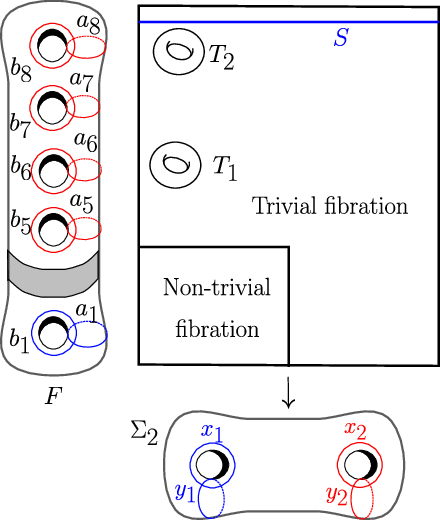
Figure 1: Schematic depiction of the Baykur-Hamada fibration $4$1, featuring the section $4$2, tori $4$3, and the symplectic generators of the fiber and base.
Tori, Surgery, and Fundamental Group Control
A key technical challenge is controlling the impact of surgeries on the fundamental group. Lemmas show that meridional triviality and geometric duals for the tori permit surgeries that reduce $4$4 to triviality or the desired finite group quotient. The construction meticulously builds links of surgery tori, ensuring that group actions are preserved and that resulting manifolds retain the required smooth and topological features.
The combinatorial nature of the gluing, tailored to the specified fundamental group (especially for $4$5 and $4$6), is more complex than previous constructions and leads to higher Euler characteristic in the resulting manifolds.
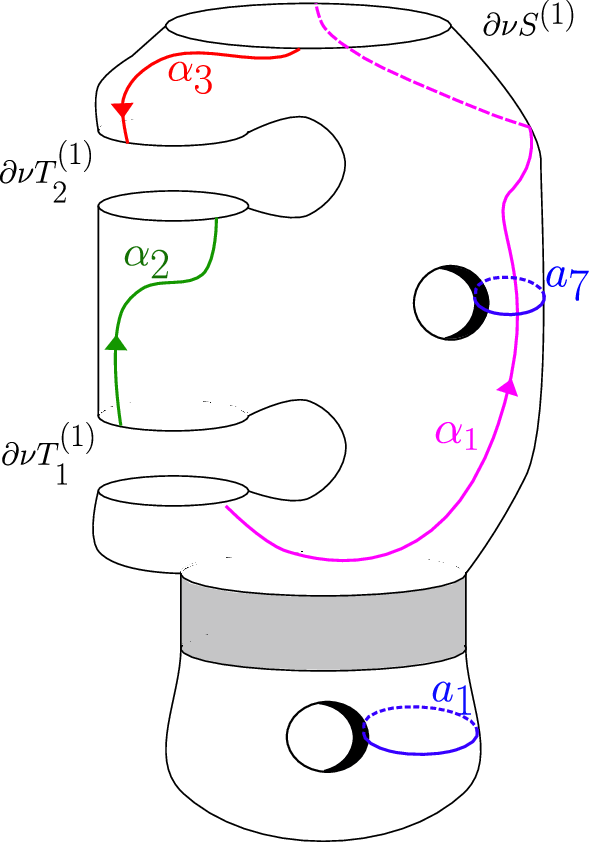
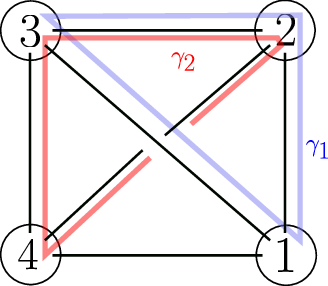
Figure 2: Schematic representing arcs and loops supporting the fundamental group in block constructions with surgery tori.
Seiberg-Witten Invariants and Exotic Smooth Structures
The presence of infinitely many distinct smooth structures is demonstrated via Seiberg-Witten theory. Polynomial relationships between surgery parameters and Seiberg-Witten invariants are exploited, showing that the number (and strength) of basic classes diverges with the surgery parameter, thereby confirming the existence of infinitely many exotic smooth structures.
Strong and explicit numeric results are obtained: manifolds with $4$7 and signature zero are constructed, and the arguments generalize to larger values by increasing the fiber's genus.
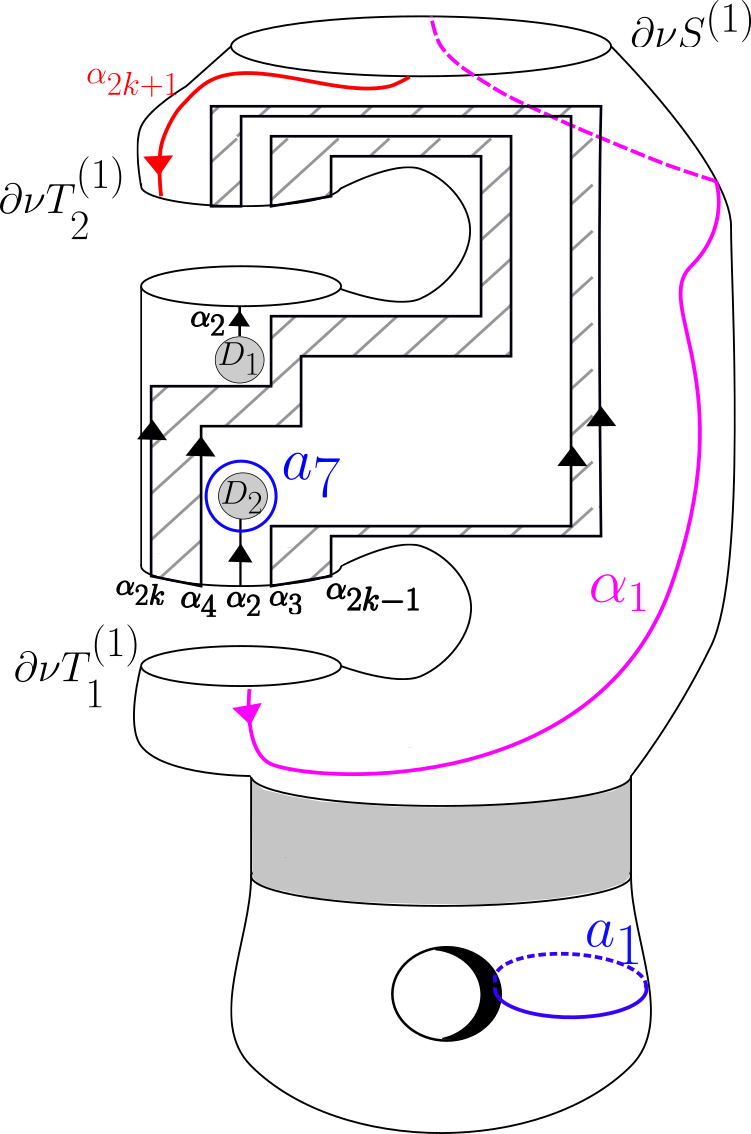
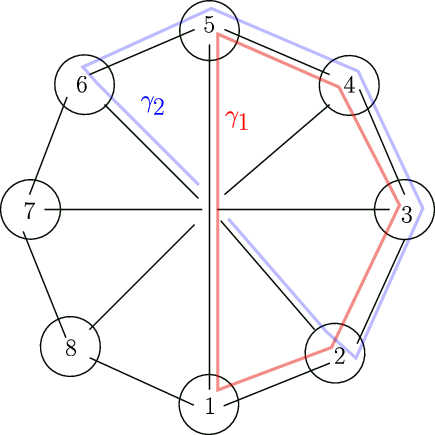
Figure 3: Visualization of refined surgery arcs on fiber surfaces, supporting the killing of generators of the fundamental group via equivariant surgery.
Generalization for Product Groups
For $4$8, the Cayley graph of $4$9 is utilized to build a surface b2+0 whose structure admits a free b2+1-action. Lefschetz fibrations are then constructed over higher-genus bases, with carefully stabilized fibers, ensuring the existence of the required tori for surgery.
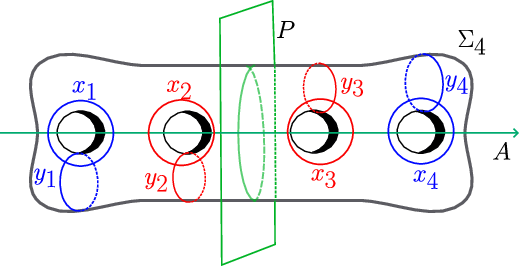
Figure 4: Representation of the surface b2+2 and the free involution b2+3, whose dynamics are pivotal for equivariant constructions with non-cyclic product fundamental groups.
Extensive stabilization procedures are introduced to address intersection points in the b2+4-orbit of fundamental group generators, yielding disjoint surgery curves and successful equivariant killing of b2+5.
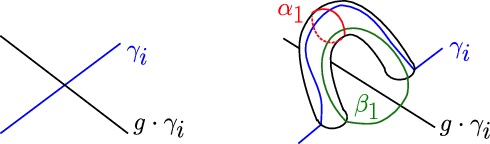
Figure 5: Local schematic showing stabilization and modification of surgery arcs to eliminate unwanted intersections, ensuring equivariant compatibility for the surgeries.
Irreducibility and Topological Properties
The constructions yield irreducible, symplectic manifolds via minimality arguments and Luttinger surgery. The manifold's irreducibility persists to quotients with the specified finite fundamental group.
Topological invariants such as Euler characteristic and signature are computed explicitly, exploiting multiplicativity under covering maps, and adjusted by stabilization processes to ensure even b2+6.
Implications and Future Directions
This work answers pivotal questions about abundance and diversity of smooth structures on b2+7-manifolds with even order fundamental group and even b2+8, filling gaps left by prior results. By developing surgery techniques compatible with complex group actions and producing explicit infinite families of exotic manifolds with prescribed invariants, it broadens the landscape of b2+9-manifold topology.
The methods suggest further expansion towards broader classes of finite groups, alternative quotient types, and possibly new strategies for controlling invariants in settings where standard symplectic or Seiberg-Witten approaches fail (e.g., when moduli spaces have odd dimension or when standard vanishing arguments apply).
A theoretical implication is the deepened understanding of the relationship between group actions, manifold topology, and available smooth structures—highlighting the delicate interplay between geometrical and combinatorial data in constructing exotic manifolds.
Conclusion
The paper rigorously establishes the existence of infinitely many non-diffeomorphic smooth structures on topological Z2k0-manifolds with finite, even-order fundamental groups, under specified topological conditions. The combination of equivariant surgery, explicit group-theoretic constructions, and advanced Seiberg-Witten invariant analysis marks a significant extension of previous work and opens avenues for future exploration in Z2k1-manifold topology and the classification of smooth structures.