- The paper provides a detailed local and combinatorial analysis of A₍r₎-stable curves, characterizing automorphism groups and deformation properties.
- It develops explicit GIT-style criteria for the existence of separated good moduli spaces through the study of singularities and isotrivial degenerations.
- The study classifies A₍r₎ and hyperelliptic singularities, laying the groundwork for modular compactifications beyond classical GIT frameworks.
The Local Geometry of the Stack of Ar-Stable Curves
Introduction and Context
The paper provides a comprehensive analysis of the local geometry of the moduli stack Mg,nr parameterizing pointed curves with at worst Ar-singularities over a field of characteristic zero. The study focuses on the automorphism groups, deformation theory, and explicit combinatorics of families over quotient stacks [A1/Gm], which serve as a central testing ground for understanding isotrivial degenerations and their role in the structure of the stack.
A primary motivation is to formulate necessary and sufficient combinatorial and geometric conditions for the existence of good moduli spaces mapping Mg,nr (or open substacks thereof) to algebraic spaces, particularly in cases not accessible by classical GIT constructions. This work forms the foundation for a broader program addressing the modular compactifications of moduli spaces of curves.
Good Moduli Spaces and Local Structure
The notion of a good moduli space (GMS) for an algebraic stack, originally formulated to generalize GIT quotients, is crucial for both the global geometry and the valuation-theoretic properties of stacks of curves. The authors revisit both the abstract definition and the local structure theorem (generalizing Luna’s étale slice) in the stack-theoretic context, extracting consequences for the existence of good moduli spaces via local analysis around closed points with reductive stabilizers.
An essential technical device is the stack Θ, which parametrizes families over [A1/Gm] encoding isotrivial degenerations. The paper details the geometry of lifting maps from Θ to moduli stacks and provides explicit GIT-style criteria (translated to the equivariant context) ensuring that open substacks admit (separated) good moduli spaces.
Classification of Ar-Stable Singularities and Crimping Data
A key structural aspect is the explicit classification of Ar-singularities on curves, their partial normalizations, and the “crimping data” needed to reconstruct such singularities via glueing. The authors distinguish between singularities of even and odd type, providing explicit moduli interpretations in both cases.
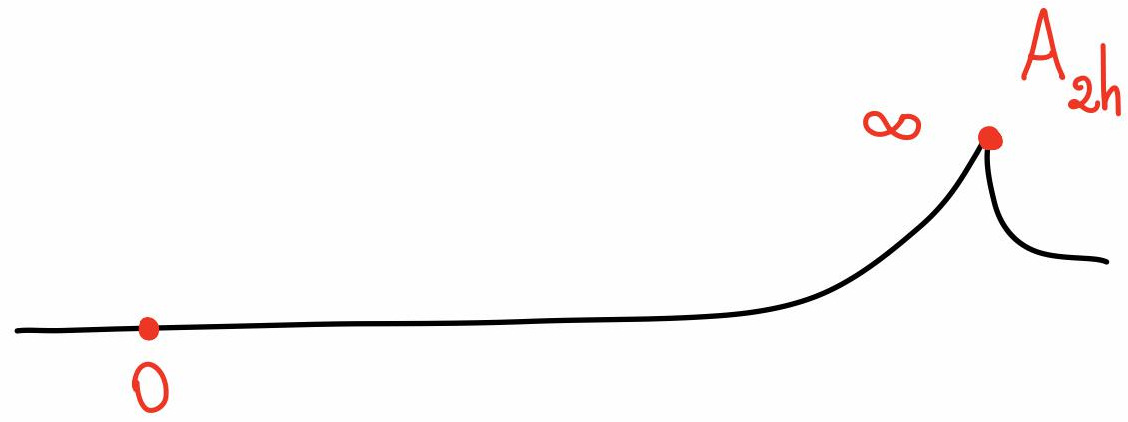
Figure 1: The even atom, a fundamental configuration for Mg,nr0-singularities formed by crimping a smooth point on Mg,nr1.
In the even case, the creation of an Mg,nr2-singularity involves attaching an “even atom”—a projective line with a Mg,nr3 automorphism group—via specific finite-length algebra extensions, whose moduli are parametrized by certain affine spaces with group actions. For odd Mg,nr4-singularities, the procedure involves glueing two points (in general on two components), with the crimping datum captured by isomorphism classes in the corresponding quotient stack.
A detailed analysis relates the combinatorics of marked points, attached components, and special singularities to the group actions and resulting automorphisms of the curve, controlling the locus of positive-dimensional stabilizers across Mg,nr5.
Automorphisms: Atoms, Rosaries, and Hyperelliptic Structures
A significant insight is that curves with positive-dimensional automorphism groups—essential for the geometry of degenerations and the stratification of the stack—are completely built out of certain fundamental configurations (“atoms”) and their iterated glueings (“rosaries”). The classification yields three explicit archetypes up to automorphism for Mg,nr6-stable curves with infinite stabilizers:
- Even atoms: Single Mg,nr7-singularities with maximal stabilizer.
- Odd atoms: Curves with an Mg,nr8-singularity formed by glueing two projective lines.
- Rosaries (possibly attached or closed): Chains of Mg,nr9’s connected via Ar0-singularities.
The paper makes the crucial connection between these configurations and the geometry of honestly hyperelliptic curves: chains of curves covering Ar1 via Ar2 morphisms, whose branch locus and singularities are determined by the combinatorics of multiplicities and glueings.
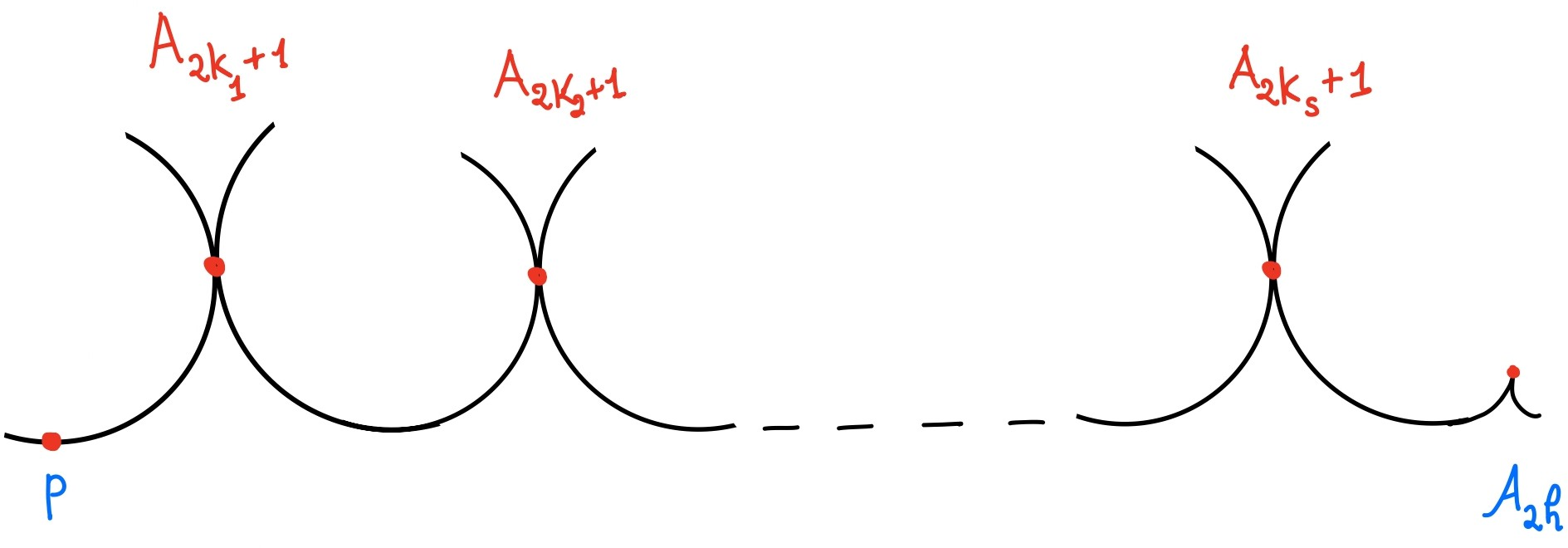
Figure 2: Example of a curve that is not a rosary but has an attached two-pointed rosary, illustrating the role of these configurations in degeneration theory.
This combinatorial classification provides both the necessary and sufficient conditions for positive-dimensional automorphisms, and underpins the analysis of degenerations.
The deformation theory of Ar3-stable curves is developed with emphasis on its equivariant aspects. The authors analyze the local structure of the Ar4-action on the deformation spaces of atoms and their attached structures. The tangent space to the moduli stack at such a point decomposes into pieces associated to deformations preserving the singularity (the “crimping space”) and those smoothing it (typically leading to attached hyperelliptic curves).
A critical outcome is the proof that the Ar5-weights on the tangent space encode the direction of possible degenerations: isotrivial degenerations correspond to positively- or negatively-weighted deformations, precisely matching the combinatorics of attached atoms and their glueings.
These results allow the authors to explicitly classify the basins of attraction for the stack under the action of Ar6, and thus to provide valuation-theoretic and combinatorial criteria for the existence of good moduli spaces.
Classification of Open Substacks with Good Moduli Spaces
By leveraging the deformation-theoretic and combinatorial analysis, the paper proves that open substacks of Ar7 (and of related stacks of cyclic covers of Ar8) admit separated good moduli spaces if and only if their boundary locus avoids configurations with non-reductive or “non-GIT” automorphism groups.
In the case of moduli of degree Ar9 cyclic covers, it is shown that the locus admitting a separated good moduli space corresponds exactly to the projectivization of semi-stable (in the GIT sense) divisors of degree [A1/Gm]0, with multiplicity conditions dictated by the weights of the corresponding [A1/Gm]1-singularities ("Theorem: classify opens-hyp"). This is shown to be maximal: no further open can admit such a structure.
Classification of Isotrivial Degenerations and Closed Points
The most technically intricate part is the complete combinatorial classification of isotrivial degenerations (families over [A1/Gm]2) between [A1/Gm]3-stable curves. The authors prove that these degenerations are governed by explicit local rules: adjacent “hyperelliptic” singularities cannot be simultaneously deformed; every curve with atom-like structures can be isotrivially degenerated to a configuration built out of basic atoms.
From this, it follows that the set of closed points in the stack can be described precisely: they are the “special” curves for which every higher [A1/Gm]4-singularity is atomic, and honestly hyperelliptic tails/bridges are themselves atomic or cannot be further degenerated. This structure controls the saturation of the locus of smooth curves inside any open with a good moduli space, and fully determines when the coarse moduli space construction for smooth curves descends to modular compactifications in [A1/Gm]5.
Implications and Outlook
The results have several significant consequences:
- Explicit Obstruction Theory: The complete combinatorial classification enables one to check, by finite computation, whether a given open substack admits a good moduli space. A byproduct is a negative answer to specific questions about stacky compactifications and their quotient structures.
- Intrinsic Methods Beyond GIT: By working directly with deformation spaces and automorphism groups, this approach enables the construction of modular compactifications even in cases excluded from the GIT paradigm. The methodology applies to stacky situations with non-reductive stabilizers.
- Hyperelliptic and ADE Singularities: The connection with hyperelliptic geometry and the rich structure of ADE singularities points toward applications in the theory of log canonical models and the minimal model program for stacks of curves.
The paper sets the stage for future work: the full realization of proper, non-projective good moduli spaces for open substacks of [A1/Gm]6 for [A1/Gm]7 and beyond, the precise saturation structure of the smooth locus under modular compactifications, and deeper connections to the birational geometry of moduli stacks.
Conclusion
This paper provides a detailed local and combinatorial analysis of the stack of [A1/Gm]8-stable curves, explicitly computing automorphism groups, deformation spaces, and isotrivial degenerations. Through this framework, it formulates critical structure results on the existence of good moduli spaces, their separatedness, and the locus of closed points. The approach leverages both intrinsic deformation-theoretic methods and the perspective of automorphism group actions, thereby enabling precise control over the modular geometry of stacks of curves with [A1/Gm]9-type singularities. These results supply foundational tools for modular compactification beyond classical GIT, with explicit applications to the geometry of stacks and their coarse spaces.