- The paper reports the first energy scan measurement of e⁺e⁻→K⁺K⁻ around ψ(2S), revealing two distinct interference solutions for the decay amplitudes.
- It employs an unbinned maximum likelihood fit to the invariant mass distribution, accurately modeling backgrounds and extracting the relative phase Φ between strong and EM processes.
- Results provide direct measurements of both the electromagnetic and strong kaon form factors, with implications for understanding SU(3) symmetry breaking in charmonium decays.
First Energy Scan Measurement of e+e−→K+K− around the ψ(2S) Resonance
Introduction
The study presents the first energy scan of the e+e−→K+K− cross section around the ψ(2S) resonance, performed with the BESIII detector at BEPCII and based on a 495 pb−1 dataset. This analysis extracts the fundamental relative phase Φ between the strong (3-gluon) and electromagnetic (EM) amplitudes of charmonium decays, quantifies interference effects, and delivers the first direct measurements of both the ψ(2S) strong form factor and the energy-dependent electromagnetic form factor of the charged kaon in this region.
Theoretical Foundations and Motivation
The decay of vector charmonia such as ψ(2S) into hadrons involves a strong amplitude mediated by three gluons and an EM amplitude via a virtual photon. The relative phase Φ between these amplitudes provides crucial insight into the interplay of QCD and QED at the charm quark mass scale. Various measurements in J/ψ decays found ψ(2S)0 [Suzuki:1998ea], fueling conjectures about the universality of this phase across charmonium states. Conversely, flavor SU(3) analyses report non-universal values, especially for specific pseudoscalar pair final states, highlighting unresolved tensions in our understanding of charmonium decay dynamics.
The process ψ(2S)1 near the ψ(2S)2 resonance is particularly sensitive to EM-strong interference due both to the SU(3)-forbidden nature of strong decays for ψ(2S)3 and the smaller (compared to ψ(2S)4) expected ψ(2S)5 for ψ(2S)6, which amplifies interference effects. Quantitative interpretation of line shapes therefore facilitates a model-independent extraction of both ψ(2S)7 and the corresponding ψ(2S)8 branching fraction ψ(2S)9.
Experimental Methodology
Events are selected by requiring two oppositely charged tracks identified as kaons, geometrically and kinematically consistent with e+e−→K+K−0 topology. Backgrounds, including Bhabha and e+e−→K+K−1, are suppressed via kinematic cuts on energy-to-momentum (e+e−→K+K−2) and time-of-flight differences. Residual backgrounds are accurately modeled using dedicated Monte Carlo samples. Signal extraction employs an unbinned maximum likelihood fit to the e+e−→K+K−3 invariant mass distribution.
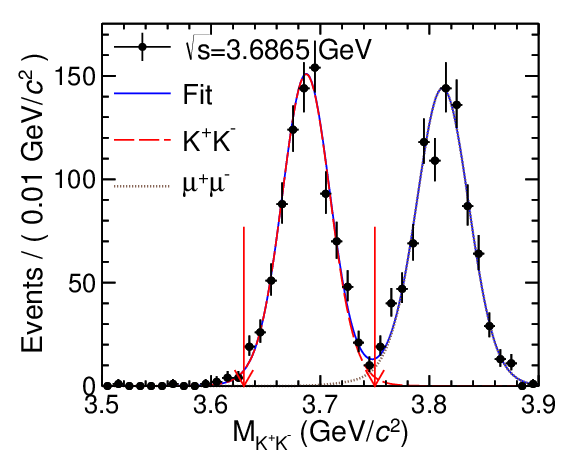
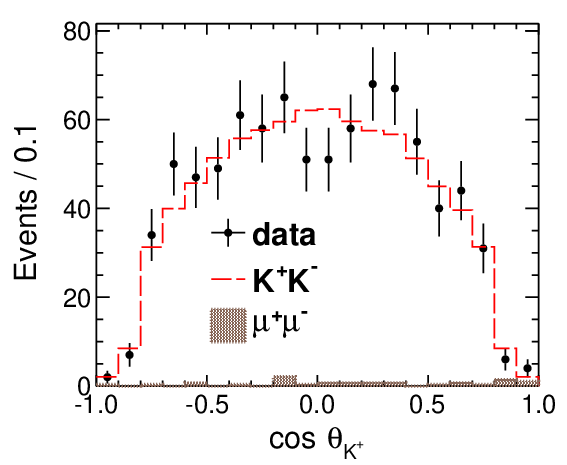
Figure 1: (a) Distribution of e+e−→K+K−4 for selected events at e+e−→K+K−5 GeV; (b) e+e−→K+K−6 angular distribution in the e+e−→K+K−7 c.m. frame, with data and MC overlaid.
Systematic uncertainties derive from tracking, PID, kinematic and timing selections, MC modeling, and integrated luminosity determination. The cross section is normalized by efficiency and luminosity, and all uncertainties propagated to the final cross section measurement.
Cross Section and Line Shape Analysis
The observed cross sections as a function of center-of-mass energy provide a direct probe of interference between the resonance and continuum amplitudes. Theoretical modeling accounts for initial-state radiation (ISR), vacuum polarization, and the e+e−→K+K−8 Breit-Wigner propagator. The total amplitude incorporates contributions from the continuum (photon), EM-resonant, and strong-resonant processes, parameterized to allow simultaneous extraction of the phase e+e−→K+K−9, the relative strong-to-EM amplitude ratio ψ(2S)0, and the electromagnetic form factor normalization ψ(2S)1.
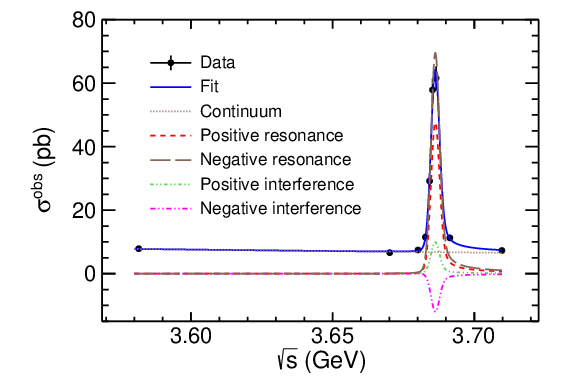
Figure 2: The ψ(2S)2 cross section as a function of ψ(2S)3. The fit decomposes continuum, resonance, and interference components.
The fit to the cross section data identifies two discrete, equally-likely solutions for ψ(2S)4:
- Constructive interference: ψ(2S)5, ψ(2S)6
- Destructive interference: ψ(2S)7, ψ(2S)8
This bimodality arises naturally from the complex phases of interfering amplitudes, and the confidence level contours in the ψ(2S)9 plane are shown to be non-overlapping.
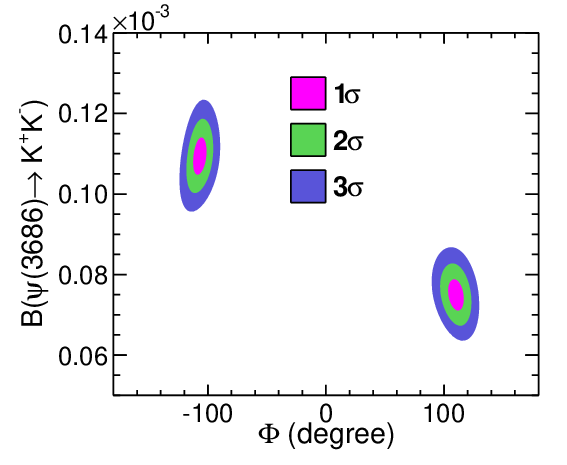
Figure 3: Contours in the −10-−11 plane showing the two non-overlapping physical solutions and their correlations.
Extraction of the charged kaon EM form factor −12 in the −13 region employs power-law fits motivated by perturbative QCD, with the fitted exponent −14 matching theoretical expectations, but significantly differing from BaBar's high-energy data (−15). At the resonance, −16 is obtained as −17.
The strong form factor −18 is derived using the fit value of −19, the EM form factor, and the known electronic width. The results are Φ0 and Φ1 for the constructive and destructive solutions, respectively.
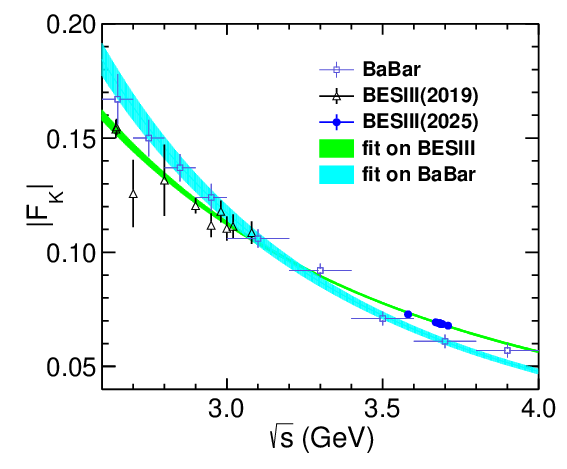
Figure 4: Energy dependence of the kaon electromagnetic form factor. The newer BESIII data are consistent with previous BESIII measurements, but systematically higher than BaBar.
Implications and Outlook
The improved precision on Φ2 and Φ3 resolves previous ambiguities in phase extraction for Φ4 and establishes that interference must be explicitly included in branching fraction measurements near vector charmonium resonances. The demonstration of two non-overlapping solutions with distinct physical interpretations illustrates the power and necessity of energy scan methodologies for amplitude analysis.
The direct determination of the strong form factor at the Φ5 mass and the detailed mapping of the EM form factor provide valuable input for ongoing studies of SU(3) breaking, quarkonium transitions, and the non-perturbative QCD regime. The systematic offset between BESIII and BaBar EM form factor measurements at higher energy underscores the need for future precision scans, possibly at Super Tau-Charm or Belle II.
On the theoretical side, enhanced constraints on Φ6 in several decay modes will support or refute universality conjectures and foster testable advances in understanding phase origins within QCD, including the role of long-distance hadronic dynamics.
Conclusion
This work represents the first energy-resolved measurement of the Φ7 cross section around the Φ8, yielding the most precise determination to date of the strong-EM relative phase and branching fractions in this channel. The first measurements of the strong and EM form factors at the Φ9 are established, and interference effects are shown to play a pivotal role in charmonium decay analyses. The results provide essential benchmarks for theoretical and experimental progress in quarkonium physics and set a new standard for studies of amplitude dynamics at the charmonium and bottomonium thresholds.
Reference: "First energy scan measurement of ψ(2S)0 around the ψ(2S)1 resonance" (2603.29854).