- The paper demonstrates that selecting initial states with commensurate energy ladders (Trotter scars) suppresses Trotter errors through stroboscopic cancellation.
- It develops a perturbative framework and variational product-state ansatz to accurately predict and optimize error suppression across multiple spin models.
- The study shows practical implications for high-fidelity quantum simulation, attaining up to six orders of magnitude error reduction compared to traditional methods.
Spectral Suppression of Trotter Error: Trotter Scars in Quantum Simulation
Context and Motivation
Digital quantum simulation relies fundamentally on the Trotter–Suzuki product formula for decomposing complex many-body Hamiltonian dynamics into executable quantum gate sequences. Although this approach introduces discretization errors—Trotter errors—that accumulate over simulation time, it remains the practical method of choice for near-term quantum hardware due to its simplicity and low overhead. Traditional worst-case commutator bounds for Trotter errors significantly overestimate realistic error behavior, especially in the context of state- or observable-dependent analysis. Recent work has demonstrated that random or entangled initial states can yield quadratic improvements in error scaling, but the underlying mechanism responsible for anomalously small Trotter errors in specific non-random states has remained elusive.
Analytical Framework and Theory
This paper employs interaction-picture perturbation theory to derive an explicit analytical expression for the leading-order Trotter error in the eigenbasis of the Hamiltonian. The central result is that initial states with spectral support concentrated on commensurate energy ladders—the so-called "Trotter scars"—display orders-of-magnitude suppression in error growth and persistent periodic Loschmidt echo revivals. Mathematically, the squared error norm for the state vector is governed by a stroboscopic factor, sin(ωnmt/2), where ωnm=En−Em. When the initial state is supported on a ladder of equally spaced eigenenergies, this factor vanishes at stroboscopic times, leading to constructive error cancellation.
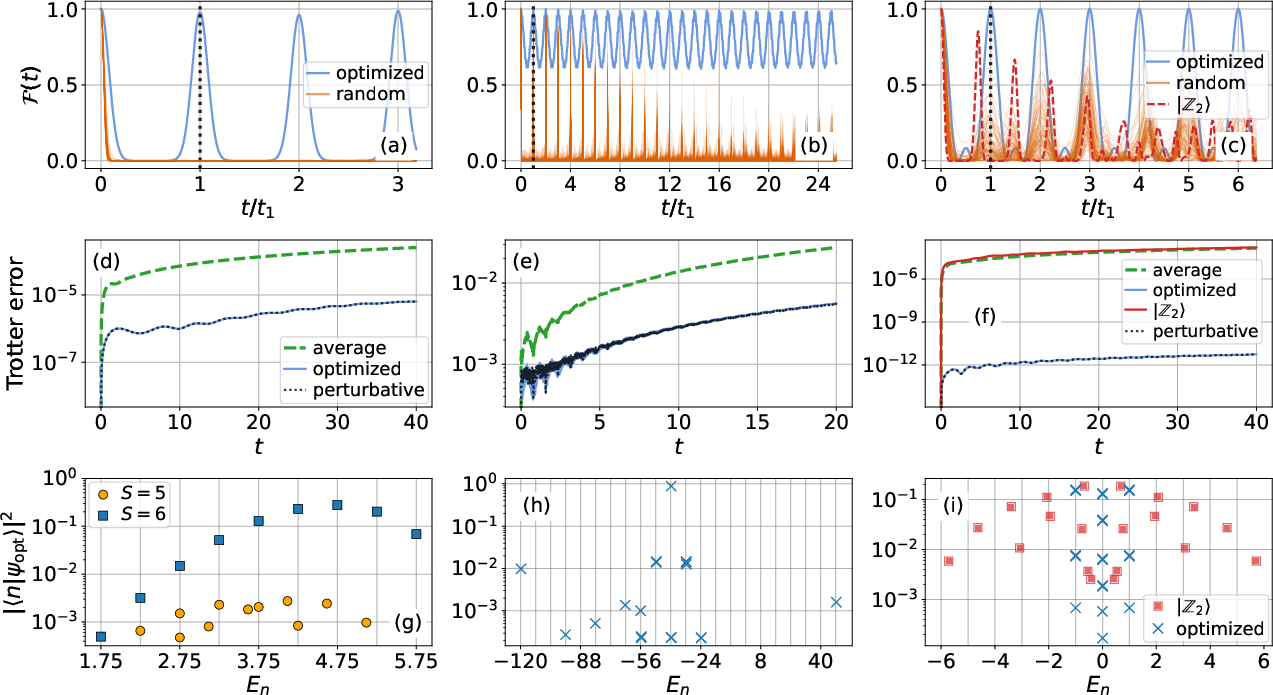
Figure 1: Characterization of Trotter scars in the Heisenberg chain, Stark spin chain, and PXP model, with Loschmidt echo revivals (top), error norm suppression (middle), and spectral concentration (bottom).
The theoretical insight is universal: the periodic error suppression mechanism is present for product formulas of arbitrary order, including both first-order Lie–Trotter and even-order Suzuki decompositions. The spectral structure of H dictates the stroboscopic times at which Trotter error cancels for ladder-supported states. This connection is precisely formalized using perturbation expansions, and the Supplementary Material extends the proof to recursive higher-order Suzuki formulas.
Variational Identification of Trotter Scars
While the spectral theory predicts qualitative features of error-resilient states, a constructive approach for identifying these states in arbitrary models is developed using a variational product-state ansatz. The method employs gradient-based minimization of a composite loss function, which combines the accumulated Trotter error and a time-averaged Trotterized Loschmidt echo penalty to avoid trivial eigenstate convergence. This optimization is executed using classical simulation and backpropagation, with Adam optimizer and cosine annealing, and is robust across different spin-models.
Applying the framework to three paradigmatic systems—the Heisenberg chain with transverse field, the Stark spin chain, and the PXP model—the optimized states concentrate spectral weight on commensurate ladders and exhibit dynamical behavior matching perturbative predictions. In all cases, the optimized Trotter scars show Loschmidt echo revivals precisely at stroboscopic times, and Trotter error is suppressed by several orders of magnitude compared to random initial states and known many-body scar states.
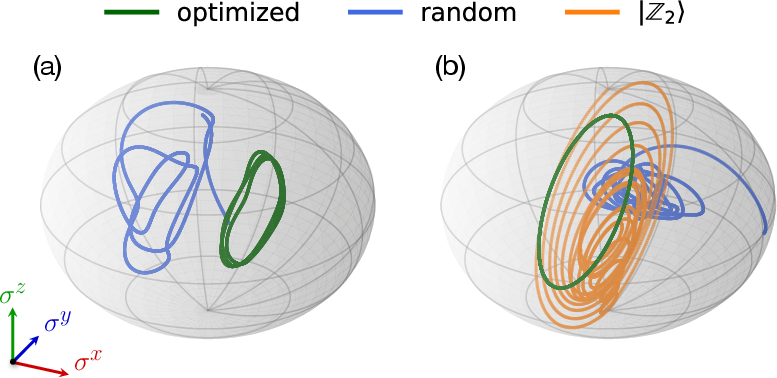
Figure 2: Bloch-sphere trajectories for optimized Trotter scars compared to random and Néel states in Heisenberg and PXP models.
Single-site Bloch-sphere trajectories for the Trotter scars demonstrate simple closed orbits indicative of global wave function periodicity, in marked contrast to the irregular or spiraling behavior of random and many-body scar initial states. Strong numerical results are reported, notably in the PXP model, where the optimized Trotter scar achieves Trotter error suppression by approximately six orders of magnitude relative to the many-body scar-based Néel state.
Implications and Future Directions
The discovery of Trotter scars has significant implications for both practical quantum simulation and the theoretical understanding of digitized quantum dynamics. The spectral mechanism underlying error suppression suggests that worst-case and average-case estimates can be highly misleading in scenarios where the initial state is carefully selected. Symmetry and kinetic constraints supporting spectrally commensurate ladders offer a route to engineered error-resilient digital simulations, but occupy low-dimensional subspaces of the Hilbert space.
The variational discovery approach is broadly applicable and hardware-agnostic, enabling error-resilient state engineering even in models lacking explicit commensurability. Scaling this optimization to larger systems (e.g., via matrix product operators) and experimental preparation of Trotter scars represents a promising avenue for extending coherent simulation times and enhancing prospects for quantum computational advantage on near-term devices.
Conclusion
This research establishes a spectral origin for Trotter-error resilience, identifying Trotter scars as initial states with concentrated spectral support on commensurate energy ladders, resulting in long-lived Loschmidt echo revivals and dramatic suppression of Trotter error across multiple spin models. The implications extend to practical strategies for quantum simulation error budgeting, variational state engineering, and experimental realization, potentially advancing the frontiers of robust, high-fidelity quantum computation.