- The paper reveals that supersonic collisions between atomic HI flows compress gas, forming a GMC and triggering high-mass star formation in N113.
- The study employs multi-scale ALMA+APEX observations to resolve sub-parsec molecular filaments and gravitationally bound clumps associated with emerging massive stars.
- The findings support cloud–cloud collision models with a key 53-pc displacement and 40–56 km/s velocity offset driving the observed star formation dynamics.
Introduction
The study offers a comprehensive analysis of the interstellar medium (ISM) surrounding the H II region N113 in the central Large Magellanic Cloud (LMC), with an emphasis on unveiling the star formation processes at sub-parsec to 100-pc scales. Utilizing ALMA+APEX observations for 12CO and 13CO transitions (resolution ~0.2 pc), complemented by ATCA/Parkes H I data at 15 pc resolution, the paper examines both the fine molecular structures and the kinematics of atomic gas. Key objectives include identifying the spatial and kinematic signatures of cloud-cloud collisions (CCC) and evaluating their role in high-mass star formation within a galactic context shaped by tidal interactions.
Multi-Phase ISM and Morphological Context
The region of N113 is characterized by distinct multi-phase ISM components that trace the progression from atomic H I, through molecular gas, to ionized hydrogen associated with ongoing star formation. The large-scale three-color composite image delineates the spatial relationship between Hα (ionized gas), 8 μm PAH emission (tracing photodissociation regions/low-density H2), and H I, with embedded CO peaks at the base of an arc-like structure. Massive YSOs, WR, and OB stars are coincident with these CO intensities, while the GMC resides in the region of maximal multiphase gas overlap.
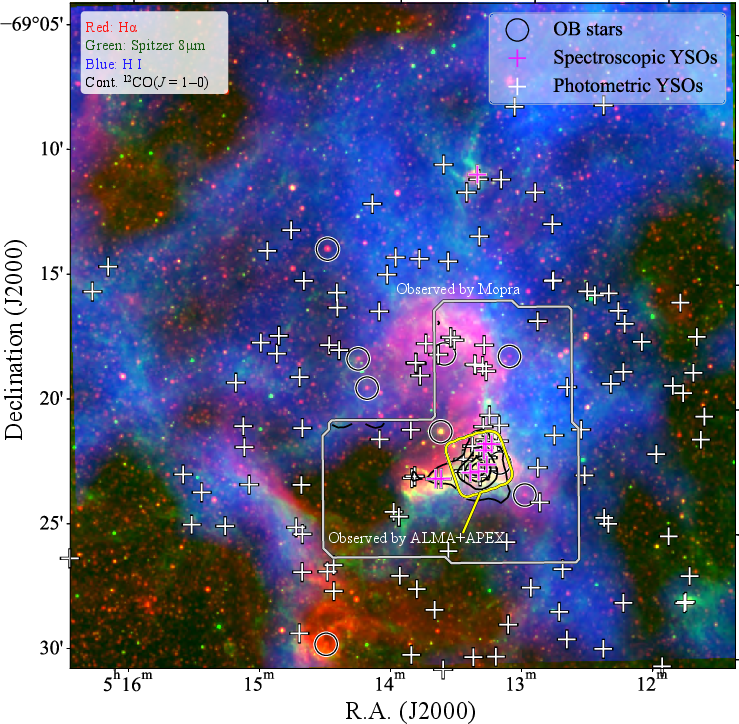
Figure 1: A holistic view of the multi-phase ISM toward N113, highlighting the spatial correlation of CO, H I, and star-forming sites.
Molecular Filamentary Structure and Kinematics
High-resolution ALMA+APEX imaging resolves the GMC into two principal 12CO/13CO filaments (∼10–20 pc in length), configured in a V-shape with a ∼90° vertex. These filaments exhibit widths (2–3 pc for 12CO; ~1 pc for 130CO) and peak integrated intensities exceeding 400 K km\,s131, especially toward massive YSO positions. Astrodendro segmentation of 132CO identifies ~200 gravitationally bound clumps, nearly all massive-star-forming, concentrated along the V-shaped filaments. The highest-mass cores (133 134) co-locate with spectroscopically confirmed high-mass YSOs (135). Localized velocity dispersion clearly correlates with protostellar activity, reaching 136–137 km/s around the most massive YSOs, indicative of active or recent energy injection likely associated with ongoing massive star formation.
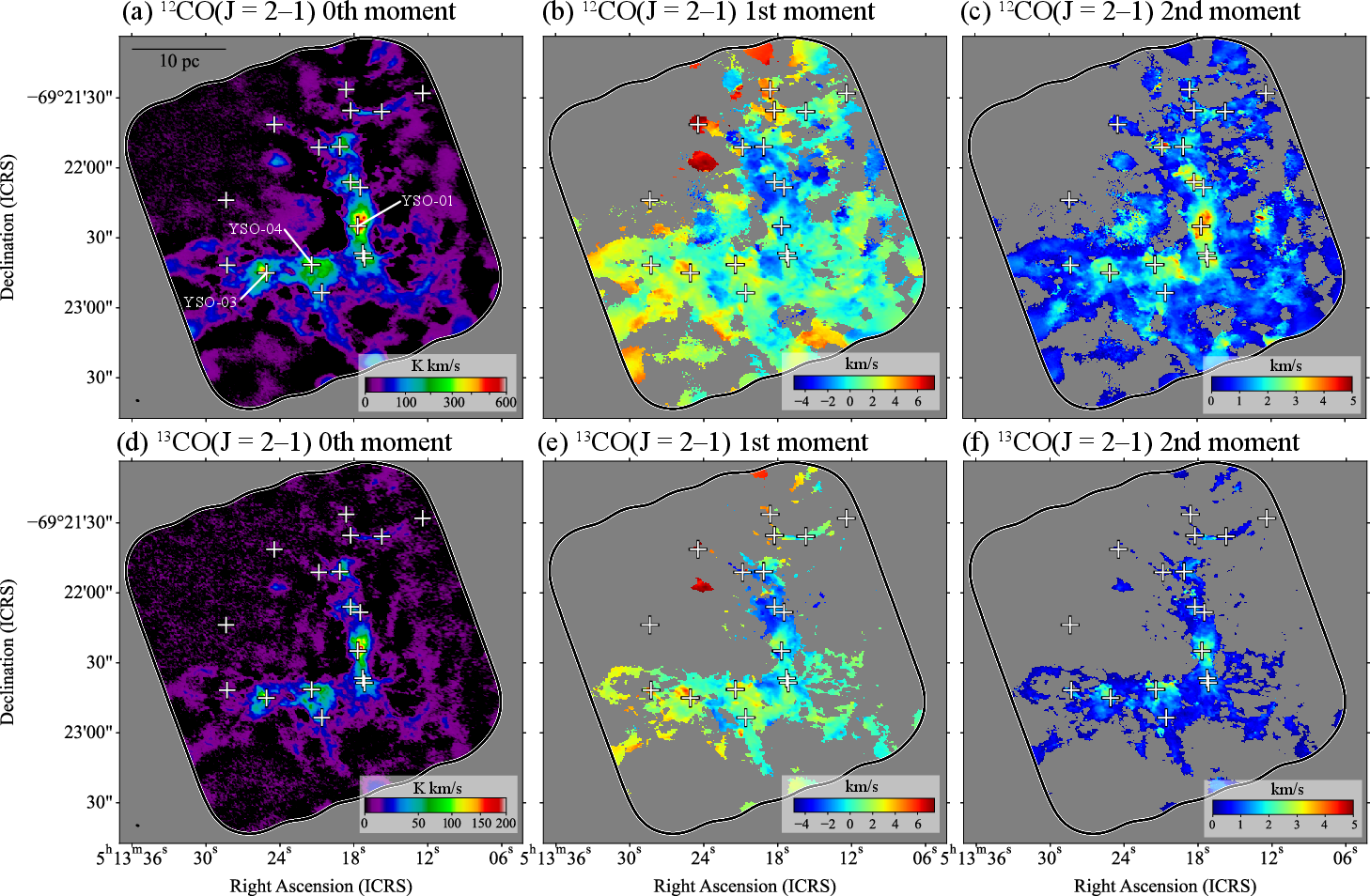
Figure 2: Moment-maps for 138CO and 139CO emission towards N113, with overlayed YSO locations and kinematic diagnostics.
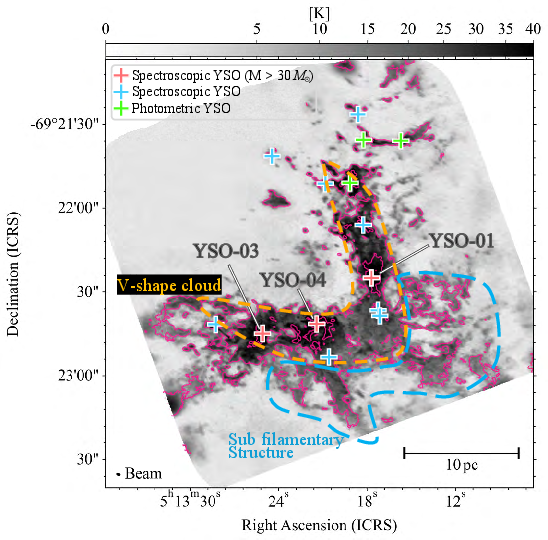
Figure 3: ALMA+APEX resolved molecular distribution highlighting the V-shaped GMC and sub-filamentary gas extensions associated with YSOs.
The morphology critically resembles features predicted by MHD simulations of shock-induced cloud compression: hub-filament networks and enhanced self-gravitating clump formation within compressed layers shaped by cloud collisions.
Atomic Gas Kinematics and Evidence for Collisions
The atomic gas (H I) at 100-pc scale reveals two distinct velocity components: an L-component (low velocity; α0 to α1 km\,sα2) and a D-component (disk; α3 to α4 km\,sα5), separated by over 40 km/s. The L-component (interpreted as tidal debris from historic LMC/SMC interaction) spatially fits a cavity within the D-component, and the filaments of CO (tracing the current GMC) are positioned on the cavity’s edge. Position–velocity diagrams reveal “bridge” features—intermediate-velocity gas linking L and D components—consistent with simulations of supersonic CCCs.
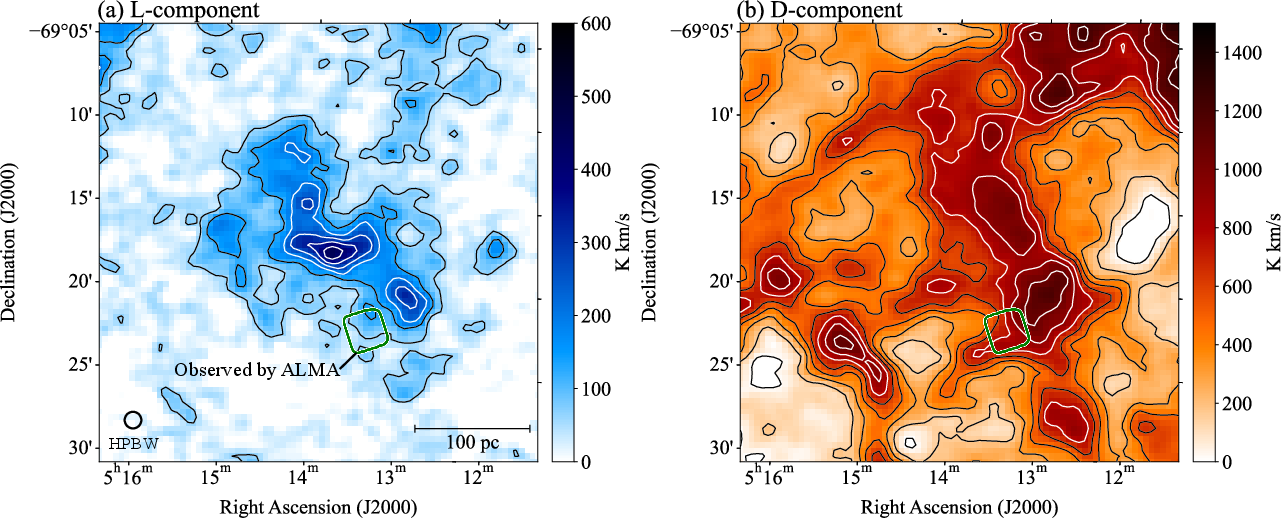
Figure 4: H I intensity maps of both the L- and D-components, showing the large-scale context and the GMC location relative to the interacting atomic flows.
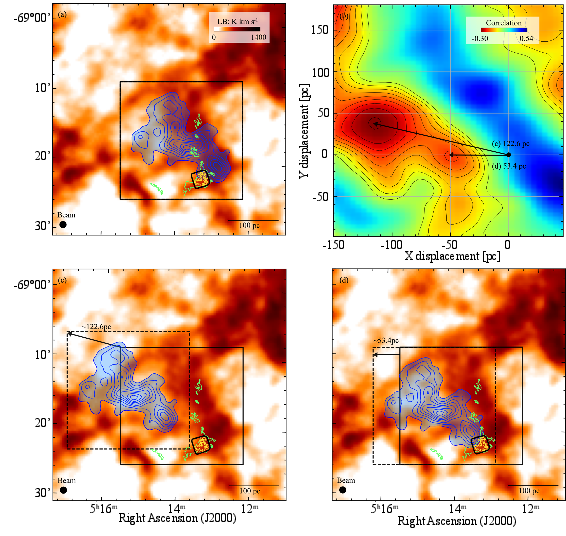
Figure 5: Position-velocity diagrams revealing bridge features that kinematically link the L- and D-components, a hallmark of CCC-driven dynamics.
Quantitative assessment via pixel-by-pixel spatial correlation (Pearson coefficient mapping) between the L- and D-components locates two minima, identifying the regions/statistics of maximal anti-correlation (“complementary distribution”). The optimal spatial displacement for maximal complementarity is α653 pc—an offset consistent with the L-component having traversed and excavated a cavity within the denser D-component over a timescale of α71.3 Myr at the measured velocity separation.
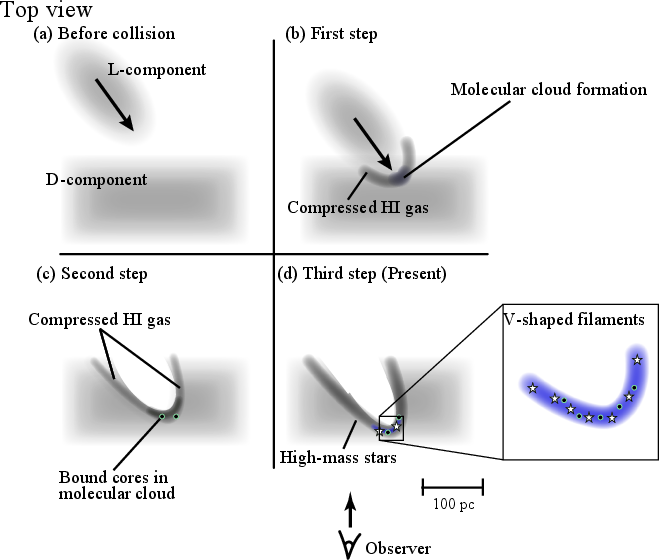
Figure 6: Schematic illustration of the inferred cloud-cloud collision geometry and resulting GMC/filament formation.
The empirically established signatures—(i) bridge features, (ii) displaced complementary distribution, (iii) cavity in the D-component—are canonical CCC diagnostics. The inferred three-stage scenario is as follows:
- HI cloud collision and cavity formation: The blue-shifted L-component, moving toward the observer and from the east, collides supersonically with the D-component (relative velocity α840–56 km/s), driving a cavity and intermediate-velocity interface.
- Compressive formation of the GMC: Shock compression at the interface triggers rapid cooling, Hα9 and CO formation on μ0Myr timescales (given μ1 cmμ2). GMC materializes in situ at the cavity wall—specifically along the high-density, V-shaped, post-shock slab. This structural outcome matches MHD models (e.g., [Inoue+2018]).
- Triggered high-mass star formation: Gravitationally bound clumps rapidly contract, forming a burst of massive YSOs along the compressed filaments. High-velocity dispersion and increased star formation efficiency are focused where the filament intersection (vertex) and sub-filament extensions concentrate mass and turbulence. The spatial configuration of O-star and YSO populations, their association with wider PAH (8 µm) and ionized (Hμ3) features, and the alignment of substructures, are all consistent with fast, turbulent, high-pressure collapse induced by the CCC.
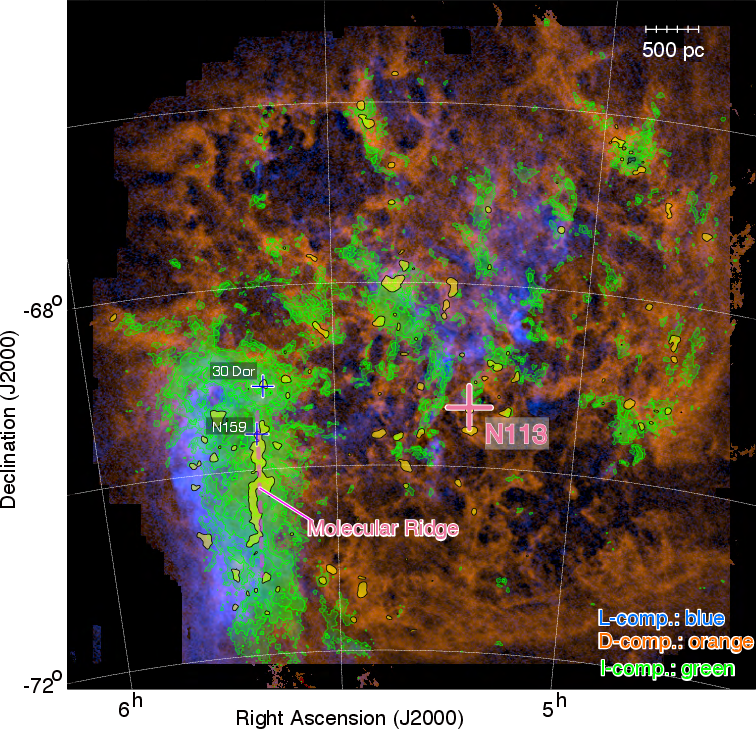
Figure 7: Composite, LMC-wide mapping of L-, D-, and intermediate (I-) components, placing N113 in the context of galaxy-scale tidal flows.
Implications and Future Directions
The study reinforces CCC as a primary mechanism for the assembly of GMCs and high-mass clusters in the LMC, a process modulated on galactic scales by recent (μ40.2 Gyr) LMC/SMC tidal interactions. The observed kinematic and spatial congruence with MHD simulation outcomes cements the role of dynamical triggering—through collisions with μ5 km/s—as a prerequisite for high-mass star birth in N113. Importantly, comparative analysis with similar LMC regions (N159, 30 Dor) highlights how collision velocity, pre-shock density, and geometry regulate GMC structure (V-shaped vs. conical filaments) and star formation morphology (distributed vs. centrally peaked cluster formation).
The results have direct implications for scaling star formation models from galactic interaction events to sub-pc structures. They suggest that enhanced cluster formation rates in interacting/irregular galaxies are structurally the result of recurrent, supersonic CCCs between massive atomic flows—an insight immediately relevant to extragalactic surveys (PHANGS, etc.) and high-z starburst/merger systems.
Conclusion
This paper provides robust, multi-scale evidence that the N113 GMC and its current burst of high-mass star formation are the products of a supersonic collision between two atomic H I flows, a process initiated and sustained by the dynamical legacy of LMC/SMC interactions. The multi-phase integration of observational data, rigorous kinematic assessment, and alignment with theoretical frameworks establishes a paradigm for triggered cluster formation by CCCs in both local and extragalactic contexts. The findings will inform future high-resolution studies of star formation efficiency and clustering in interaction-driven environments.