- The paper introduces a heterogeneous packet type framework that reduces subpacketization in D2D coded caching while preserving the optimal communication rate.
- The methodology jointly optimizes user grouping and coordinated transmitter selection with type-dependent packet sizing to lower further-splitting factors.
- The approach enables practical deployment for odd-numbered user groups by eliminating redundant subfile types and simplifying file partitioning.
Heterogeneous File Splitting for Subpacketization Reduction in D2D Coded Caching
Introduction
The paper "Reducing Subpacketization in Device-to-Device Coded Caching via Heterogeneous File Splitting" (2603.29945) introduces a new design paradigm for device-to-device (D2D) coded caching, which aims to minimize file subpacketization while preserving the optimal communication rate. The key innovation is a heterogeneous packet type (PT) framework that allows file packets to have type-dependent sizes, in contrast to prior PT frameworks restricted to homogeneous subpacketization. This facilitates finer granularity in memory allocation and flexible user grouping, enabling packet reduction strategies that were not previously attainable, especially in the regime of odd user populations.
Background: Subpacketization and Prior Art
D2D coded caching schemes such as the Ji-Caire-Molisch (JCM) design require splitting each file into an exponential number of subpackets. While JCM is rate-optimal, its subpacketization level FJCM=t(tK) (for K users and parameter t) is prohibitively high for practical systems. Several alternative constructions—e.g., based on projective geometry, placement delivery arrays (PDAs), or combinatorial designs—provide substantially reduced subpacketization but at the cost of increased communication rate and lack of generality.
Previous work [Zhang et al., (Zhang et al., 12 Feb 2026)] established a PT-based framework that systematically explored rate-optimal subpacketization reduction by leveraging user grouping and type-based subfile and packet classification. However, its applicability was limited due to the requirement of homogeneity in packet size, preventing further optimization under unequally sized user groups and odd K values.
Heterogeneous PT Framework
The paper extends the PT framework to the heterogeneous setting, where packet sizes can vary according to type and are jointly designed with user grouping and transmitter assignment. This increased flexibility enables new D2D coded caching schemes for parameters of the form (K,t)=(2q+1,2r) with q,r∈N+, achieving a constant-factor reduction in subpacketization compared to JCM—without any increase in communication rate.
Core Concepts
- Refined Packet Types and Coupled Groups: Each subfile type is further partitioned into subtypes, grouped so that packets within a group have uniform size, but groups themselves can have heterogeneous sizes.
- Coordinated Transmitter Selection: Transmitters for each coupled group are chosen independently, allowing vector least common multiple (LCM) coordination of local further-splitting (FS) factors to achieve globally minimal subpacketization.
Reduction in Subpacketization: Numerical Results
The proposed heterogeneous PT construction, for (K,t)=(2q+1,2r), employs unequal grouping (q+1,q) and coordinated transmitter selection. The subpacketization level is
FPT=∑k=1t+1αkfk
where αk is the (globally coordinated) further-splitting factor and K0 is the count of subfiles of the K1th type. This structure enables two sources of subpacketization savings:
- Subfile exclusion: Certain subfile types (e.g., the first) are entirely eliminated from both placement and delivery.
- Reduced FS factors: Many subfile types are split into fewer than K2 packets.
The relative reduction is illustrated in (Figure 1), which displays actual and asymptotic subpacketization ratios as a function of K3. For fixed K4, the ratio K5 approaches K6 as K7 grows, signifying a constant-factor improvement for practical system sizes.
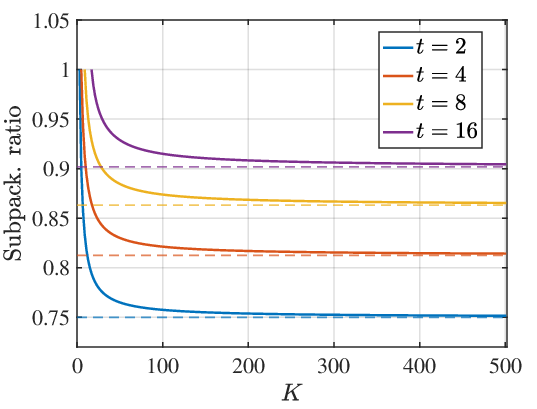
Figure 2: Actual (solid) and asymptotic (dashed) subpacketization ratios for various K8 values. Both ratios increase with K9, indicating a diminishing PT reduction over JCM.
Mechanism: Subfile and Packet Type Structure
The flexibility of type-dependent packet sizing is illustrated by the subfile/packet layout. Consider the case t0; each subfile type is bifurcated into two subtypes, each assigned to a different coupled group (Figure 3). Packet coloring in (Figure 3) visualizes the assignment to coupled groups and consequent packet-size distinctions.
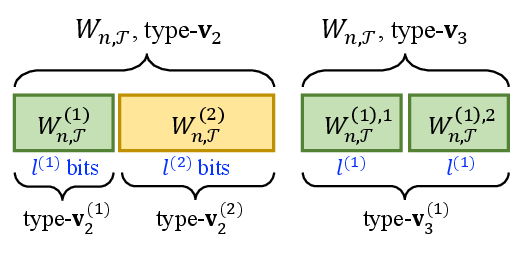
Figure 4: Illustration of subfile and packet types. Packets of the same color (i.e., belonging to the same coupled group) have identical sizes.
User grouping is orchestration-dependent; in the proposed scheme, a t1 split enables satisfaction of the memory constraints with heterogeneity, whereas under homogeneous constraints, such reductions are structurally precluded.
Global FS Vector Design and Subpacketization Analysis
A central technical device is the construction of the global FS vector, which prescribes the number of splits for each subfile type to ensure all users meet their memory constraints. For the case t2, (Figure 5) contrasts the global FS vectors for the two intermediate coupled groups with the resulting aggregate global FS vector, which is always pointwise less than or equal to the JCM FS vector.
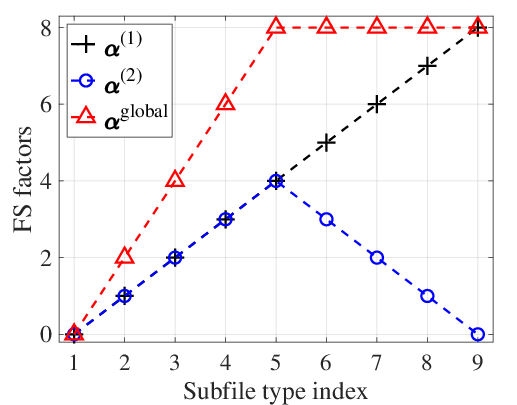
Figure 1: Comparison of global FS vectors for t3.
The design ensures that for a large subset of subfile types, the further splitting factor is strictly less than t4, plateauing at t5 only for higher-index types. This gives rise to the subfile-type-specific packet splitting structure—a critical enabler for the asymptotic reduction in total subpacketization.
Implications and Theoretical Advances
The construction fills the gap left by homogeneous PT designs for rate-optimal D2D caching with odd t6, fully characterizing the minimal subpacketization attainable in this challenging setting. Contradicting prior limitations, the work demonstrates that heterogeneous subpacketization not only expands the class of feasible user groupings but is essential for further subpacketization reduction.
Practical implications include the ability to deploy rate-optimal D2D coded caching in larger systems where packetization overhead previously rendered such schemes infeasible. The explicit characterization of asymptotic reduction offers clear guidelines for system designers to select appropriate packetization granularity.
Theoretically, the framework underscores the necessity of relaxing symmetry/homogeneity constraints to realize unexplored subpacketization-rate trade-offs. The methodology—jointly optimizing user grouping, transmitter selection, and packet sizing—suggests a broader design principle applicable to other coded distributed systems.
Future Directions
Open problems raised by this work include extending heterogeneous PT designs to additional t7 regimes (especially for odd t8), exploring more general user-group assignments, and quantifying trade-offs under practical constraints (file size, limited field sizes, non-uniform demand). Moreover, optimizing for further subpacketization reduction beyond the rate-optimal regime (i.e., permitting slight rate loss for exponential reductions) is a compelling direction.
Conclusion
This paper systematically shows that allowing heterogeneous packet sizes in type-based D2D coded caching unlocks significant reductions in subpacketization level, achievable with optimal communication rate and feasible user groupings otherwise unattainable under previous frameworks. The approach provides a rigorous foundation and concrete construction for practical deployment, and opens new avenues in the investigation of the rate-subpacketization trade-off in coded distributed caching systems.