- The paper presents a novel soft logic framework that extends classical probability by assigning infinitesimal nonzero probabilities to point events.
- The methodology leverages Soft Numbers and a two-parameter coordinate system to bridge microscopic deterministic mechanics with emergent statistical phenomena.
- The approach integrates a Möbius-strip geometric mapping to visually represent the transition from local microstate details to overall macroscopic laws.
Soft Logic, Soft Probability, and Hilbert's Sixth Problem: Axiomatizing Physics from Infinitesimal Foundations
Introduction
The paper "Hilbert's Sixth Problem and Soft Logic" (2603.29969) presents a novel approach to the longstanding challenge posed by Hilbert's sixth problem: the rigorous axiomatization of probability theory within physical laws, and particularly the derivation of macroscopic statistical regularities from microscopic deterministic mechanics. The authors assert that classical, Kolmogorovian probability spaces—where each individual microstate has measure zero—are conceptually inadequate when modeling physical systems. To address this, they develop and formalize a framework based on "Soft Logic" and "Soft Numbers," directly extending the numerical treatment of zero and enabling the assignment of infinitesimal but nonzero probabilities to point events.
Classical Probability and Its Limitations
Kolmogorov's axiomatic probability theory provides a robust foundation, yet in continuous spaces, every singleton event has probability zero, whereas physical systems necessarily inhabit specific microstates. This mismatch complicates the translation between microscopic states and macroscopic statistical phenomena, a core issue in statistical mechanics and the axiomatization of physics. The paper critiques the inability of traditional frameworks to distinguish between different events whose probabilities collapse to zero, motivating the introduction of a refined system that can differentiate distinct "zero-probability" events.
Soft Logic and Soft Numbers: Mathematical Construction
The authors elaborate the structure of Soft Logic, extending the ordinary real numbers by introducing a continuous zero axis alongside the usual real axis. "Soft Numbers" are defined as pairs (a0ˉ+˙b) where a,b∈R, and 0ˉ denotes the soft zero (not an element of R, but squaring to 0). The system incorporates axioms for distinction, order, addition, and nullity. Soft numbers obey algebraic operations analogous to Clifford's dual numbers, but uniquely, the system reflects innumerable distinct zeros, each associated with a unique multiplicity. Bridge operators connect the zero and real axes, and non-commutativity is imposed to reflect directional relationships.
Soft probability is formalized by decomposing the probability Ps(X≤x) into a sum of a PDF-weighted soft zero term and a CDF term, specifically:
Ps(X≤x)=fX(x)0ˉ+˙FX(x)
where FX(x) is the CDF and fX(x) the PDF. This construction grants infinitesimal probabilities to singleton events in continuous spaces, overcoming the classical impediments to microstate modeling.
Algebraic and Geometric Implications
The paper meticulously develops the operation rules for soft numbers (addition, multiplication, power), and demonstrates their application in analytic functions and polynomials. For example, operating a polynomial on a soft number yields a soft number whose soft-zero part is proportional to the derivative—cementing the connection between infinitesimal probability and the local density of events.
The authors propose a novel coordinate system—the Soft Number Strip (SNS)—that extends the zero axis vertically and real axes horizontally, encoding soft numbers via two parameters: height A and width B. The system distinguishes between a,b∈R0 and a,b∈R1, thereby representing two distinct "zero" entities, a geometric innovation compared to standard Cartesian coordinates.
Geometric Representation on the Möbius Strip
An important aspect of the framework is its geometric realization as a Möbius strip. By mapping the SNS according to the relationships between height and width, and employing a color-coded scheme, the authors embed the soft number system into a Möbius-strip topology. The Möbius strip, locally two-sided but globally one-sided, elegantly models the passage from local microscopic information to emergent global macroscopic laws—a central concern of Hilbert's sixth problem. The authors provide explicit equations and illustrative code to generate this embedding.
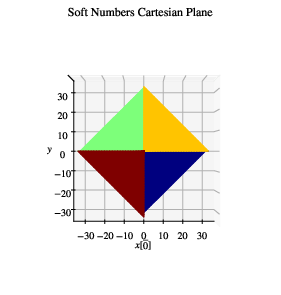
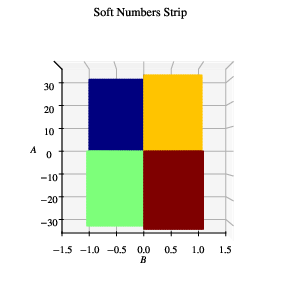
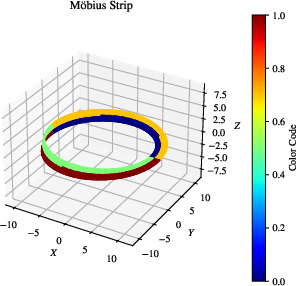
Figure 1: The Soft Möbius Map: (a) Cartesian square domain of the soft numbers; (b) Complete soft coordinate system; (c) Möbius-strip mapped by the soft numbers.
Theoretical and Practical Implications
By allowing infinitesimal nonzero probabilities for microstates, soft probability offers a more physically faithful underlying structure for statistical mechanics. This addresses the classical problem of reconciling deterministic microstate evolution with the emergence of statistical macroscopic laws. The Möbius-strip topology further connects the framework to topological and geometric models of emergence, suggesting that macro-laws could arise from the global structure of infinitesimal probability distributions.
This approach complements other rigorous advances, such as Deng et al.'s derivation of fluid mechanics equations from hard sphere particle systems (Deng et al., 3 Mar 2025), by providing an alternative (and potentially unifying) geometric and logical basis for understanding emergent phenomena.
Numerical and Structural Results
The paper offers strong formal results:
- Soft probability operator: assigns infinitesimal probabilities to point events, enabling explicit treatment of equality cases in continuous random variables.
- Soft numbers equivalence to dual numbers: algebraically, but distinguished by direct infinitesimal construction and detailed geometric interpretation.
- Coordinate system mapping: realization of the soft number system and its Möbius-strip embedding via explicit coordinate and color-coded visualization.
- Topological singularity: all connection lines in the SNS intersect at "absolute zero," encapsulating the conceptual foundation of the geometric model.
Future Directions
The theoretical innovations of Soft Logic and Soft Probability signal a promising direction for axiomatizing physics, particularly in statistical mechanics and quantum probability. The Möbius-strip representation points to further topological investigations, including the modeling of observer-system dichotomies and the paradoxical reconciliation of locality and globality. Integration with measure-theoretic and kinetic-theoretical approaches could refine the mathematical underpinnings for emergent laws in complex systems, and inspire new methods in AI and probabilistic modeling.
Conclusion
Hilbert's sixth problem continues to inspire foundational inquiry into the axiomatization of physical theories. The framework of Soft Logic, Soft Numbers, and Soft Probability extends classical probability theory by providing a formal system where infinitesimal probabilities are distinguished and assigned to microstates, thus resolving the inadequacy of classical measure-zero assignments. The geometric Möbius-strip embedding provides an intuitive and rigorous model linking the microscopic and macroscopic domains. As a mathematical extension of probability and a geometric language for physics, Soft Logic offers both theoretical insight and practical tools for future research in foundational physics and AI.